Inspiration
We were inspired by a simple question: What if communicating could require much less effort for someone living with ALS?
People with ALS can lose the ability to speak and use their hands, while eye movement can remain an important way to interact with technology. Existing communication tools can require users to select letters one by one, making even a simple sentence slow and exhausting. We wanted to rethink that experience not by asking users to adapt to technology, but by designing technology around the way they can communicate.
What it does
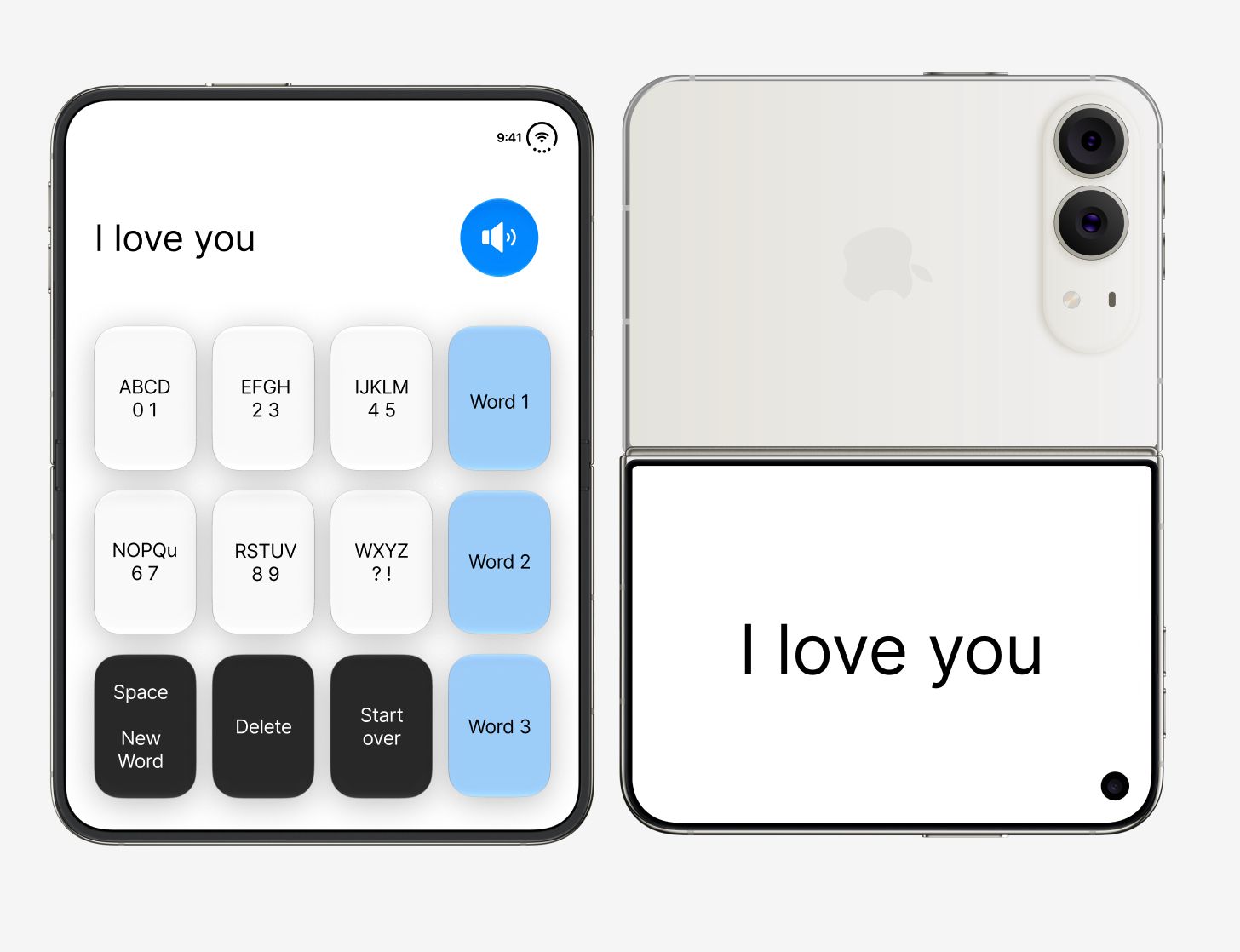
Aris is an AI-powered communication app designed for the iPhone Duo. The user interacts with Aris through eye movement. They can select letters, numbers, spaces, or start over. But instead of requiring them to type every word, Aris uses AI to understand shortcuts and predict what they are trying to say.
For example: Stbs 1 pm → “Can we meet at Starbucks at 1 PM? ”
Aris can also suggest commonly used questions and responses, reducing the number of interactions needed during everyday conversations.
The iPhone Duo makes this experience two-sided: the person with ALS can communicate on one side, while the person they are talking to sees the conversation on the other side without passing the phone back and forth.
How we built it
We focused on creating a simple experience with zero onboarding. When Aris opens, the user can immediately start communicating. We designed the interface around eye-based interaction and combined it with AI-powered text prediction and contextual suggestions. We also designed the experience specifically around the dual-screen form factor of the iPhone Duo rather than treating it as a traditional phone app.
Challenges we ran into
Our biggest challenge was balancing accuracy, speed, and simplicity. For someone who may need to control the interface through eye movement, every additional interaction matters. We had to think carefully about how to minimize typing while still giving the user control over what they want to say. Designing for a new device form factor also challenged us to rethink what a communication interface can look like when two people can interact with the same device from opposite sides.
Accomplishments that we're proud of
We’re proud that we built Aris around a real human need rather than simply adding AI to an existing workflow. In a short amount of time, we created a working concept that combines eye-based interaction, AI-powered text prediction, contextual suggestions, and the two-sided iPhone Duo experience into one communication tool. We’re especially proud of the idea of reducing the number of interactions required to communicate. Turning something as simple as “tmrw” into a complete thought shows how AI can remove physical effort instead of adding complexity.
Most importantly, we’re proud that Aris has a clear purpose: helping people with ALS communicate with less effort.
What we learned
The biggest lesson was that accessibility is not just about adding an accessibility feature to an existing product. The entire interaction needs to be designed around the user's abilities and limitations. We also learned that AI can be valuable not only for generating text, but for reducing the amount of physical interaction required to communicate.
What's next for Aris
Our next step is to test Aris with people who have ALS, their families, and caregivers to understand how the experience works in real-life conversations. We want to improve the AI so it becomes more personalized over time, learning the user's vocabulary, communication style, frequently used phrases, and everyday conversations. We also want to make eye-based interaction faster and more reliable, expand contextual predictions, and explore additional accessibility features.

Log in or sign up for Devpost to join the conversation.