ARIE: Adaptive Readiness Intelligence Engine
Inspiration & Problem Statement
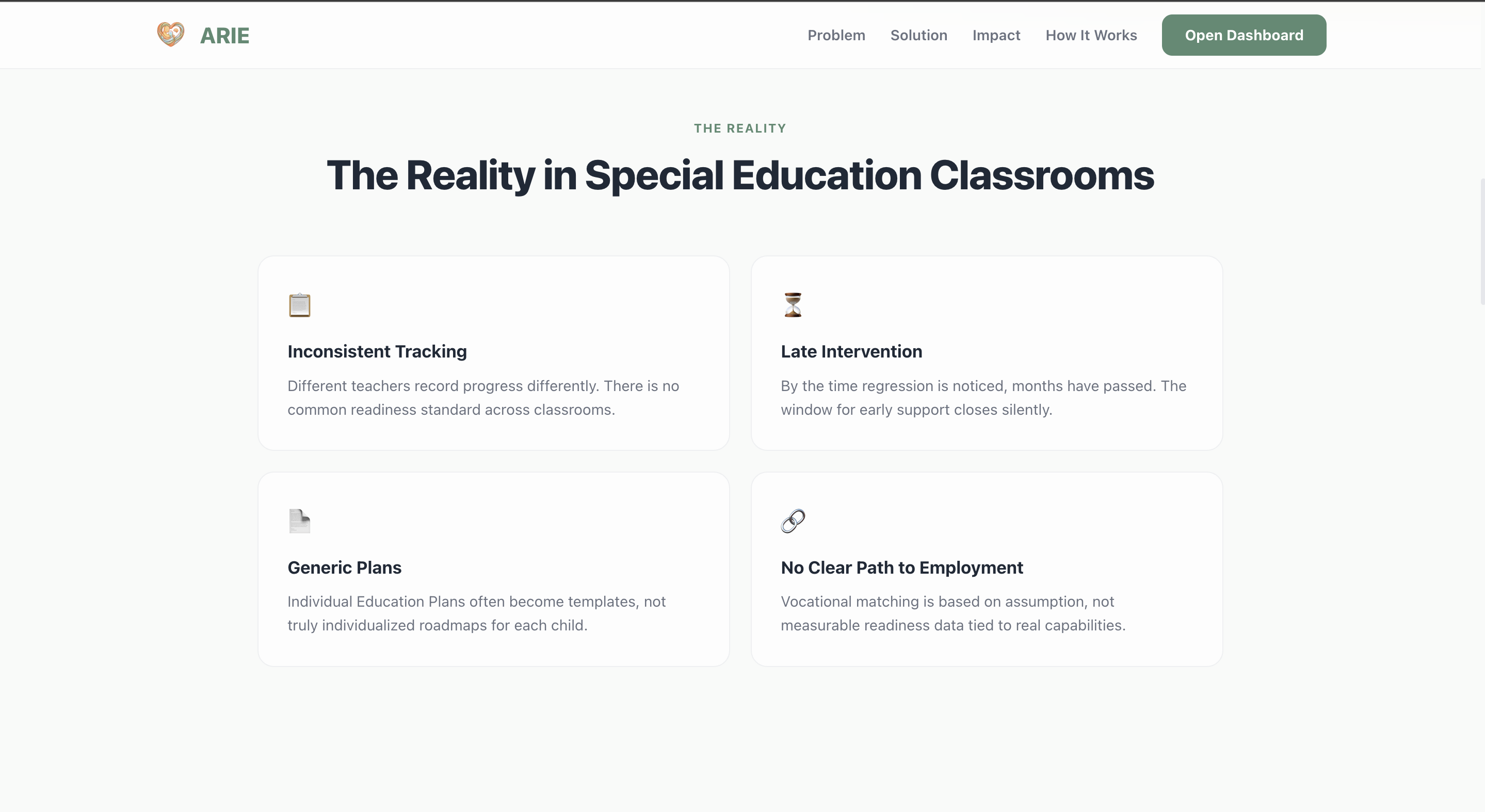
In India's special education system, transition readiness tracking is critically fragmented. Different teachers record progress subjectively, meaning regression often goes unnoticed for months. By the time intervention occurs, the critical window for early support has closed silently. Furthermore, vocational alignment for neurodiverse teens relies heavily on guesswork rather than empirical, capability-based data. We built ARIE to eliminate this subjectivity and construct a measurable, structured pathway from education to employment.
Explanation of the Solution: How It Works
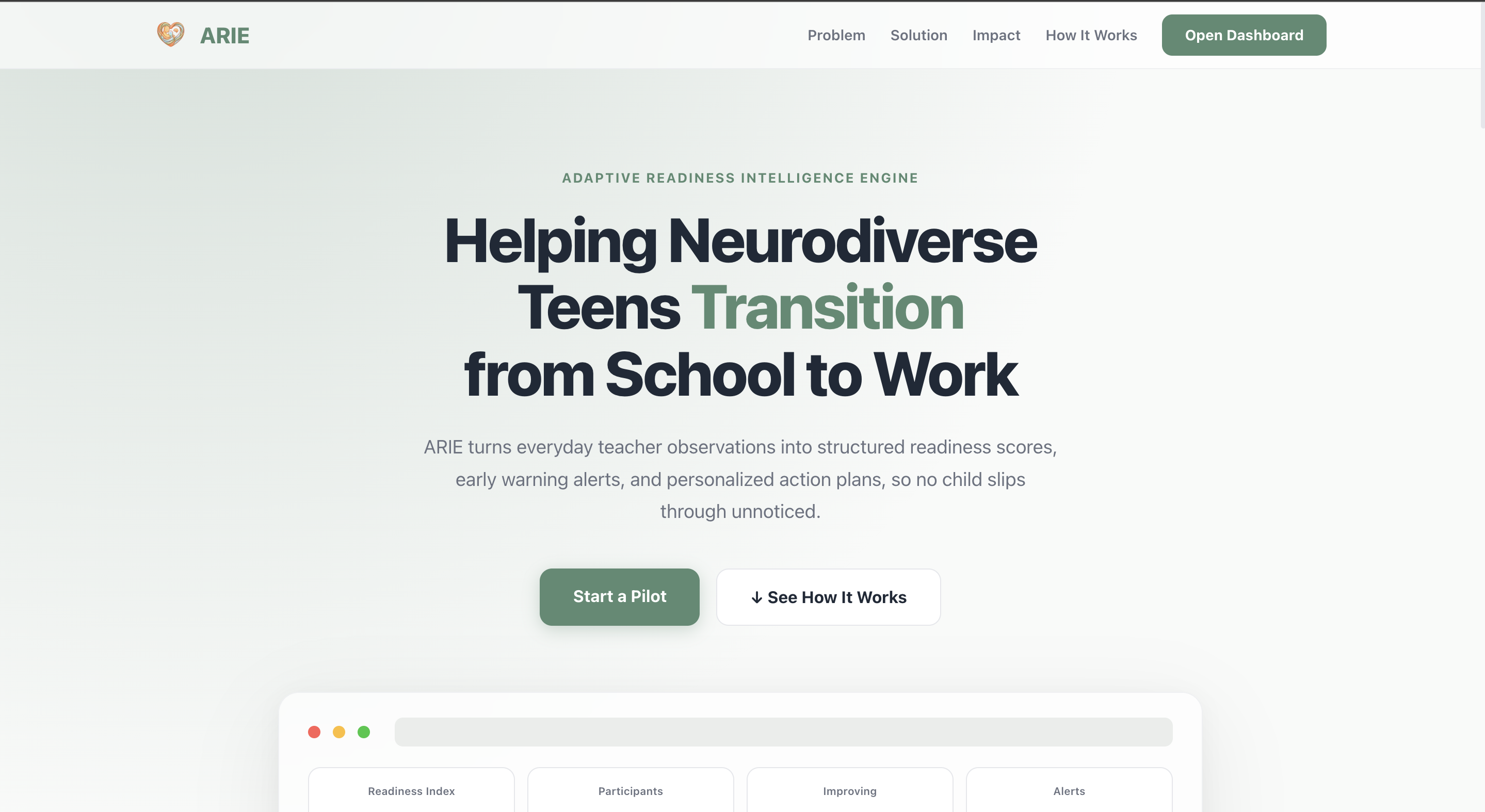
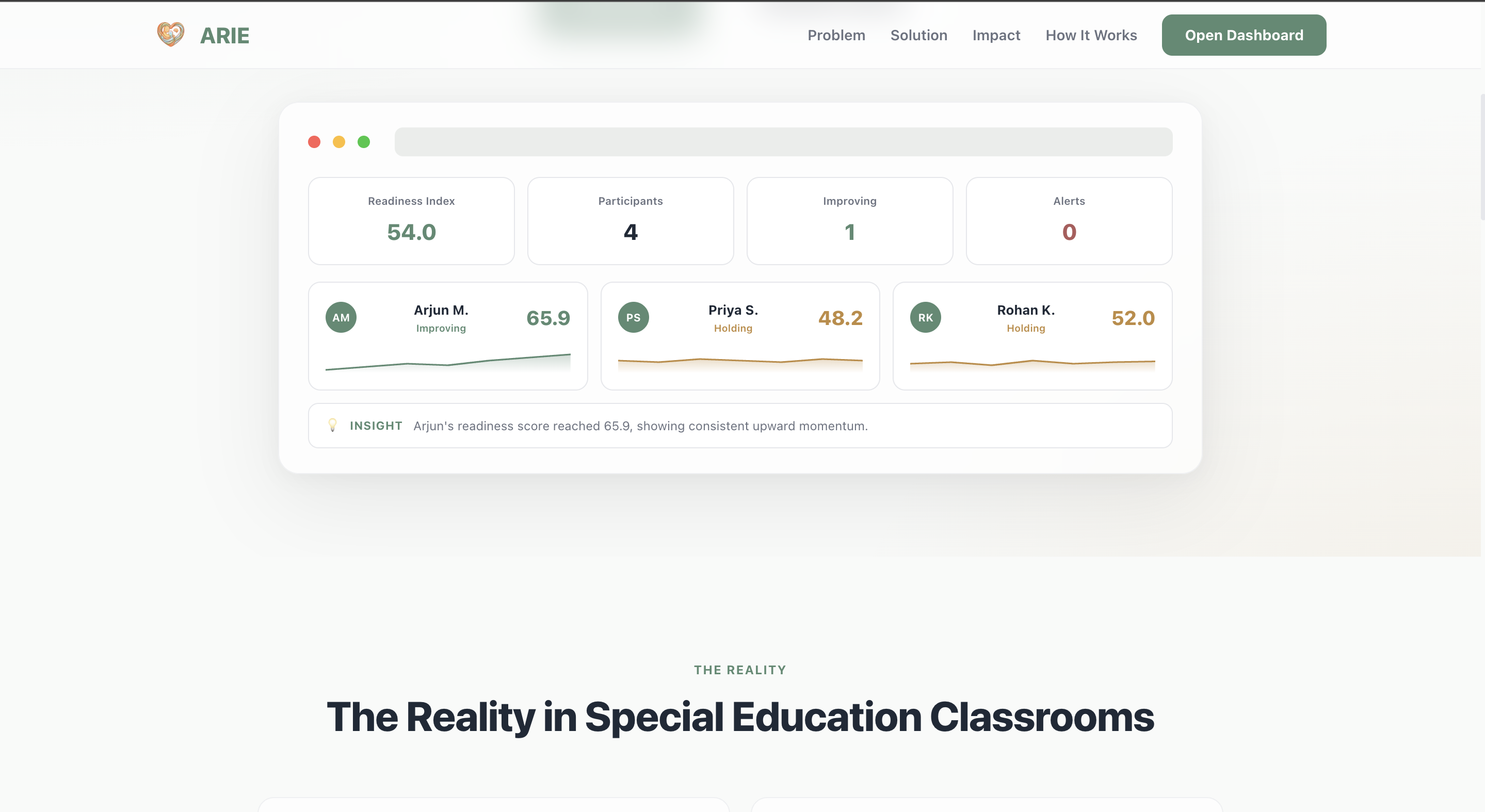
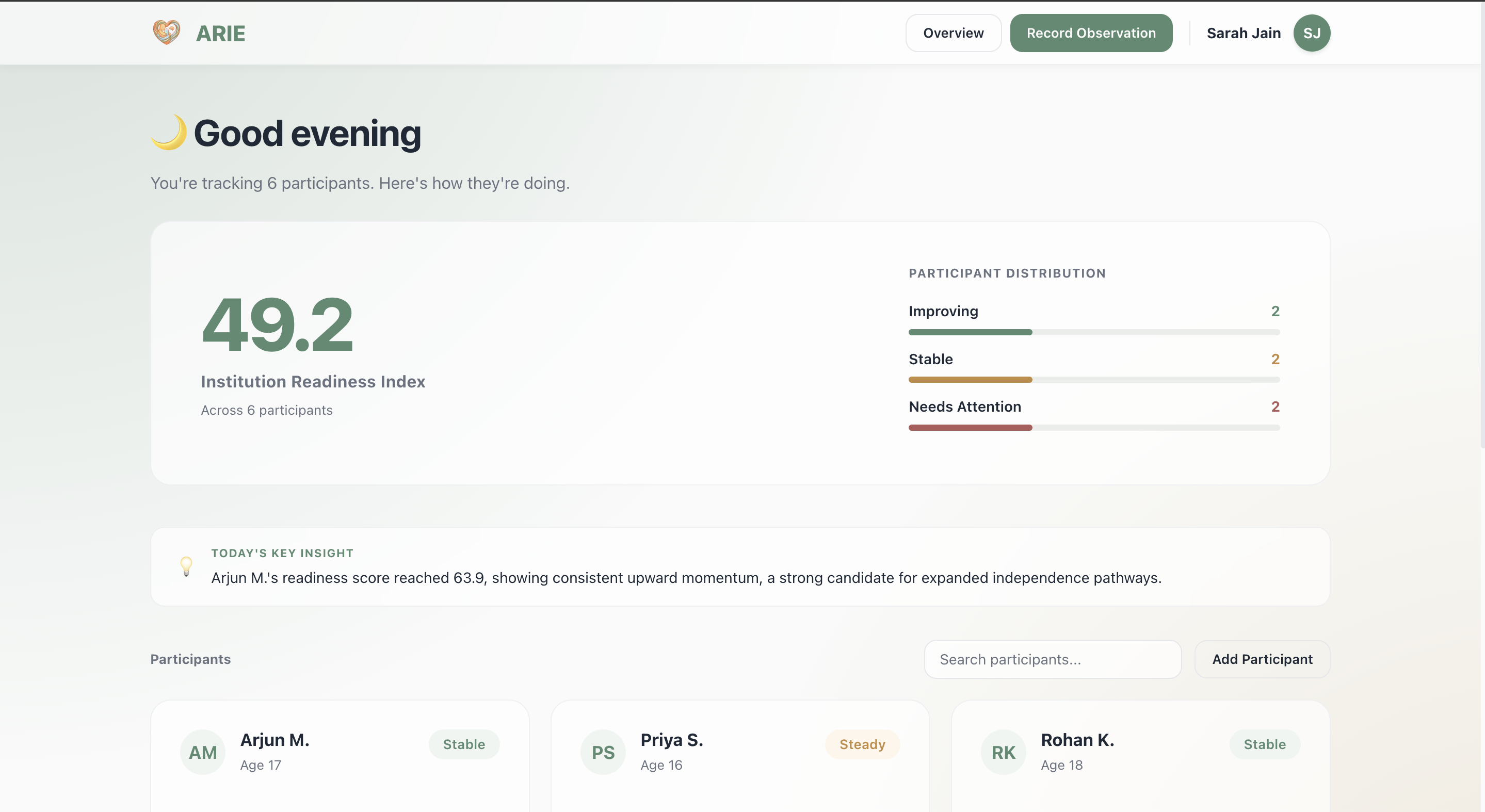
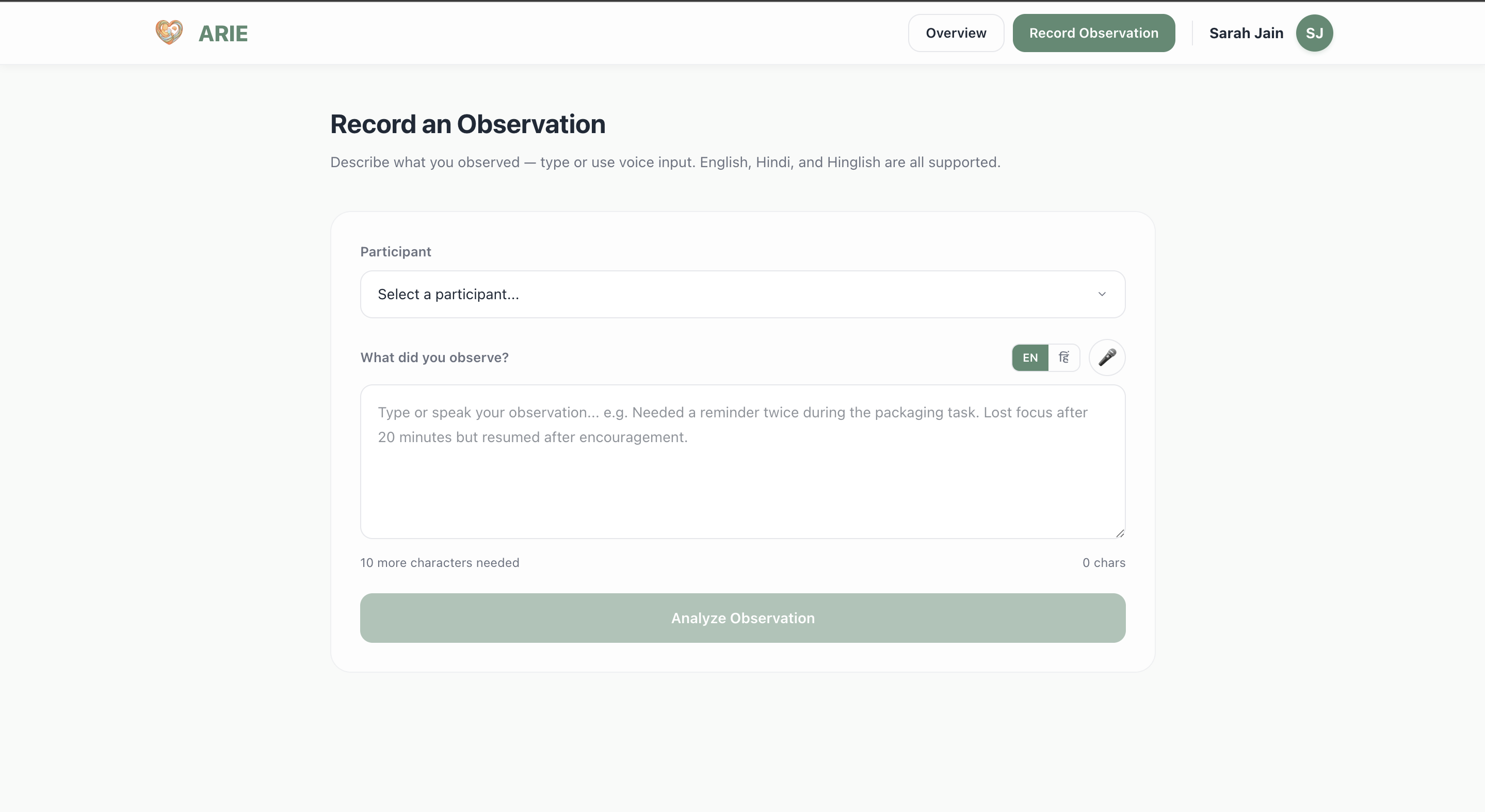
ARIE is a hybrid intelligence system that transforms daily, unstructured teacher observations into standardized readiness scores, early regression alerts, and actionable growth plans.
The pipeline operates through interconnected engines:
- NLP Engine: Extracts keywords and patterns from free-text observations (English/Hindi) to generate raw dimension scores.
- Ontology Engine: Normalizes raw NLP outputs into calibrated $0-100$ scores using specialized lookup tables and subcomponent weights.
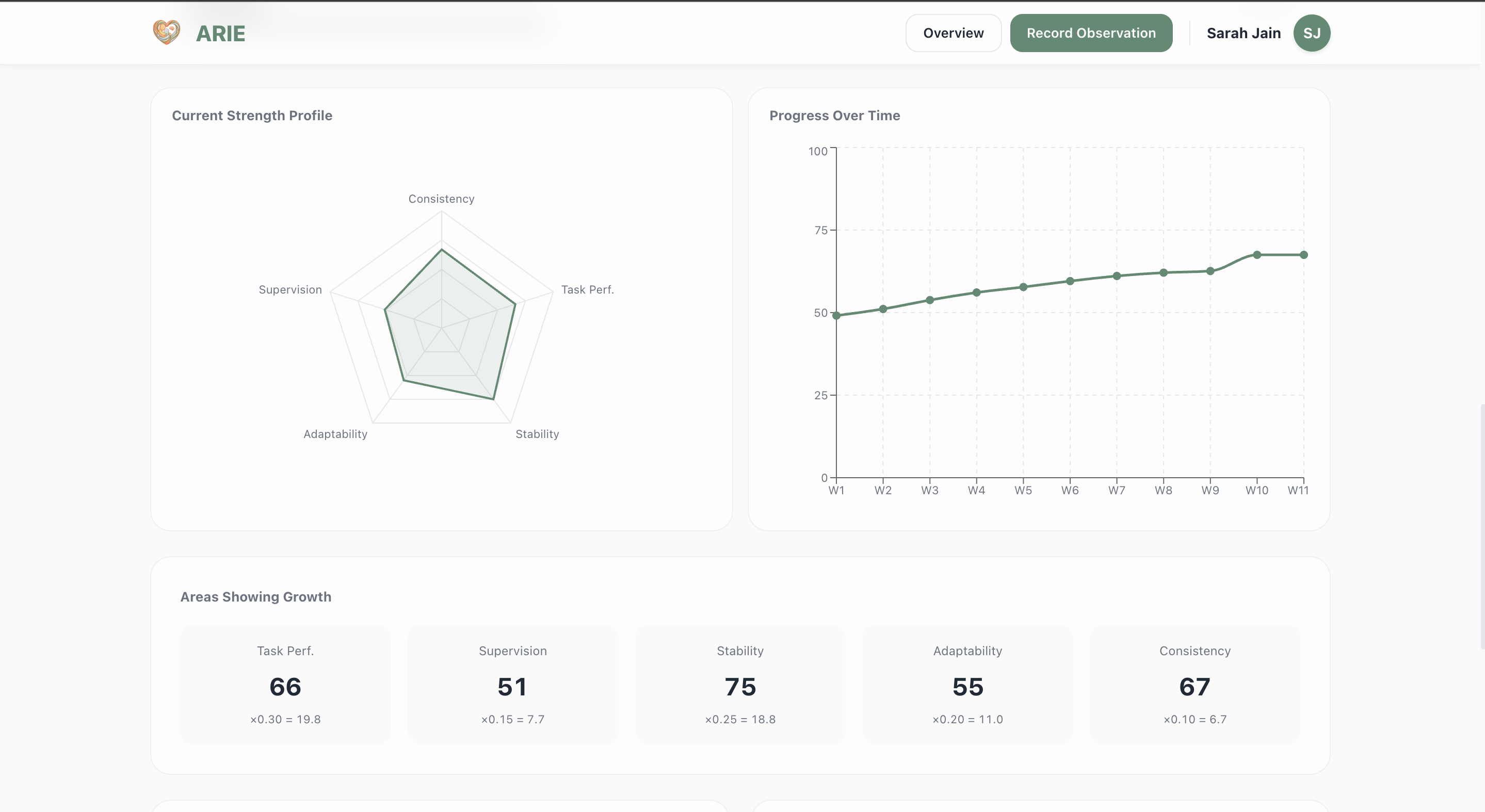
- Readiness Engine: Computes the final Readiness Score using a deterministic weighted sum equation:
$$\text{Readiness} = 0.30(\text{TP}) + 0.25(\text{BS}) + 0.20(\text{CA}) + 0.15(\text{SI}) + 0.10(\text{C})$$
(Where TP = Task Performance, BS = Behavioral Stability, CA = Cognitive Adaptability, SI = Supervision Independence, C = Consistency)
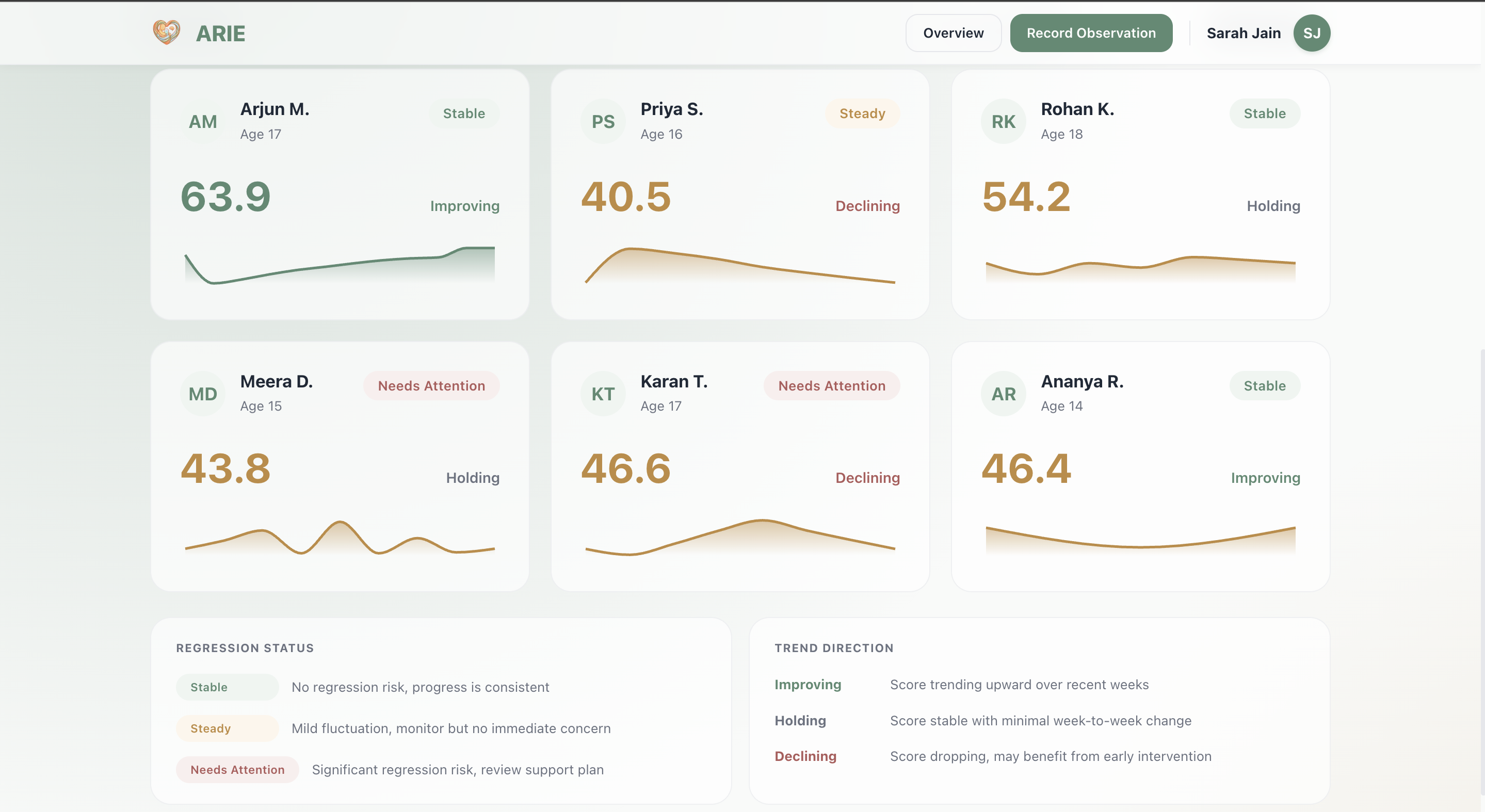
- Temporal & Trajectory Engines (ESTE): Tracks rolling averages (3-week windows) and computes trajectory direction via linear regression, enabling the system to trigger early support windows when decline patterns emerge.
- Vocational Engine: Executes cosine similarity computations between the student's readiness vector and predefined job profile vectors, applying constraint-based penalties for severe dimension deficits ($>30$ point gap).
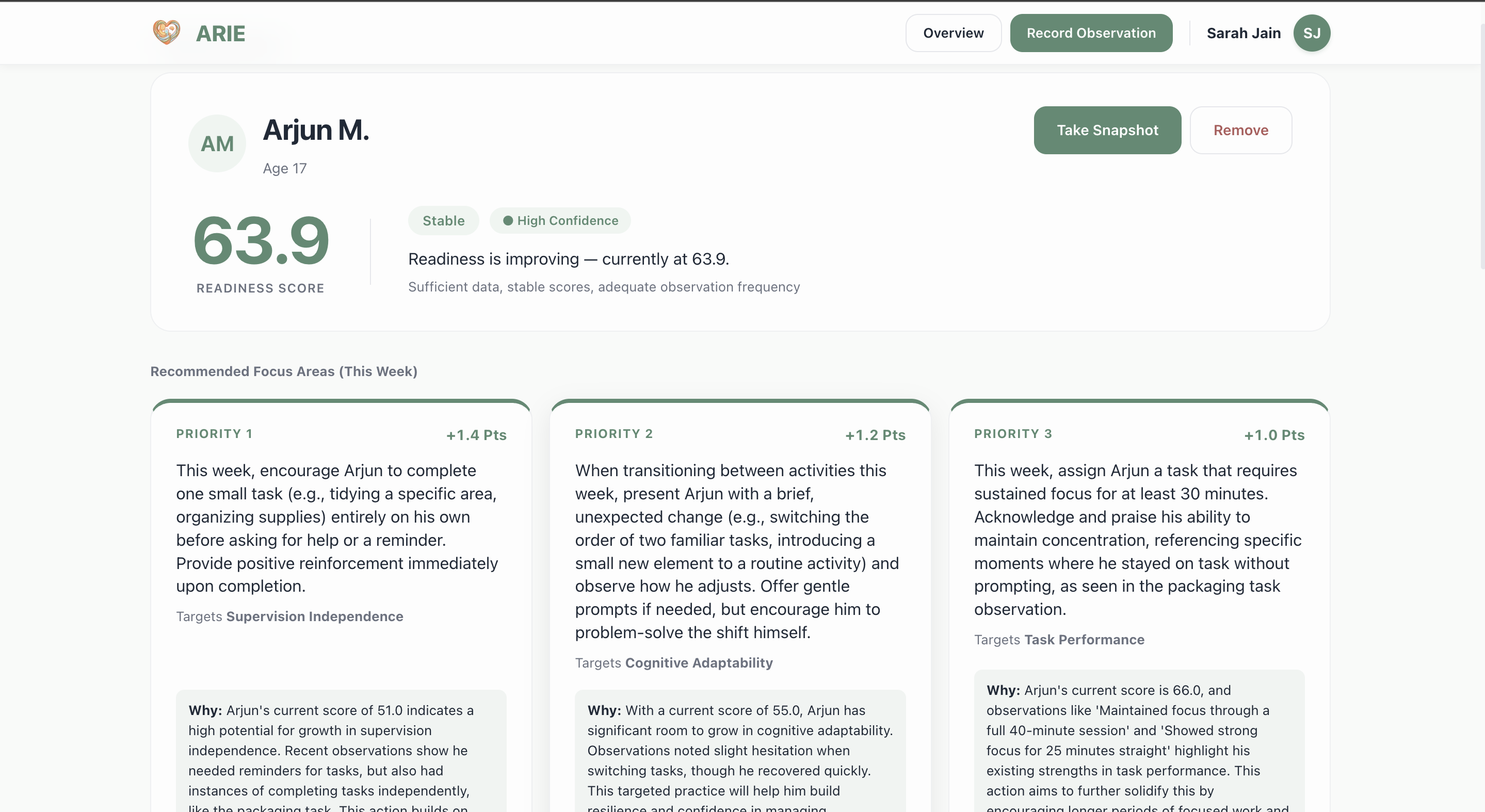
- Growth Engine: The isolated AI layer. It consumes the deterministic metrics to generate exactly three actionable, highly-specific growth recommendations.
How We Built It (Technologies & Frameworks)
We engineered a scalable, decoupled architecture designed for institutional deployment:
- Frontend: Next.js 16, React 19, TypeScript, Tailwind CSS 4, Recharts (deployed on Vercel).
- Backend: FastAPI, Python 3.12+, SQLAlchemy, Pydantic (Docker-ready).
- Database: PostgreSQL (via Supabase) utilizing
JSONBfor vector storage flexibility. - AI: Google Gemini (
gemini-2.5-flash-lite).
Challenges We Faced
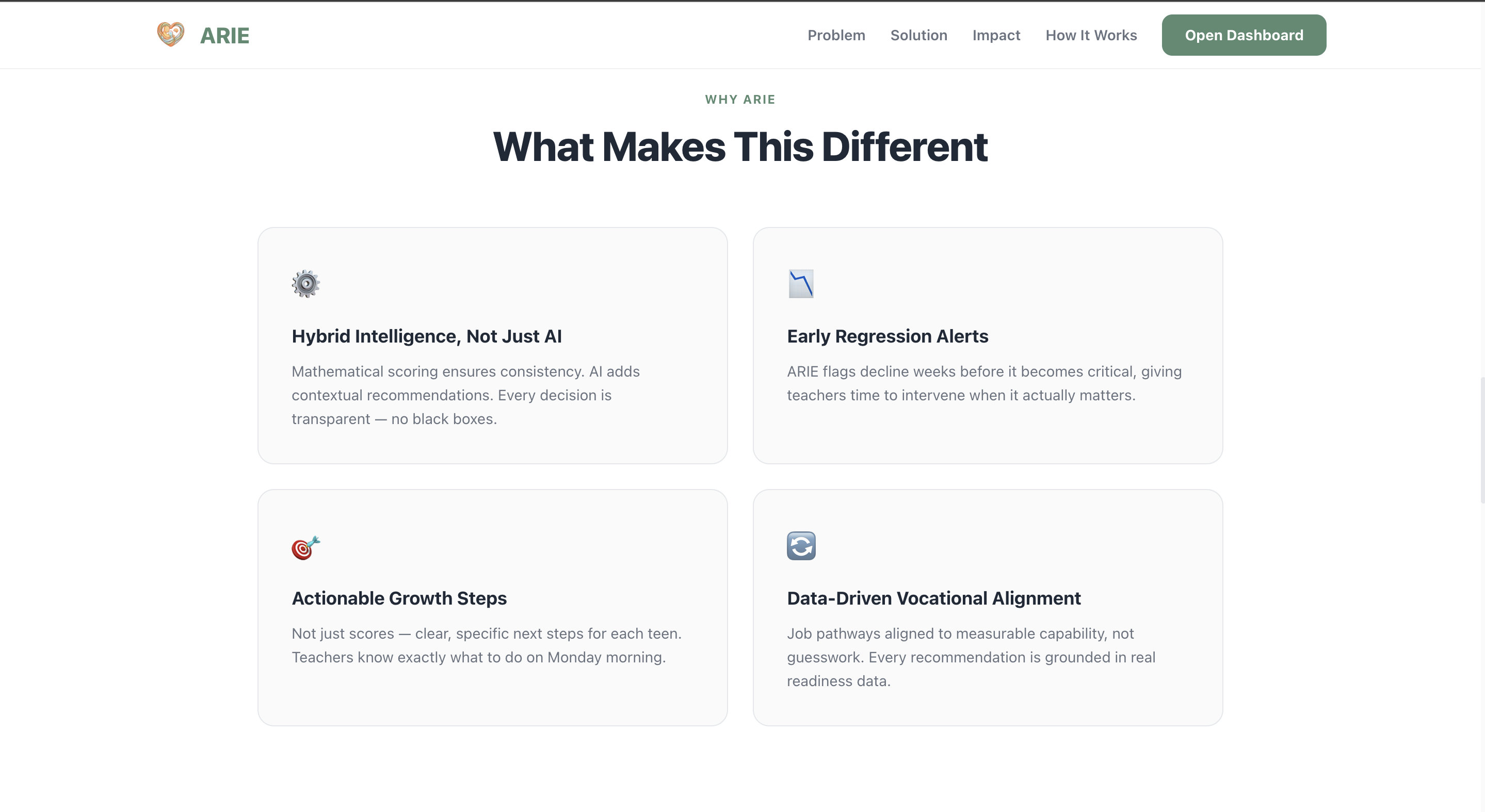
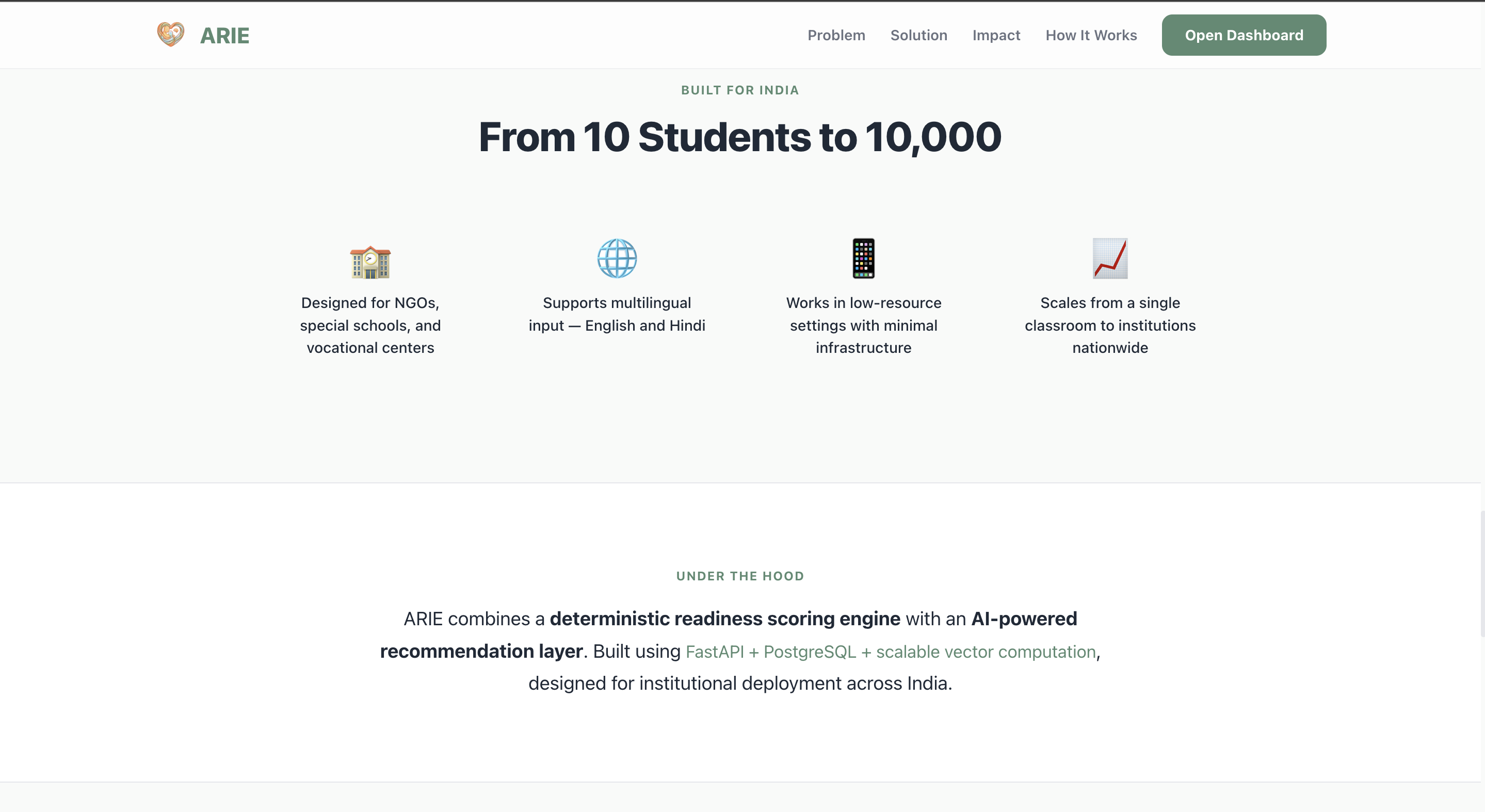
The core challenge was isolating AI hallucination risk from assessment metrics. Special education data requires strict explainability. If an AI generates the primary score, the system becomes an unverifiable black box. We solved this by forcing a deterministic core: all dimensional scoring, temporal tracking, and vocational mapping execute pure mathematical logic. We relegated the LLM strictly to generating human-readable growth plans based on the deterministic output, ensuring zero cross-student comparison and total reproducibility.
What We Learned
Building ARIE proved that LLMs are most effective when utilized as contextual interpreters of hard data, rather than decision-makers. Developing the Early Support Trajectory Engine (ESTE) taught us the value of rolling averages and sliding window algorithms to differentiate between statistical noise (a bad day) and actual behavioral regression.
Team Member Roles
- Aryan: Frontend Engineering. Engineered the client-facing architecture using Next.js, React, and Tailwind CSS, building the dashboard and interactive data visualizations.
- Alex: Backend Architecture. Designed the FastAPI server, PostgreSQL database schema, and programmed the mathematical core (Ontology, Readiness, and Trajectory engines).
- Lakshay: AI Integration. Developed the Growth Engine, structuring the prompts and integrating the Gemini API to reliably generate actionable, context-aware support plans from deterministic outputs.
Future Scope
We intend to scale ARIE from single NGO classrooms to an institutional-level transition framework. Roadmap milestones include:
- Deepening the multi-lingual voice transcription capabilities for low-resource environments.
- Expanding the Vocational Engine's dataset to map against localized, hyper-regional employment matrices.
- API integration with state-level disability registries to standardise baseline metrics nationwide.
Built With
- fastapi
- gemini
- next.js
- postgresql
- react


Log in or sign up for Devpost to join the conversation.