-
-
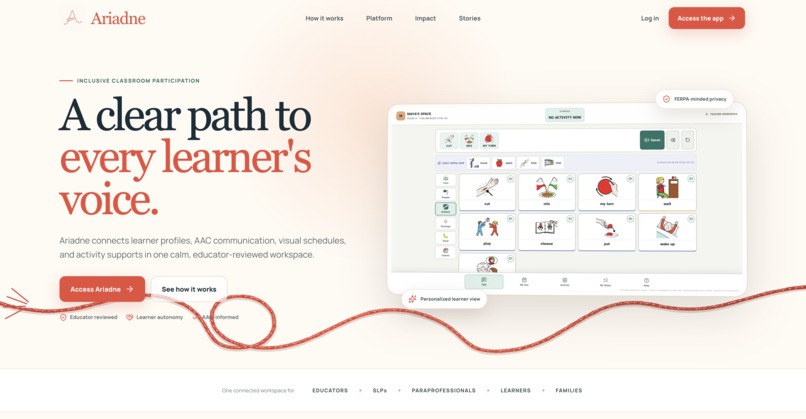
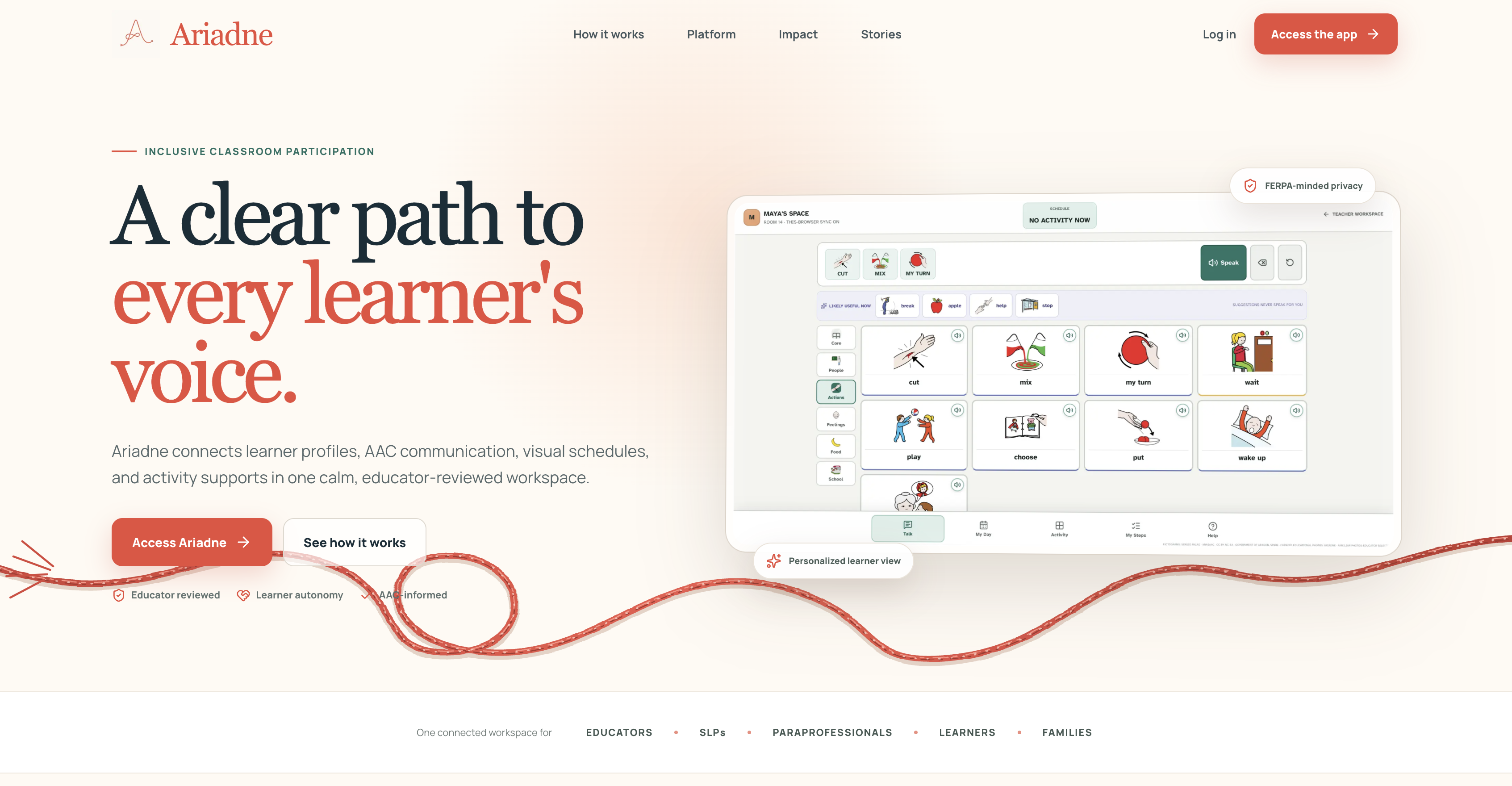
Ariadne landing page
-
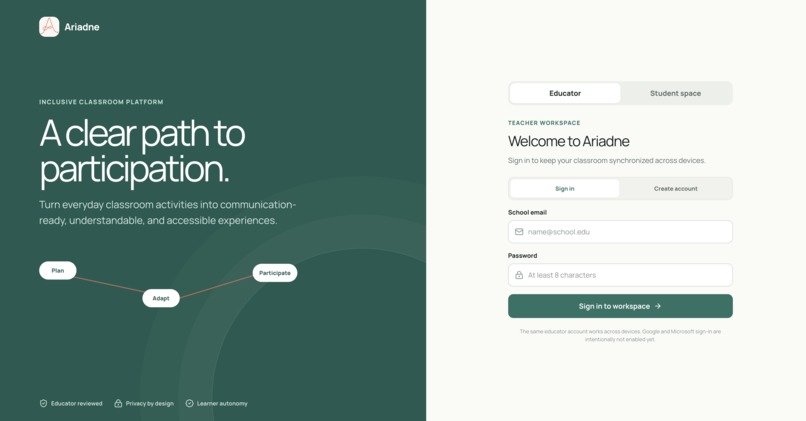
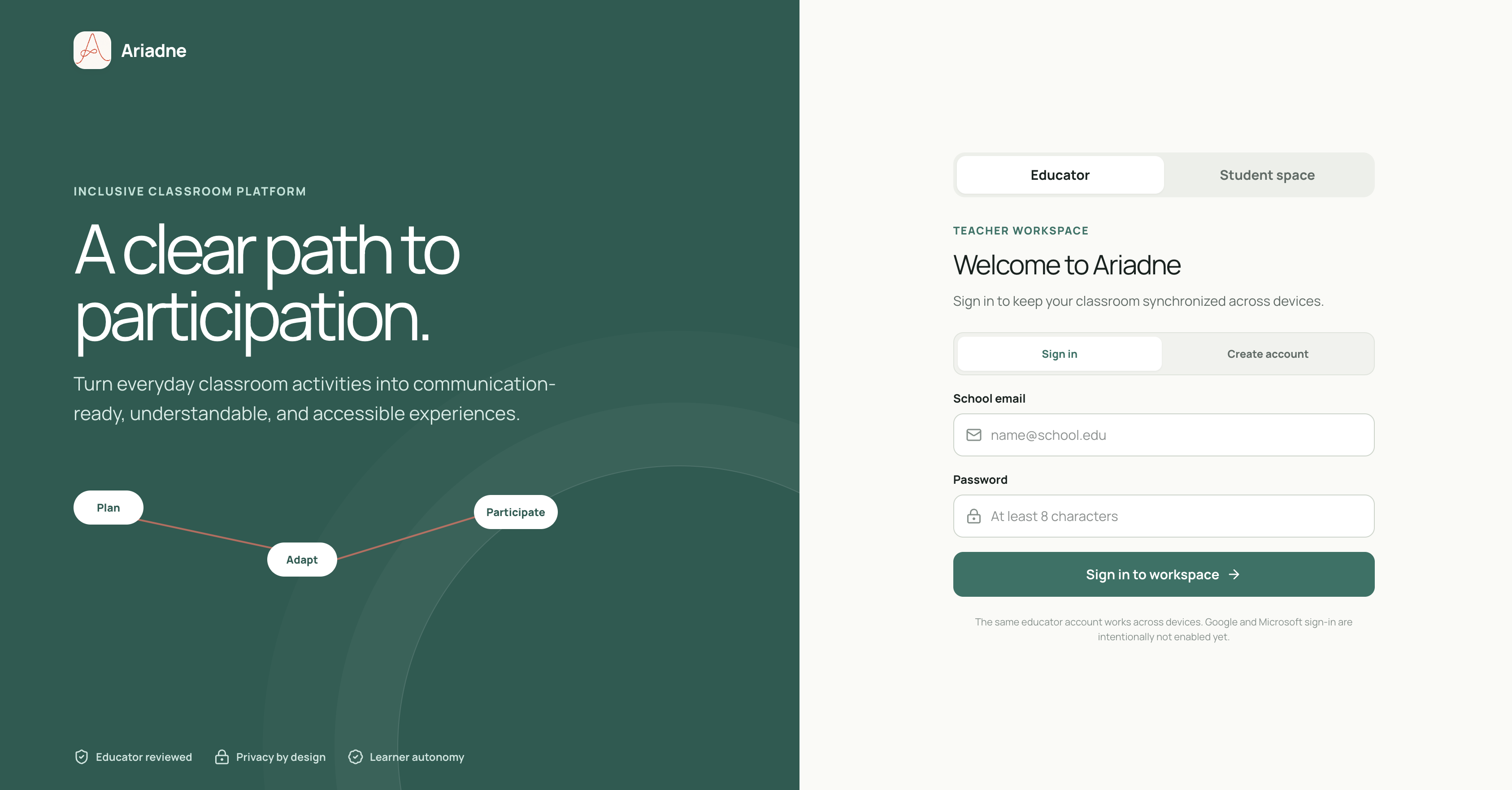
Ariadne login screen
-
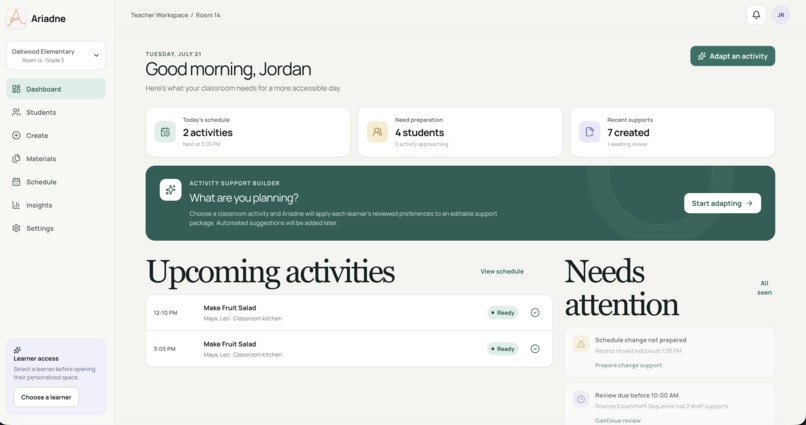
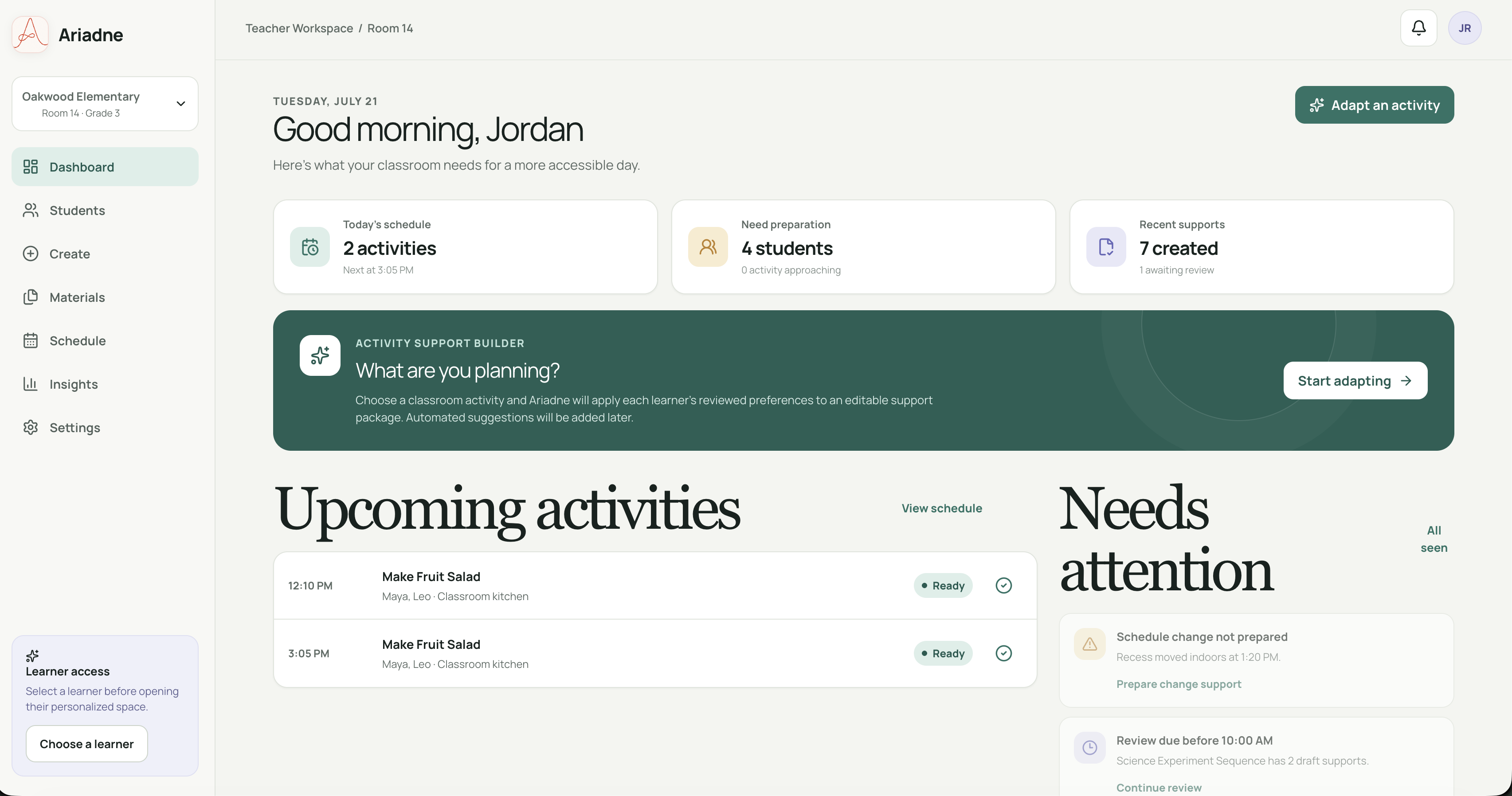
Teacher dashboard
-
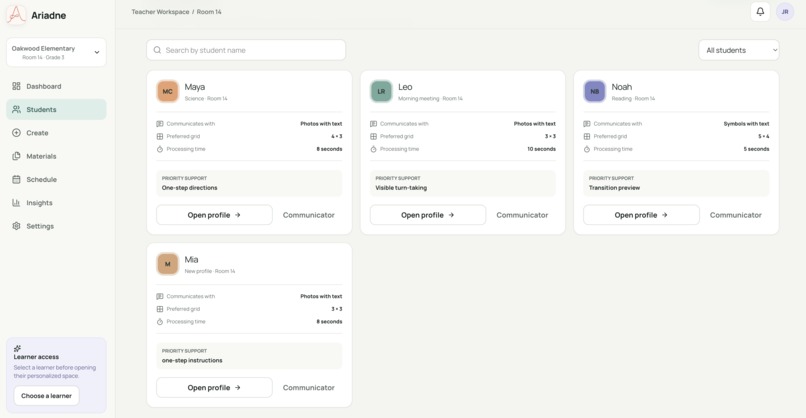
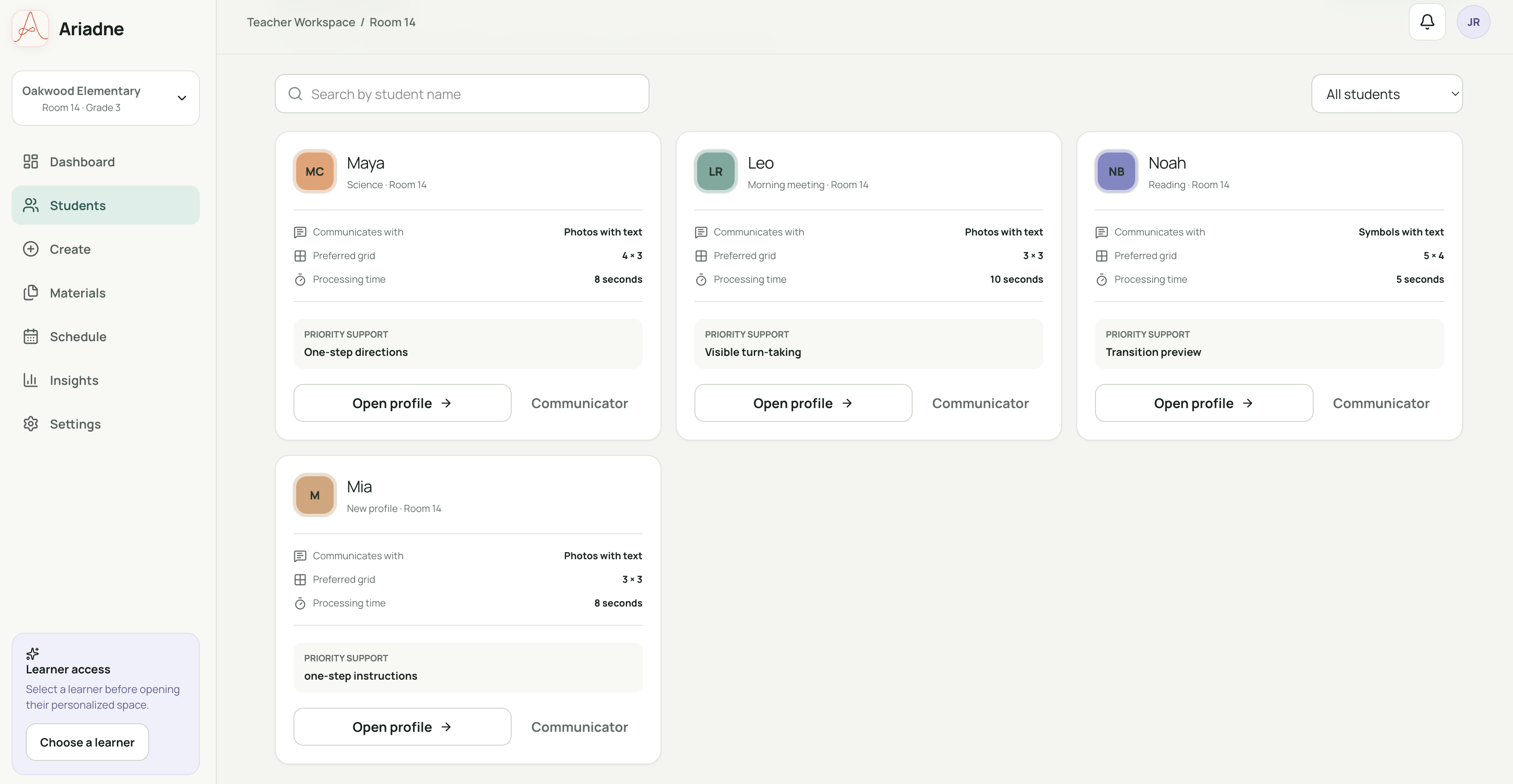
Student profiles
-
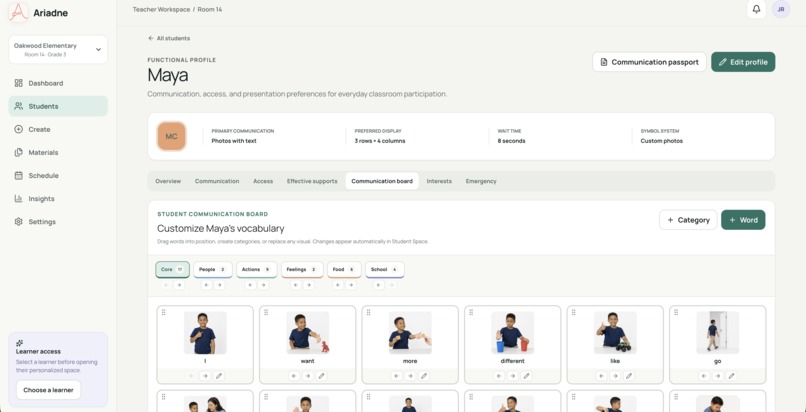
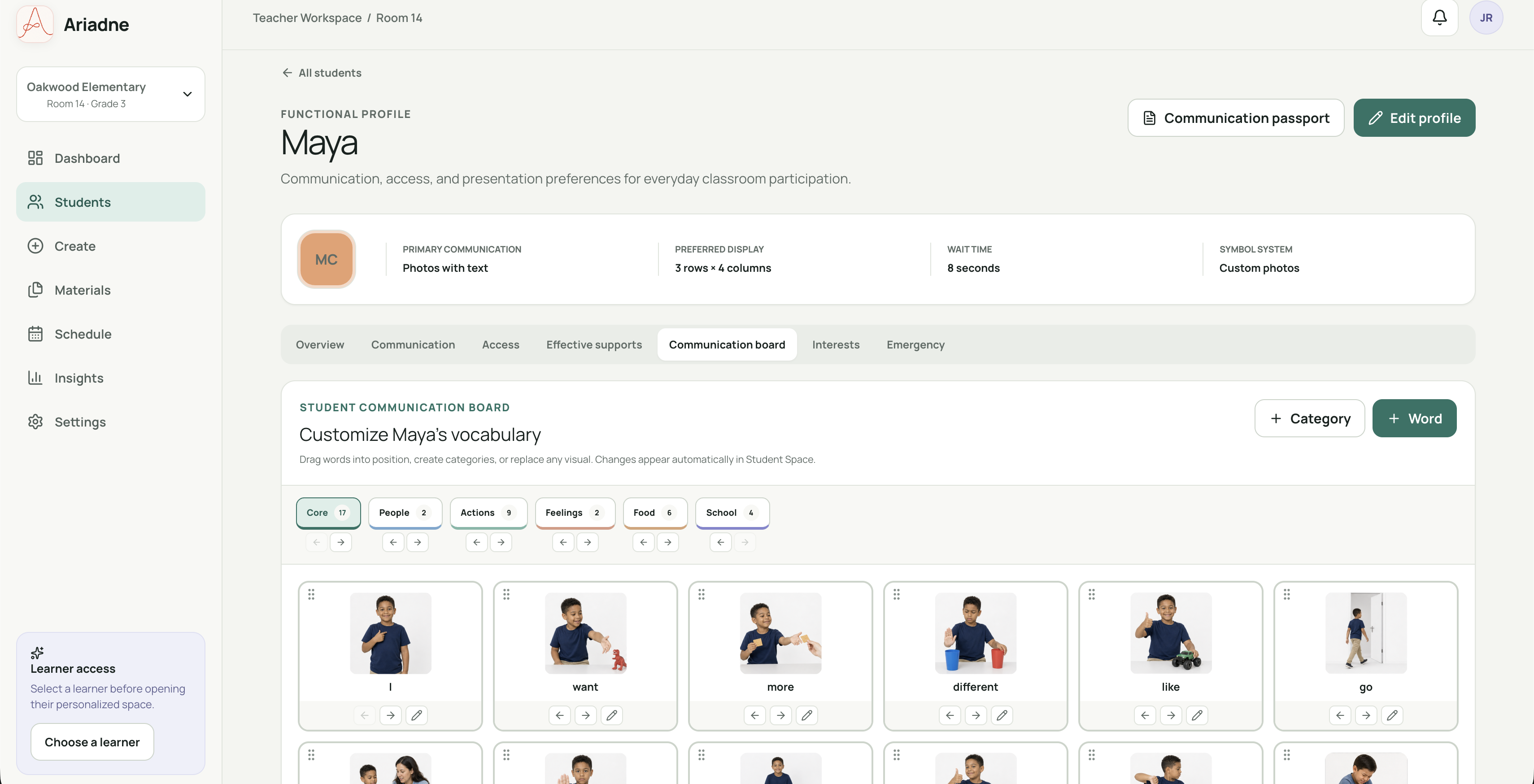
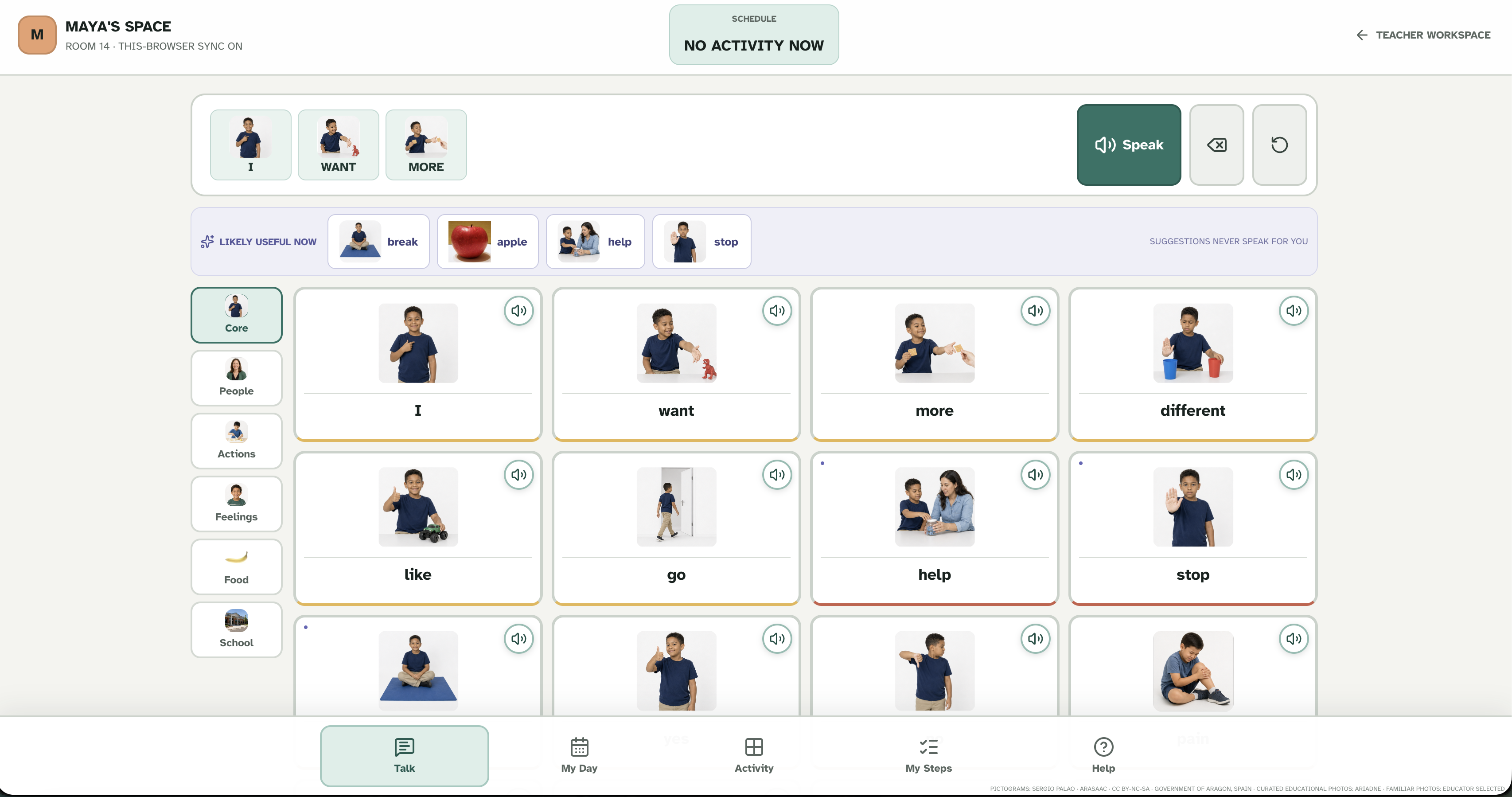
Student communication board
-
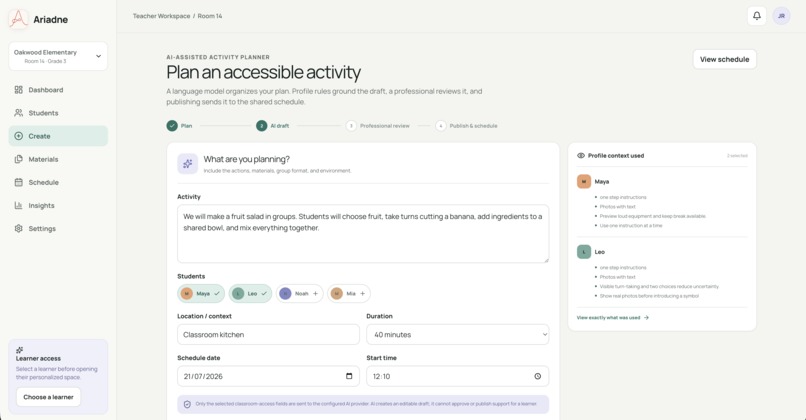
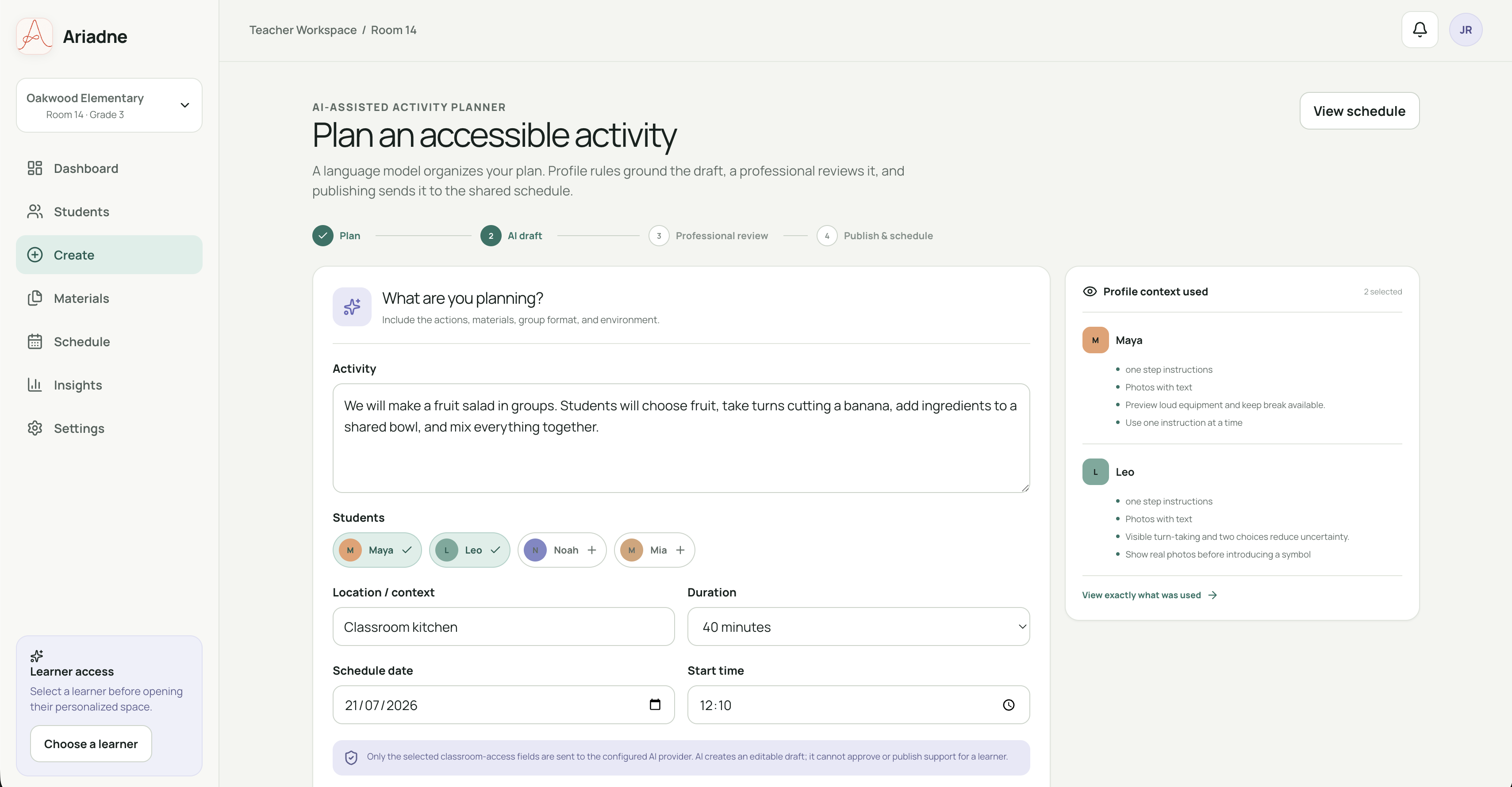
AI-assisted activity planner
-
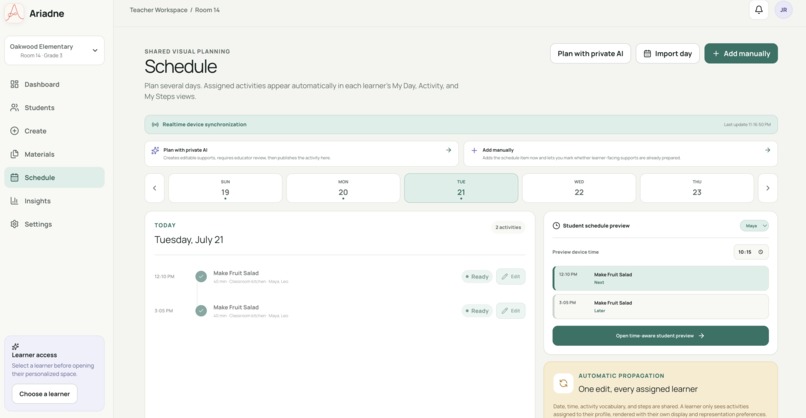
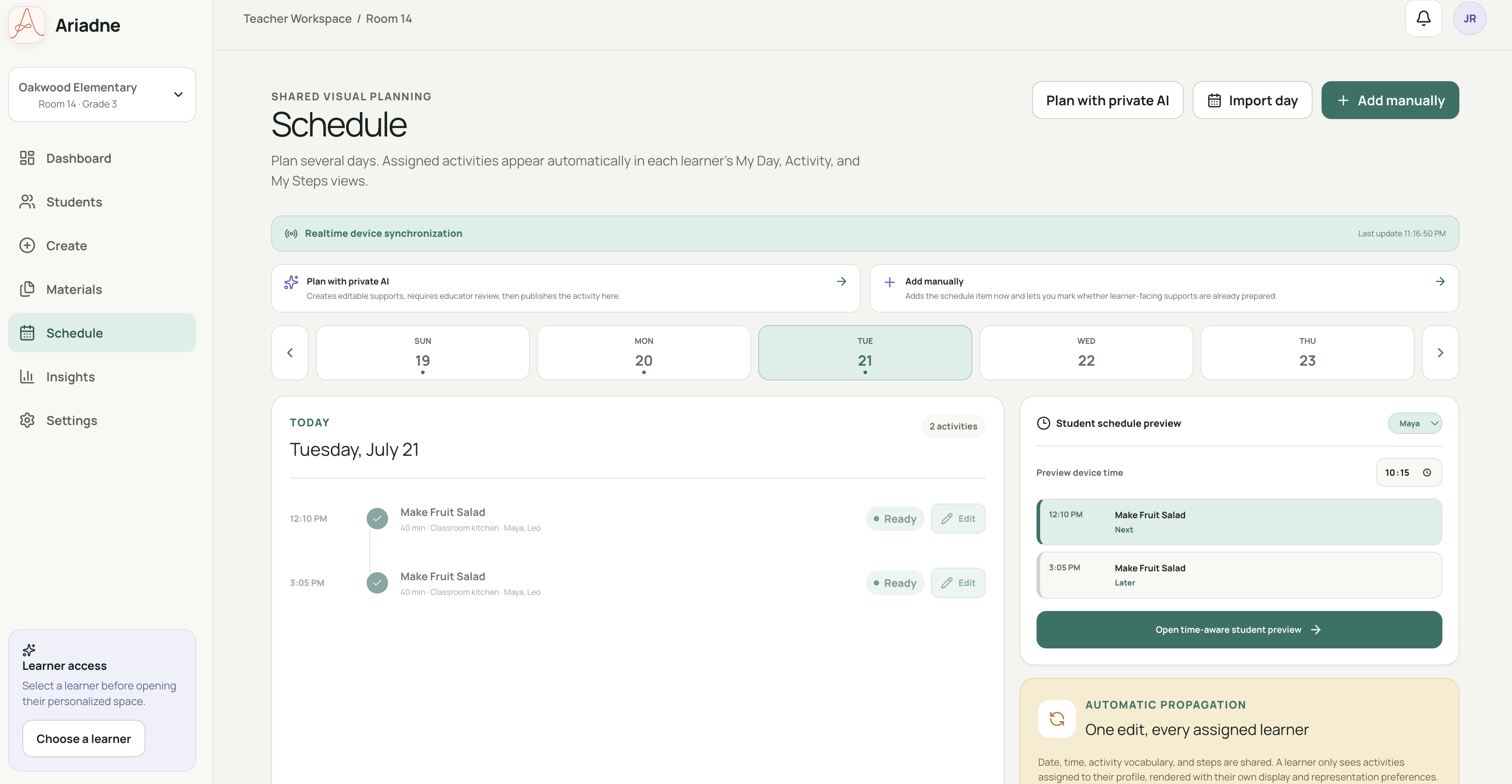
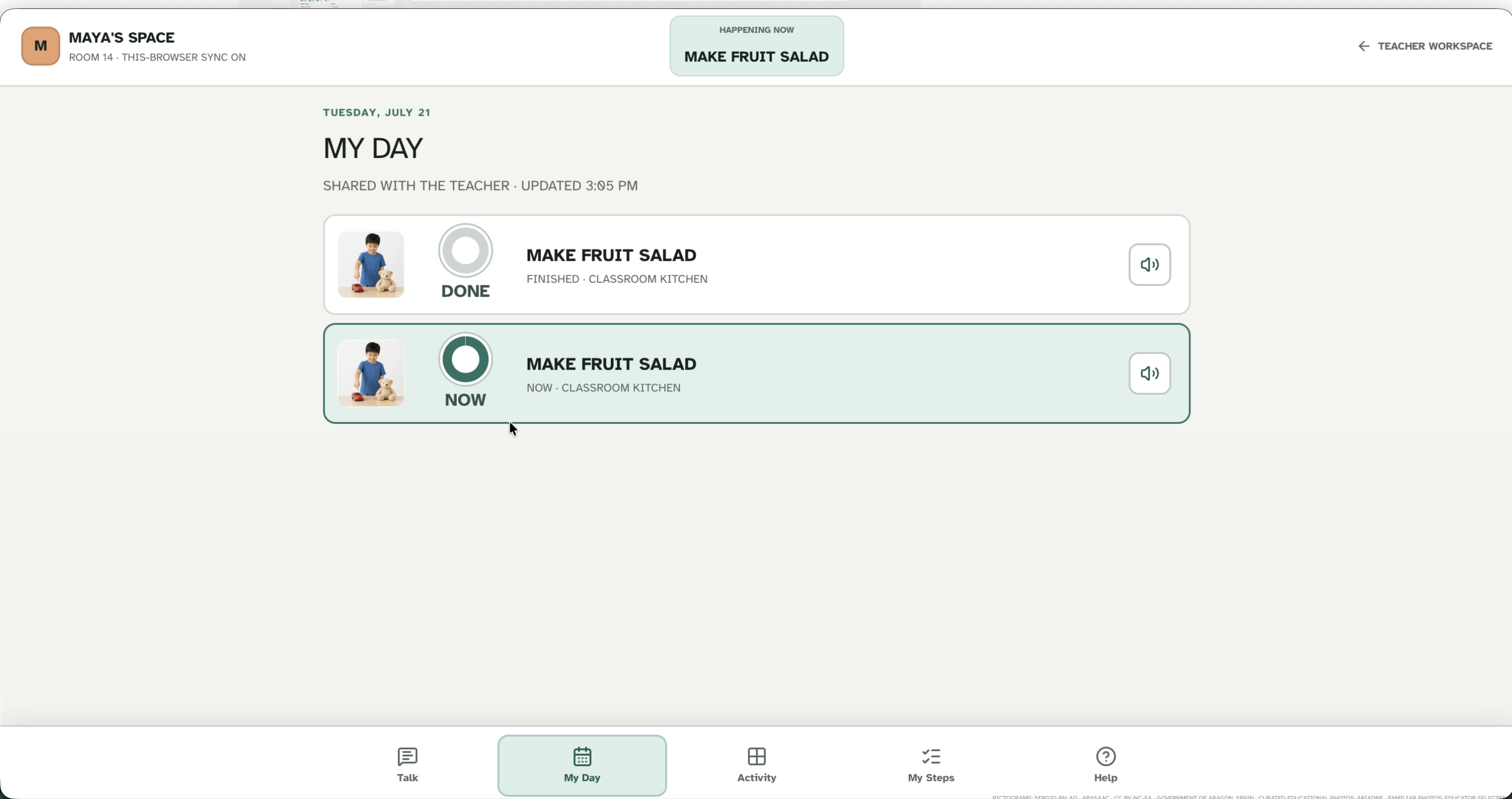
Classroom schedule
-
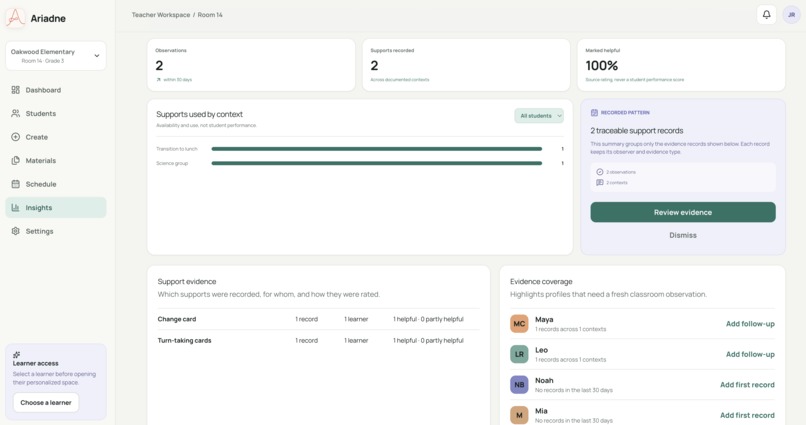
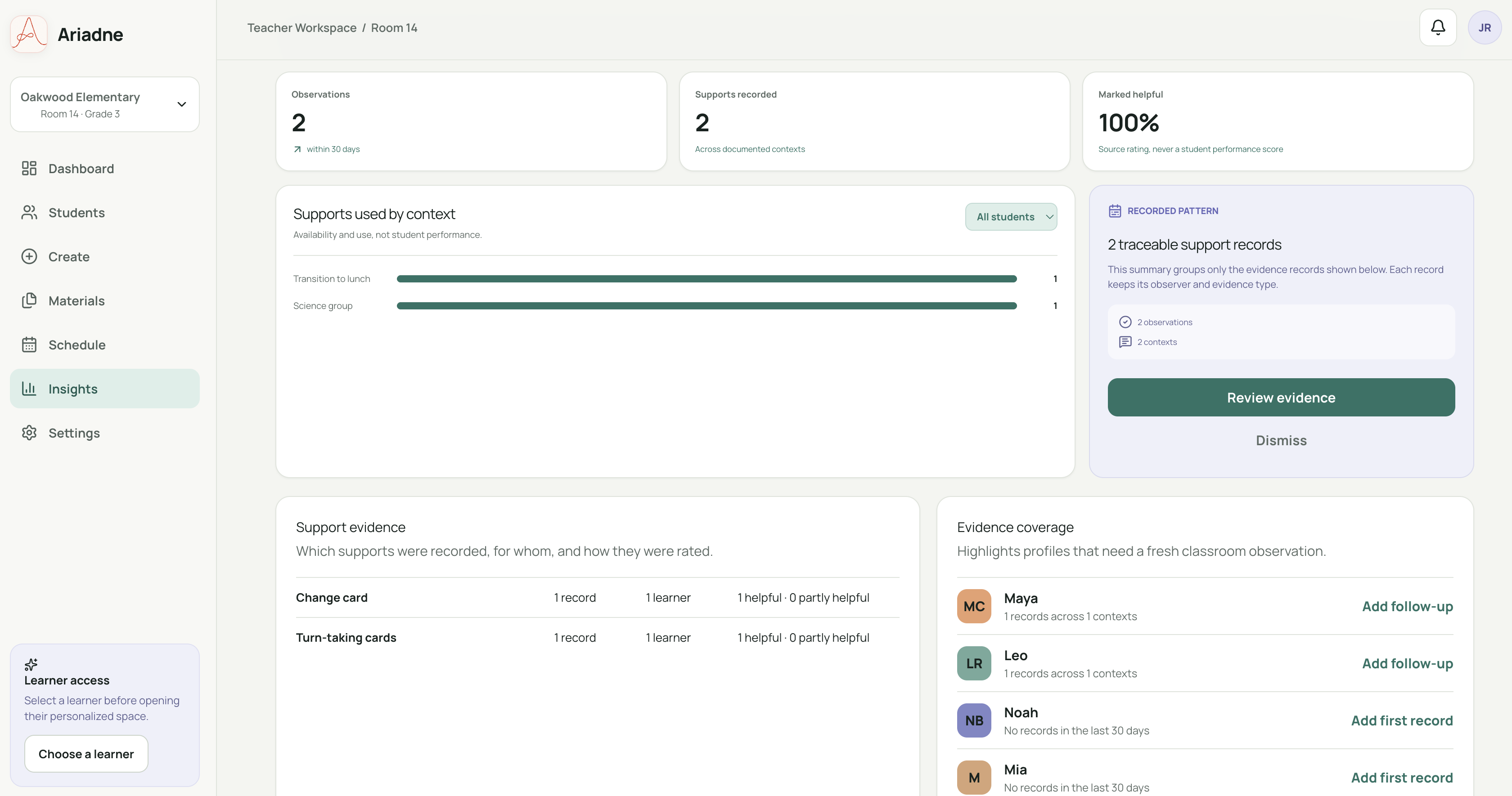
Teacher insights
-
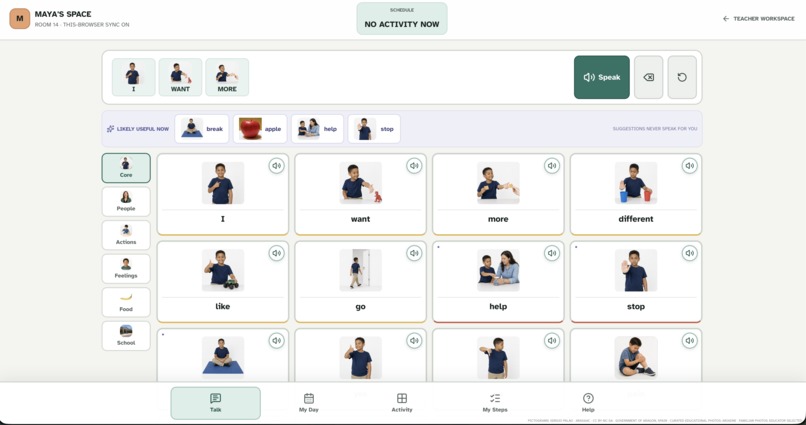
Student Comunicator Board
-
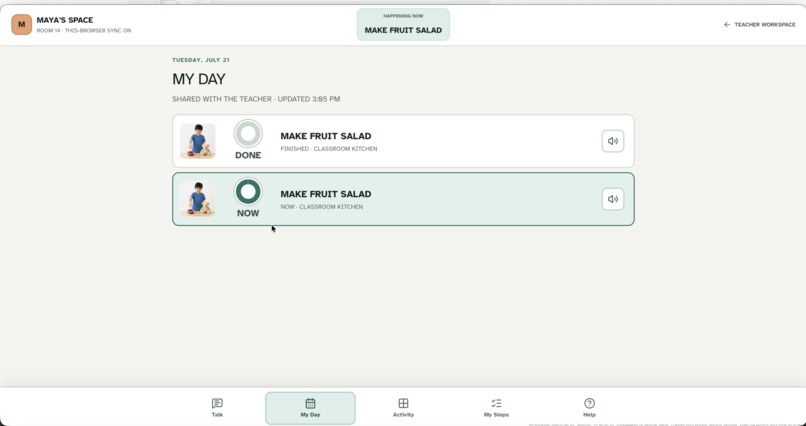
Student Schedule
-
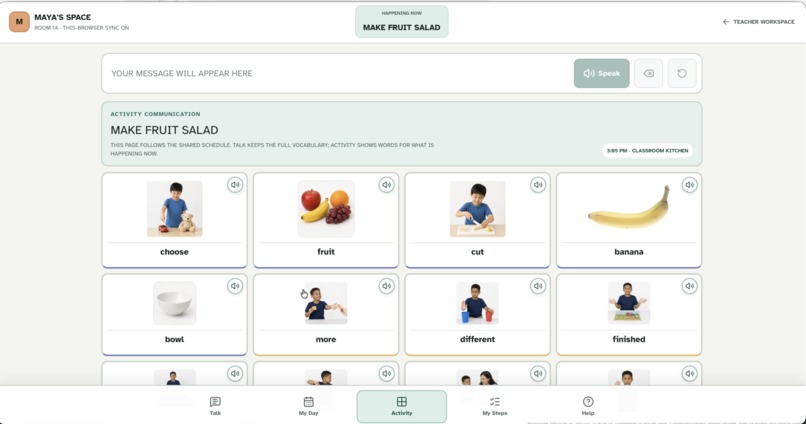
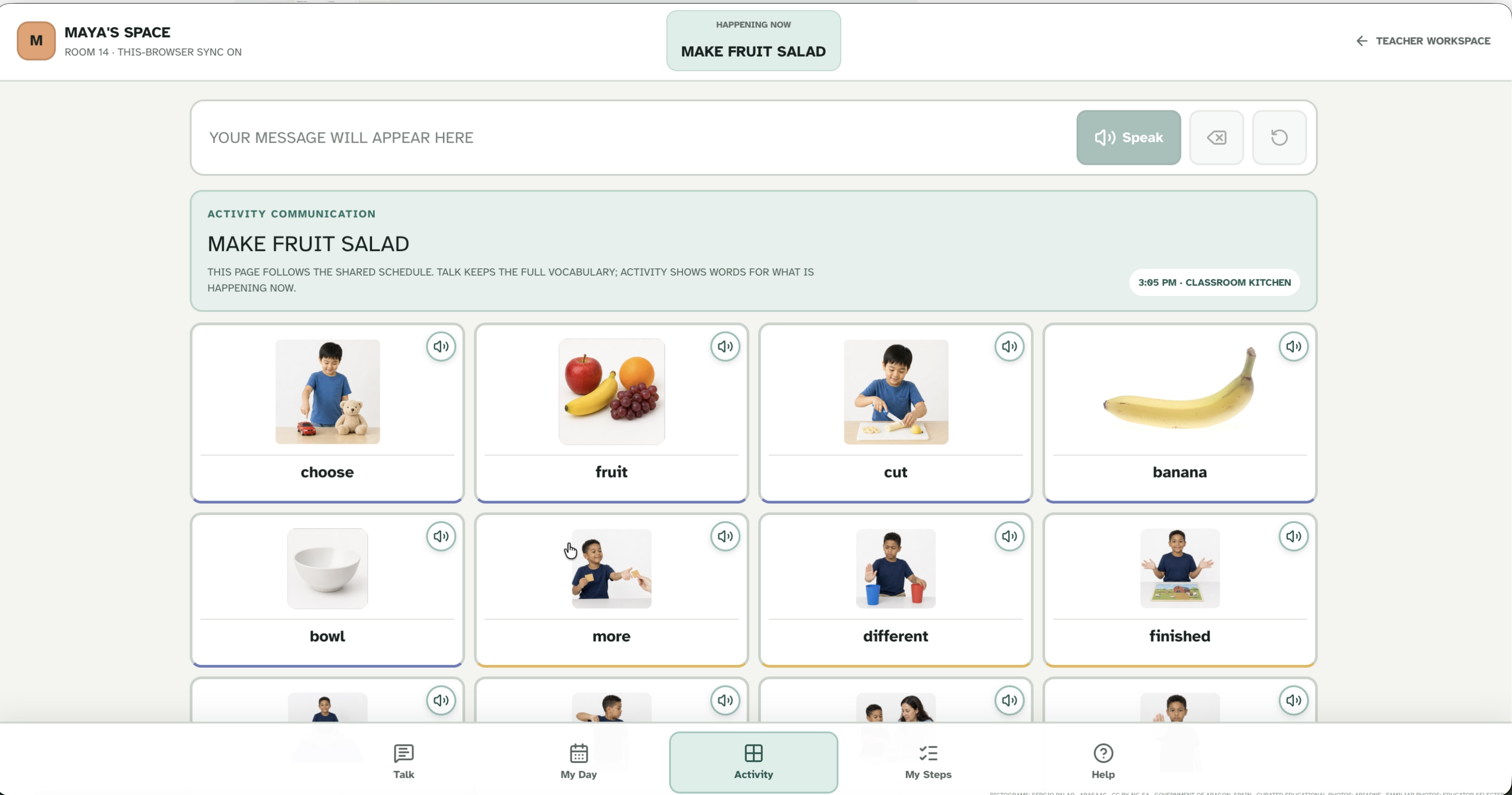
Student Activity-Based Comunicator Board
-
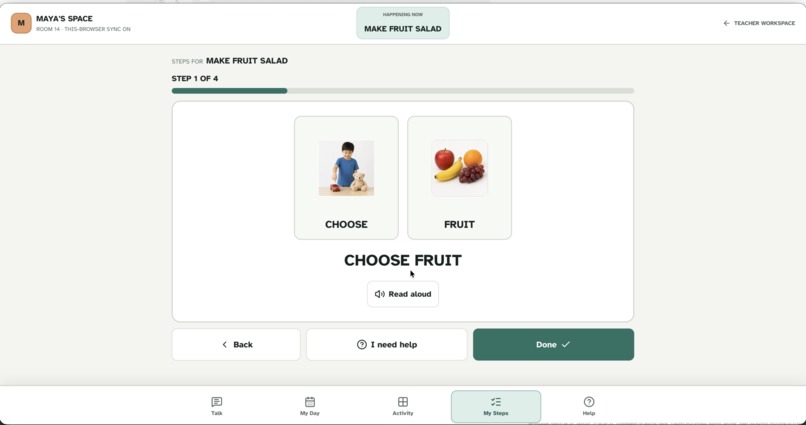
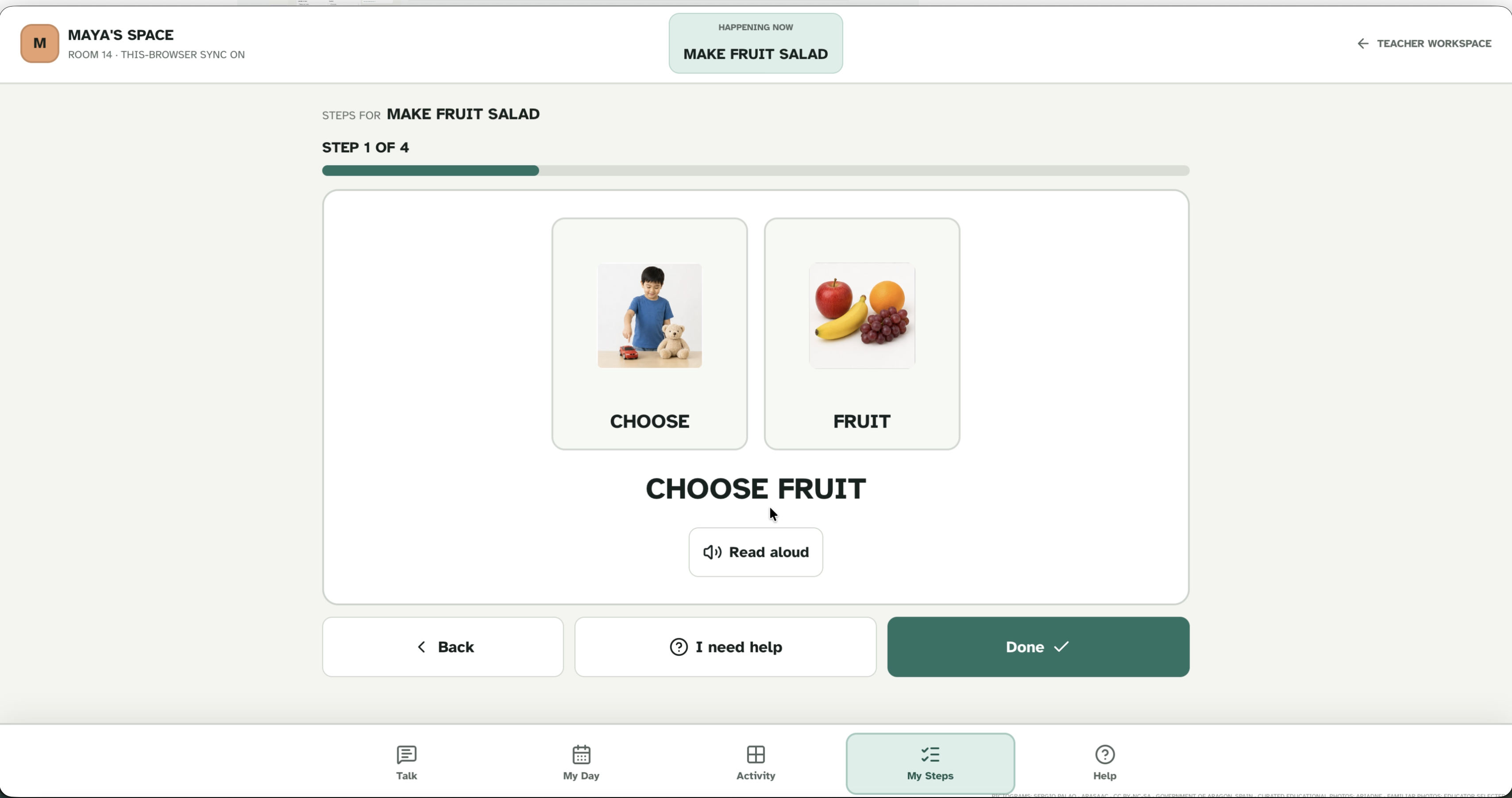
Student Activity Step Guide
Inspiration
Being physically present in a classroom does not always mean being included.
Students with complex communication needs may struggle to understand instructions, anticipate changes, express discomfort, ask for help, or participate in everyday activities. Educators want to support them, but the tools they rely on are often fragmented across communication boards, visual schedules, social narratives, reports, and informal knowledge shared between professionals.
We created Ariadne to connect those pieces into one inclusive classroom platform.
The name comes from the Greek myth of Ariadne and her thread: a guide through complexity. In the same way, Ariadne helps educators turn everyday classroom situations into clearer, more accessible paths for participation.
Our core principle is simple:
Ariadne does not speak for the child. It gives the child more ways to speak—and gives the classroom a clearer path to listen.
What it does
Ariadne is a role-based web platform for educators and learners with complex communication needs.
It combines two central components:
- An always-available AAC communicator that learners can use throughout the school day.
- An AI-powered inclusion workflow that helps educators adapt real classroom activities to each learner’s functional communication and access needs.
Each learner has a personalized communication space that can include AAC symbols, real photographs, written text, speech output, stable core vocabulary, contextual vocabulary, visual schedules, step-by-step instructions, and anticipatory narratives.
The communicator is not limited to requesting objects. Learners can reject, comment, ask questions, express pain or sensory discomfort, request clarification, ask for help, request a break, or change their mind. Essential autonomy messages such as no, stop, help, and break remain available even when activity-specific vocabulary is added.
In the Educator Workspace, teachers can manage functional learner profiles, communication passports, schedules, reusable materials, structured observations, activities, and personalized support packages.
An educator can describe one classroom activity, assign it to several learners, and receive a different support pathway for each profile. For example, the same school fire drill may generate:
- A symbol-and-text visual sequence and AAC vocabulary for one learner
- A reduced real-photo sequence for another
- A plain-language checklist with audio playback for another
Ariadne focuses on functional access needs rather than diagnosis and keeps educators in control of every support that reaches the learner.
How we built it
We built Ariadne as a responsive, role-based web platform with separate educator and learner experiences.
The platform uses:
- GPT-5.6 for context-aware barrier analysis and first drafts of personalized support packages
- Codex as an engineering partner throughout implementation
- Supabase for authentication, structured data, access control, and role-based workflows
- PostgreSQL as the underlying database
- Vercel for deployment
- A modular architecture for learners, profiles, activities, vocabulary, materials, support packages, observations, and audit events
When an educator describes a classroom activity, Ariadne combines the activity context with the learner’s communication profile, receptive-language needs, representation preferences, sensory needs, and previously effective supports.
GPT-5.6 then proposes:
- Potential participation barriers
- An editable anticipatory narrative
- A visual sequence
- One-step accessible instructions
- First–Then support
- Contextual AAC vocabulary
- Explanations for why each support was suggested
The system uses cautious language such as potential barrier and consider, rather than making clinical claims or predicting a learner’s behavior.
Nothing is automatically published. The educator must review the generated content, edit language and symbols, reorder steps, preview the learner experience, approve the package, and publish the final version.
We used Codex as a genuine engineering partner. It helped us translate the educational specification into a product architecture, iterate on the Supabase data model, implement role-specific workflows, debug authentication and cross-device access, refine accessibility, test edge cases, and strengthen the safety constraints around generated content.
Challenges we ran into
One of the main challenges was turning a broad educational need into a coherent product. AAC communication, schedules, social narratives, learner profiles, observations, and activity planning are often handled by separate tools. We had to connect them without creating a confusing collection of unrelated features.
We solved this by organizing Ariadne around one continuous workflow:
Learner profile
      +
Classroom activity
      ↓
Potential barrier analysis
      ↓
Personalized support package
      ↓
Educator review
      ↓
Learner participation
Another challenge was preserving consistency in the AAC communicator while still adapting vocabulary to each activity. Continuously moving or replacing familiar words can undermine motor planning and confidence. We therefore separated stable core vocabulary from temporary contextual vocabulary.
We also needed to support very different learners without creating one “default” user. One learner may rely on symbols and speech output, another may understand real photographs more reliably, and another may use spoken language but need plain-language text, audio replay, and a checklist.
A further challenge was defining responsible boundaries for AI. Ariadne must not diagnose, infer emotions, predict behavior, remove refusal vocabulary, choose a message on behalf of the learner, or publish content without professional review.
Finally, the educator and learner experiences required different interfaces, permissions, and workflows. Implementing authentication, role-based access, publication states, Supabase policies, and cross-device access while keeping both experiences intuitive required repeated iteration and testing.
Accomplishments that we're proud of
We are proud that Ariadne is not just a generator of isolated materials. It connects planning, personalization, professional review, publication, and learner use in one continuous workflow.
We built an always-available AAC communicator that supports more than requests. Learners can reject, comment, ask questions, express discomfort, request help, take a break, or change their mind.
We also created a workflow in which the same classroom activity can produce meaningfully different supports for several learners at once. Personalization is based on functional access needs rather than a generic disability category.
Every AI-generated support remains editable and unpublished until an educator reviews it. Educators can change language, replace symbols or images, reorder steps, preview the learner experience, approve or reject recommendations, and publish only the final reviewed version.
We are especially proud of the principle:
AI drafts. Educators decide.
Ariadne also preserves learner autonomy. It does not interpret emotions or choose messages for the learner. The learner makes every communicative selection.
Technically, we delivered a deployed, role-based platform with separate educator and learner experiences, authentication, structured data, access controls, schedules, learner profiles, AAC vocabulary, activities, materials, observations, support packages, and review and publication states.
What we learned
We learned that inclusion is not only about changing the learner. Many barriers are created by the environment: rapid verbal instructions, unclear transitions, missing vocabulary, sensory overload, inconsistent supports, or too many simultaneous choices.
We also learned that communication is much more than requesting. A meaningful AAC system must support refusal, choice, commenting, questions, pain, fear, sensory discomfort, clarification, breaks, and social participation.
Personalization must preserve consistency. Contextual vocabulary is valuable, but stable core vocabulary should remain familiar and predictable.
Most importantly, we learned that the most responsible role for AI in this context is to draft, organize, and reduce preparation time—not to diagnose or decide. Educators provide context, professional judgment, and responsibility.
Codex also showed us how much faster we could iterate when the engineering workflow remained anchored to a clear educational rationale. It helped us move from concept to working product without losing sight of accessibility, safety, and learner dignity.
What's next for Ariadne
Our next step is to validate Ariadne with educators, AAC users, families, speech-language pathologists, and school support teams.
Future development could include:
- Licensed symbol-library integrations for U.S. schools
- Family collaboration with controlled permissions
- School and district administration
- Integration with classroom calendars and learning-management systems
- Expanded switch and keyboard access
- Offline access to essential communication messages
- Multilingual communication and family-language support
- Exportable communication passports and support materials
- More detailed analytics on barriers and effective supports
- Broader accessibility testing
- Evidence-based suggestions that always require professional approval
Our long-term goal is to reduce the gap between what educators know about a learner and what is actually available to that learner during the school day.
Ariadne will continue to follow the same principle:
A clearer path to understand, communicate, and participate.
Built With
- codex
- css
- gpt-5.6
- html
- next.js
- openai
- openai-api
- postgresql
- react
- supabase
- tailwind-css
- text-to-speech
- typescript
- vercel
- web-speech-api


Log in or sign up for Devpost to join the conversation.