-
-
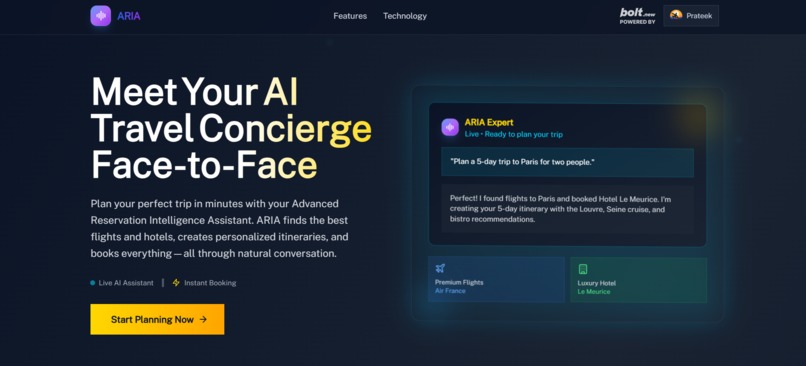
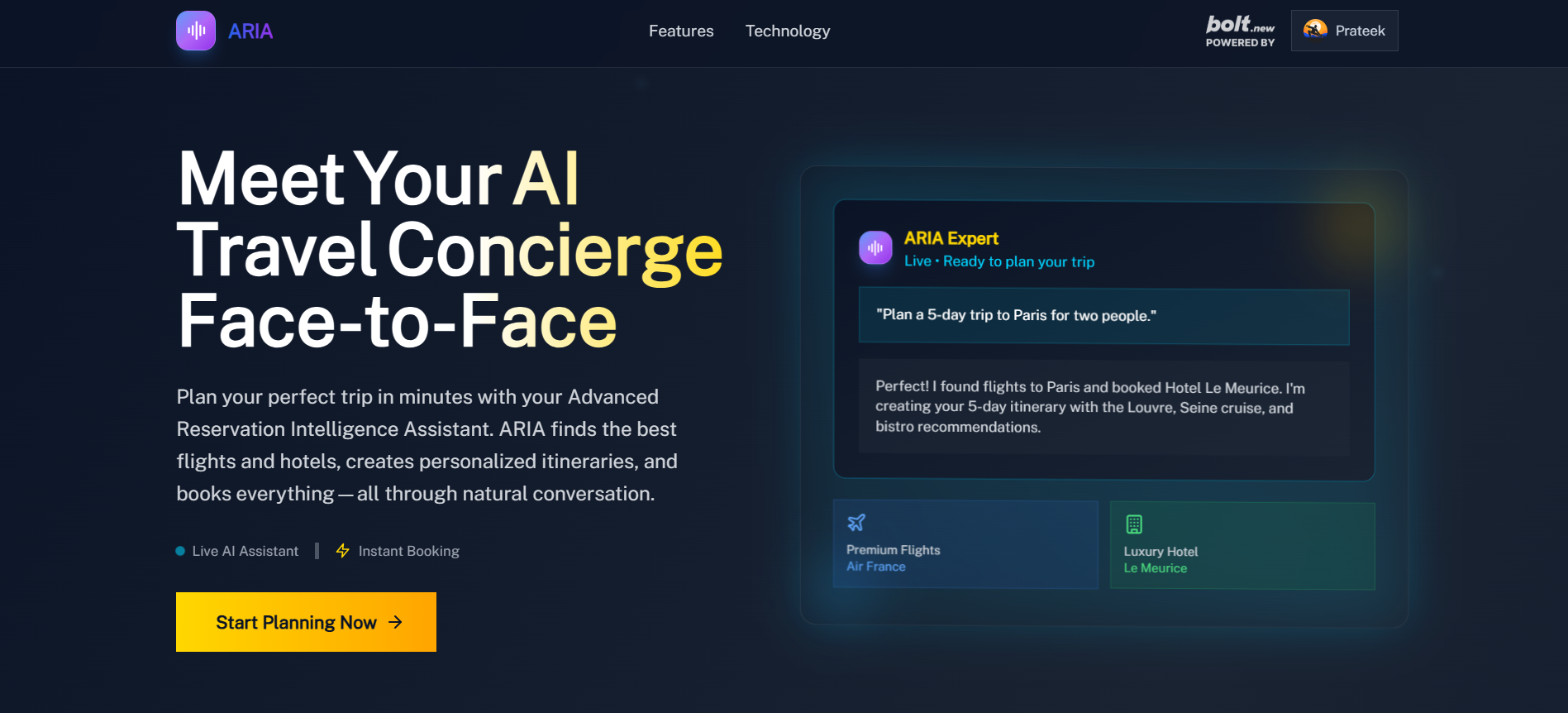
ARIA - Landing page
-
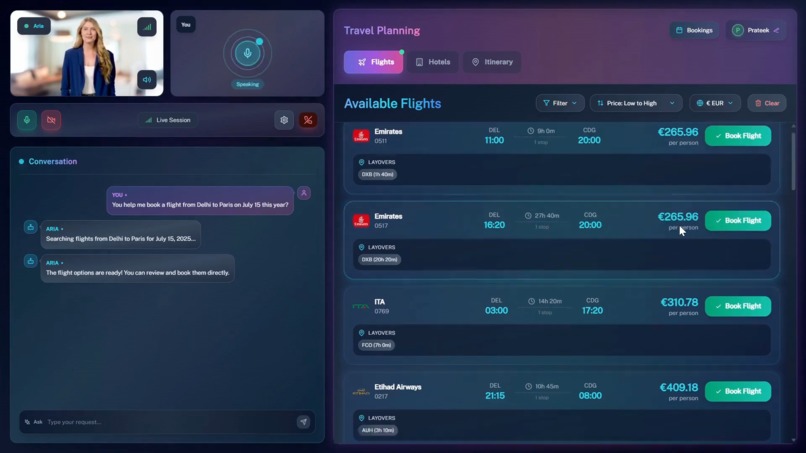
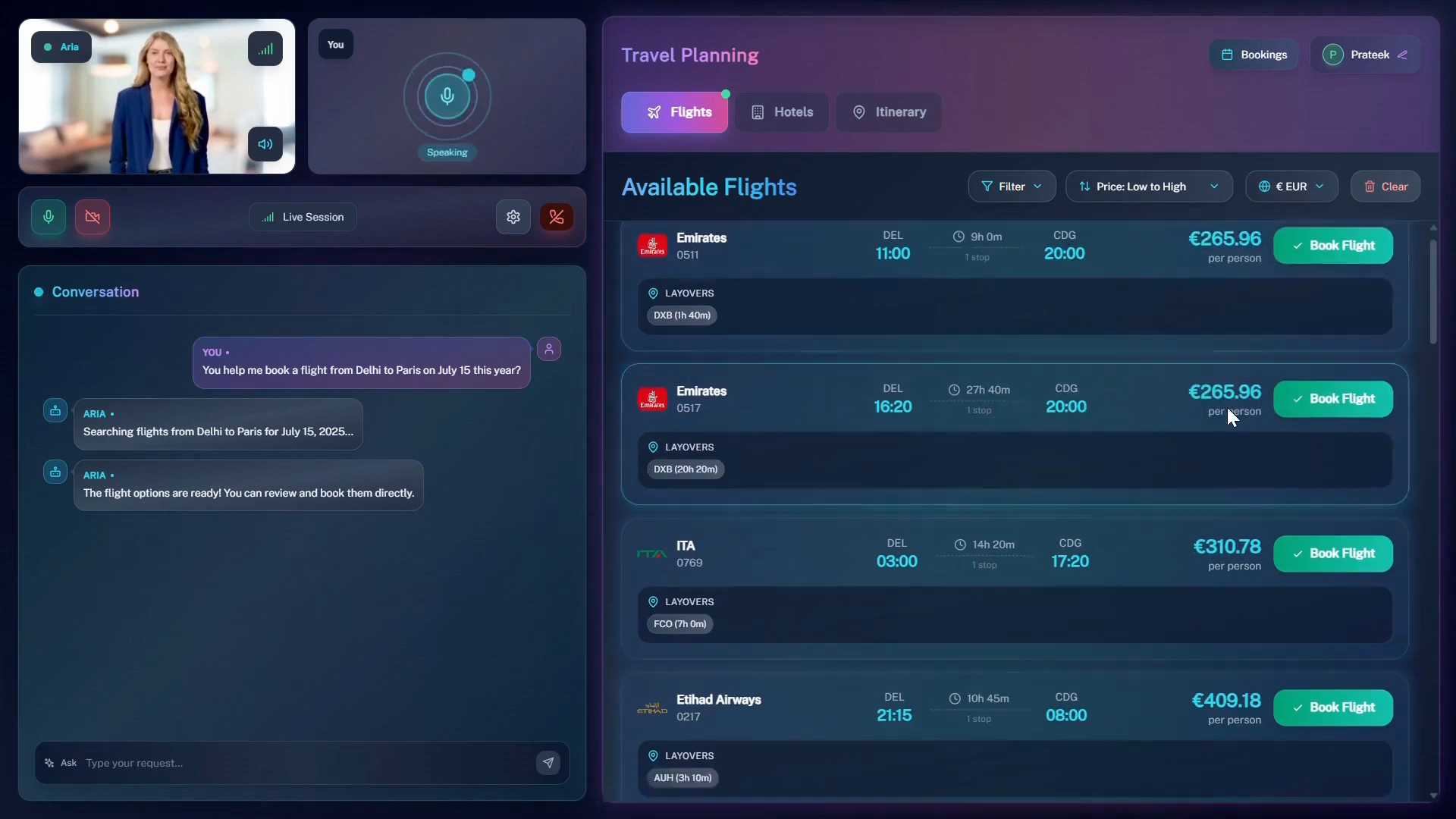
Flight search flow
-
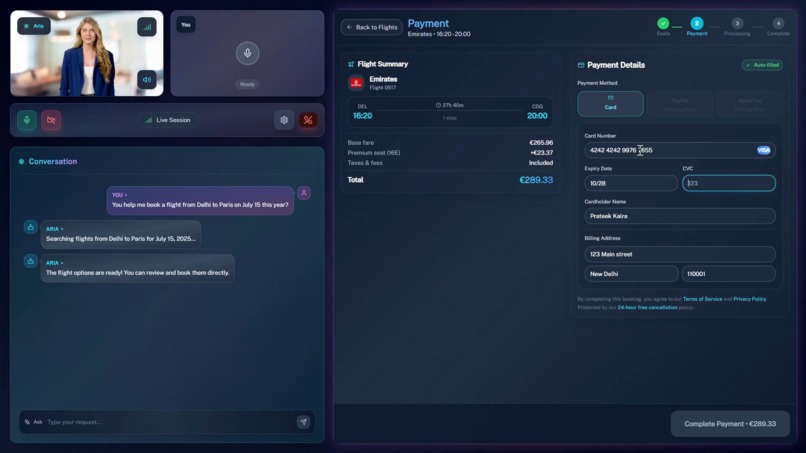
Flight booking flow
-
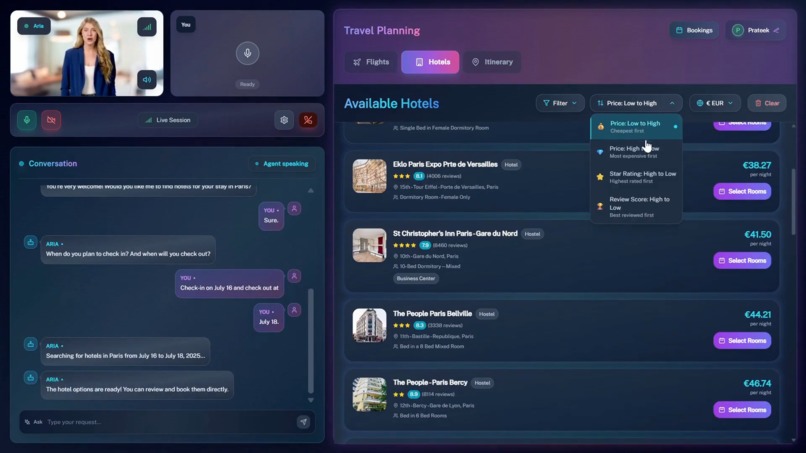
Hotel search flow
-
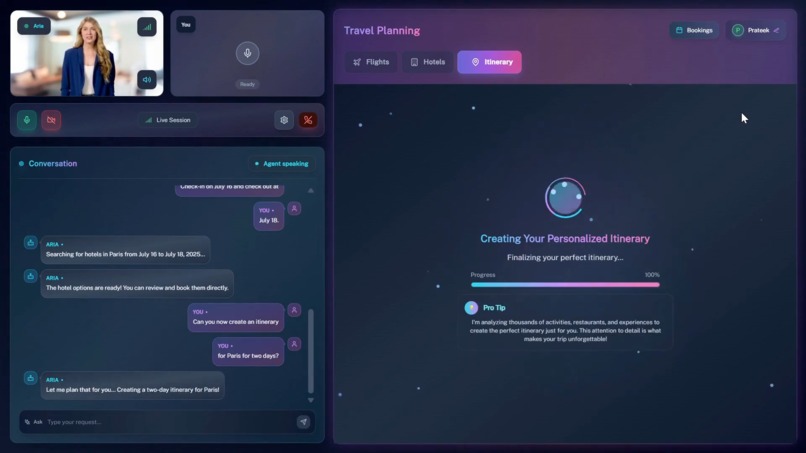
Personalized itinerary creation
-
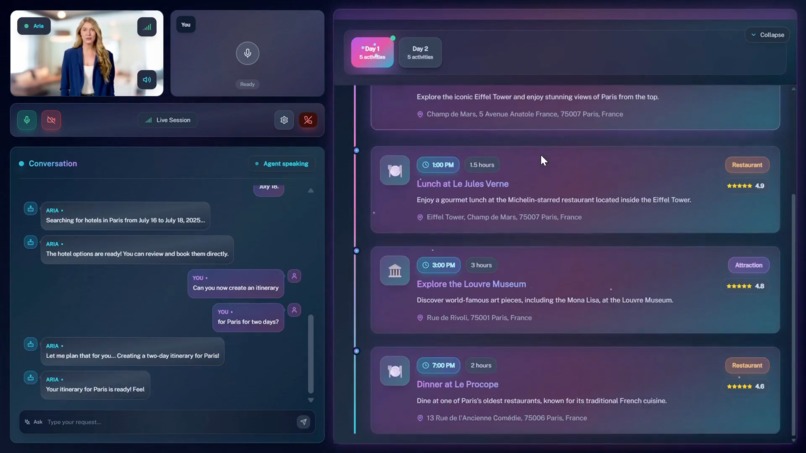
Personalized itinerary flow
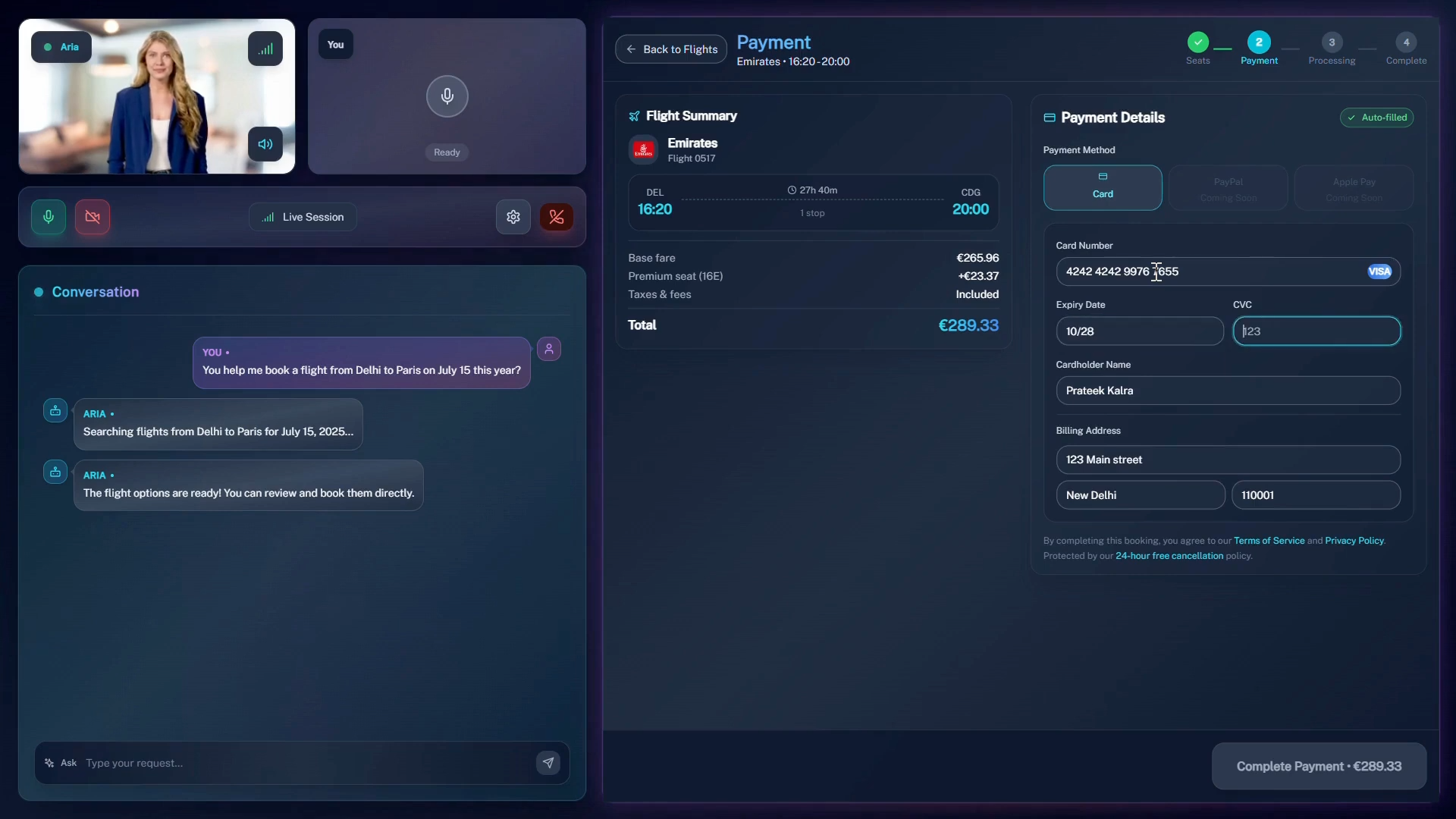
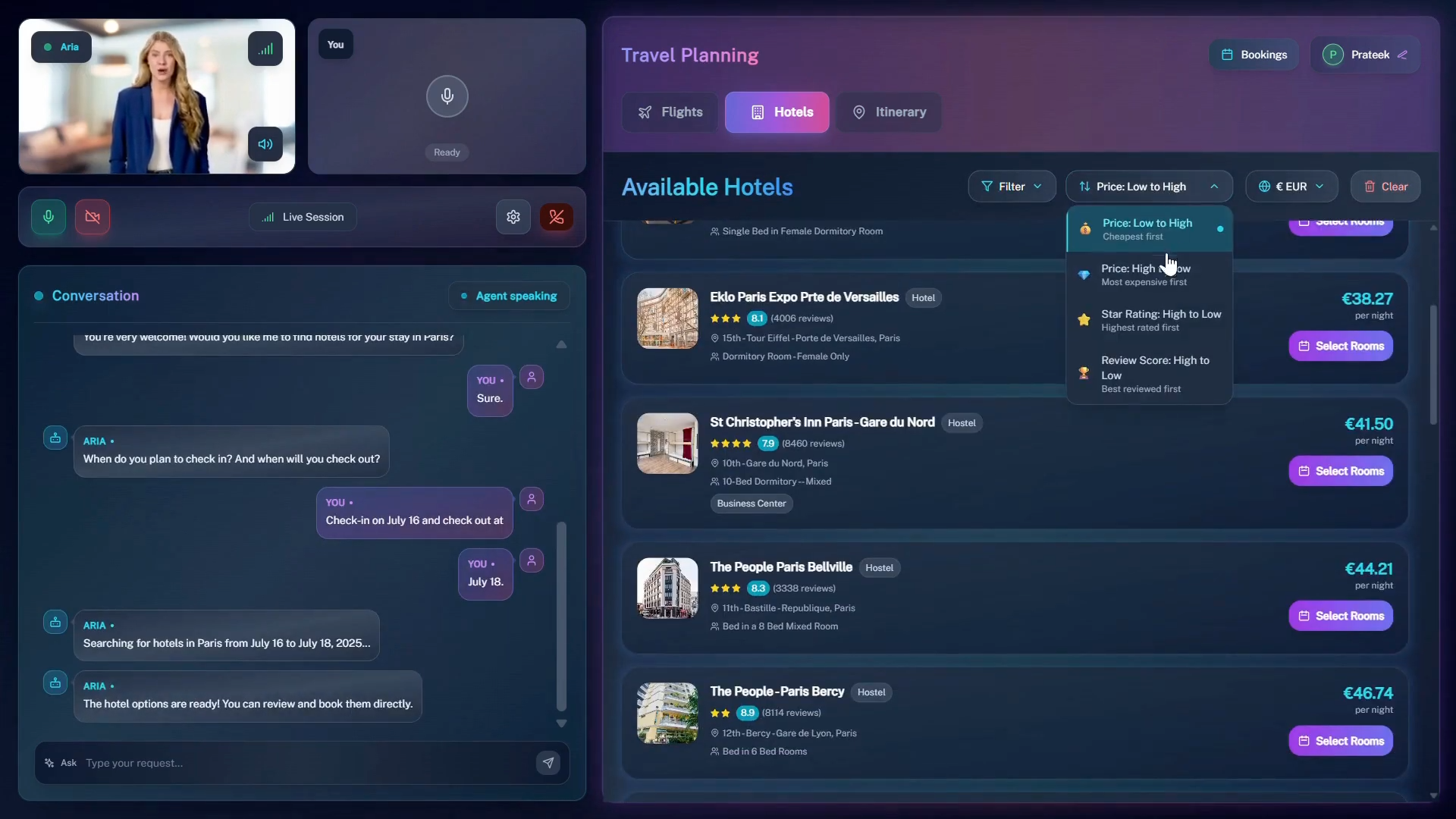
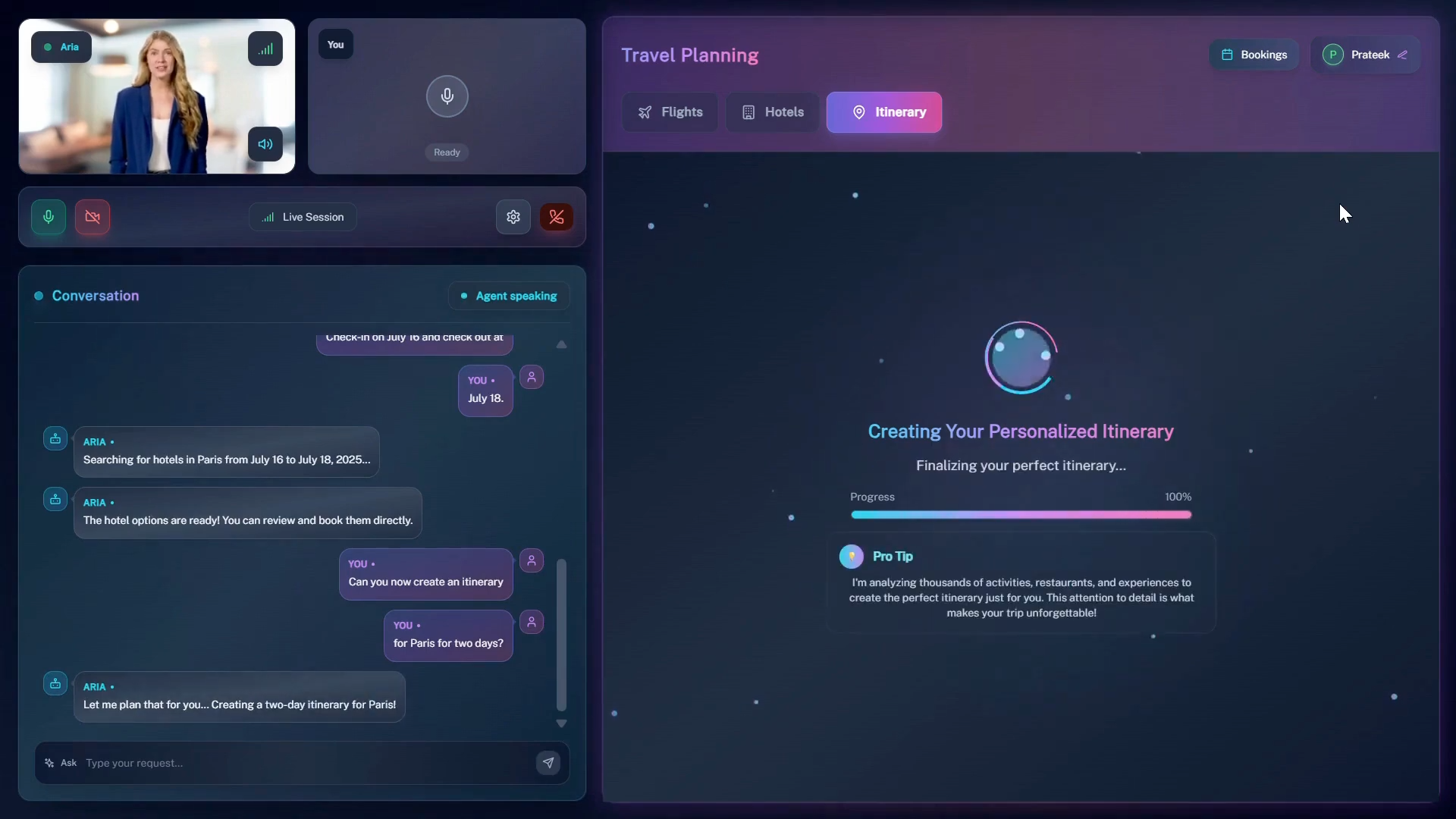
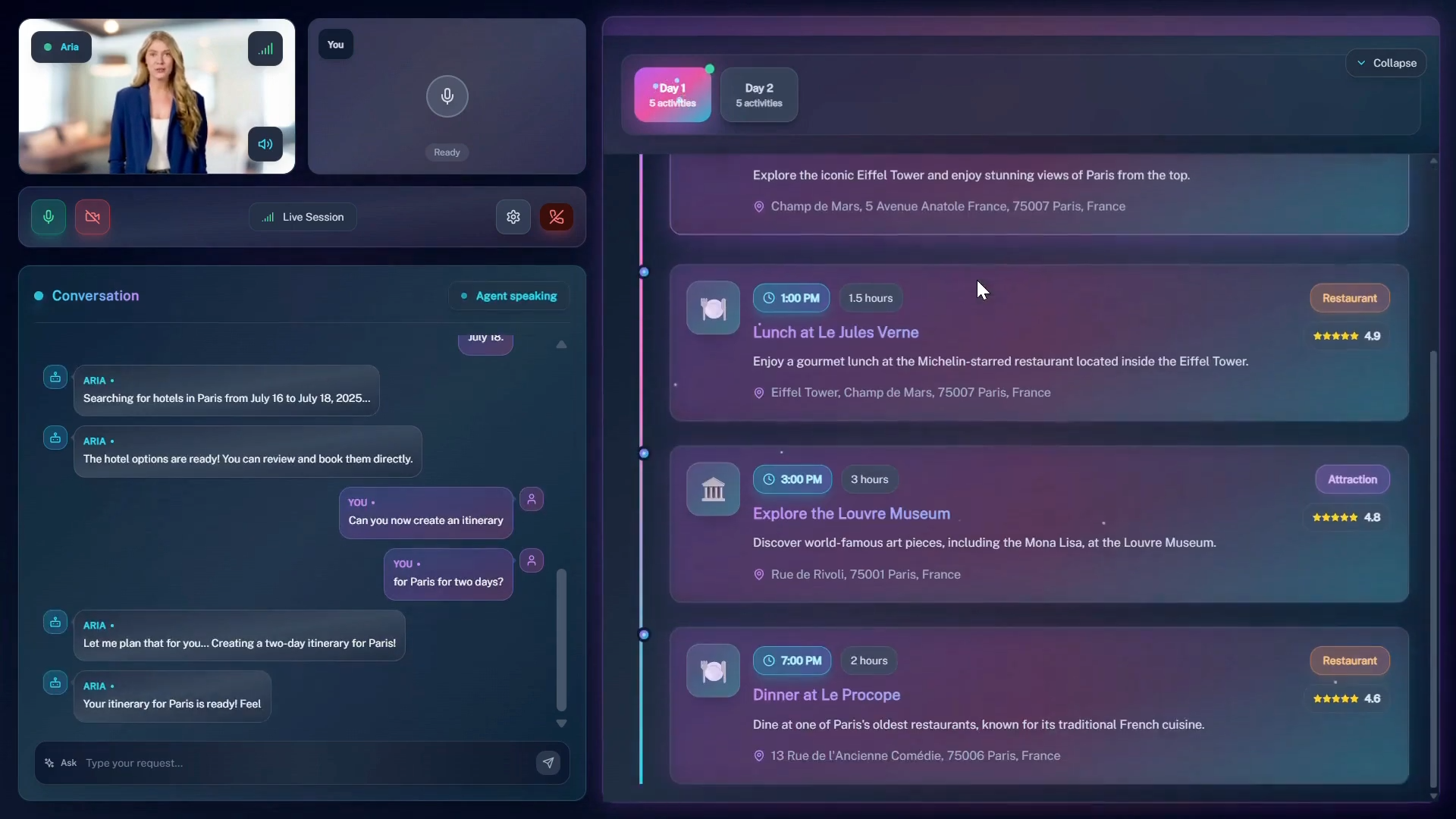
ARIA - Advanced Reservation Intelligence Assistant
The world's first AI-powered travel concierge with real-time video consultation
Inspiration
You know that feeling when you're planning a trip and suddenly it's 2 AM, you have 50+ tabs open, and you're no closer to actually booking anything? That was me three months ago, trying to plan a weekend in Tokyo.
I'm sitting there with flights in one tab, hotels in another, restaurant reviews scattered across five more tabs, and I'm starting to lose my mind. Nothing connects. I don't know if my hotel is actually near anything interesting. I can't tell if my flight times make sense with check-in. And don't even get me started on figuring out what to actually do when I get there.
That's when it hit me: we're living in 2025, but travel planning still feels like I'm assembling furniture without instructions. All the pieces are there, but good luck making them fit together.
So I thought, what if I could just talk to someone who actually knows travel inside and out? Someone who could see all the options, understand what I really want (even when I don't say it perfectly), and just... handle it? Not some frustrating chatbot, but a real conversation with someone who gets it.
That's how ARIA was born. Built for the Bolt.new Hackathon, this project represents my attempt to solve one of the most universally frustrating experiences in modern life.
What it does
ARIA turns the nightmare of travel planning into a 15-minute conversation with an AI travel expert who appears on your screen and talks with you like a real person.
Here's what actually happens when you use it:
You just talk normally: "I want to go somewhere in Japan next month, maybe somewhere a bit cultural but not crazy touristy, and I hate early morning flights"
ARIA actually listens: She's powered by GPT-4o, so she gets the context and even picks up on the stuff you don't say directly
Real options show up instantly: Flight cards from hundreds of airlines appear on your screen, filtered exactly how you'd want them
Hotels that actually make sense: Instead of random properties, you see places that fit your style, budget, and work with the flights you're looking at
A real itinerary comes together: Day-by-day plans with local spots that aren't just tourist traps, realistic timing, and photos that actually make you excited
Book everything without the tab-juggling: Secure payments built right into the conversation
The crazy part? This all happens while you're talking face-to-face with an AI avatar who maintains eye contact, shows real expressions, and feels genuinely human. It's like having a travel agent who happens to have access to every flight and hotel in the world.
How we built it
Building ARIA felt like trying to conduct an orchestra where every musician speaks a different language. Getting all these technologies to work together seamlessly was... intense.
The Game-Changer: Bolt.new
This entire project was built using Bolt.new. Instead of spending months writing boilerplate code and wrestling with setup configurations, I could describe what I wanted ARIA to do and watch Bolt.new generate the foundational structure. It's like having a senior developer who never gets tired, never makes syntax errors, and can instantly scaffold complex applications. Bolt.new handled the heavy lifting of code generation, allowing me to focus on the creative problem-solving and integration challenges that make ARIA special. This project simply wouldn't have been possible in the timeframe without Bolt.new's AI-powered development capabilities.
The AI Brain 🧠
Azure OpenAI GPT-4o is ARIA's conversational intelligence. I spent days crafting prompts that make her think like someone who's planned thousands of trips, remembers your preferences throughout the conversation, and makes suggestions that actually make sense for real humans.
Making Her Feel Real 🎭
- ElevenLabs powers ARIA's incredibly natural voice generation - their AI audio platform delivers realistic speech with emotional nuance that makes conversations feel genuinely human rather than robotic
- Tavus AI enables the real-time video avatar experience with their conversational video interface technology that creates lifelike avatars capable of live video interaction, proper lip-sync, and natural expressions
- Deepgram for speech-to-text that actually works in real conversations
- Silero VAD to detect when you're speaking so conversations flow naturally
The Real-time Magic 📡
LiveKit handles all the complex real-time stuff:
- WebRTC for crystal-clear video and audio
- Custom RPC methods so the UI updates instantly when ARIA finds something
- Session management that actually works
- Low enough latency that conversations feel natural
The Booking Engine ⚡
This is where ARIA goes from impressive demo to actually useful:
- Duffel API: Live access to 500+ airlines with real pricing and availability
- Agoda RapidAPI: Over a million hotels with real-time booking capability
- Duffel Components: Secure payment processing that actually works
- Custom API coordination that presents options intelligently instead of just dumping data
The Frontend ✨
Next.js 14 + TypeScript with:
- Framer Motion for animations that respond to conversation state
- Dynamic UI updates that happen based on what ARIA is saying
- Tailwind CSS for a design that feels trustworthy, not sketchy
- Real-time synchronization so everything stays in sync
Backend Coordination 🎪
Python + Flask + LiveKit Agents:
- Multi-threaded server handling multiple AI conversations
- Async functions for searching flights, hotels, and building itineraries
- Error handling that actually handles errors gracefully
- Production-ready setup with Waitress
Challenges we ran into
The Uncanny Valley Problem Early versions of ARIA looked perfect but felt... off. Turns out, making AI feel human isn't about perfect lip-sync - it's about conversation design. I spent forever tweaking ARIA's personality, how she responds, even her facial expressions to feel naturally helpful instead of weirdly perfect.
Everything Needs to Happen in Real-Time Coordinating live video, speech recognition, AI responses, API calls, and UI updates while keeping conversation flowing smoothly is borderline impossible. I built a complex state management system that choreographs every interaction so it feels seamless instead of chaotic.
APIs That Don't Play Nice Each travel API has its own personality. Duffel wants specific city codes, Agoda has complicated location matching, and they return data in completely different formats. I built robust translation layers that make it all work together invisibly.
Murphy's Law of Development If something could break at the worst possible moment, it did. Azure would hit rate limits during demos, LiveKit would disconnect during important calls, and the AI would generate broken JSON exactly when I needed it to work. I learned to build backup plans for my backup plans.
Making UI Updates Feel Natural Creating interface elements in real-time based on AI conversation is technically complex. The UI needs to update smoothly, handle loading states gracefully, and present information in the right order. I built a custom system that syncs conversation state with visual updates.
Accomplishments that we're proud of
Technical achievement: Successfully getting 8+ complex APIs to work together seamlessly. The real-time coordination alone took weeks to get right.
Solving the conversation + interface problem: ARIA doesn't just talk - she actively updates what you see based on your conversation, creating something that feels genuinely multimodal.
Performance under pressure: The system handles real-time video, AI processing, and API calls while maintaining response times that feel natural.
Production-ready from day one: Proper authentication, error handling, and scalable architecture built in from the start.
What we learned
AI is only as good as everything around it: Having GPT-4o means nothing if the user experience is clunky. The magic happens when the technology disappears and people focus on their trip, not the interface.
Real-time is a completely different challenge: Building responsive web apps is one thing. Building AI systems that process speech, generate responses, call APIs, and update interfaces in real-time taught me entirely new ways of thinking about architecture.
Everything needs to stay synchronized: When conversation state, UI state, and API data all need to stay perfectly in sync, you quickly learn that timing issues can destroy the entire experience.
APIs lie (or at least omit the truth): Every external service has quirks and undocumented behavior. Building robust error handling isn't optional - it's survival.
Trust is built in milliseconds: When someone is talking to an AI about spending thousands on travel, every single interaction either builds or destroys trust. I learned to obsess over micro-interactions and response timing.
Quality matters more than impressive features: I focused on building something that works reliably, not just something that looks cool in demos.
What's next for ARIA - Advanced Reservation Intelligence Assistant
Mobile Experience: Native apps optimized for voice interaction and location-aware recommendations
Smarter Personalization: Learning from conversations to provide better suggestions over time
Group Travel: Better coordination for planning trips with multiple people
Business Integration: Corporate travel management and expense tracking
The bigger vision is expanding conversational commerce beyond travel - this is just the beginning of how we'll interact with complex systems through natural conversation.
Built With
- elevenlabs
- fastapi
- livekit
- python
- react
- tavus
- typescript


Log in or sign up for Devpost to join the conversation.