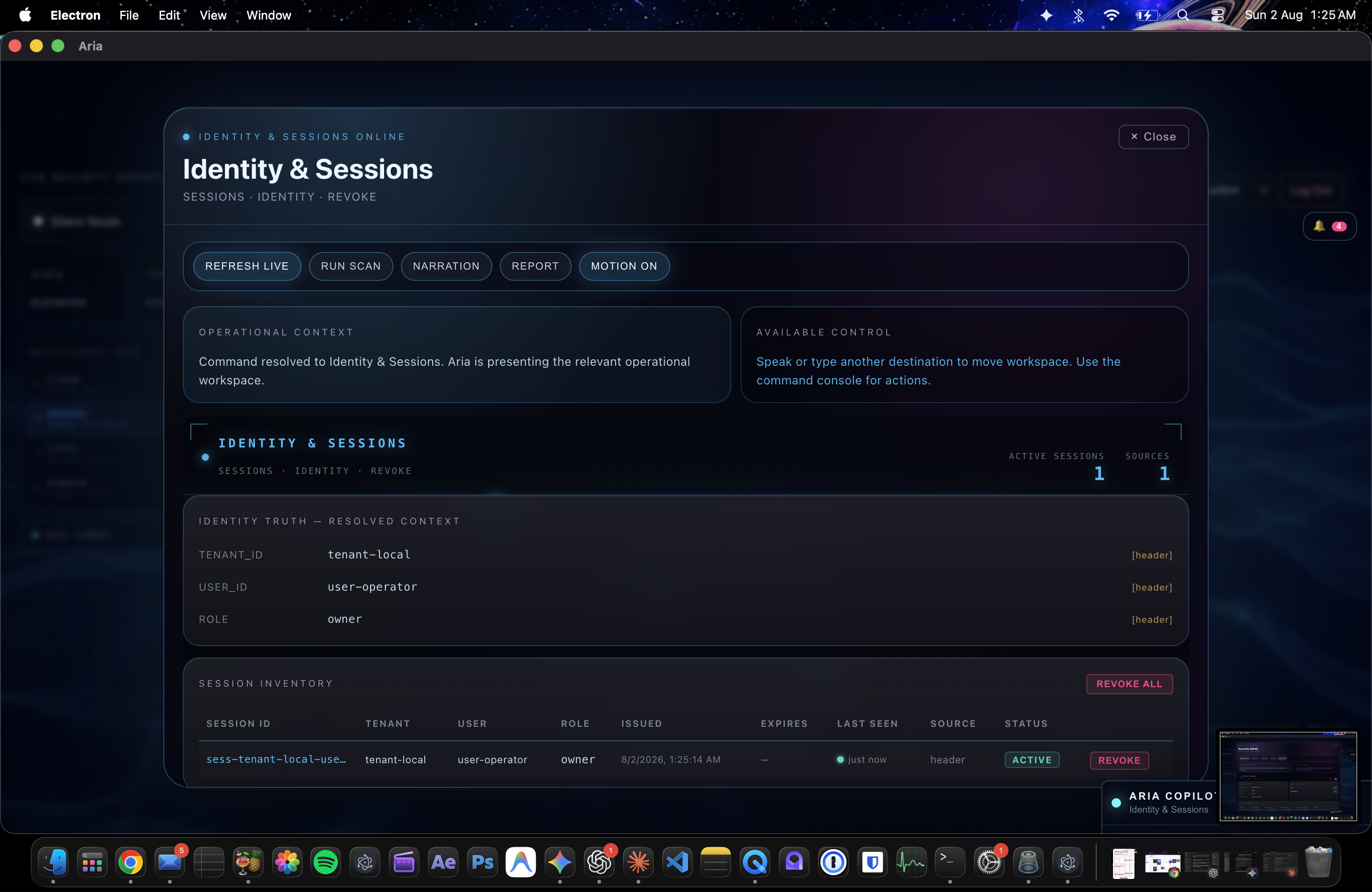
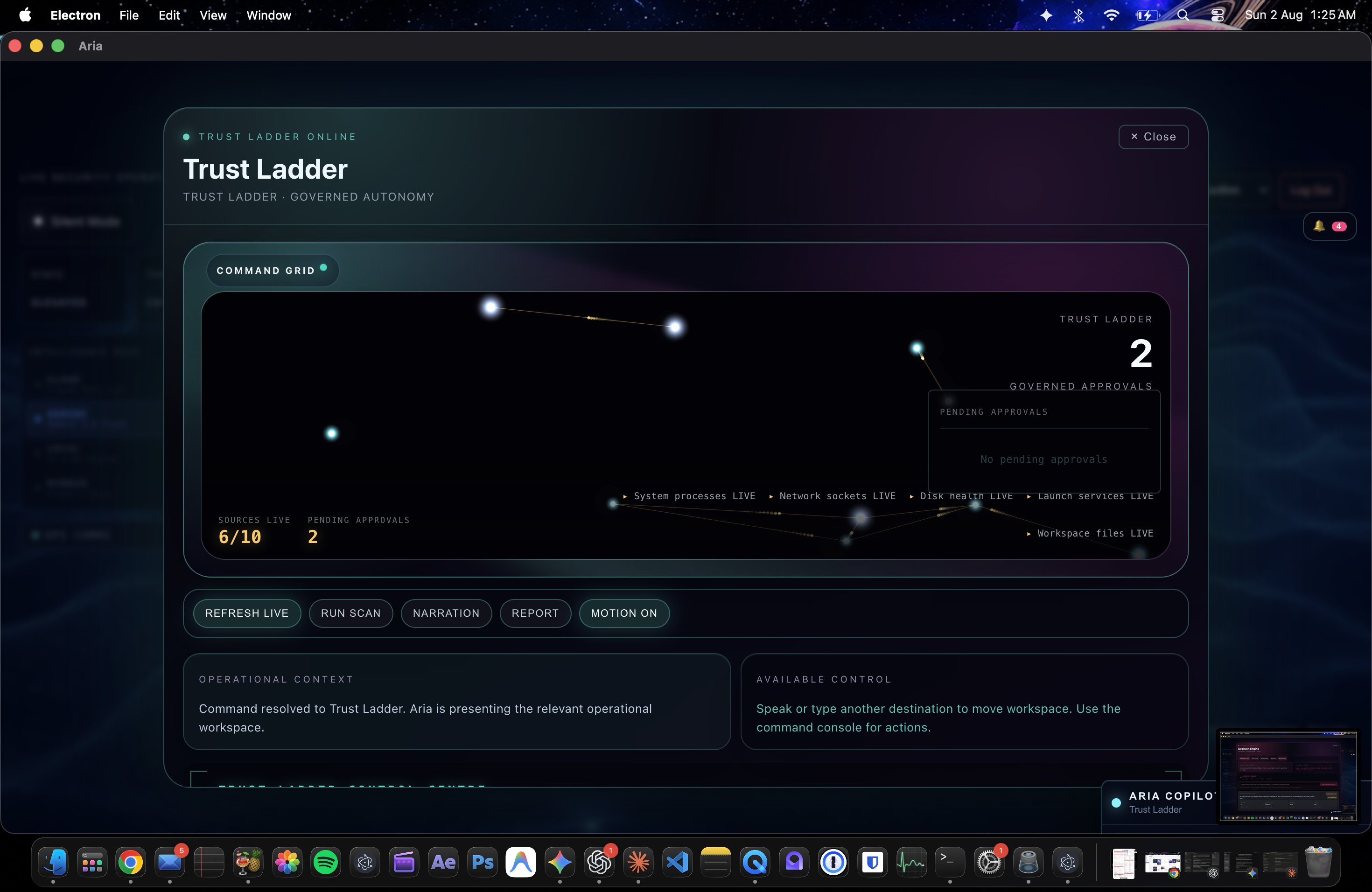
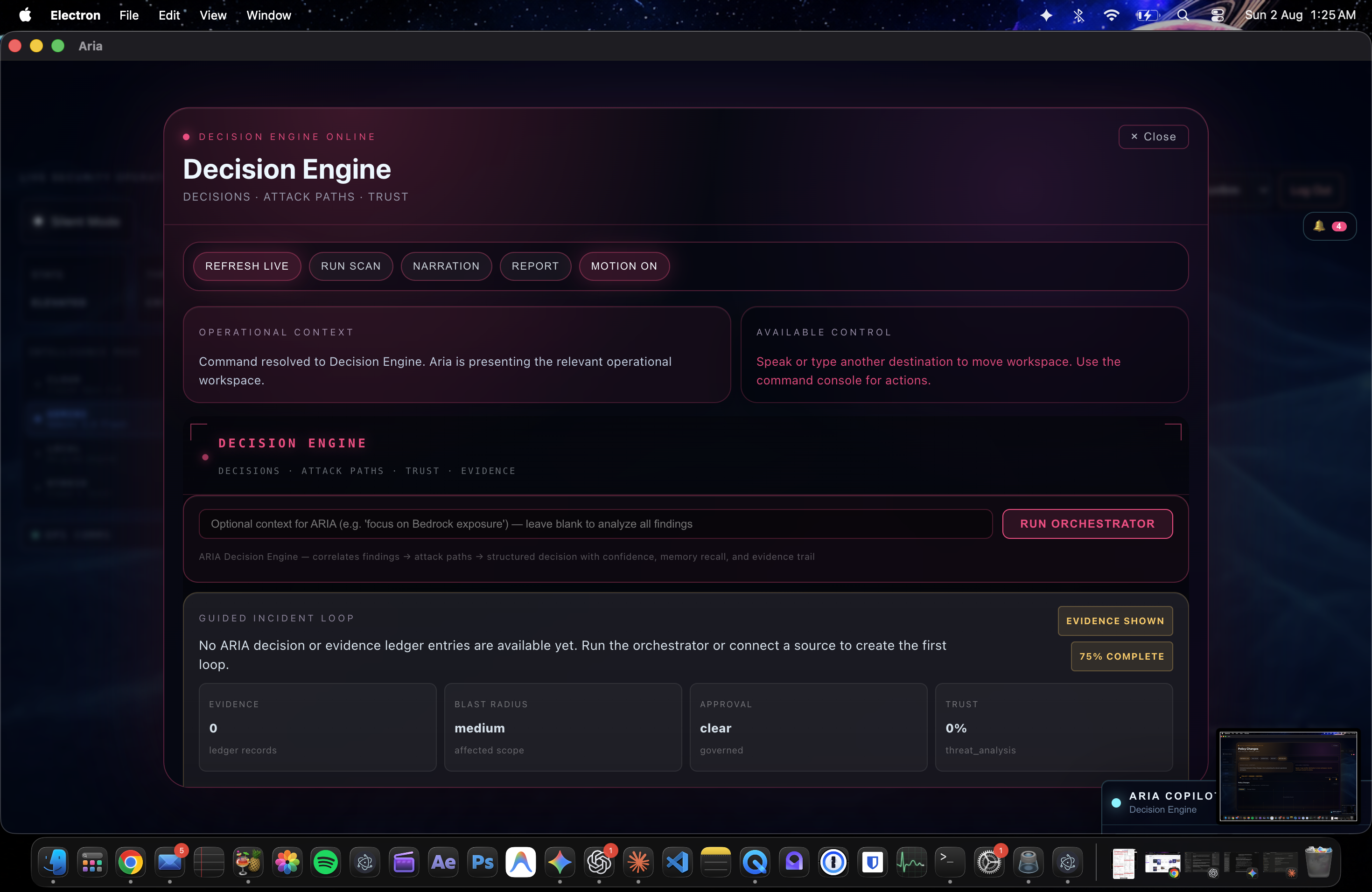
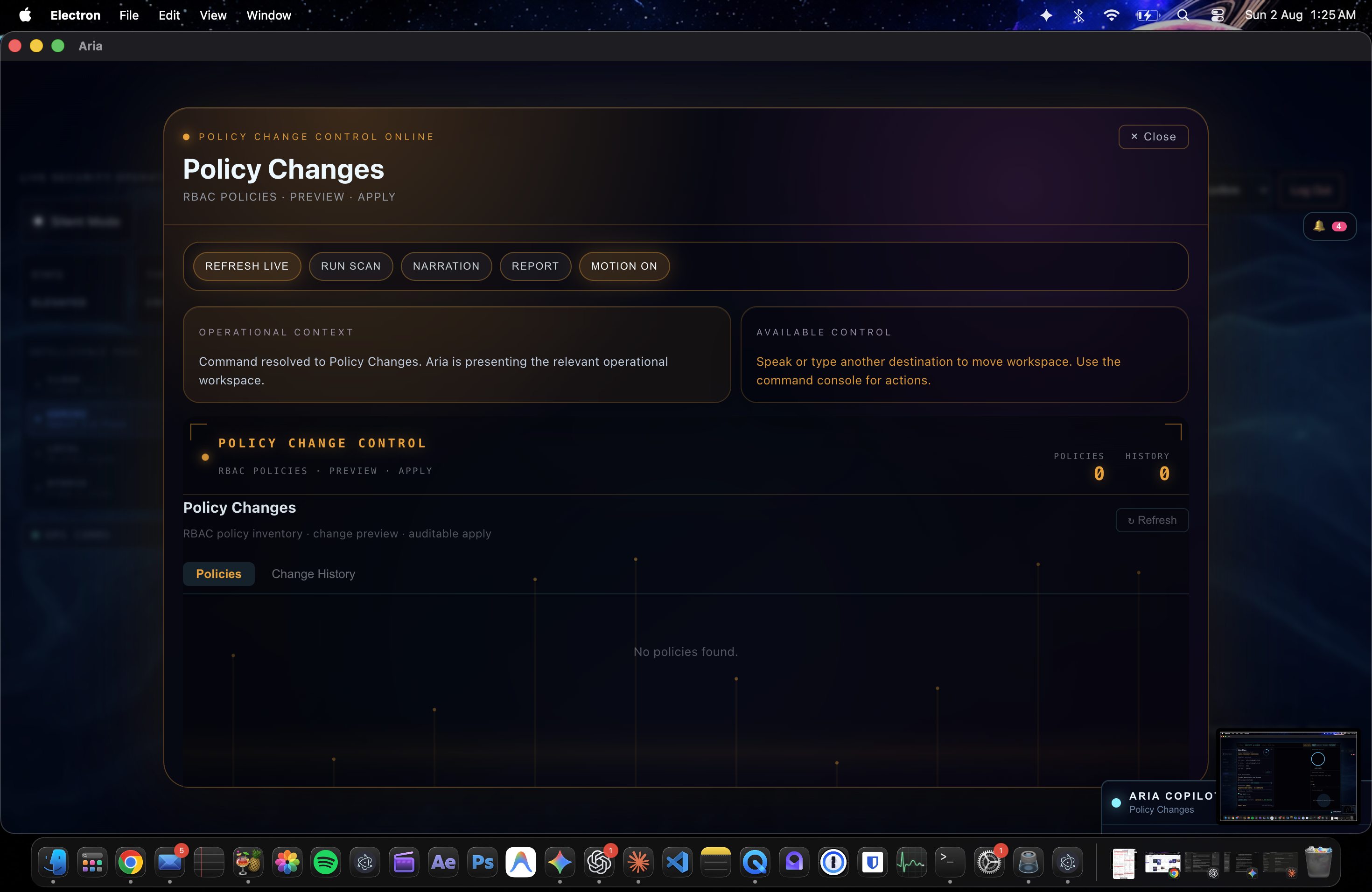
What this is
Most AI security tools act and then ask you to trust them. ARIA inverts that: every autonomous capability has to earn its authority through measured outcomes, and you can see and bound exactly how far it is allowed to go.
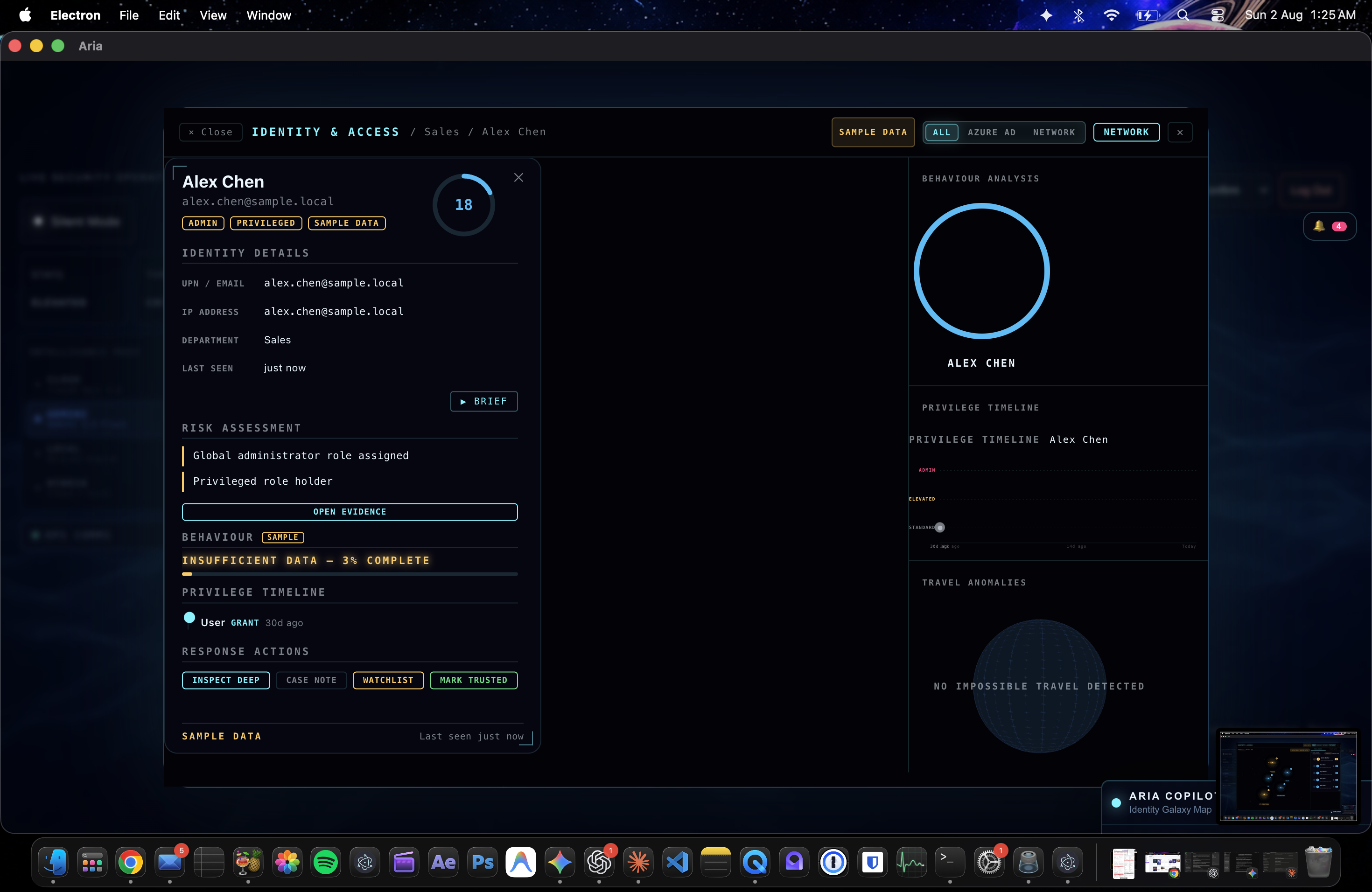
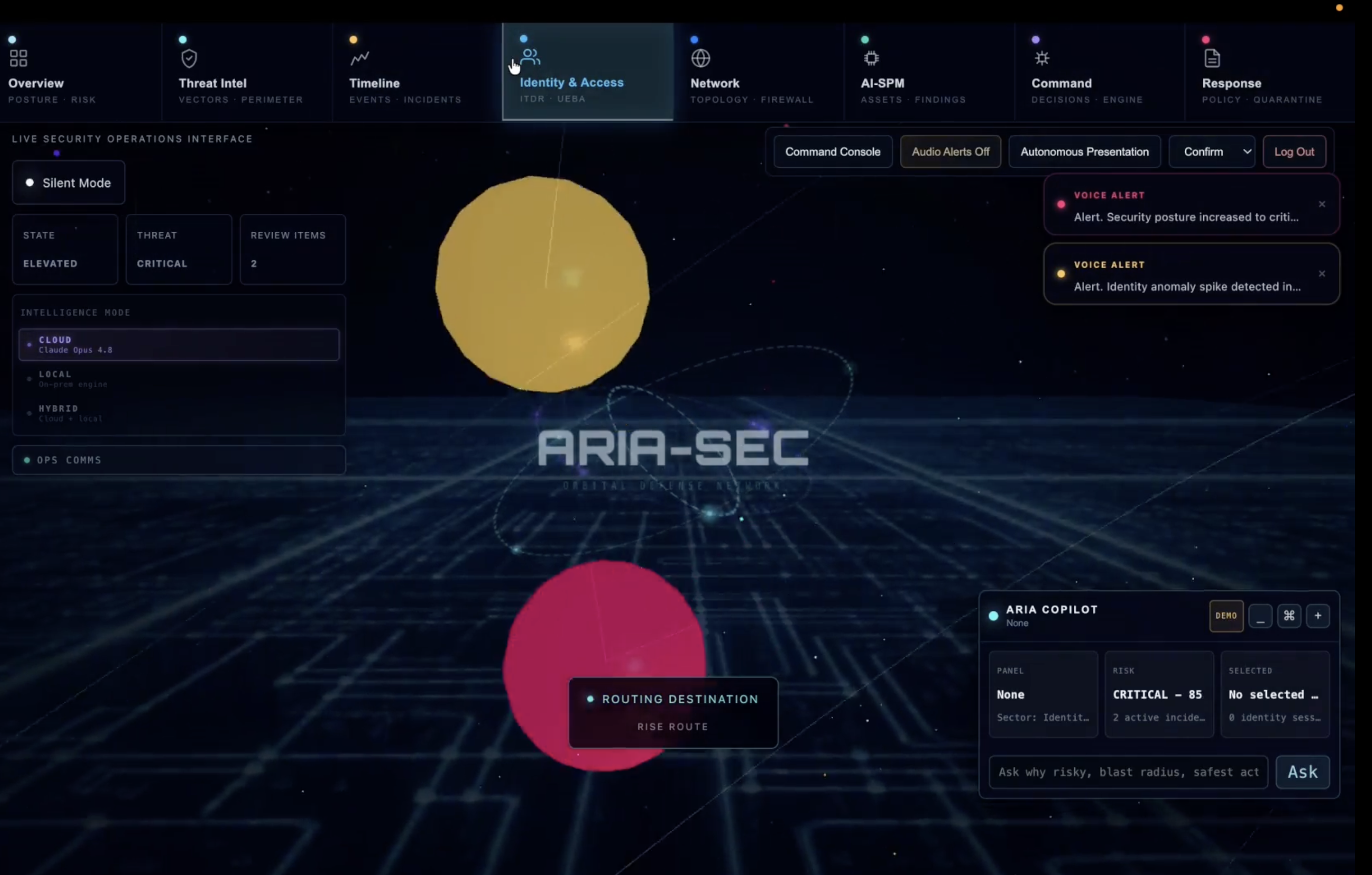
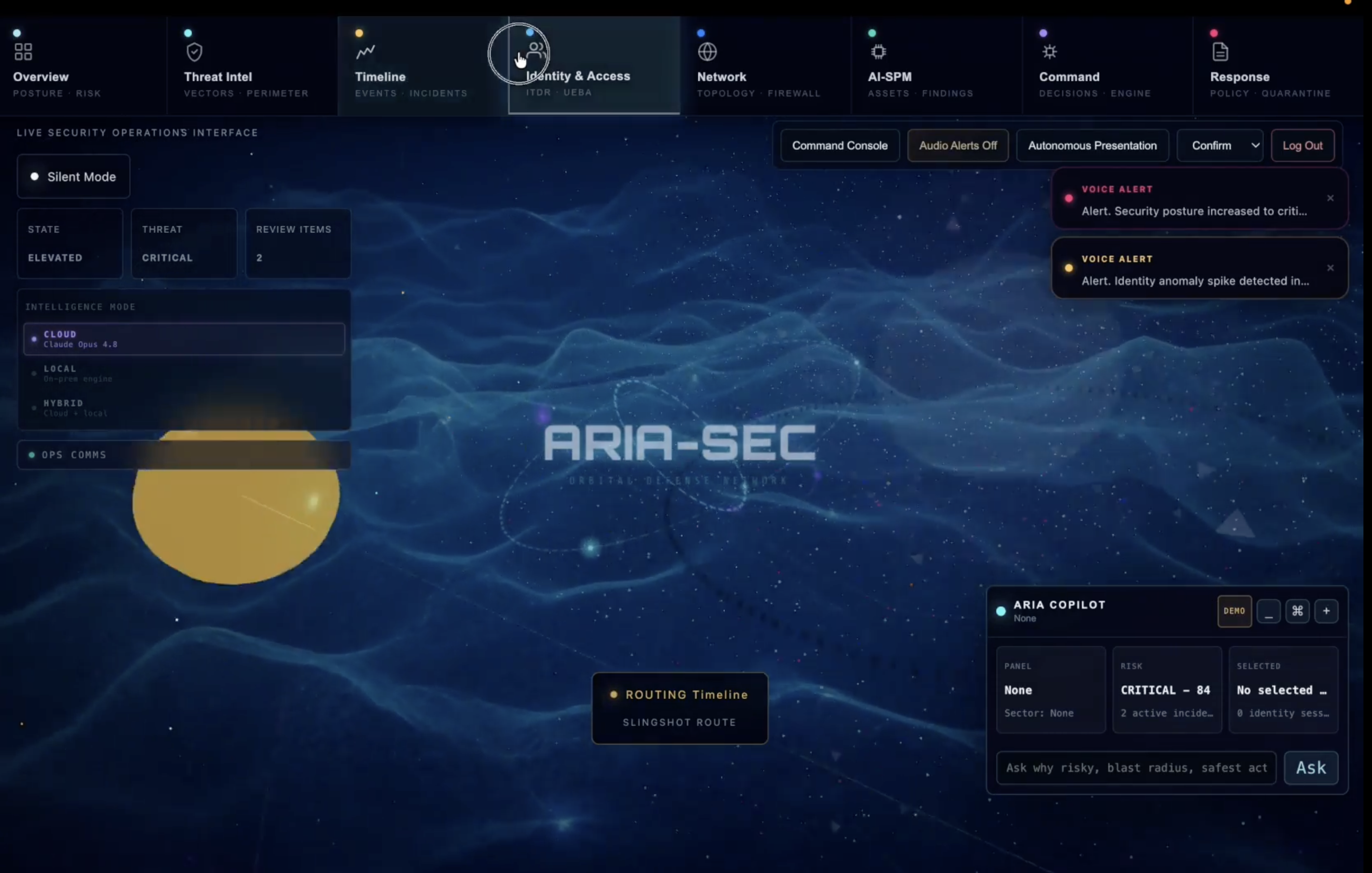
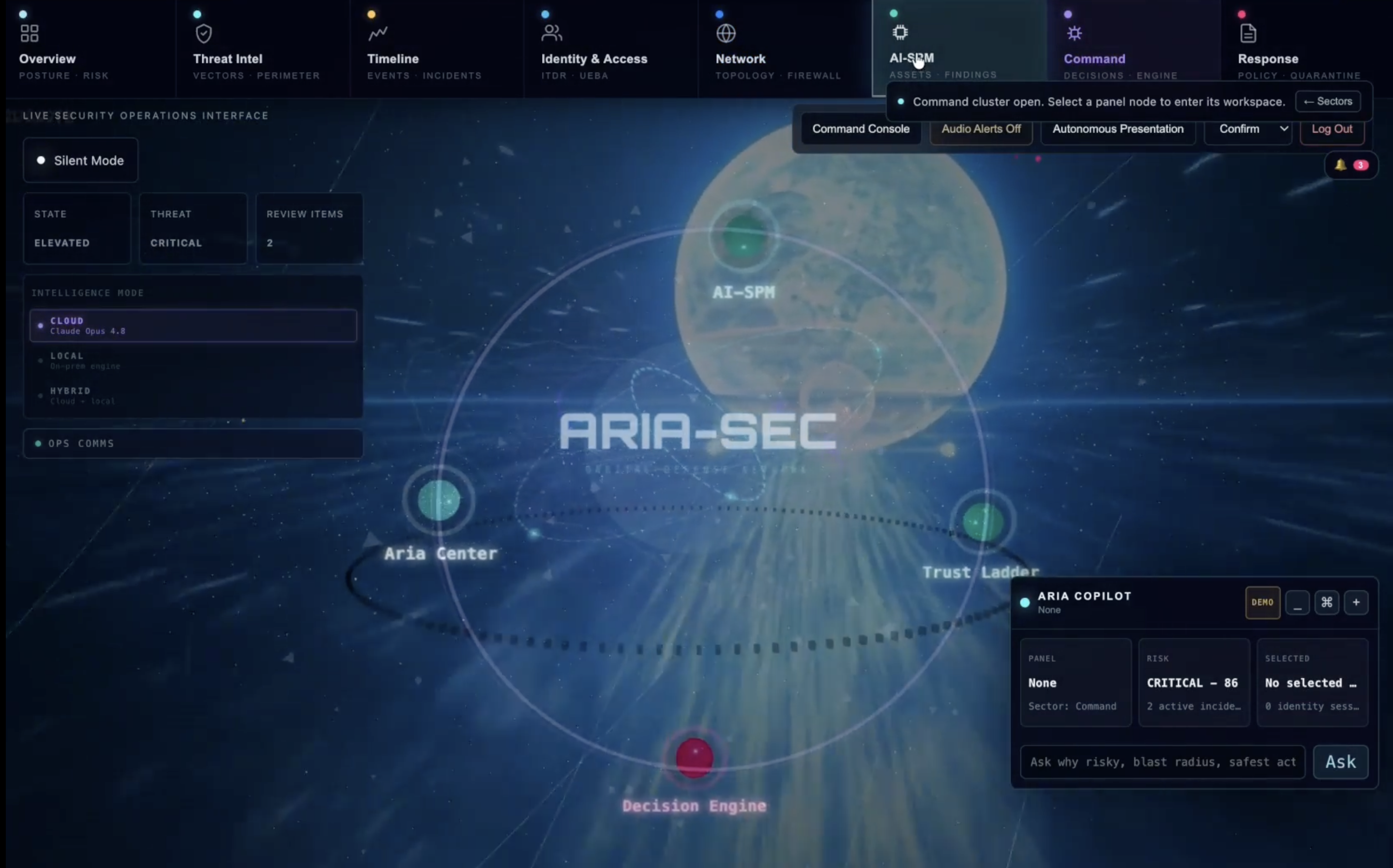
It is a single-operator SOC cockpit you talk to. The entire feature set is a navigable 3D galaxy rather than a sidebar of menus. It ingests telemetry from your cloud, identity, code, and network surfaces, explains what matters in plain language, and proposes bounded actions that are gated by policy and written to an audit trail.
Honest status: ARIA is a working platform under active solo development, not a hardened commercial product. It is genuinely functional - real connectors, real local network and BLE discovery, real audit trails, a real local-model path - but parts of it are demo-grade and labelled as such throughout this README and in the product itself. Nothing here is presented as more finished than it is.
→ ROADMAP_AND_LIMITATIONS.md is the full engineering audit, published unedited: module-by-module status with file paths and line numbers, naming exactly which subsystems are production-grade and which are simulated. If it disagrees with this README, believe it instead. A shorter summary is in Maturity & what is not done below.
Current verified baseline
The 15 August public release includes the engineering hardening completed after the original audit:
- 48 isolated test files passing in CI, with ESLint and the production build clean.
- A deliberately wrong recommendation can be rejected with a written reason and correlated across the decision, evidence, audit, memory and Trust Ladder records.
- Action results distinguish observed, staged and externally enforced outcomes, with post-action verification rather than optimistic success reporting.
- Tenant or decision-scoped audit evidence packs include a canonical SHA-256 digest and optional HMAC-SHA256 signature.
- Autonomous-response windows survive restart through a bounded replay log, and file-backed state has verified backup and safe restore tooling.
- The realtime narration path uses an eight-second reasoning ceiling and ElevenLabs Flash streaming. Measured development-machine timings are recorded in the report.
- GitHub Actions validates lint, all tests, the production frontend and the Docker image. It contains no deployment step.
The full evidence and remaining external pilot checks are in the technical capability and design report.
✨ Core features
🌌 Spatial Galaxy Command Interface
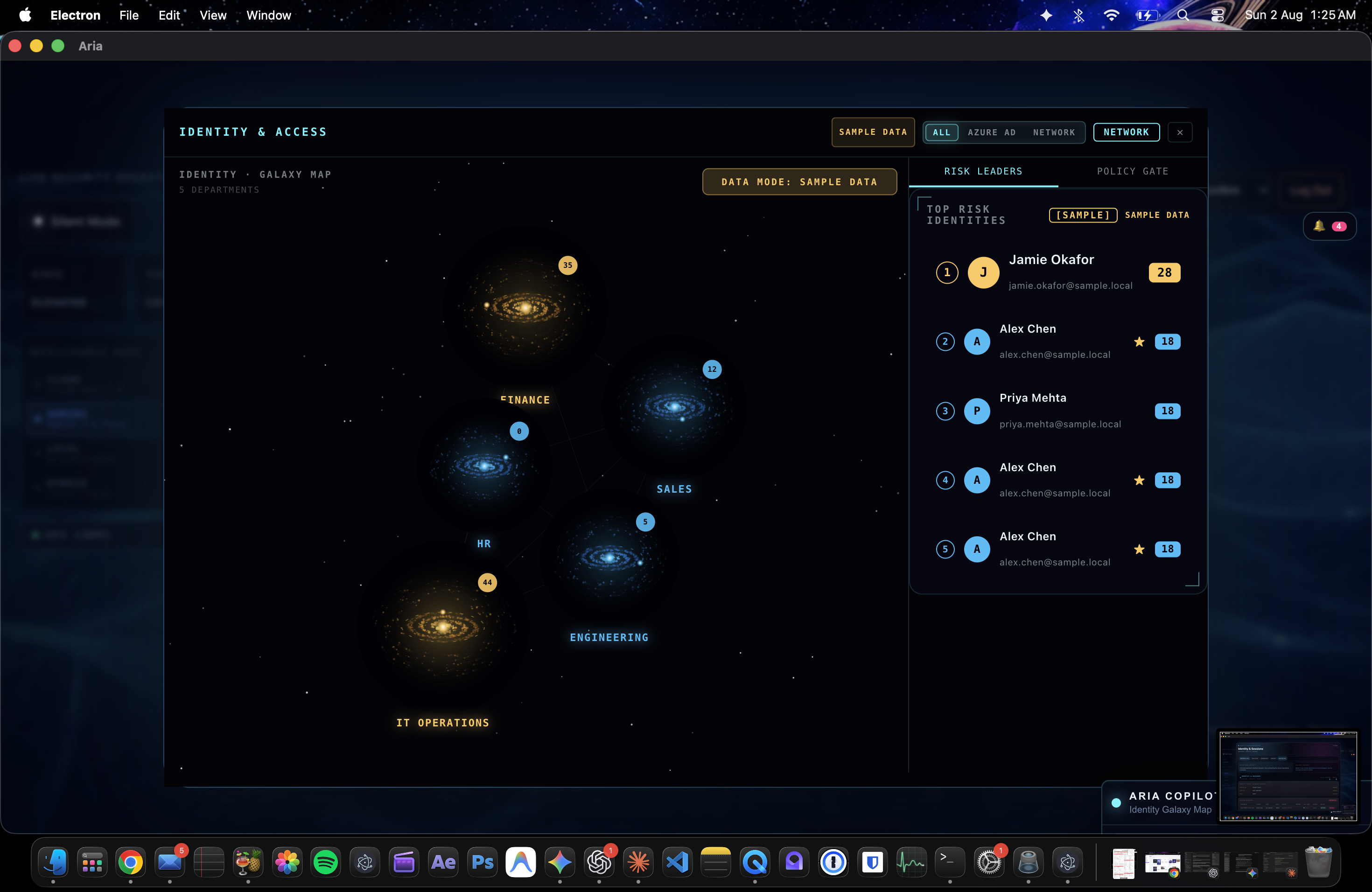
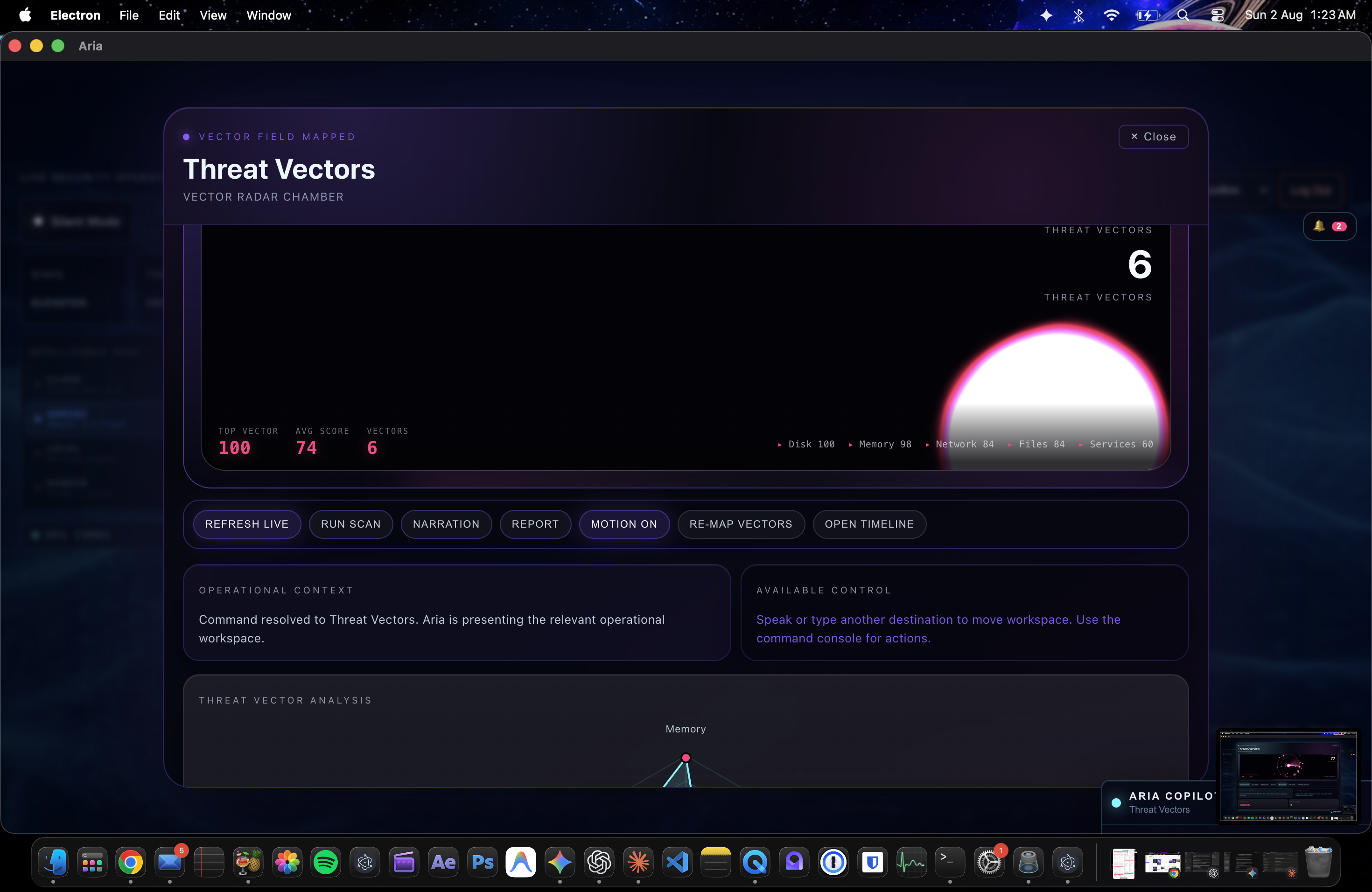
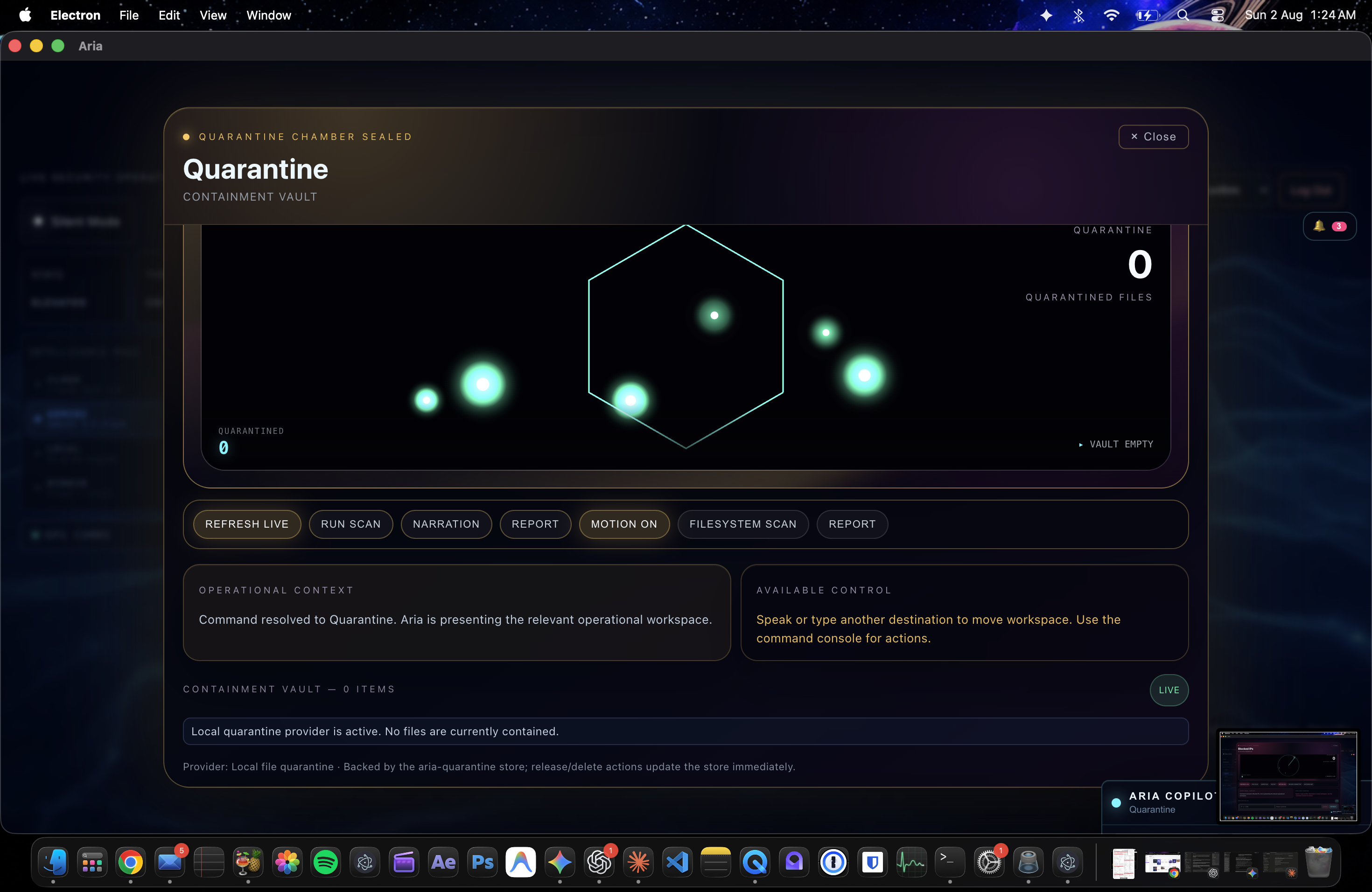
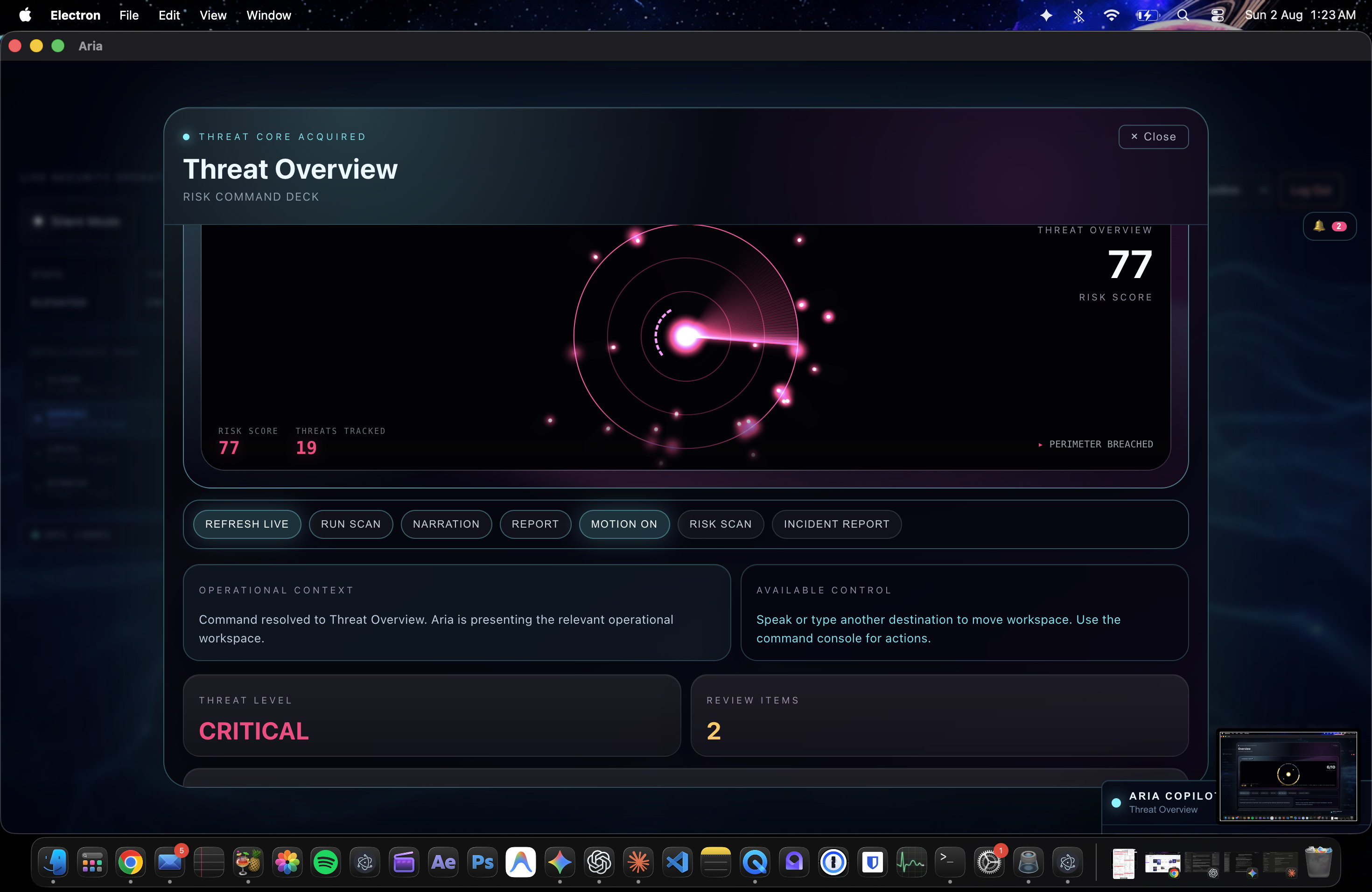
The whole platform is a Three.js/WebGL galaxy. Sectors are capability domains; nodes are individual panels. A three-tier colour system (blue nominal → amber threat → red critical) propagates live from scan and telemetry state, so posture is legible from across the room.
Four interchangeable ways to navigate: click a node, speak a destination, type a command, or let ARIA route you automatically when a critical event fires.
⚖️ Governed Autonomy & the Trust Ladder
The core idea, and the reason the rest exists. Autonomy is not a global on/off switch - it is per-capability and earned.
Four capabilities (threat_analysis, remediation, containment,
identity_actions) each sit independently on a four-rung ladder:
| Rung | Mode | Behaviour |
|---|---|---|
| 1 | approval |
ARIA proposes; a human approves every action |
| 2 | assisted |
ARIA acts on low-risk items, escalates the rest |
| 3 | auto |
ARIA acts autonomously except on critical-risk actions |
| 4 | full_auto |
ARIA acts, and reports |
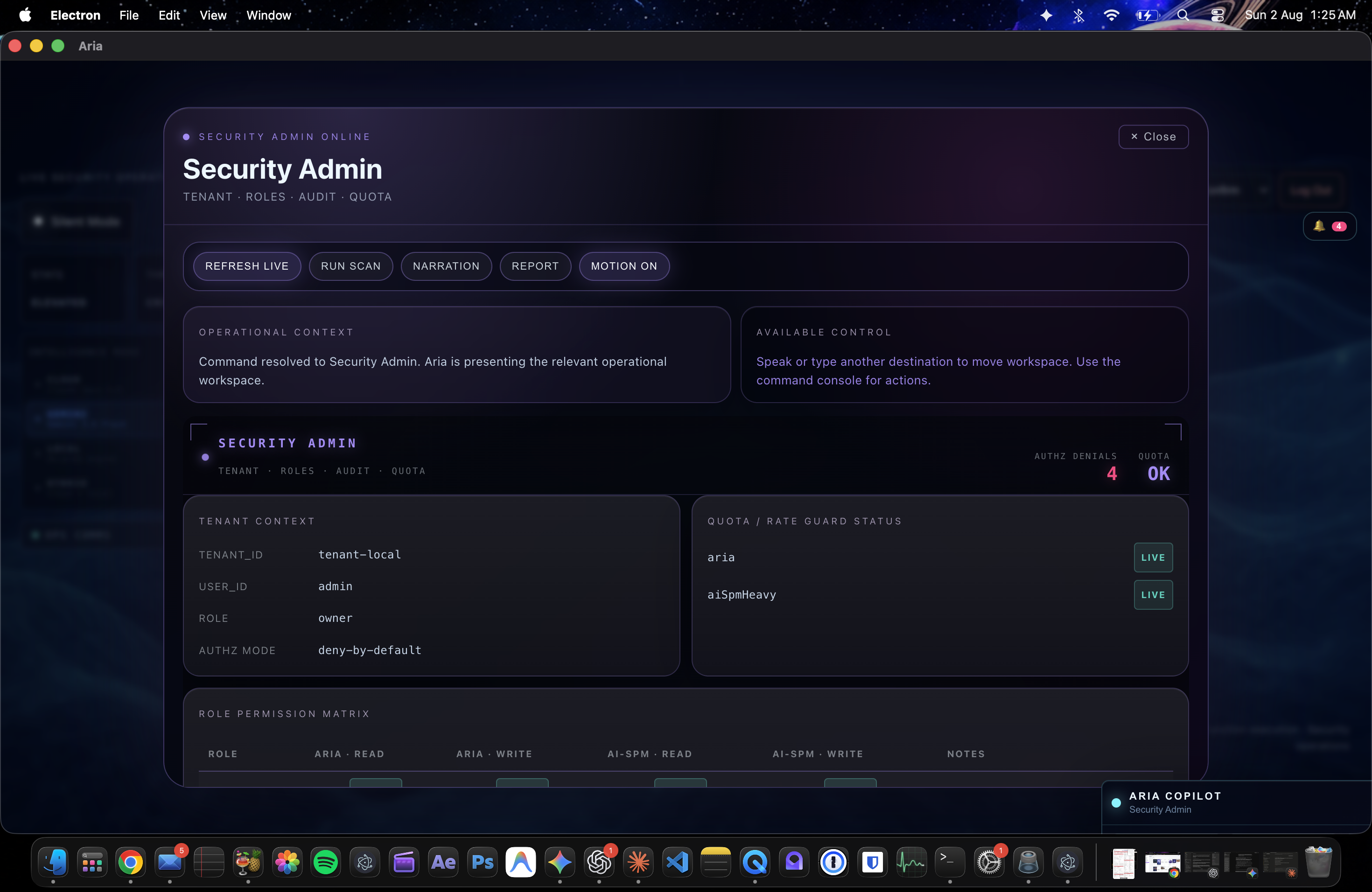
Promotion requires a track record of measured outcomes. Crucially, the model cannot promote itself - a capability only climbs when an operator promotes it, and demotion on a bad outcome is immediate. Every promotion, demotion, approval and action is written to an append-only audit log with a retention envelope.
🎙️ Voice-Native & Interruptible
Two-way spoken conversation over live data, not a chatbot bolted to a dashboard.
Speech-to-text is always local (Whisper via @xenova/transformers) - your voice
never leaves the machine. Text-to-speech is an optional cloud call you can leave
unconfigured.
🛡️ Air-Gapped & Sovereign-Ready
ARIA is built for regulated environments where sending telemetry to a third-party
SaaS is not merely undesirable but illegal. In LOCAL mode reasoning runs against
your own model over an OpenAI-compatible endpoint (Ollama, vLLM, LM Studio,
llama.cpp) and the sovereignty boundary is enforced in code, not promised in
docs:
server/localLlm.mjsrefuses to send a prompt to any host outside loopback or a private range. A public address is rejected unless you explicitly setARIA_LOCAL_LLM_ALLOW_REMOTE=true.LOCALmode never silently falls back to a cloud provider, even when a cloud API key is sitting right there in your environment. If your local engine is down you get a clearly-labelled degraded summary and the reason - not a quiet egress.- The server binds to loopback by default and is not designed to face the internet.
🔌 Connectors & AI-SPM
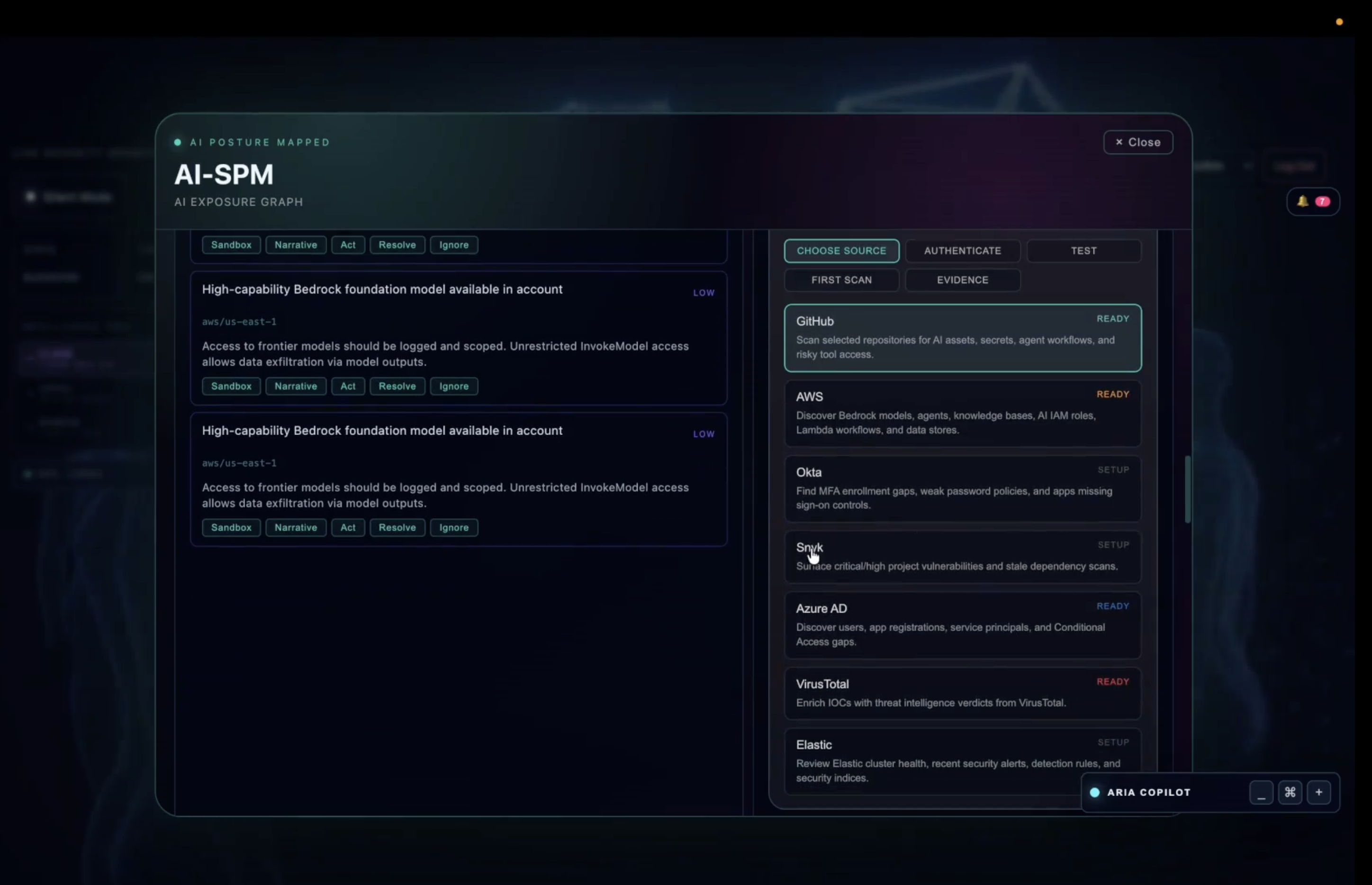
AI Security Posture Management across GitHub, AWS, Okta, Snyk, Azure AD, VirusTotal, and Elastic Security - inventorying AI assets, secrets, model infrastructure, endpoints, and identity links, then mapping attack paths and blast radius across them. Connector credentials are encrypted at rest with AES-256-GCM.
📡 Local Network & Bluetooth Intelligence
Real ARP-table and BLE discovery with IEEE OUI vendor attribution and Bluetooth assigned-number decoding, device identity claims, and proximity estimation. Broadcast and multicast MACs are filtered at parse time rather than reported as devices. Active discovery is authorization-gated; passive visibility is not.
🚀 Quickstart
Under five minutes, no API keys required - ARIA starts with local-only features and every AI provider disabled but visibly labelled as such.
Prerequisites
- Node.js ≥ 22 (uses
node:builtins and nativefetch) - npm (or pnpm)
- Optional: Ollama for sovereign local reasoning
- Optional: Docker, for the containerised server
1. Clone and install
git clone https://github.com/sidevworks/aria-sec.git
cd aria-sec
npm install
2. Configure
cp .env.example .env.local
node scripts/generate-encryption-key.mjs --write   # AES-256-GCM key for the credential vault
.env.example documents every variable. All AI keys are optional - fill in only
what you want. See Bring Your Own Key.
3. Run
npm run start:local # API on :5000 + web UI on :5173
Then open http://127.0.0.1:5173 and log in with the development operator:
username: operator
password: aria
This built-in account exists only when
NODE_ENVisdevelopment/test, or whenARIA_ENABLE_DEMO_LOGIN=trueoutside production. Production is fail-closed: it refuses to boot without real operator credentials and a credential encryption key. SetARIA_LOGIN_USERNAME/ARIA_LOGIN_PASSWORD(orARIA_OPERATORS) for any real deployment.
Other entry points
| Command | What it does |
|---|---|
npm run start:local |
API + web UI together (recommended first run) |
npm run aria |
Electron desktop app |
npm run server |
API server only, on :5000 |
npm run dev |
Vite frontend only |
npm run build |
Production frontend bundle |
npm run build:yc-demo |
Reproducible YC review build with the submitted license gate |
npm run dist |
Packaged desktop app (macOS .dmg) |
npm run lint |
ESLint |
npm run test:all |
Complete isolated test suite |
npm run test:server |
Focused server test suite |
Docker
export ARIA_CREDENTIAL_ENCRYPTION_KEY=$(node scripts/generate-encryption-key.mjs)
docker compose up
Compose fails fast with an explanatory message if that key is unset - the image runs
with NODE_ENV=production, which will not silently store credentials in plaintext.
To reach a model server running on your host rather than in a container, set
ARIA_LOCAL_LLM_URL=http://host.docker.internal:11434/v1.
🔑 Bring Your Own Key
ARIA ships with no keys, has no telemetry, and never proxies your traffic through anyone else's infrastructure. There is no analytics SDK in this repo - verify it yourself:
grep -rniE --include='*.mjs' --include='*.js' --include='*.jsx' \
  "posthog|mixpanel|amplitude|google-analytics|gtag|datadog|sentry" src/ server/
Every outbound host in the codebase is one you configured: your chosen LLM provider, your connectors' own APIs, and ElevenLabs if you enable speech.
Keys live in .env.local (gitignored) or your process environment. Connector
credentials entered through the UI are encrypted at rest with AES-256-GCM, or can be
delegated to AWS Secrets Manager.
Four Intelligence Modes, switchable live from the cockpit:
| Mode | Provider | Requires | Data leaves your network? |
|---|---|---|---|
CLOUD |
Anthropic Claude | ANTHROPIC_API_KEY |
Yes |
GEMINI |
Google Gemini | GEMINI_API_KEY_V2 |
Yes |
LOCAL |
Any OpenAI-compatible local server | a running engine | No - enforced in code |
HYBRID |
Cloud first, local failover | either | Only while cloud is reachable |
The selector reflects reality, not aspiration: each mode is greyed out with a
hover explanation when it cannot actually answer, and LOCAL displays the name of
the model you actually have loaded. Query it directly at
GET /api/model/status.
Sovereign setup
ollama serve
ollama pull qwen3:8b
That is the entire configuration. ARIA defaults to Ollama on loopback and, if you have not named a model, uses the first one the server reports - so it works with whatever you have already pulled. To be explicit:
ARIA_LOCAL_LLM_URL=http://127.0.0.1:11434/v1
ARIA_LOCAL_LLM_MODEL=qwen3:8b
vLLM, LM Studio, llama.cpp's server and text-generation-webui all work through the
same path - anything that speaks /v1/chat/completions.
🏗 Architecture
┌──────────────────────────────────────────────────────────────────┐
│  Renderer - React 19 + Three.js (Electron window or browser)     │
│  Galaxy scene · panels · voice loop · Intelligence Mode selector │
└───────────────────────────────┬──────────────────────────────────┘
                                │  HTTP + WebSocket (loopback)
┌───────────────────────────────┴──────────────────────────────────┐
│  Node.js server - server/index.mjs                               │
│                                                                  │
│  authz · quotaGuard · rateLimiter · auditLog · securityHeaders    │
│  ariaTrust (Trust Ladder) · actionRunner · policyStore            │
│  reasoningEngine · autonomousResponse · ariaMemory                │
│  aiSpmInventory · aiRiskEngine · aiSpmBlastRadius                 │
│  NetworkIntelligence/ · Bluetooth/ · connectors/                  │
└───┬──────────────────────┬───────────────────────┬───────────────┘
    │                      │                       │
┌───┴────────┐   ┌─────────┴──────────┐   ┌────────┴─────────────┐
│ Reasoning  │   │ Connectors         │   │ Persistence          │
│            │   │                    │   │                      │
│ Anthropic  │   │ GitHub · AWS       │   │ JSON under           │
│ Gemini     │   │ Okta · Snyk        │   │ aria-memory/         │
│ Local      │   │ Azure AD           │   │ + optional KV mirror │
│ (sovereign)│   │ VirusTotal·Elastic │   │ AES-256-GCM vault    │
└────────────┘   └────────────────────┘   └──────────────────────┘
Frontend - React 19 with Three.js via @react-three/fiber, drei, and
postprocessing. Panels are lazily code-split. Vite for dev and build;
electron-vite for the desktop target.
Server - a single Node.js HTTP + WebSocket server, no framework, ~4,500 lines of
routing in server/index.mjs delegating to 74 focused modules. Loopback-bound by
default. Role-based authz (owner/admin/analyst/viewer) with opaque
in-memory session tokens.
Reasoning - one dispatcher (callAI) fans out to Anthropic, Gemini, or your
local engine, with per-mode fallback policy that respects the sovereignty
guarantee.
Persistence - file-based JSON under aria-memory/, with an optional Upstash KV
mirror for durability across restarts. Deliberately boring: it is inspectable with
cat, which matters for an audit trail.
Voice - local Whisper STT (@xenova/transformers, runs on-device); ElevenLabs
TTS as an optional cloud call.
🧭 Maturity & what is not done
Publishing an honest list is more useful than a feature grid. Known gaps, current as of this commit - the full module-by-module account with file paths is in ROADMAP_AND_LIMITATIONS.md:
| Area | Status |
|---|---|
| Network scan depth | ARP-table reads and BLE scanning are real; "deep scan" is not a full active port/vuln scan. Phase naming is being made literal. |
| Local TTS | Speech-to-text is local; text-to-speech is still a cloud call, so LOCAL mode is sovereign for reasoning but not for speech output. Piper/Kokoro is the intended fix. |
| Semantic memory | Keyword search, not vector search. Fine at current scale. |
| Multi-tenancy | Trust and the hardened governance paths are tenant-scoped, but legacy stores do not yet use one uniform repository abstraction. Single-site desktop deployment remains the supported model. |
| Approval queue | File-backed and restart-safe for a single local service, but not coordinated across multiple server instances. |
| Audit log rotation | Capped per file with a retention envelope; rotation is not yet implemented. |
| Rate limiting | Legacy in-memory limiter still present alongside the newer quotaGuard. |
| CI/CD | GitHub Actions runs lint, all tests, the production build and a Docker image build. Releases and deployments remain deliberately manual. |
| Lint and tests | ESLint has no errors and all 48 isolated test files pass in the current release gate. |
| Compliance | No SOC 2, no formal privacy policy or IR plan yet. |
Security reports are welcome - please open a private advisory rather than a public issue.
📁 Repository layout
server/               Node.js API - routing, autonomy, connectors, intelligence
  ariaTrust.mjs         Trust Ladder: scoring, promotion, demotion
  localLlm.mjs          Sovereign local LLM client + egress guard
  auditLog.mjs          Append-only audit trail with retention
  authz.mjs             Role-based authorization
  connectors/           GitHub, AWS, Okta, Snyk, Azure AD, VirusTotal, Elastic
  NetworkIntelligence/  ARP discovery, OUI vendor lookup, device identity
  Bluetooth/            BLE scanning and intelligence
src/                  React 19 + Three.js renderer
  landing/              Cinematic Three.js entry surface
  panels/               Operator panels (galaxy nodes)
  voice/                Local Whisper STT + voice loop
electron/             Desktop main + preload
scripts/              Launchers, registry updaters, key generation
infra/trial-form/     AWS SAM reference stack for the landing page's forms
docs/                 Capability reference and API documentation
test/                 Node test-runner suites
.github/workflows/    Non-deploying quality and container CI

ROADMAP_AND_LIMITATIONS.md   Full engineering audit - read this before evaluating
docs/reports/ARIA-TECHNICAL-CAPABILITY-AND-DESIGN-REPORT-2026-08-02.md
                             Current technical assessment and hardening evidence
📄 License
Business Source License 1.1 - source-available, not open source.
- ✅ Permitted without a fee: development, testing, evaluation, security and academic research, personal sandbox use, internal demonstration.
- ❌ Requires a commercial license: production use, or offering ARIA's functionality to third parties as a hosted or managed service.
- 🔓 Converts to GPL-3.0-or-later on 2030-07-26.
Full terms in LICENSE. Copyright © 2026 Sary Ismail.
Built in the Kingdom of Bahrain.
Built With
- css
- dockerfile
- html
- javascript
- procfile
- shell

Log in or sign up for Devpost to join the conversation.