-
-
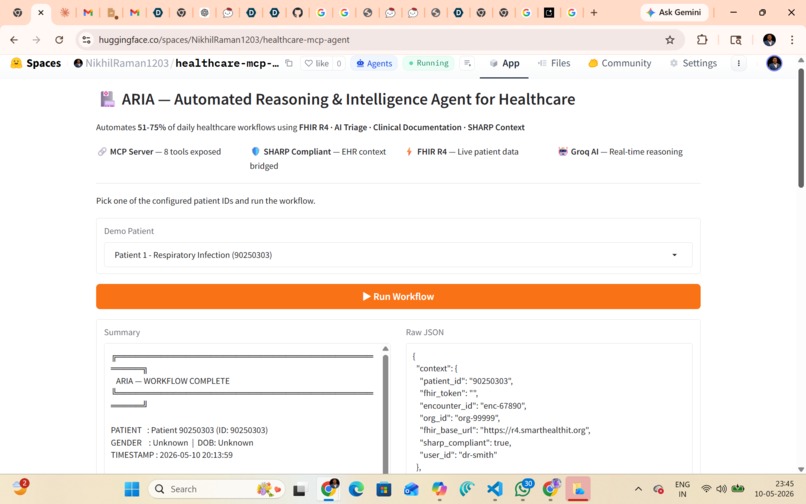
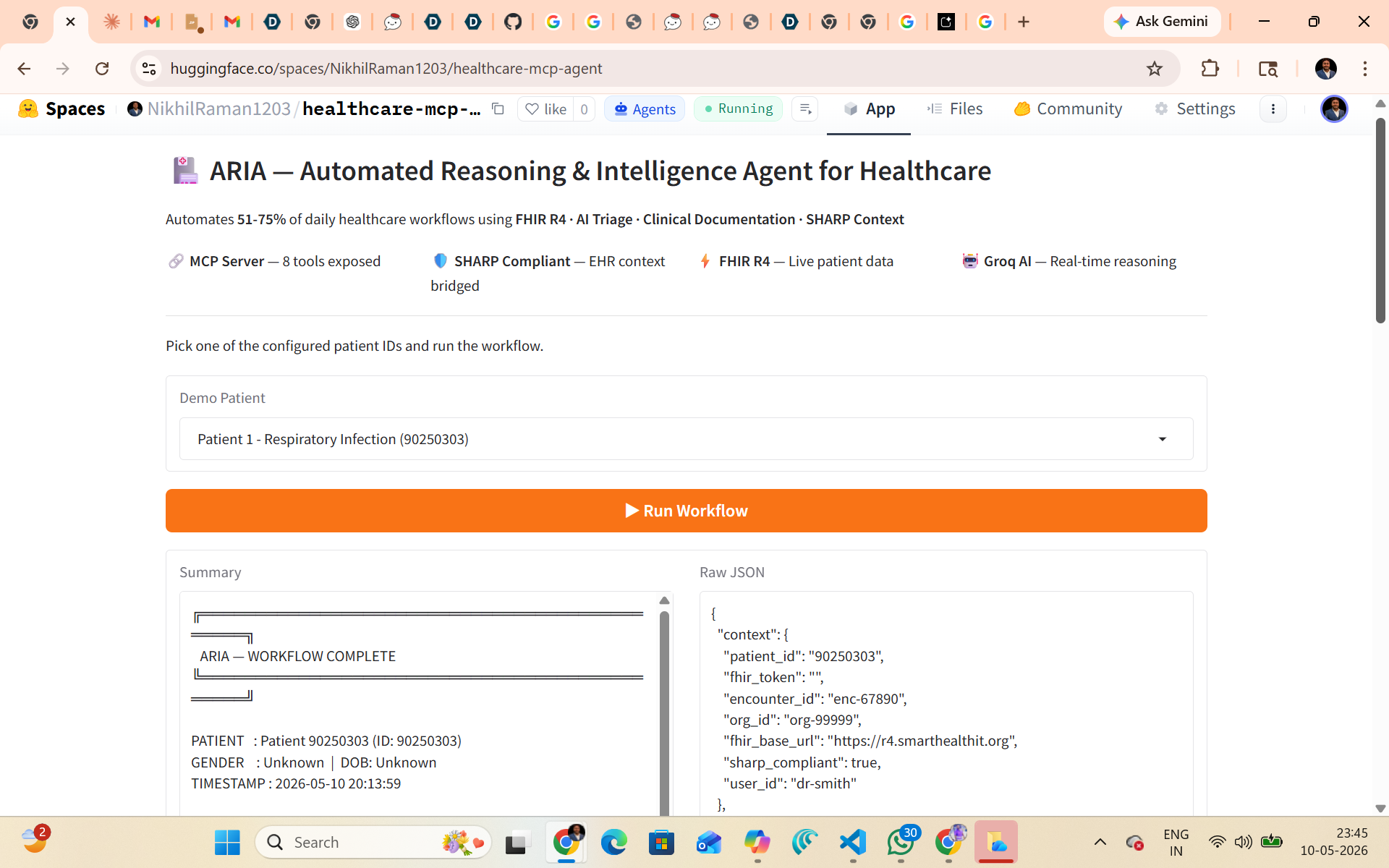
Live Hugging Face demo of ARIA
ARIA — Automated Reasoning & Intelligence Agent for Healthcare
Inspiration
Physicians spend nearly 2–3 hours every day on documentation instead of patient care. Nurses repeat the same intake questions across every shift. Prior authorizations delay treatment for days. Critical lab results sit unread while clinicians manage overwhelming administrative load.
The problem is no longer a lack of medical expertise. The problem is workflow fragmentation.
Burnout now affects over 60% of physicians, with administrative overhead consistently cited as the leading cause. At the same time, modern AI systems are capable of reasoning, summarization, orchestration, and automation at scale — yet most healthcare workflows still rely on disconnected systems, manual chart review, and repetitive data entry.
We realized the challenge was not building another chatbot for healthcare. The challenge was connecting clinical reasoning, interoperability, workflow automation, and safety into one coordinated system.
That is why we built ARIA.
ARIA is designed to operate directly on live healthcare context using MCP, SHARP context propagation, FHIR R4 interoperability, and stateful agent orchestration. Instead of replacing physicians, ARIA removes repetitive operational burden while preserving human oversight where clinical judgment matters most.
What It Does
ARIA is a stateful AI healthcare workflow agent that automates clinical documentation, intake analysis, triage reasoning, safety validation, and workflow routing directly on top of live FHIR R4 patient data.
The system automates 51–75% of repetitive administrative workflow tasks while keeping physicians in the loop for all clinically significant decisions.
Workflow Overview
1. Patient Intake
ARIA securely retrieves live FHIR R4 patient data, including:
- Conditions
- Medications
- Allergies
- Encounter history
- Lab results
- Vital signs
No manual chart review or data pulling is required.
2. Intelligent Clinical Triage
ARIA performs AI-assisted Emergency Severity Index (ESI) triage with explainable clinical reasoning.
Example:
“Patient presents with chest pain, HR 112, SpO2 93%, elevated cardiovascular risk profile — immediate ACS evaluation recommended.”
The system does not produce opaque risk scores. Every decision includes a visible clinical rationale tied to patient-specific findings.
3. Safety Validation Layer
ARIA performs:
- Drug-drug interaction checking
- Allergy conflict detection
- Rule-based red flag identification
- Conservative escalation analysis
Drug safety checks are powered using the NLM RxNorm API.
When uncertainty exists, ARIA escalates instead of suppressing risk.
4. Automated Clinical Documentation
ARIA generates:
- SOAP notes
- ICD-10 coding suggestions
- Discharge summaries
- Follow-up recommendations
- Care gap analysis
Documentation tasks that traditionally require 30–45 minutes can be completed in seconds.
5. Intelligent Workflow Routing
ARIA dynamically routes cases into one of three paths:
Auto-Complete
Low-risk cases with no safety concerns are automatically completed.
Physician Review
Moderate-risk cases are routed into a review queue for physician approval.
Immediate Escalation
Emergent cases or safety-critical findings trigger immediate physician escalation.
Routing decisions are based on:
- Triage severity
- Safety flags
- Clinical confidence thresholds
- Deterministic fallback rules
6. SHARP Context Propagation
Every MCP tool call automatically carries:
- Patient ID
- Encounter ID
- FHIR authorization context
Prompt Opinion’s SHARP infrastructure propagates clinical context across the entire workflow without requiring custom authentication glue code.
Why ARIA Is Different
Most healthcare AI systems only summarize notes.
ARIA operates as a full clinical workflow orchestration agent.
Key differentiators include:
- Stateful multi-step clinical workflow execution using LangGraph
- Standards-native interoperability using MCP + SHARP + FHIR R4
- Explainable triage reasoning instead of black-box scoring
- Built-in human oversight and escalation pathways
- Conservative safety-first decision architecture
- Persistent context propagation across every tool invocation
- Deterministic fallback systems when LLM reasoning fails
- Production-oriented error handling and workflow resilience
ARIA is designed around clinical trust, not just AI output generation.
Architecture
System Design
FHIR R4 Data Sources
        ↓
MCP Healthcare Tools
        ↓
LangGraph Stateful Agent
        ↓
Safety & Validation Layer
        ↓
Clinical Documentation Engine
        ↓
Routing & Escalation Engine
        ↓
Auto-Complete | Review Queue | Escalation
Built With
- docker
- fastapi
- fastmcp
- fhir-r4
- gradio
- groq-ai
- huggingfacespaces
- langgraph
- sharp-context

Log in or sign up for Devpost to join the conversation.