-
-
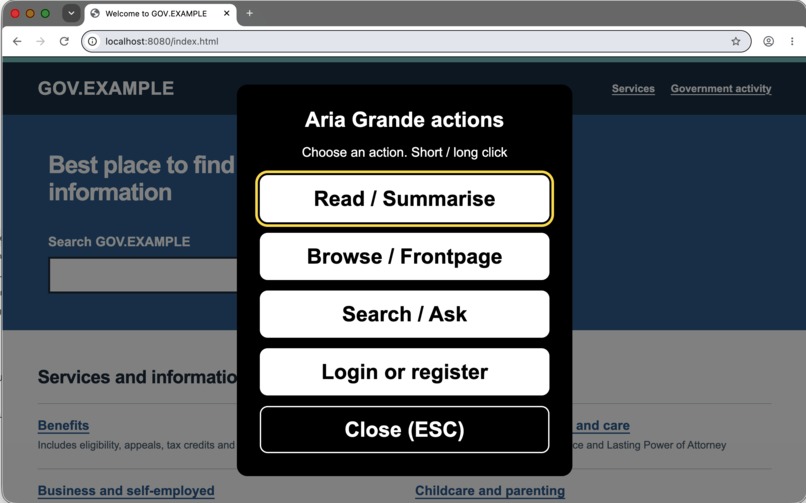
Main view
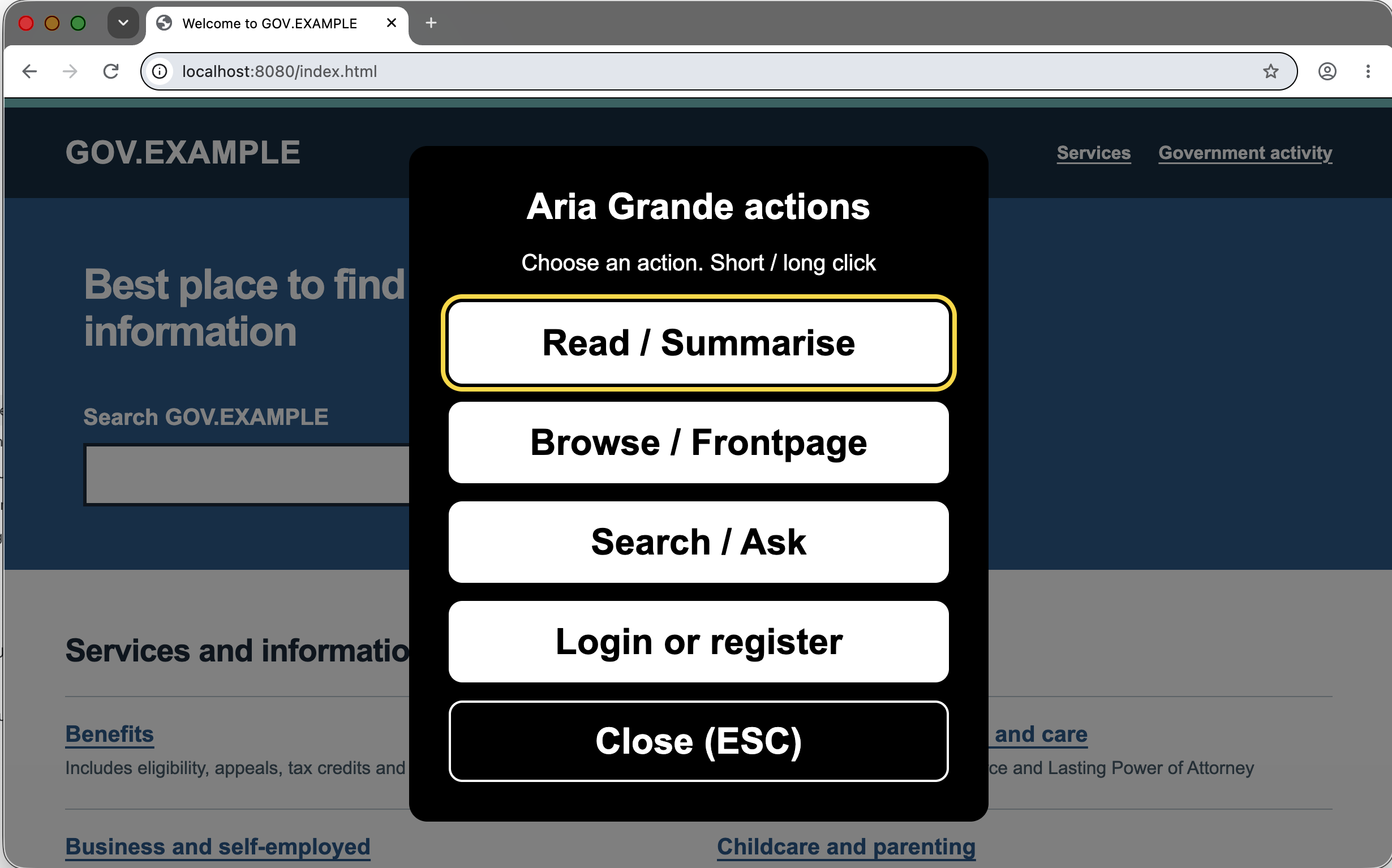
Aria Grande
Inspiration
The web is designed primarily for people who can visually scan pages, interpret layouts, and manually move between controls. That makes finding, understanding, and acting on information slower and more difficult for many people, especially people who use assistive technology. AI-assisted browsers can help, but they are often limited to the current page and must infer a website's structure and intent from an interface built for sighted users.
I wanted to give websites a simple, interoperable way to share the context they already know with an AI-assisted browser—without making every site adopt one product or requiring users to give up a usable experience on sites that have not yet implemented the standard.
This is a practical solution, as it is designed to start small with only client side support that works on any website and scale and improve user experience as websites adopt the proposed system.
I believe a simple system can change lives of people with disabilities, by making the web easy to find and browse.
What it does
Aria Grande is an accessibility-focused interoperability system for AI-assisted browsing, built on WebMCP. It defines seven common browsing activities as consistent WebMCP tools:
- Read
- Summarise
- Search
- Ask
- Frontpage
- Explore
- Login
Websites can implement whichever actions are useful to them. For example, a site can provide authoritative source material for a summary, return structured search results, answer a question using its own context, or expose a simplified navigation hierarchy. AI-assisted browser clients implement every action along with a local fallback, so the browsing experience remains functional on any website.
How I built it
I designed a compact action vocabulary and mapped each behaviour to a stable ariag-* WebMCP tool name. For each action, I specified the expected client behaviour, a model prompt, and a fallback strategy. This makes the boundary clear: websites can contribute richer, authoritative information, while clients retain responsibility for a dependable experience.
I also built example implementations: a browser extension that acts as an Aria Grande client and a government-website example that demonstrates website-side support. The specification treats website responses as untrusted source data, instructing clients to preserve user intent, validate navigation targets, and avoid inventing answers or claiming actions that did not happen.
Challenges I ran into
The central challenge was balancing a useful standard with a realistic adoption path. A broad protocol would be hard for websites and browser clients to implement; a narrow one would not cover the activities people actually need. I focused on the small set of actions that recur across websites and made every website endpoint optional.
Another challenge was ensuring graceful degradation. An AI browser cannot assume a site supports Aria Grande or that a returned result is complete. I therefore defined concrete fallback behaviour for every action, from extracting readable document content to finding visible search and login controls. Security and trust were equally important: tool output may contain instructions, navigation targets must be validated, and secrets must not be passed to the model or tool unless the user intentionally provides them.
Accomplishments that I'm proud of
I created a practical contract between websites and AI-assisted browsers that improves accessibility without replacing the web. Its seven actions cover the core journey from understanding a page to searching, asking questions, exploring a site, and signing in.
I am especially proud that the system makes room for both early adopters and the existing web. Sites may add support incrementally, while clients still provide local fallbacks everywhere. The client guidance also makes safety a first-class part of the design rather than an afterthought.
What I learned
Accessibility for AI-assisted browsing is not only about extracting text. Useful assistance requires structure, authoritative context, clear navigation, and honest handling of uncertainty. I also learned that interoperability works best when responsibilities are explicit: websites describe what they know, clients protect user intent and perform reliable fallbacks, and users stay in control of consequential actions.
What's next for Aria Grande
Next, I want to validate the action set with more real websites and AI-assisted browser clients, refine the response formats through interoperability testing, and expand the examples and implementation guidance. I also plan to explore stronger conventions for structured results, navigation validation, and authentication handoffs—while keeping the protocol small, optional for websites, and dependable for users.

Log in or sign up for Devpost to join the conversation.