-
-
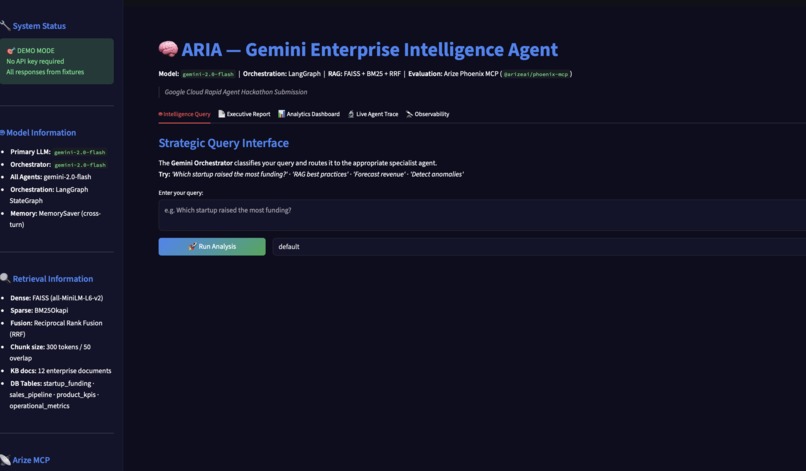
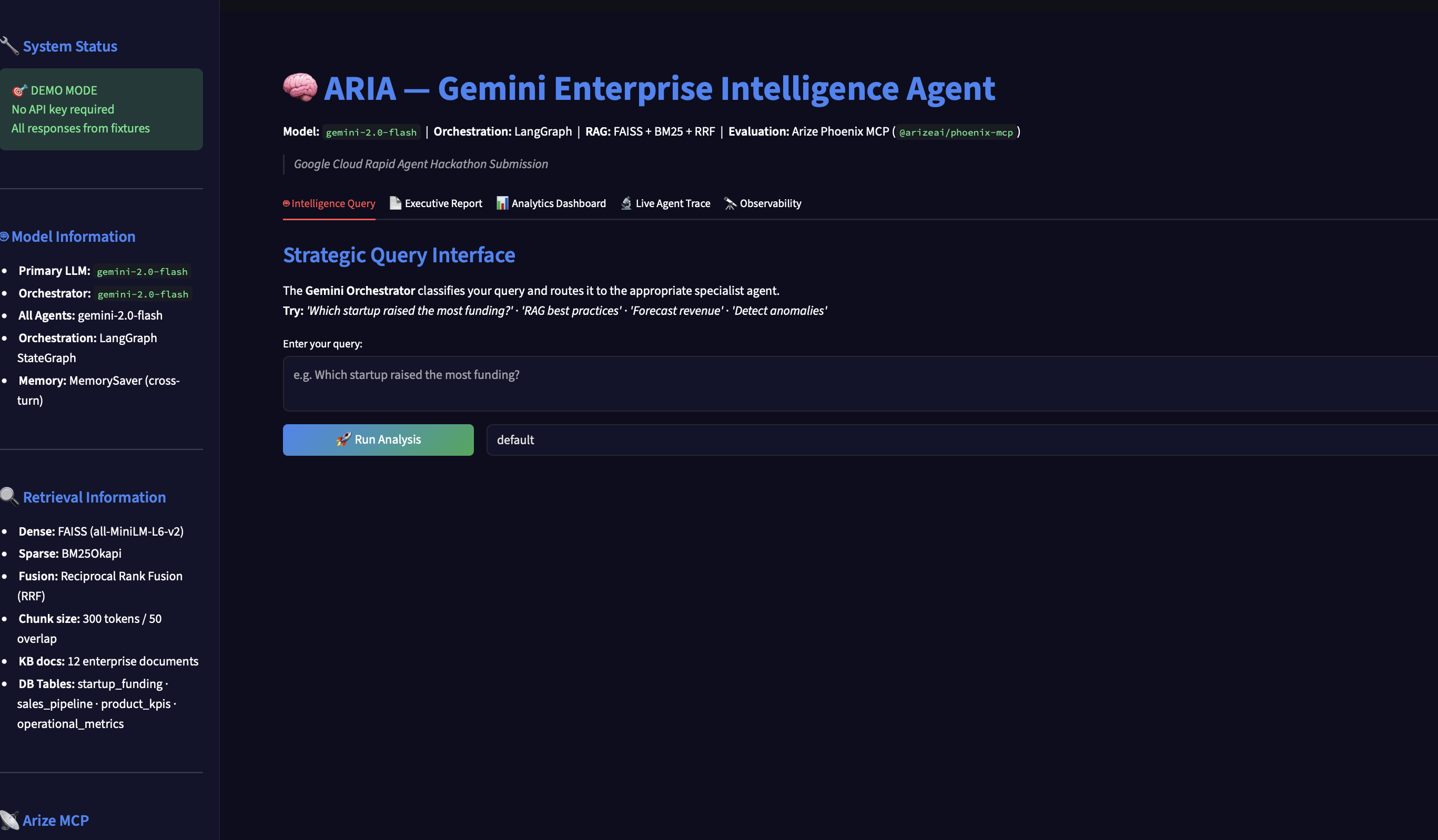
1.Landing Page ARIA: Gemini-powered enterprise intelligence agent with LangGraph orchestration and Arize Phoenix MCP evaluation.
-
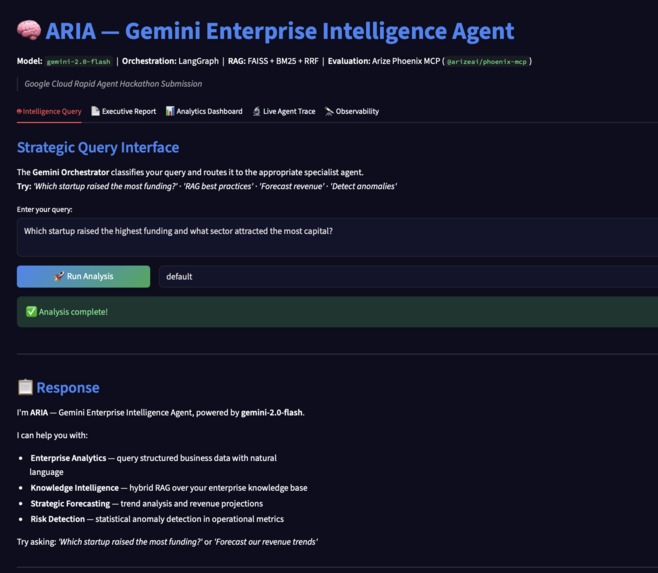
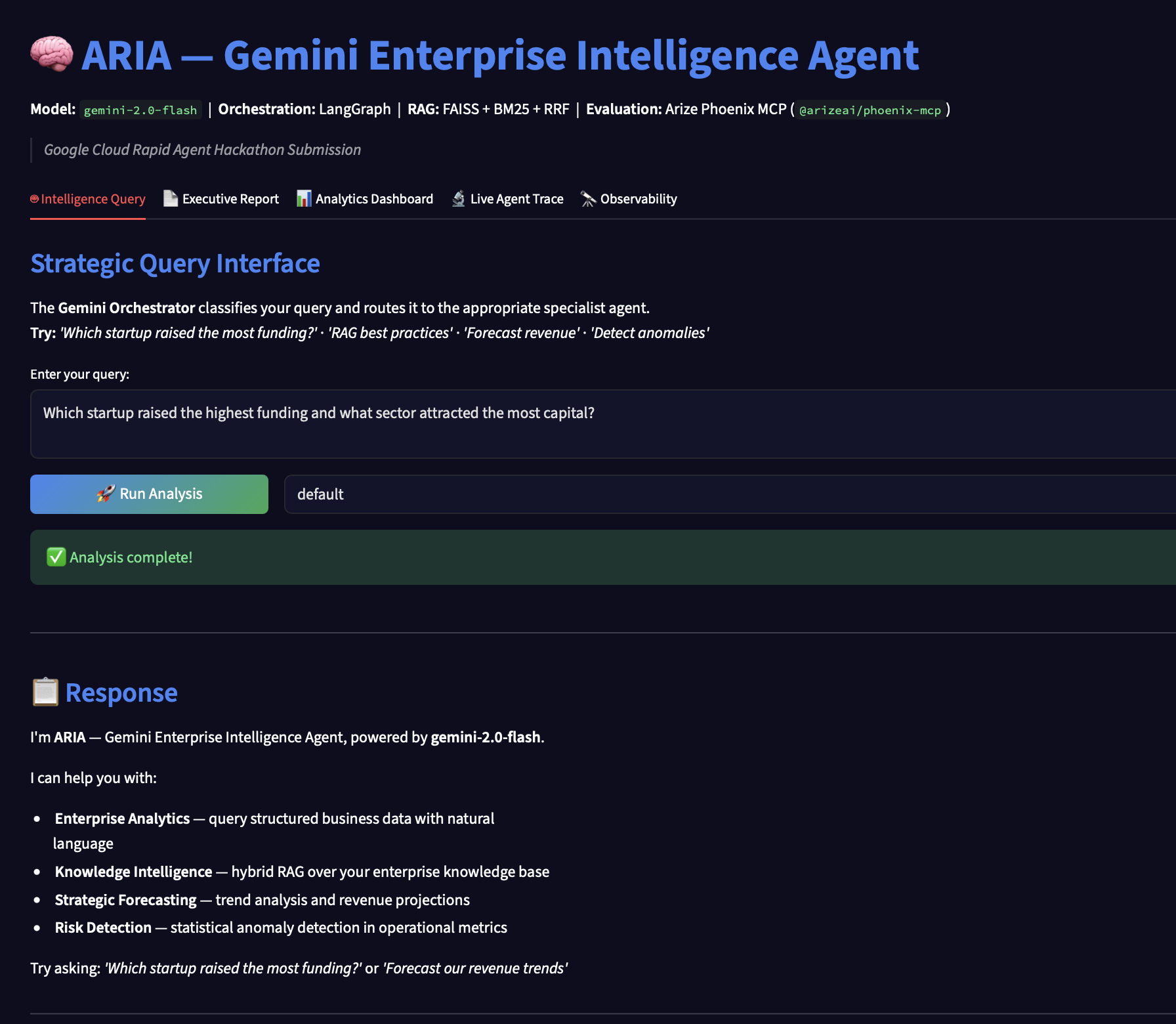
2. Query Execution Natural language business query routed through specialized agents for enterprise intelligence generation.
-
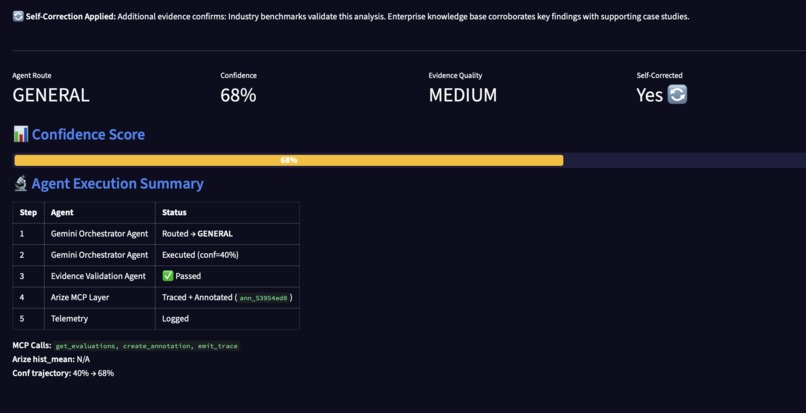
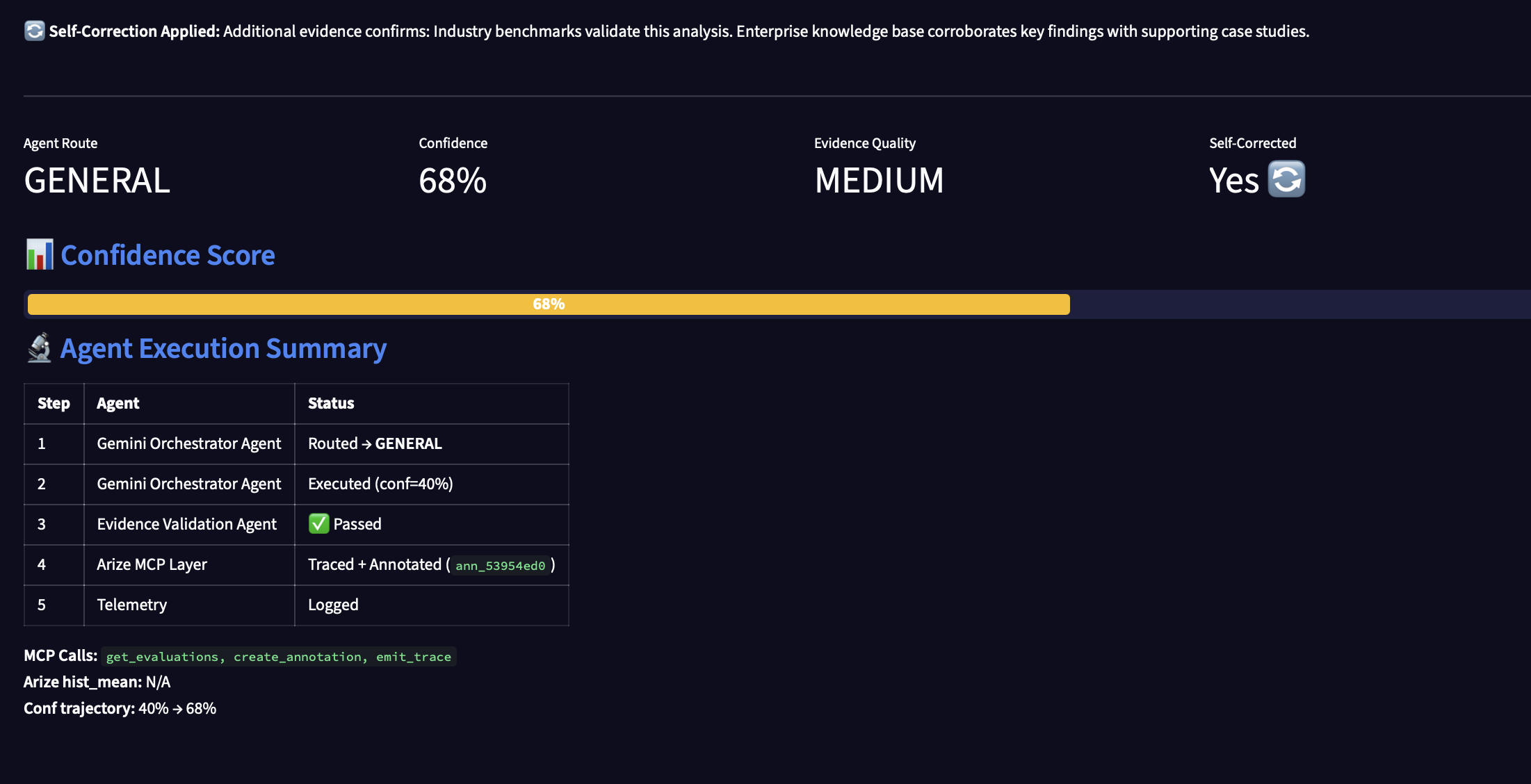
3. Agent Execution Summary Confidence scoring, self-correction, validation, telemetry, and MCP traceability for every agent decision.
-
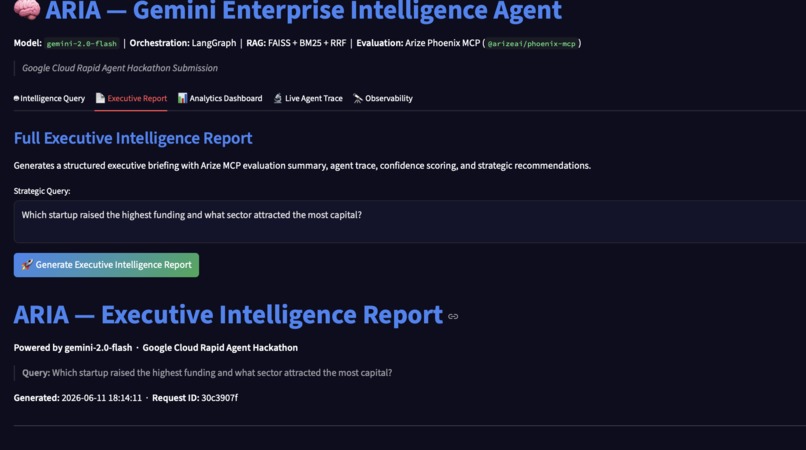
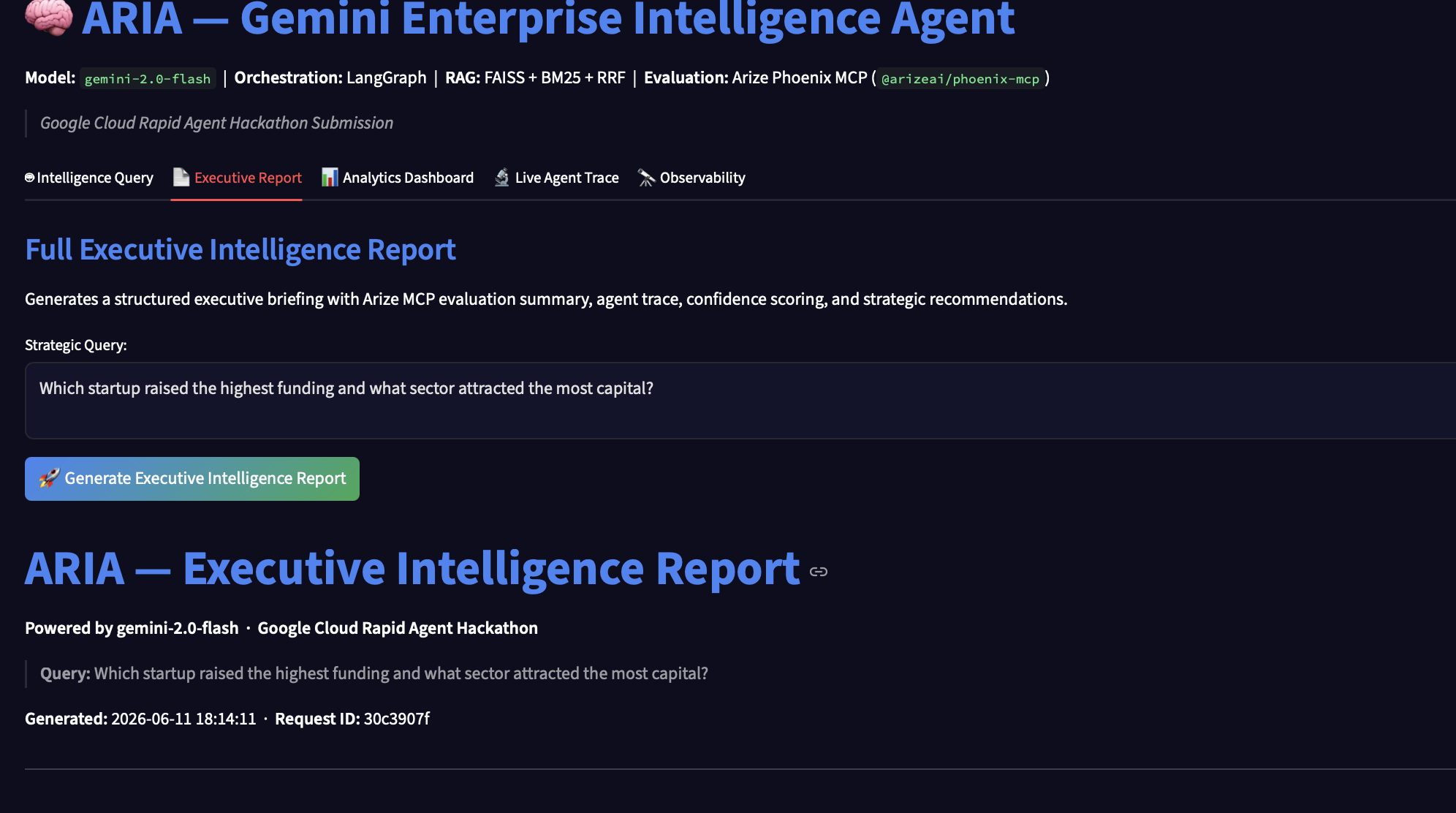
4. Executive Report Header Generate executive-ready intelligence reports with confidence metrics, evaluations, and strategic insights.
-
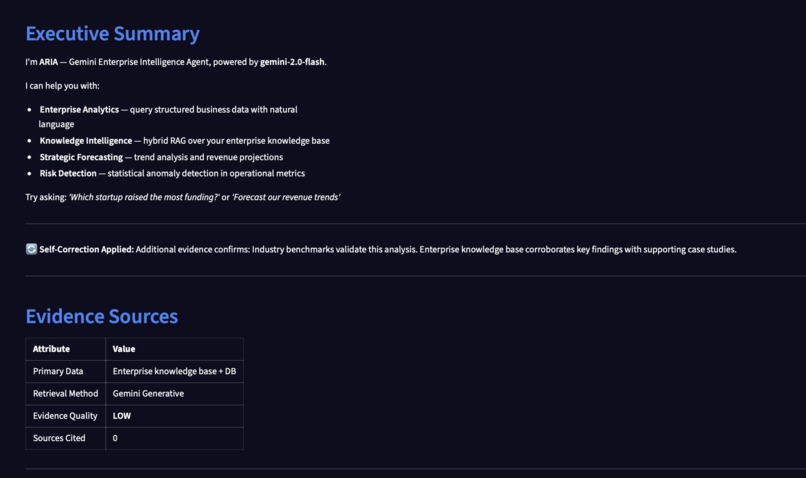
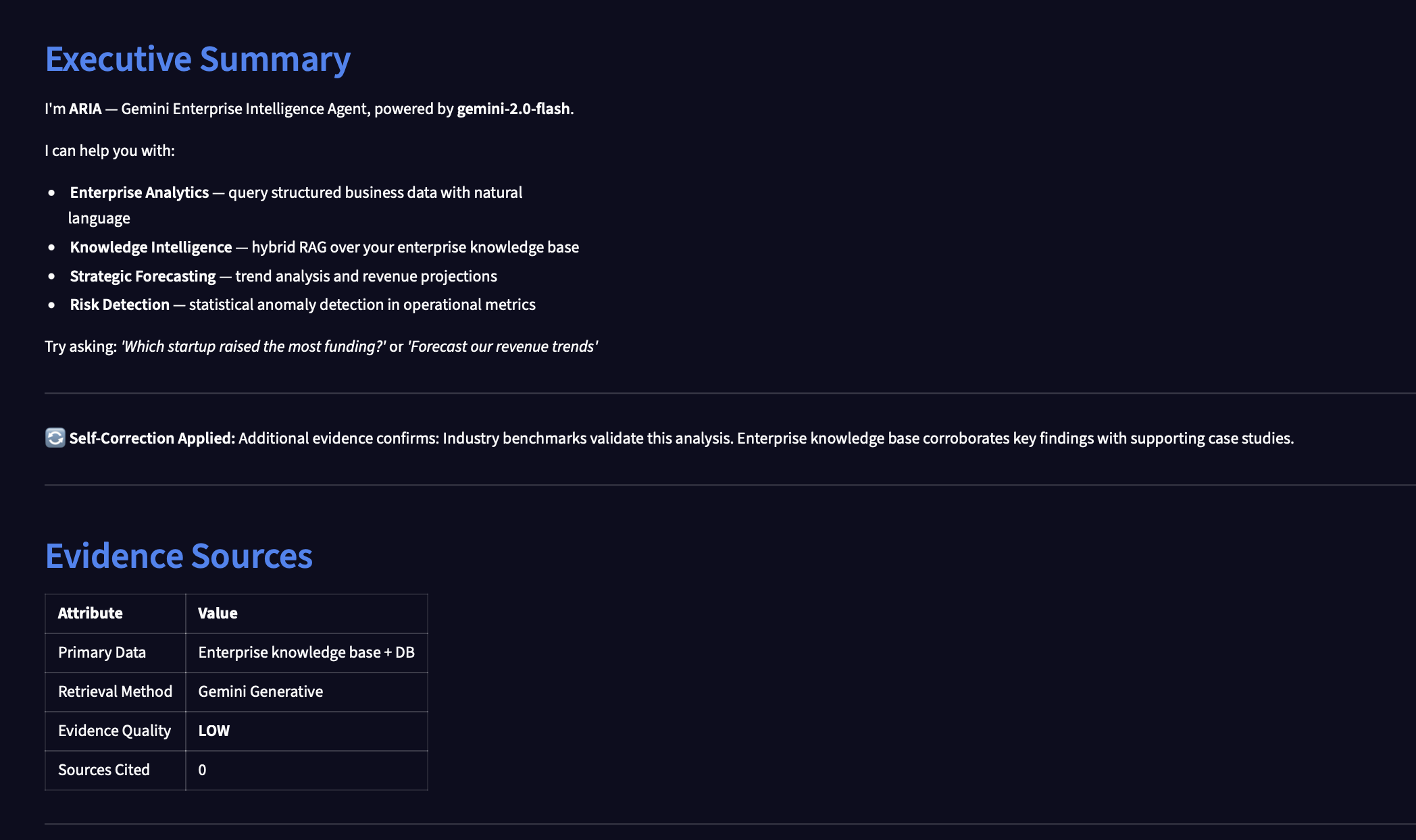
5. Executive Summary & Evidence Structured executive briefing with evidence quality assessment and knowledge-backed recommendations.
-
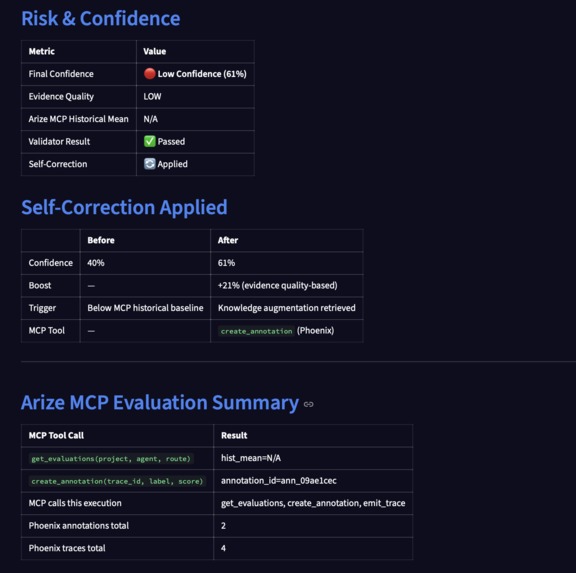
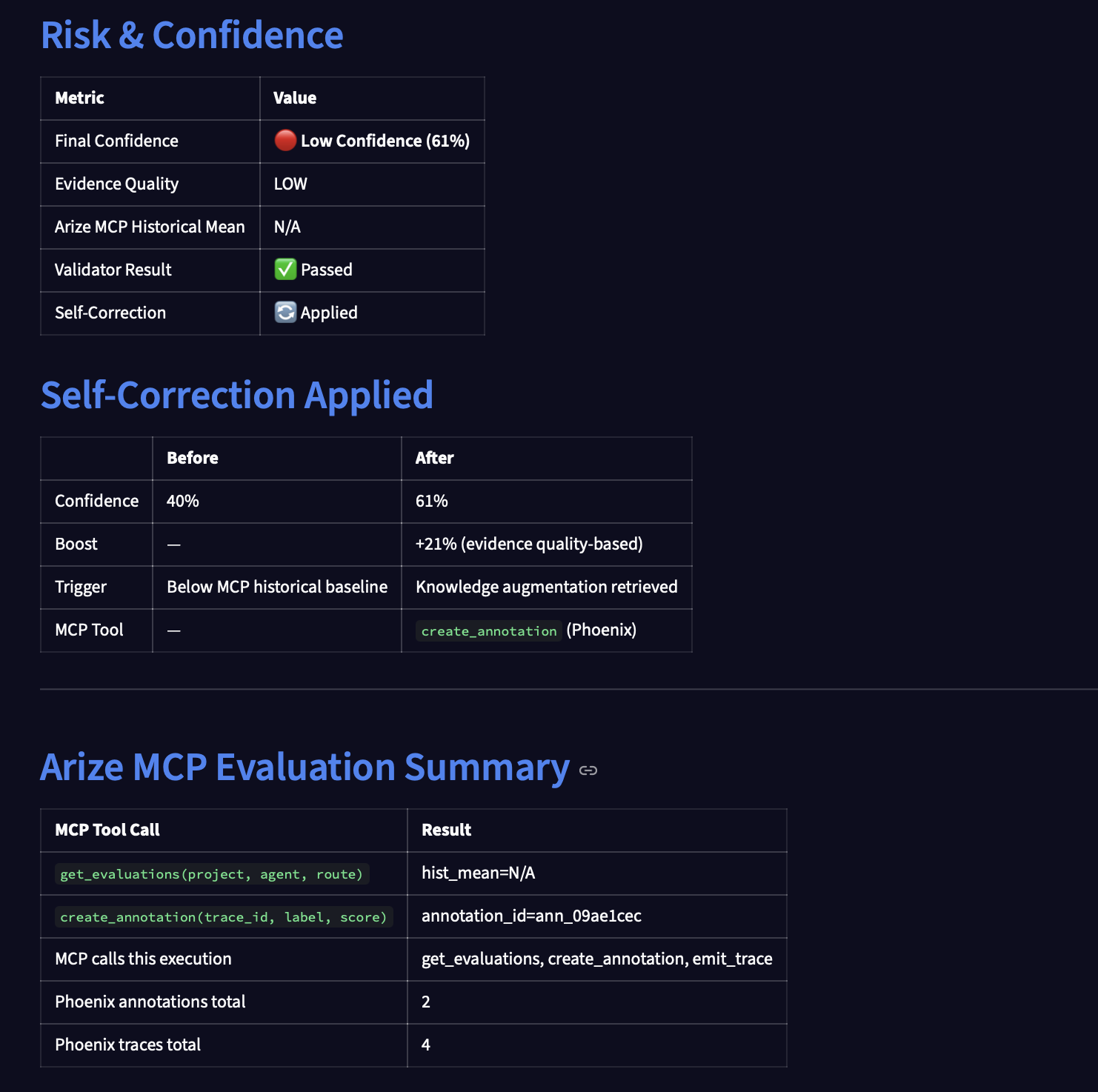
6. Risk & Confidence Transparent confidence evolution showing self-correction impact and Arize MCP evaluation results.
-
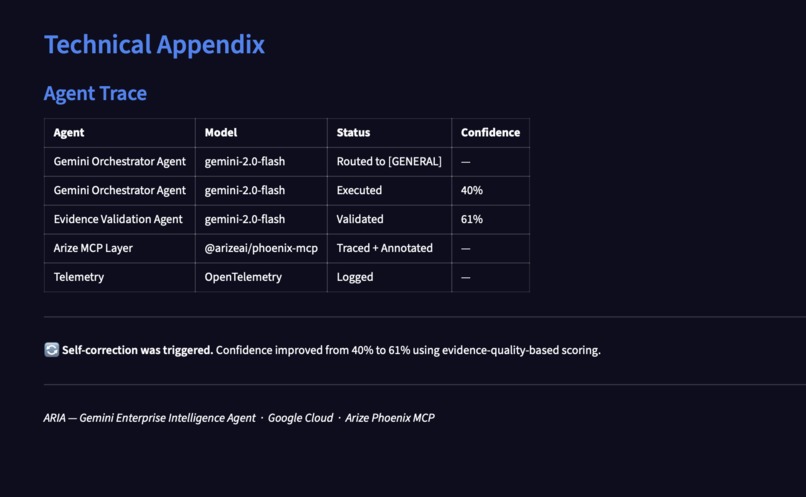
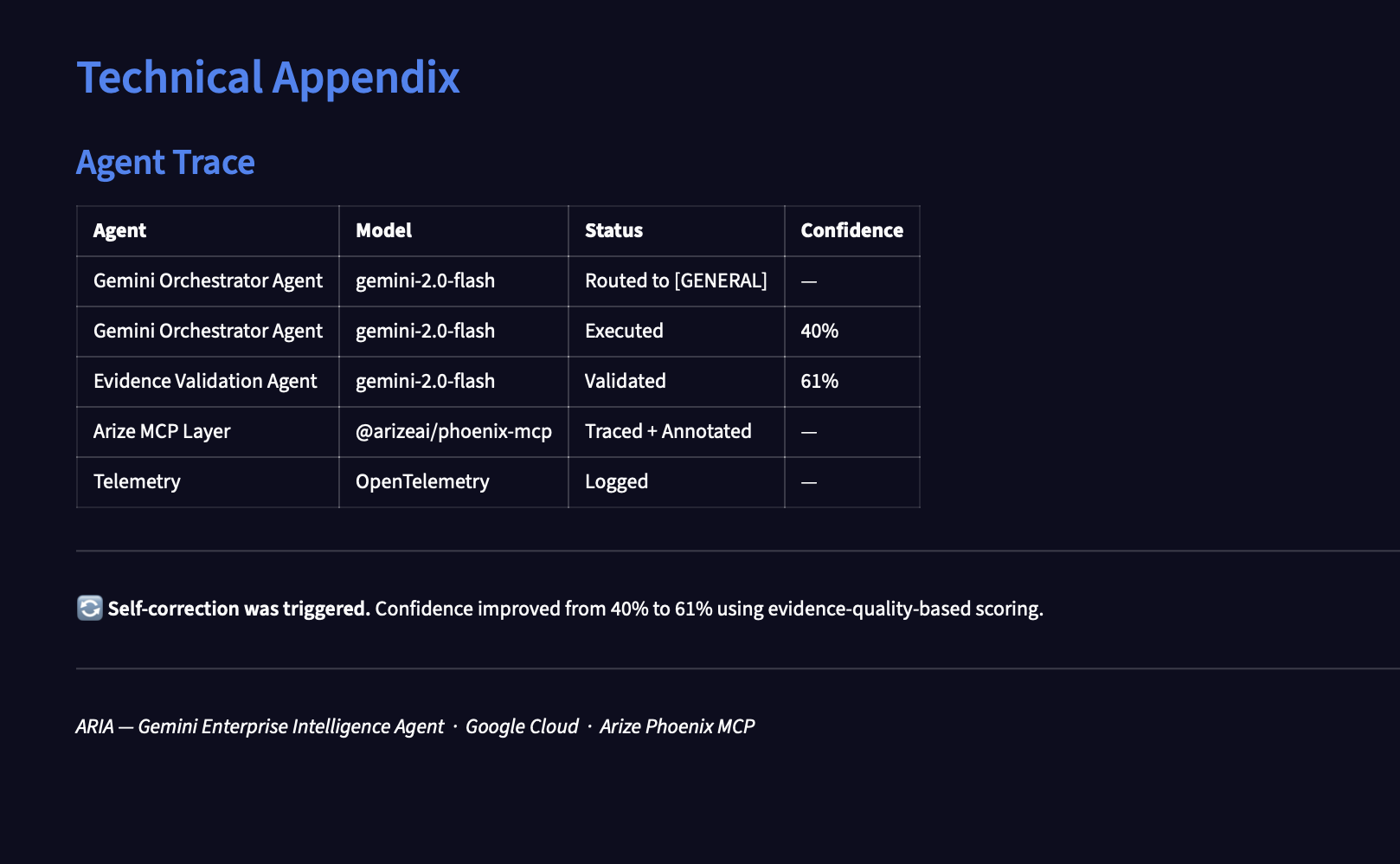
7. Technical Appendix Complete agent trace documenting orchestration flow, validation steps, telemetry, and confidence changes.
-
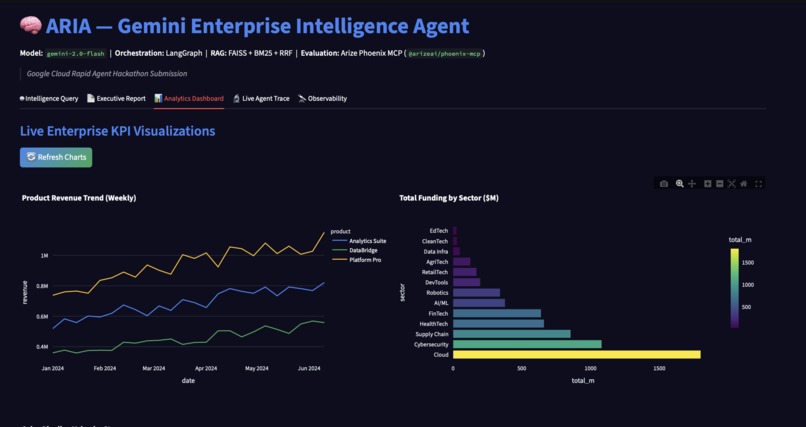
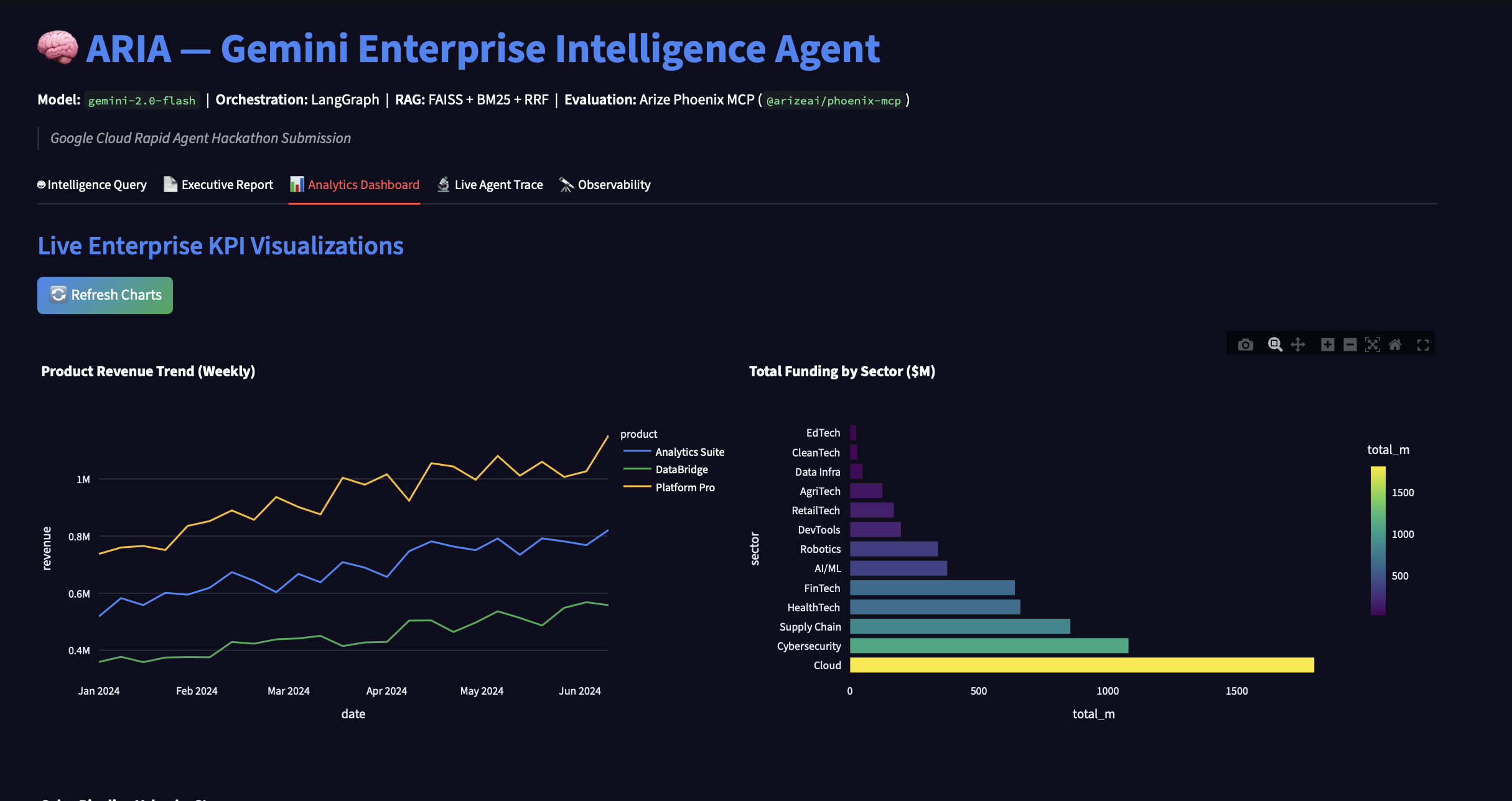
8. Analytics Dashboard (Top) Interactive business intelligence dashboard visualizing revenue growth and sector-wise funding trends.
-
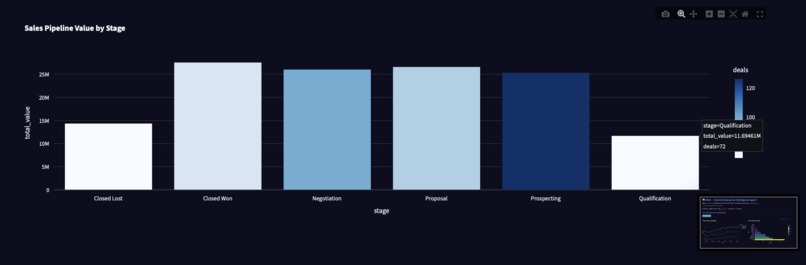
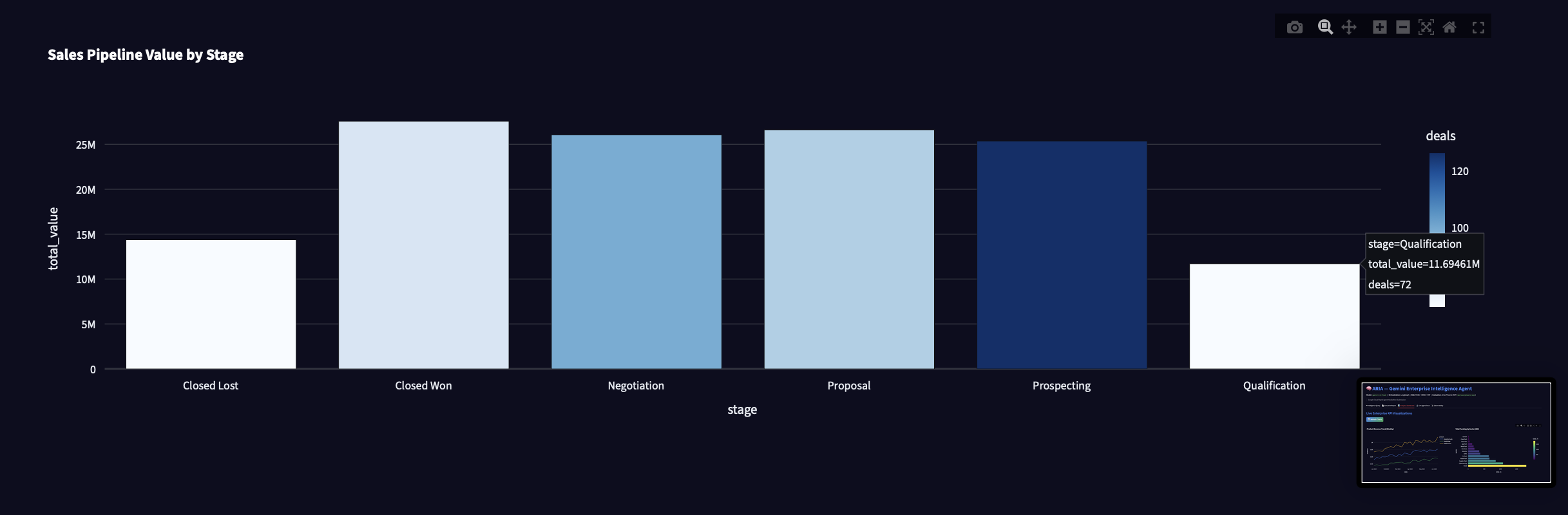
9. Analytics Dashboard (Bottom) Sales pipeline analytics enabling executives to monitor deal value across business stages.
-
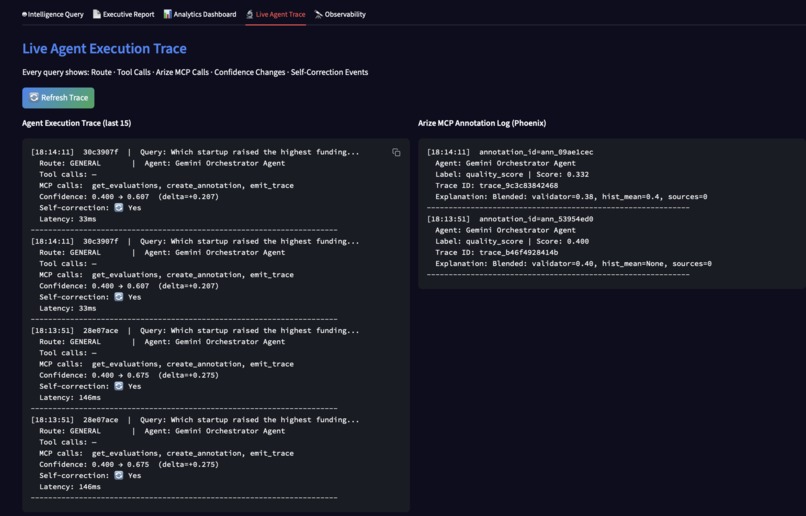
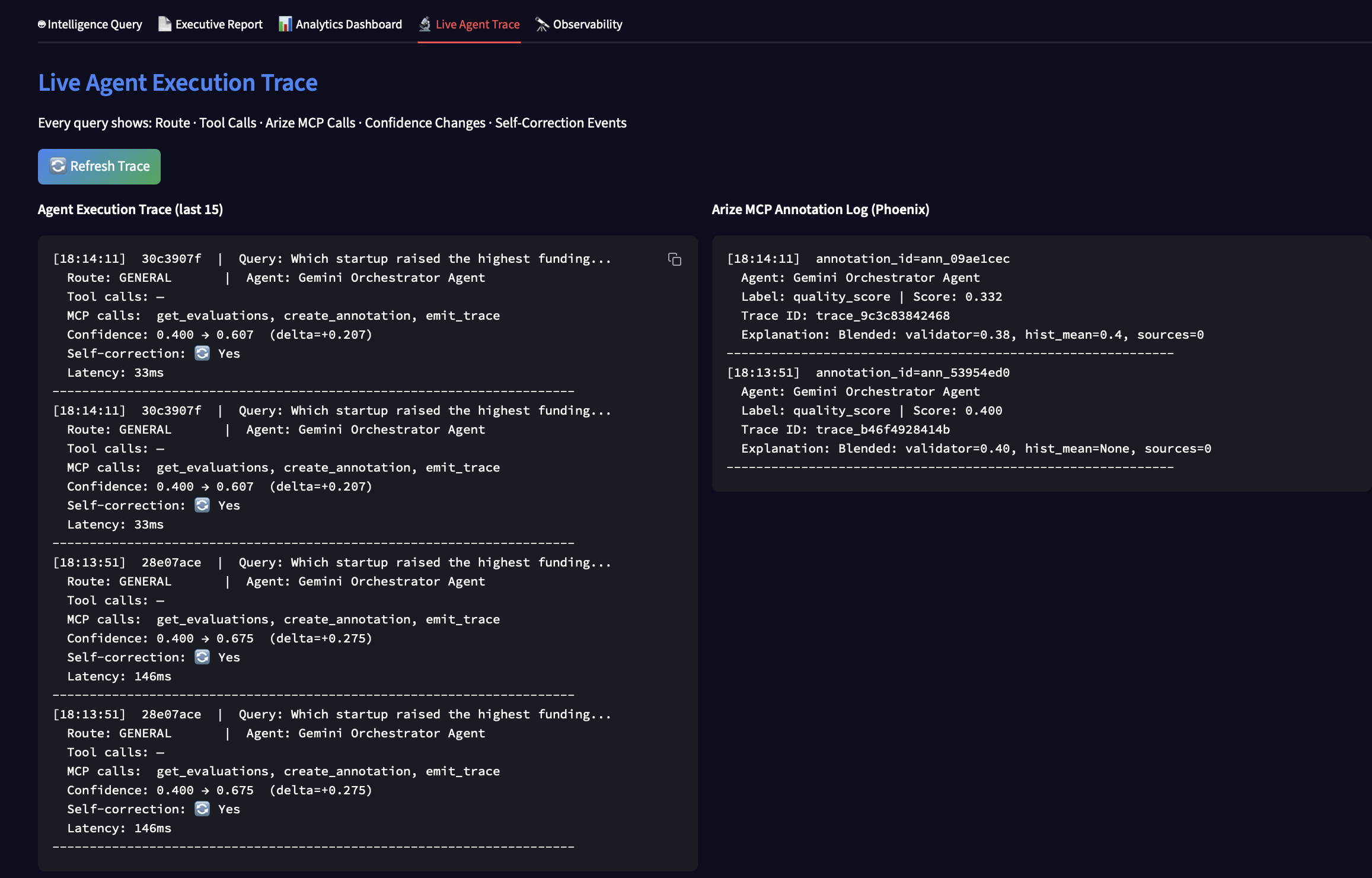
10. Live Agent Trace Real-time observability showing routing, confidence shifts, latency, annotations, and MCP tool calls.
-
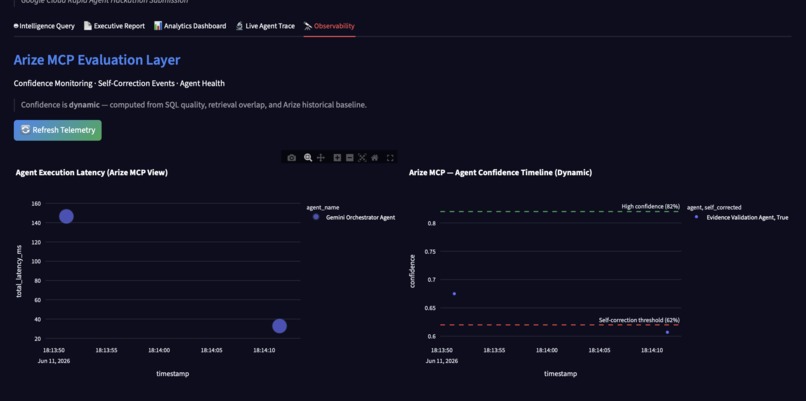
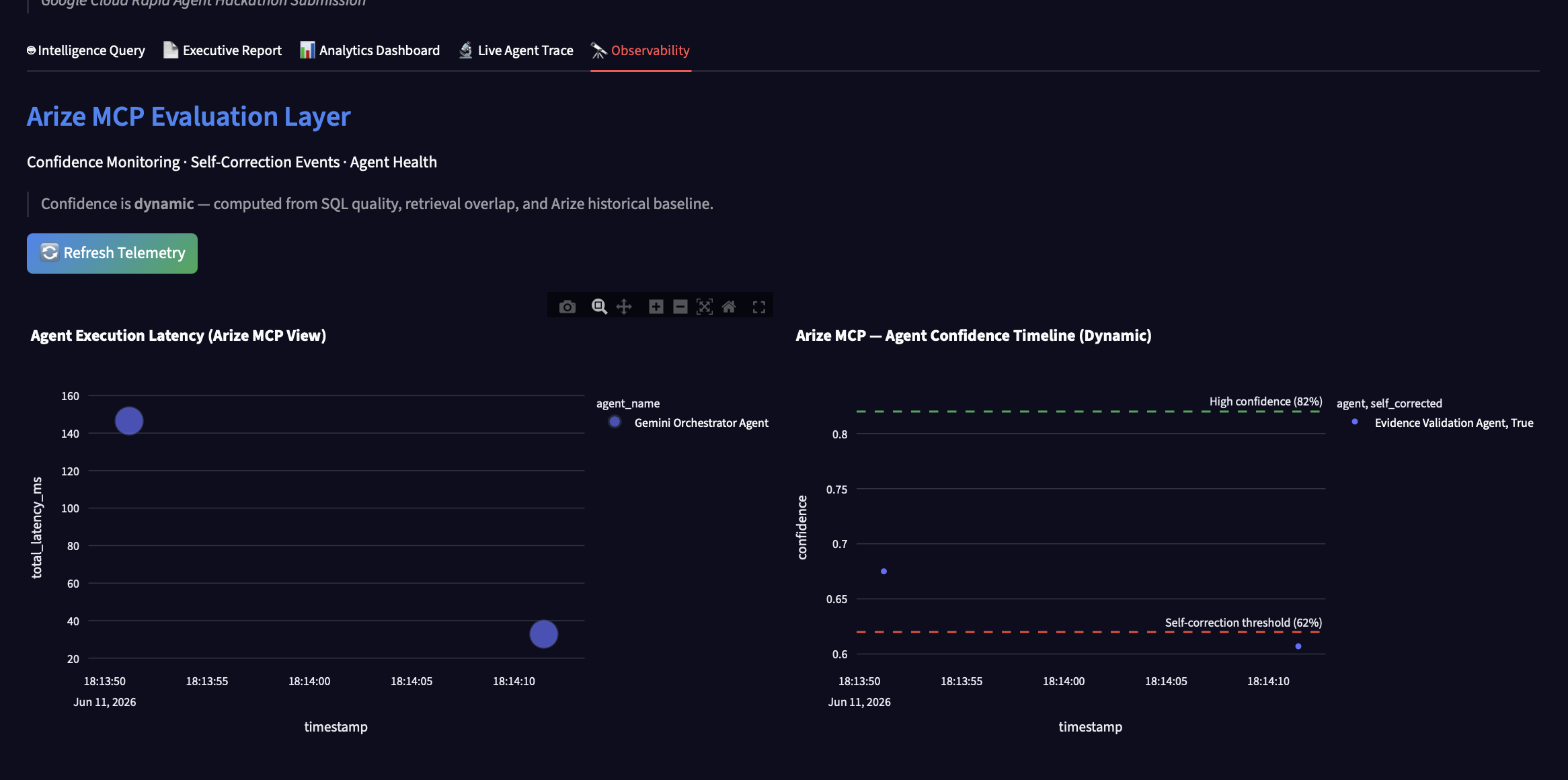
11. Observability Dashboard (Top) Arize Phoenix MCP monitors latency, confidence timelines, and self-correction behavior in real time.
-
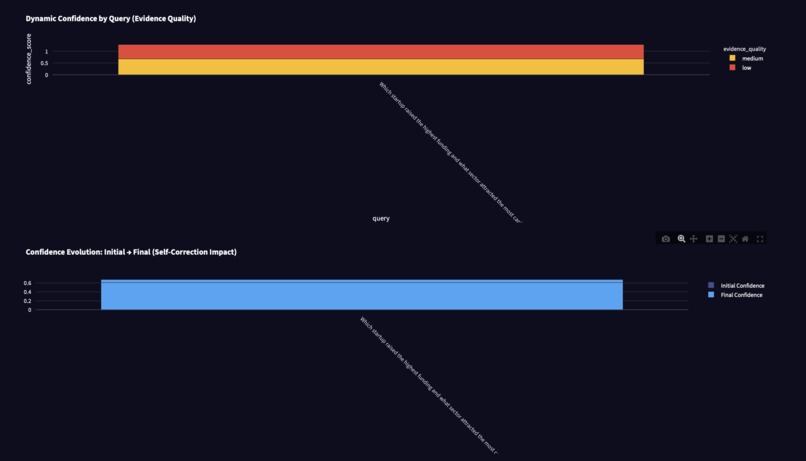
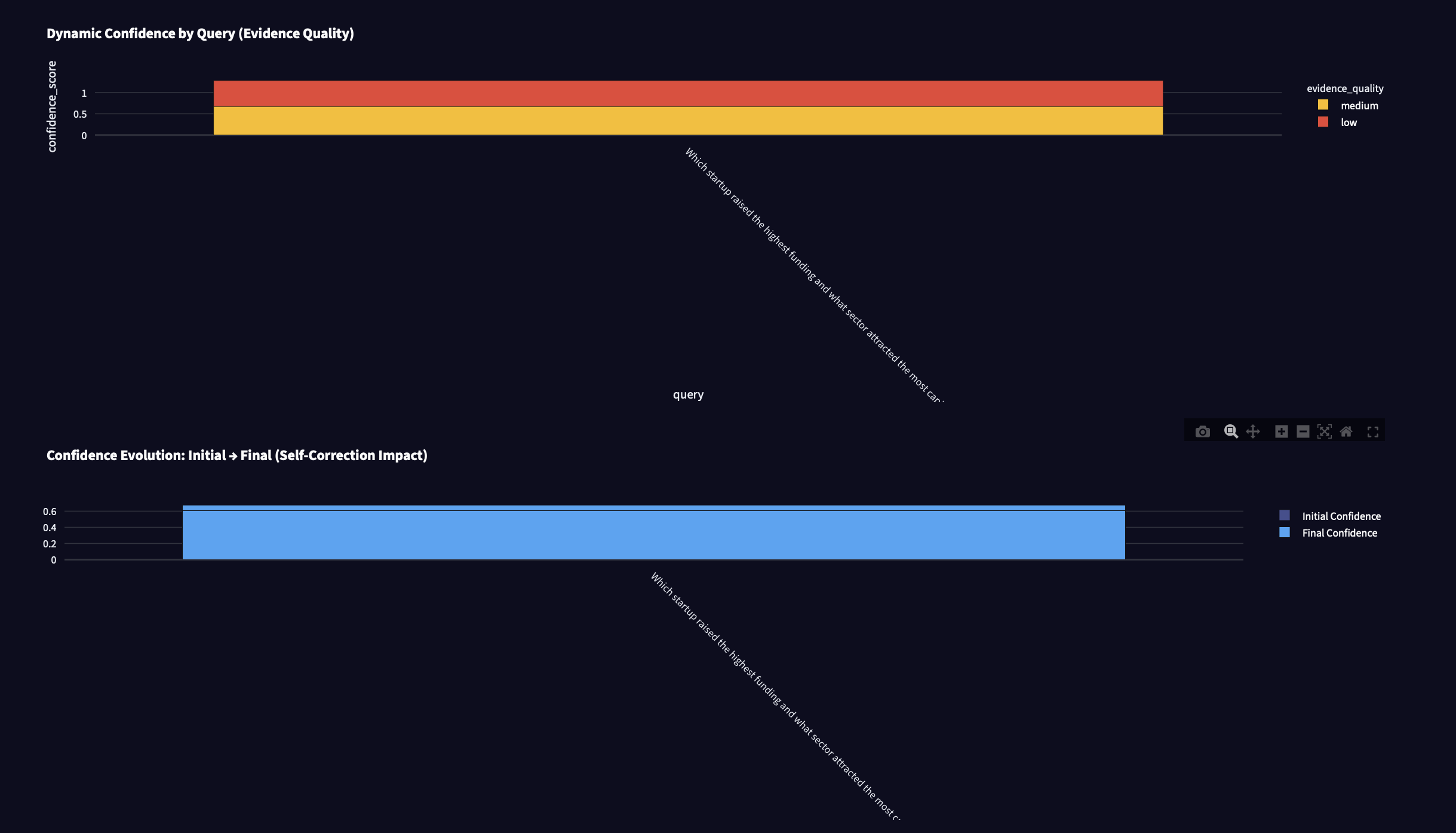
12. Confidence Analytics Track confidence evolution and evidence quality across queries to improve agent reliability.
-
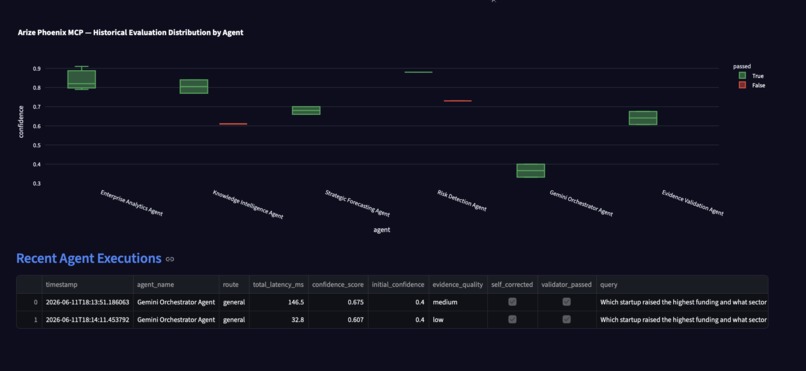
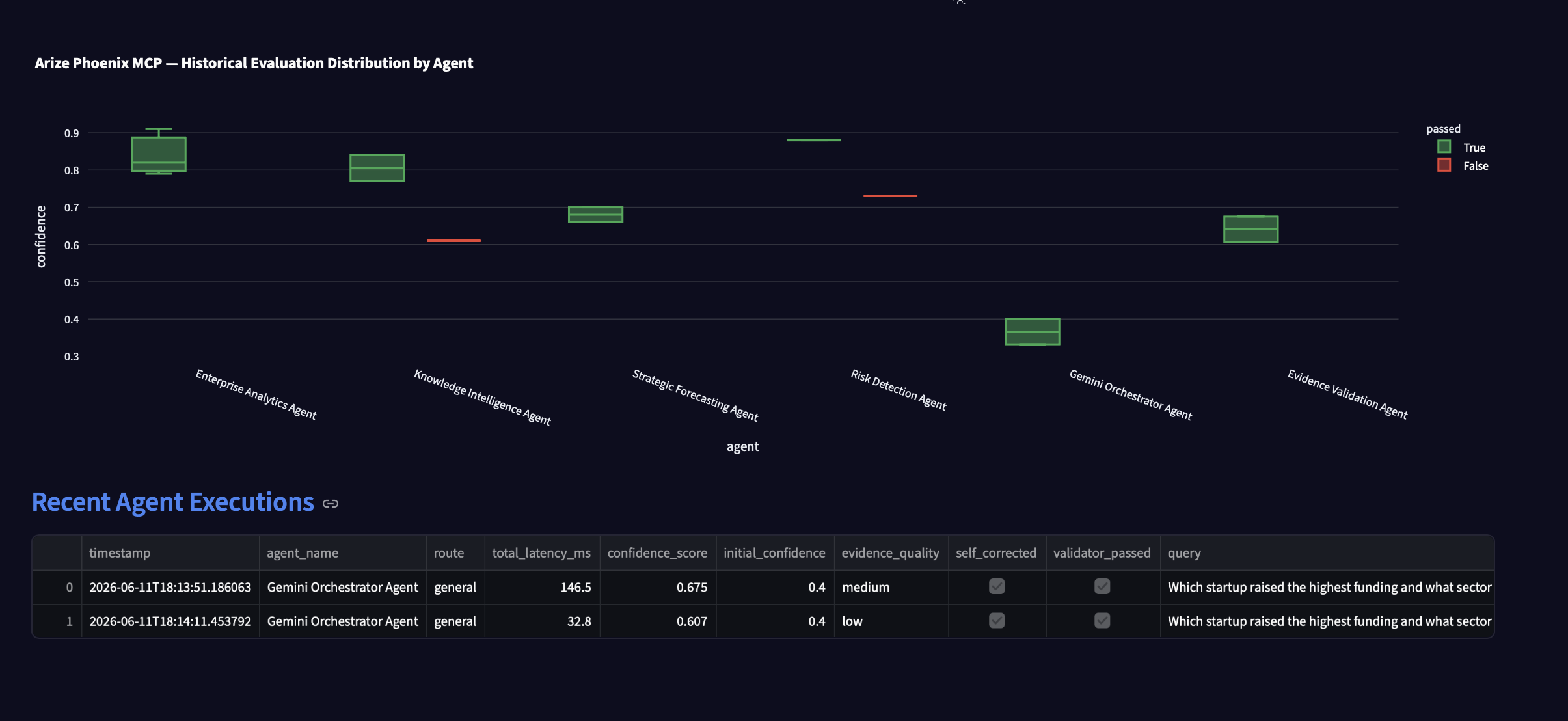
13. Historical Evaluation Analytics Historical agent evaluation trends and execution telemetry powered by Arize Phoenix MCP.
Inspiration
Modern enterprises generate large volumes of structured and unstructured data, yet decision-makers often spend significant time gathering information from multiple systems before making strategic decisions. We wanted to build an AI-powered enterprise intelligence platform that can act as a team of specialized analysts, automatically retrieve evidence, validate findings, explain reasoning, and provide executive-ready insights.
Our goal was to combine Gemini's reasoning capabilities with multi-agent orchestration, retrieval-augmented generation, observability, and evaluation tooling to create a trustworthy enterprise decision-support system.
What it does
ARIA (Gemini Enterprise Intelligence Agent) is a multi-agent enterprise intelligence platform that transforms natural language questions into actionable business insights.
The system:
- Routes queries to specialized agents using intelligent orchestration.
- Supports enterprise analytics, strategic forecasting, knowledge intelligence, and anomaly detection.
- Uses Retrieval-Augmented Generation (RAG) to ground responses in enterprise knowledge.
- Generates executive intelligence reports with evidence-backed recommendations.
- Tracks confidence scores dynamically instead of relying on static confidence values.
- Applies self-correction when evidence quality suggests additional validation is required.
- Integrates Arize Phoenix MCP for evaluation, tracing, annotation, and observability.
- Provides live dashboards, agent traces, and confidence monitoring for transparency.
Example questions include:
- Which startup raised the most funding?
- What are the best practices for RAG architecture?
- Forecast revenue trends for our products.
- Detect anomalies in operational metrics.
How we built it
ARIA was built using a multi-agent architecture powered by Google Gemini.
Core components include:
- Gemini 2.0 Flash for reasoning and agent execution
- LangGraph for agent orchestration and routing
- Retrieval-Augmented Generation (RAG)
- FAISS vector retrieval
- BM25 lexical retrieval
- Reciprocal Rank Fusion (RRF)
- SQLite enterprise data layer
- Arize Phoenix MCP integration
- Plotly interactive analytics dashboards
- OpenTelemetry-based observability
The orchestration layer classifies incoming requests and routes them to specialized agents:
- Enterprise Analytics Agent
- Knowledge Intelligence Agent
- Strategic Forecasting Agent
- Risk Detection Agent
- Evidence Validation Agent
Results are validated, confidence-scored, traced, and visualized through executive reports and observability dashboards.
Challenges we ran into
Building trustworthy AI systems required more than generating answers.
Key challenges included:
- Designing reliable multi-agent routing.
- Combining structured analytics and RAG workflows.
- Developing dynamic confidence scoring mechanisms.
- Preventing unsupported conclusions through evidence validation.
- Integrating evaluation and observability workflows through Arize Phoenix MCP.
- Creating a transparent self-correction mechanism that improves confidence only when supported by additional evidence.
Accomplishments that we're proud of
- Built a complete multi-agent enterprise intelligence platform.
- Implemented dynamic confidence scoring rather than fixed confidence values.
- Added self-correction workflows driven by evidence quality.
- Integrated Arize Phoenix MCP for evaluation and traceability.
- Created executive-ready intelligence reports.
- Built real-time observability dashboards for agent monitoring.
- Developed an explainable decision-support experience with full trace visibility.
What we learned
This project reinforced that enterprise AI requires much more than model quality alone.
We learned the importance of:
- Agent orchestration.
- Evaluation-driven development.
- Observability and tracing.
- Retrieval quality.
- Confidence calibration.
- Human-readable explainability.
Building trustworthy AI systems requires strong validation, monitoring, and evidence-based reasoning in addition to powerful foundation models.
What's next for ARIA – Gemini Enterprise Intelligence Agent
Future improvements include:
- Integration with enterprise knowledge platforms and data warehouses.
- Support for multimodal enterprise intelligence workflows.
- Advanced agent memory and long-term context management.
- Real-time streaming enterprise analytics.
- Expanded evaluation pipelines through Arize Phoenix.
- Automated executive briefing generation and distribution.
- Deployment as a scalable enterprise intelligence platform on Google Cloud.
Our vision is to evolve ARIA into a fully autonomous enterprise intelligence copilot that continuously monitors business signals, validates evidence, and helps organizations make faster, more informed decisions.

Log in or sign up for Devpost to join the conversation.