Inspiration
Meet Mary. She's a volunteer coordinator at a local food bank. Every Tuesday morning, she has 2 hours to check 300 deliveries across 8 drivers before the vans leave — and she's doing it in a spreadsheet.
She can't always catch everything. And sometimes, what she misses matters:
- A client with a severe peanut allergy gets a meal that contains peanuts
- A client in a wheelchair gets assigned a van with no lift
- A family that moved away three months ago still has a delivery scheduled today
We built ARIA so Mary never has to catch those things manually again — and so no one ever gets hurt because a spreadsheet was too hard to check.
What it does
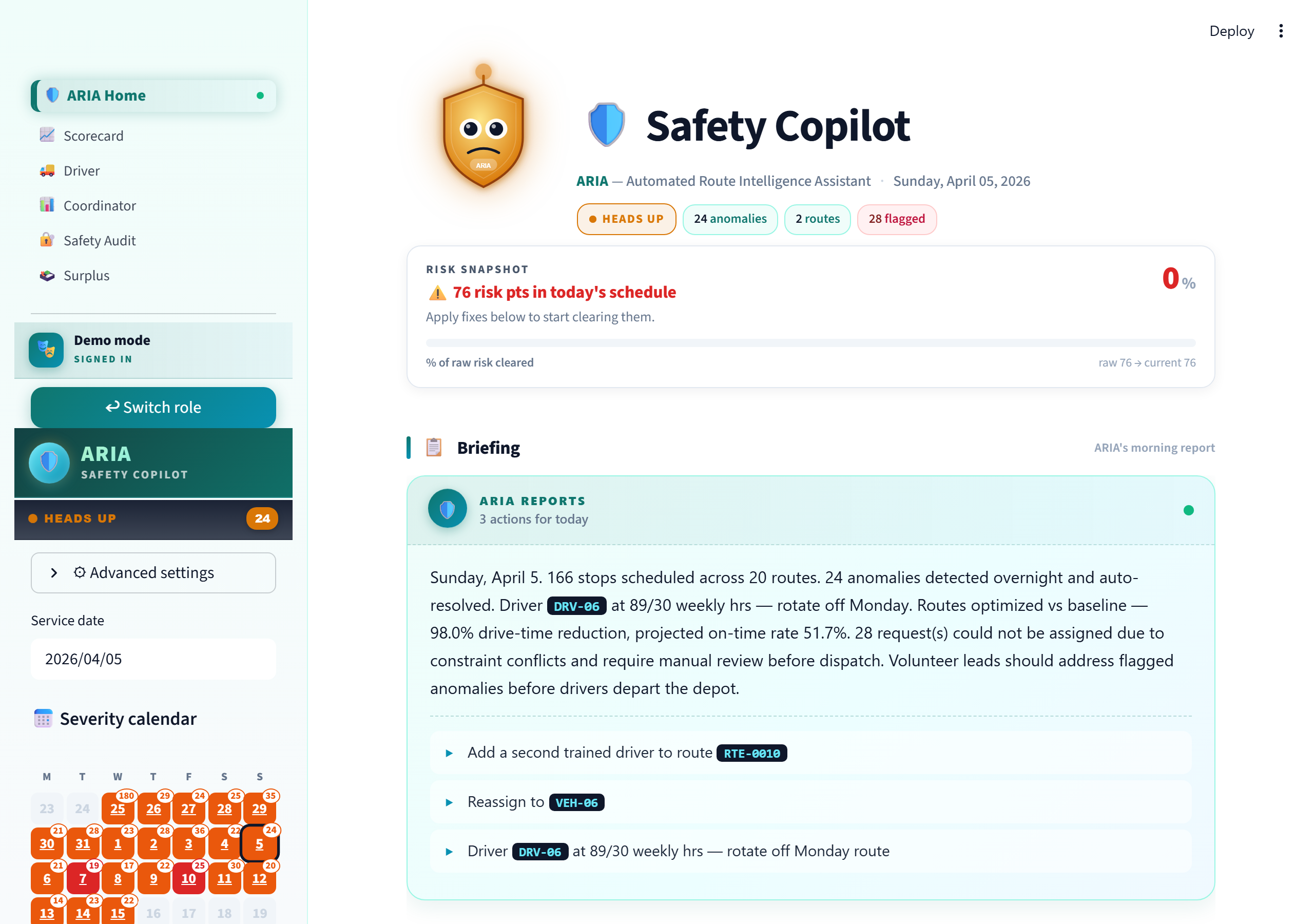
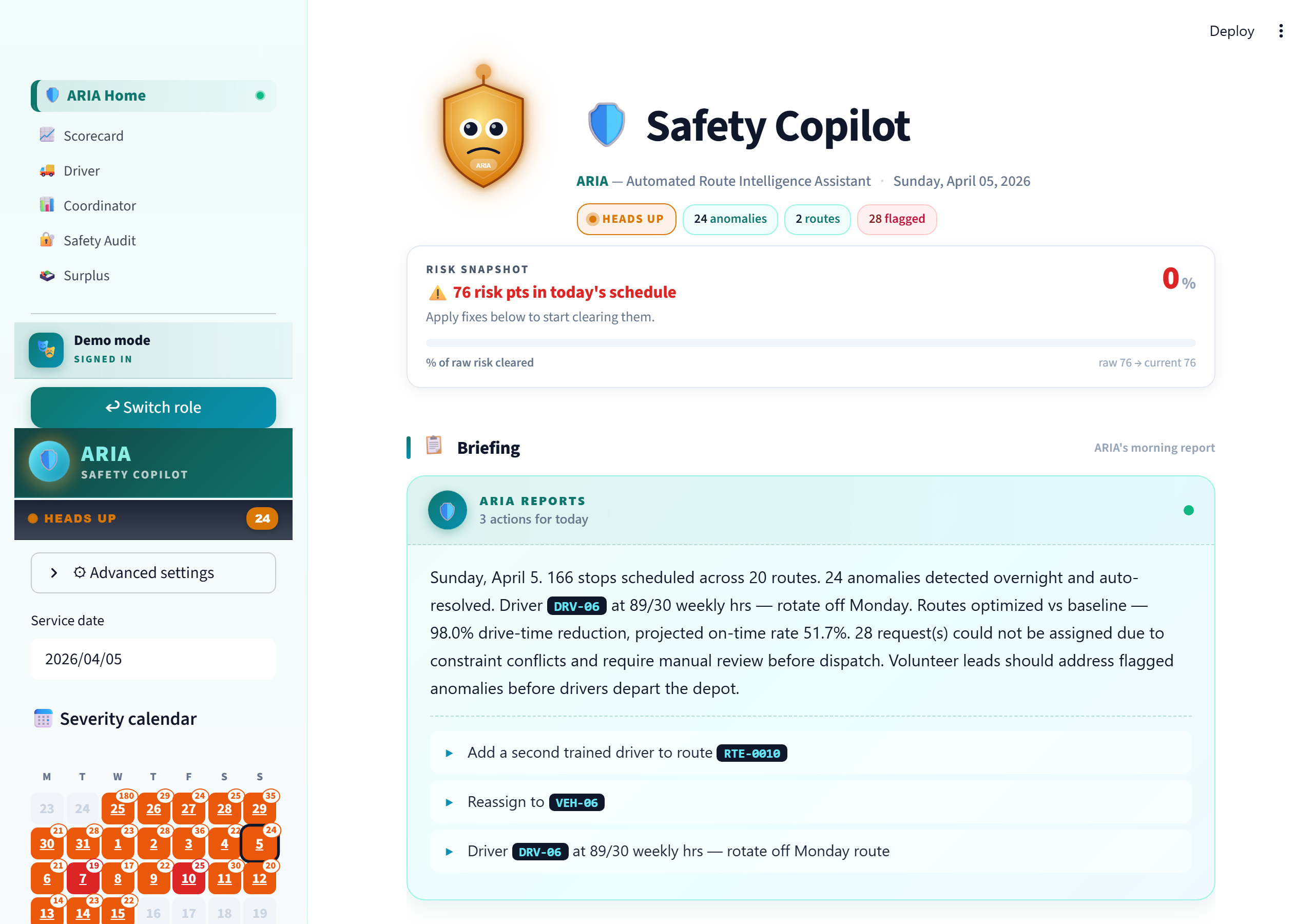
ARIA is a mobile-friendly safety co-pilot for volunteer meal-delivery services. Open it on your phone before the vans leave — it has already scanned every route and flagged every problem.
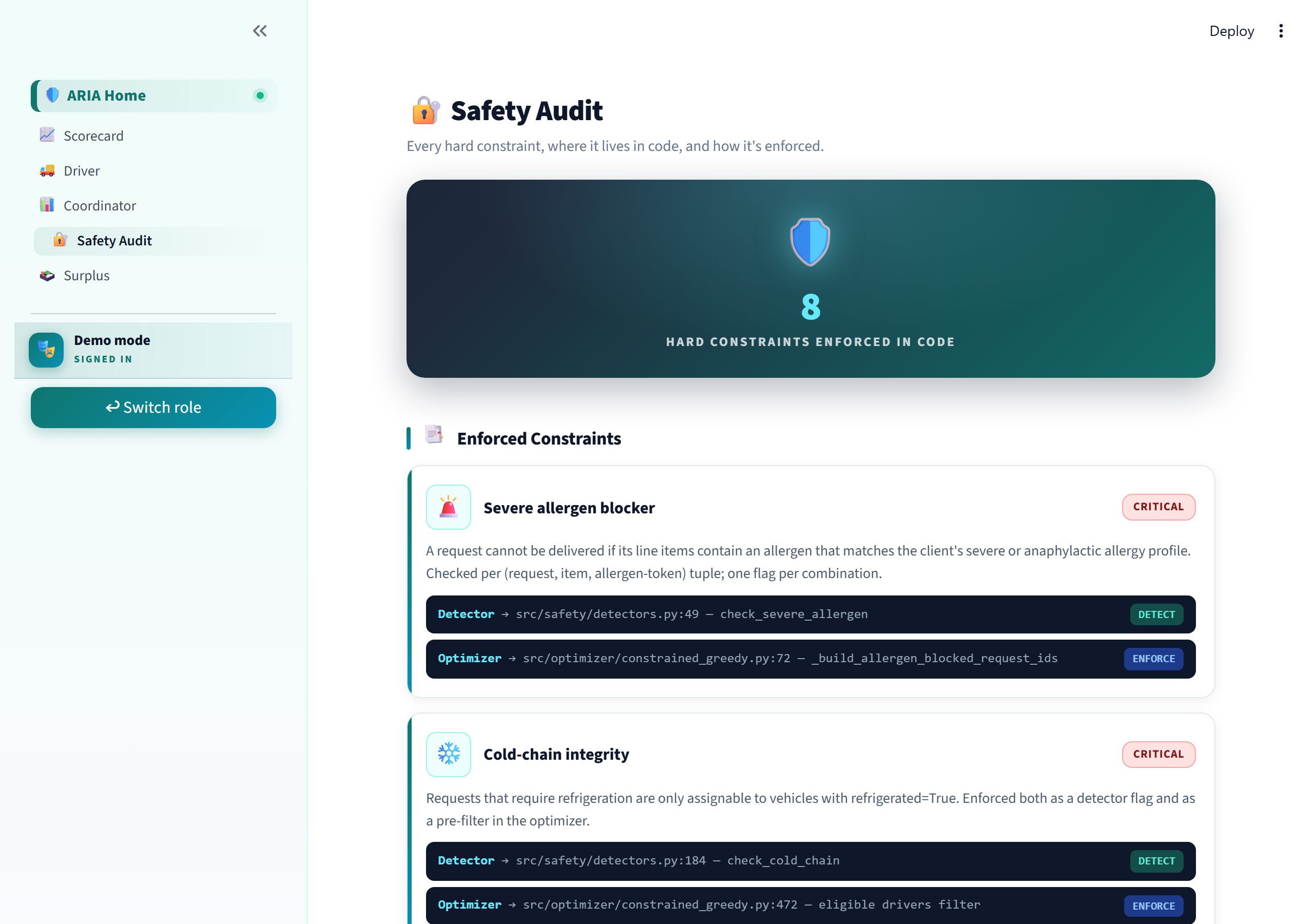
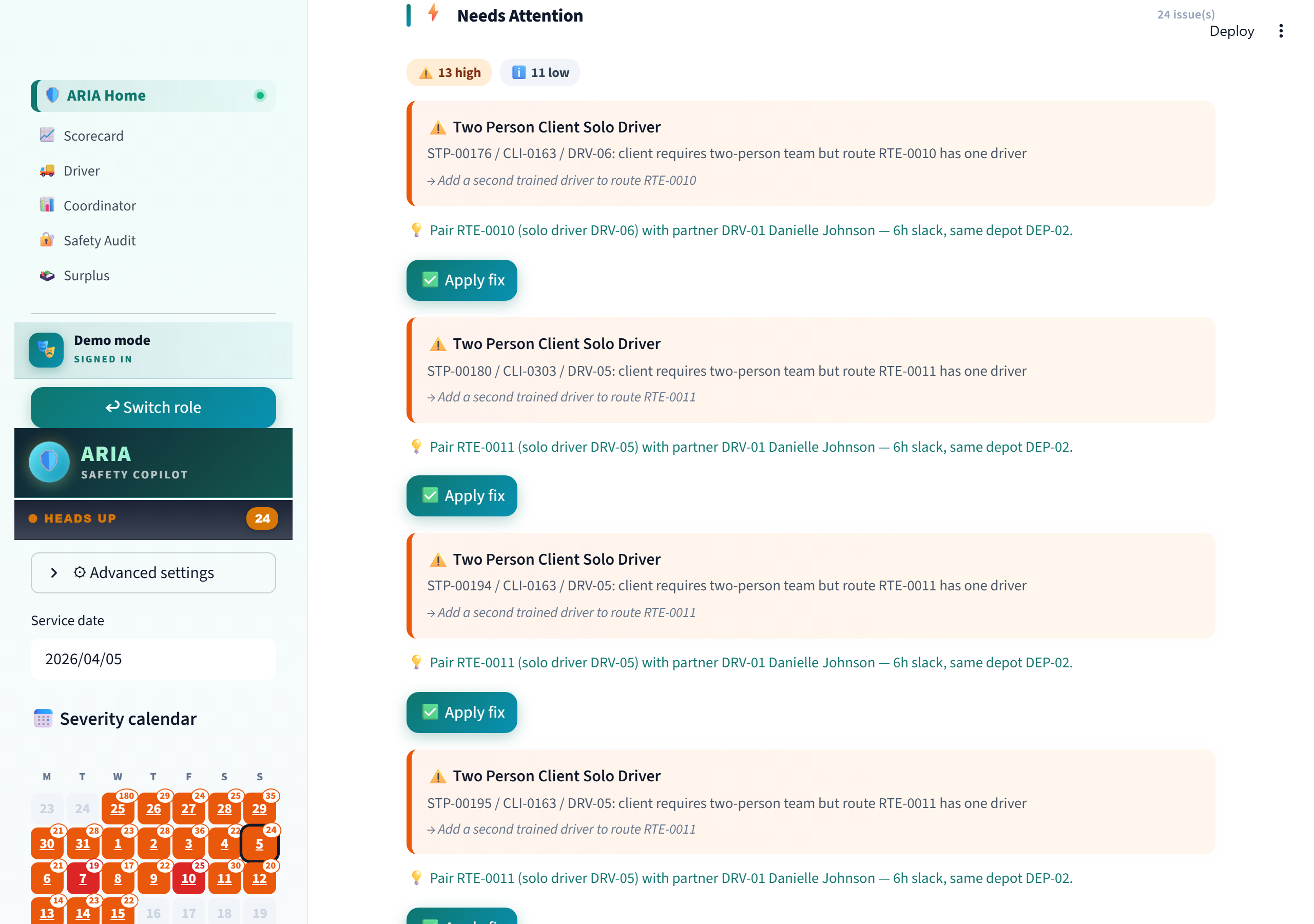
Catches safety risks automatically ARIA runs 8 checks on every delivery, every stop, every item — things like:
- "This meal contains peanuts, but this client has a severe peanut allergy"
- "This client uses a wheelchair, but the assigned van has no lift"
- "This client's file was closed in January — why are we still delivering?"
- "This driver has a pet allergy, but this client has a dog at home"
Fixes them in one tap Every flagged issue comes with a suggested fix. Tap to apply it — ARIA swaps the item, reassigns the vehicle, or cancels the stop. The plan updates instantly.
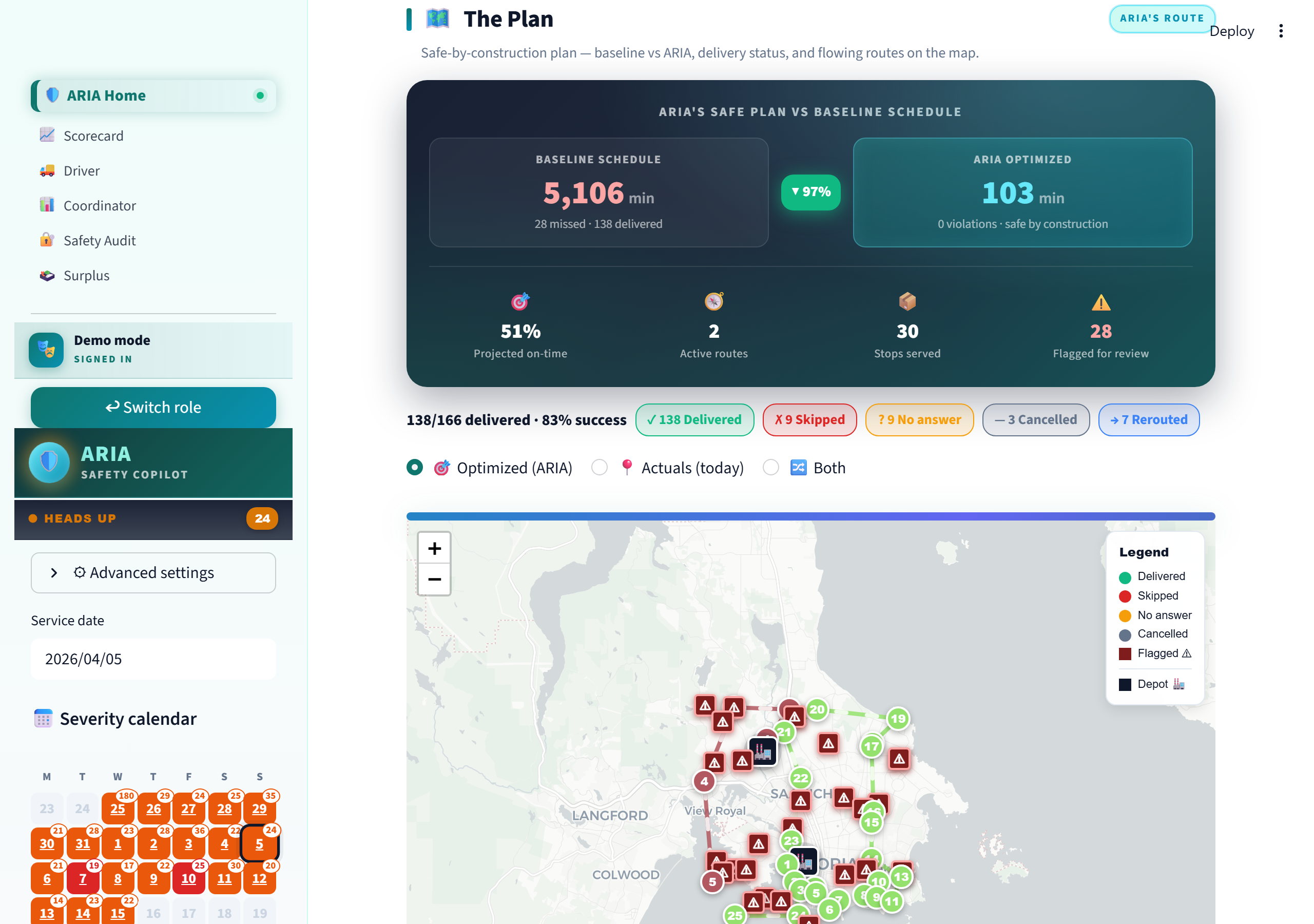
Rebuilds the route safely After fixes, ARIA rebuilds the full delivery plan from scratch — filtering every safety constraint before building a single route. The result: 0 critical violations, versus an average of 15 high-severity issues per day in a manually planned schedule.
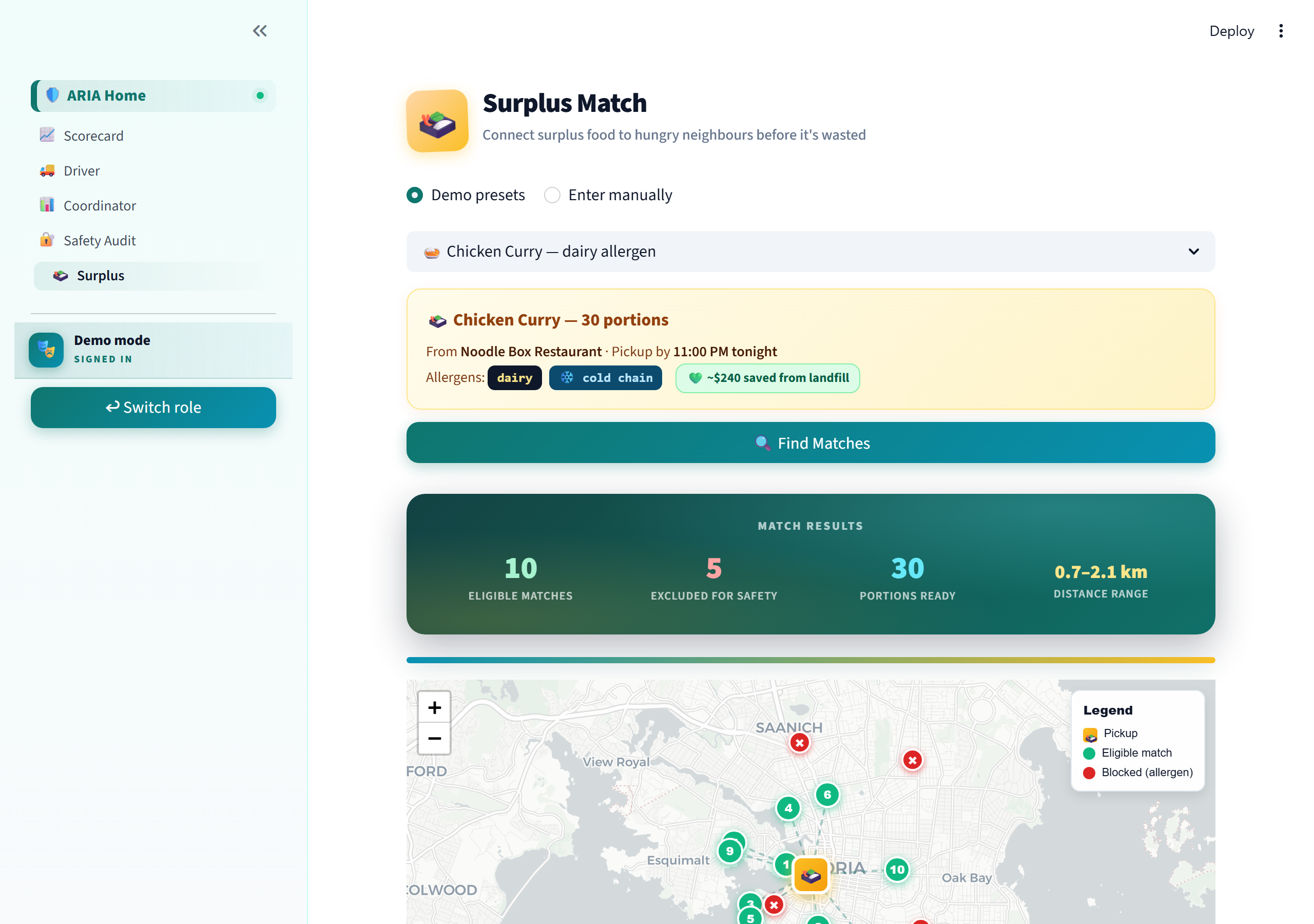
Matches surplus food donations When a local restaurant has leftover food, ARIA finds the highest-need clients nearby who can safely receive it — checking every allergy automatically before making a match. Green pins show eligible clients. Red pins show who is excluded and exactly why — full transparency, zero guesswork.
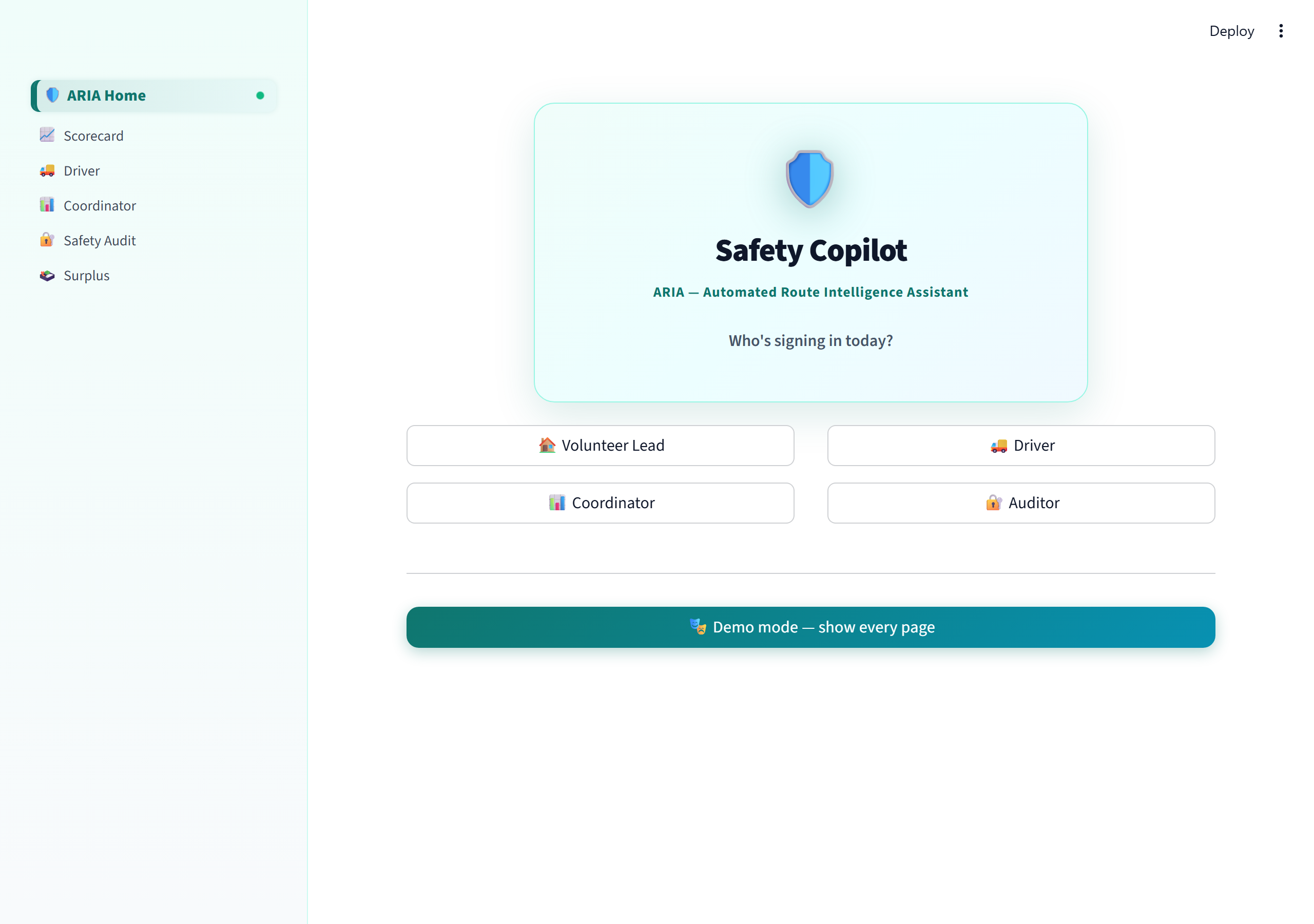
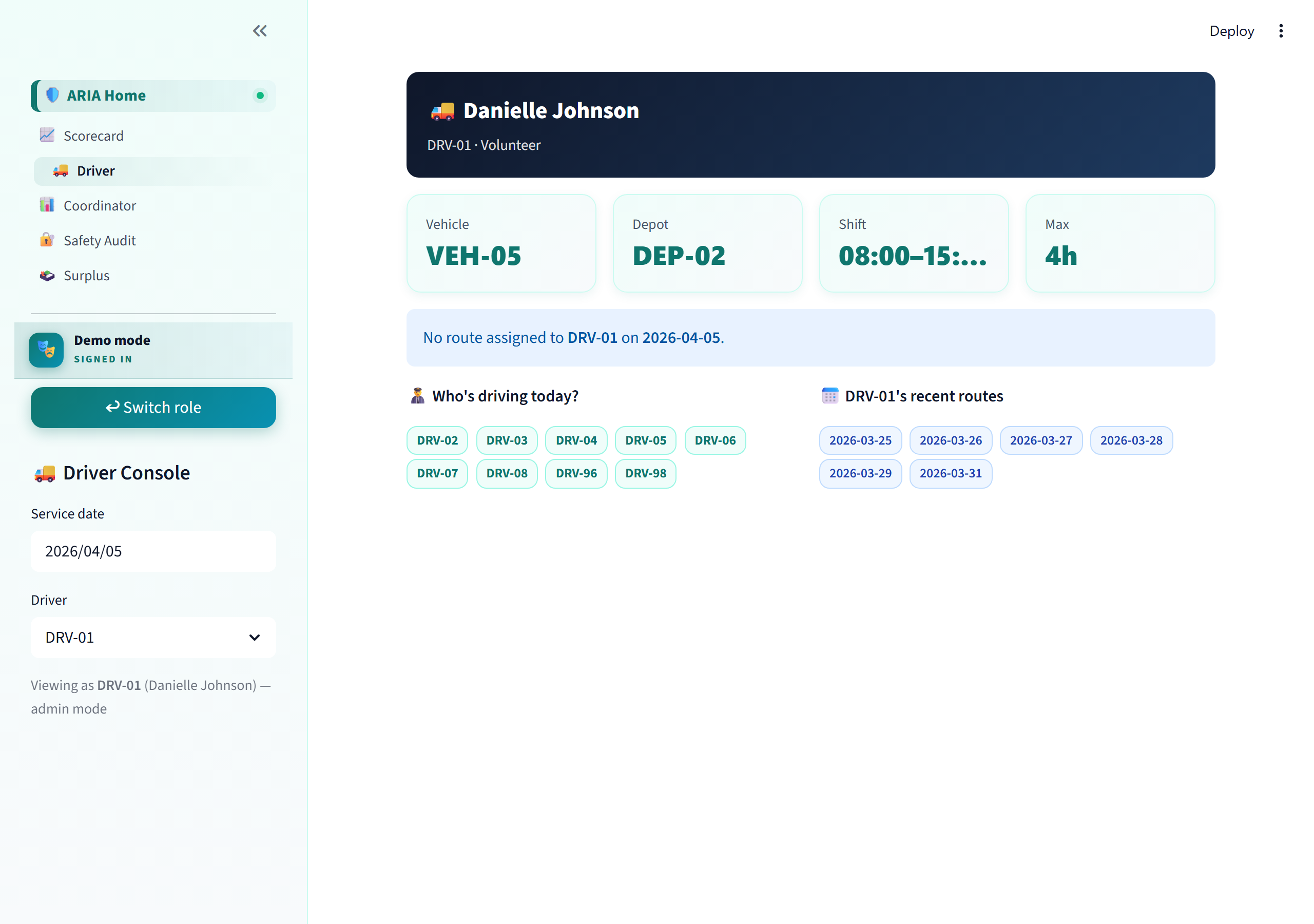
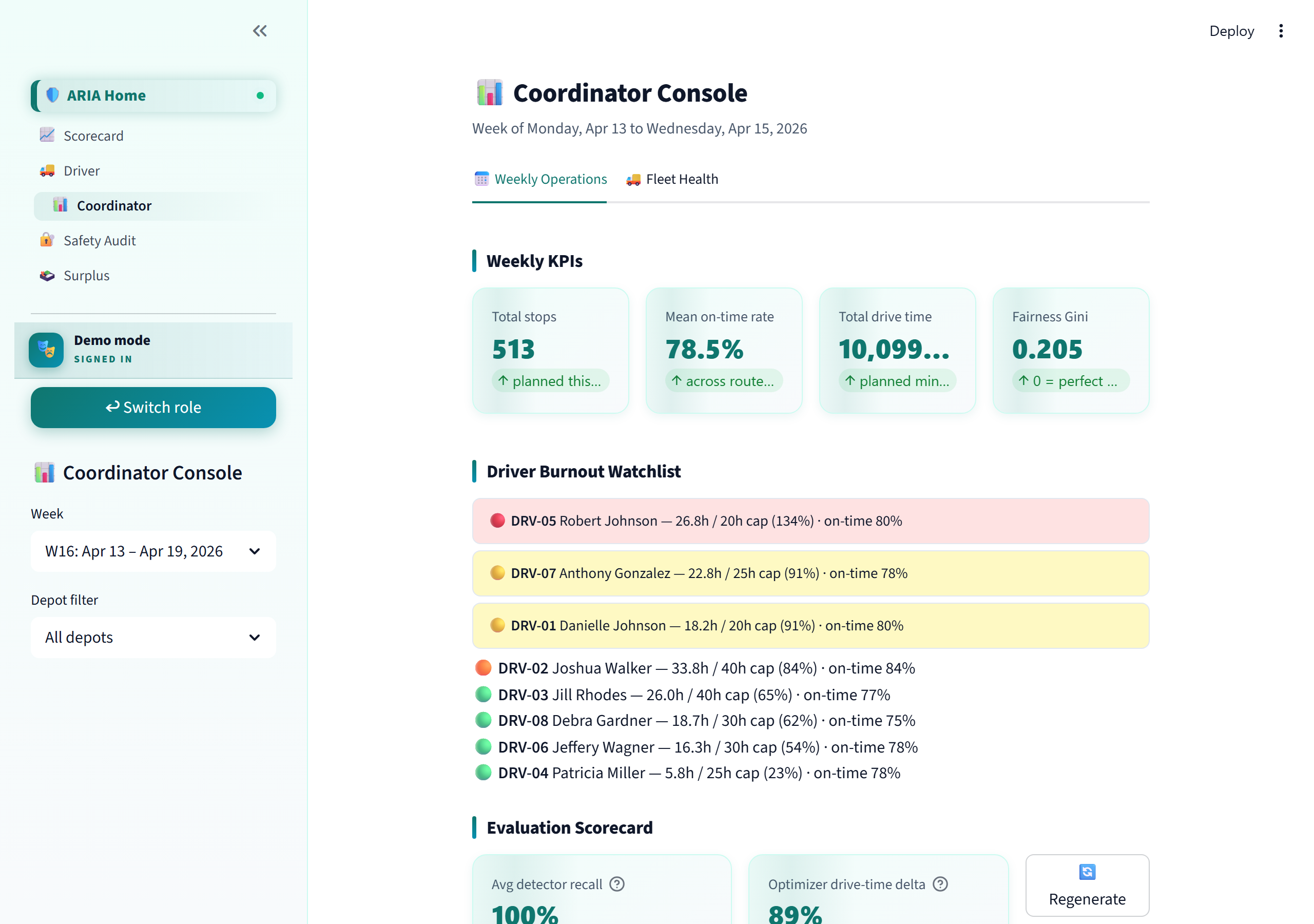
Works for every role, on any device Five role-aware views — dispatcher, driver, coordinator, auditor, and surplus matcher — give each person exactly their screen, nothing more. Fully mobile-friendly. No complex login. Pick your role and go.
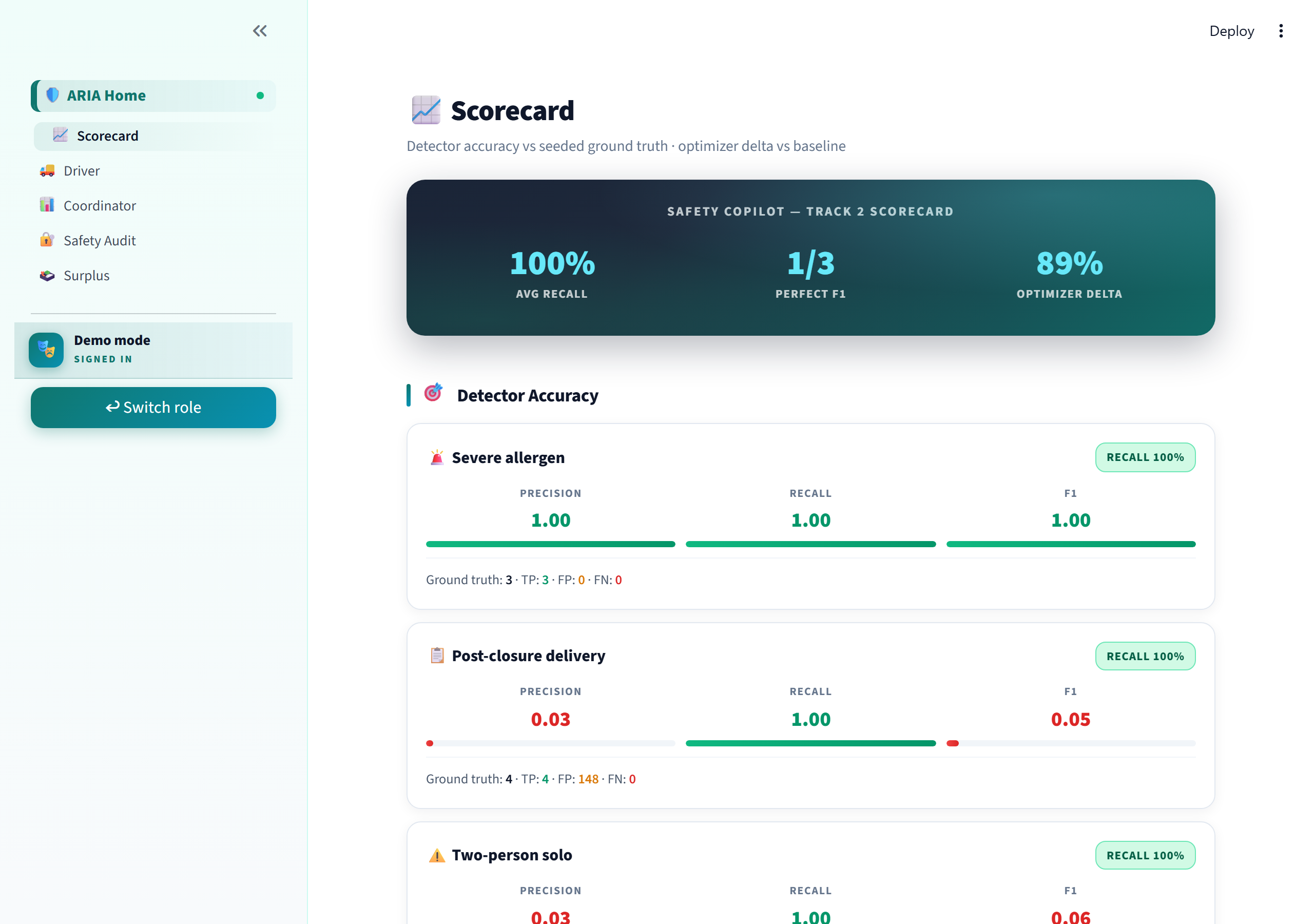
Try everything instantly — Demo mode Judges can tap 🎭 Demo mode on the login screen to unlock every single page in one tap — no role switching, no setup needed. Full access to the dispatcher view, driver stop list, coordinator stats, safety audit, and surplus food matcher. Works on mobile too — just open the link and tap Demo.
How we built it
- Python + Streamlit — fast, lightweight, works on mobile out of the box
- 8 deterministic safety detectors — pure rule-based logic, not a black-box model. Every flag is explainable and traceable to a line of code
- Live fix overlay — fixes are held in memory on top of the original data so the source is never changed. Reset anytime and start fresh
- Safe-by-construction VRP optimizer — filters hard constraints before building routes, not after. The output is guaranteed safe, not just checked
- Folium maps — interactive route maps colour-coded by stop status and violation severity, and a surplus mini-map with green/red pins
- Synthetic dataset — 500 clients, 300 routes, ~24,000 delivery line items, designed to mirror real food bank messiness — mixed date formats, missing fields, and seeded safety violations with known ground truth
- No LLM. No cloud. No internet required. Fully offline — built for organisations with limited IT infrastructure
Challenges we ran into
Making fixes feel instant without breaking the data When a dispatcher taps "fix this," ARIA can't edit the original database — the source data has to stay clean. We built a session overlay system where every fix is applied live on top of the raw data. It feels instant to the user. Getting the caching right so the detector and optimizer always see the correct state took serious iteration.
Handling real-world data messiness Closure dates arrived in four different formats. Allergen tokens needed canonicalisation. Phone numbers came in five formats. Making the detectors catch 100% of known violations reliably across all of that was harder than it sounds.
Designing for a stressed volunteer at 7am on a phone Every UI decision came back to one question: would Mary understand this in 3 seconds on a small screen? Simplicity that feels obvious is never simple to build.
Accomplishments that we're proud of
- Recall = 1.00 — ARIA catches 100% of seeded safety violations across all tested categories. Zero misses.
- 0 CRITICAL + 0 HIGH violations in every optimised output schedule, vs. a baseline average of 15.82 HIGH per day
- 31 automated tests pass — the safety logic is independently verified, not just visually demonstrated
- Fully mobile-friendly — works on a phone in a car park at 7am, which is exactly where it needs to work
- Five roles, one app — dispatcher, driver, coordinator, auditor, and surplus matcher, all from a single codebase with clean separation
- Demo mode — any judge can access every feature in one tap, on any device, with zero setup
- Surplus food matching — directly addresses food waste with full allergy safety built in, going beyond the original problem brief
What we learned
Safety tools only work if real people actually use them. That forced us to design for Mary — not for a judge, not for a demo. A tired volunteer on a small screen, under time pressure, needs something obvious at a glance.
We also learned that explainable beats sophisticated when lives are involved. An LLM could plausibly flag some of these issues — but it couldn't give you recall = 1.00 with a traceable citation for every rule. When someone's health is on the line, you need to prove the system works, not just trust it.
What's next for ARIA — Automated Route Intelligence Assistant
- Live data integration — connect directly to tools like Onfleet or Routific so coordinators don't manually export data
- Push notifications — alert drivers and coordinators in real time when a safety issue is detected mid-route
- Expanded surplus network — let multiple food banks and restaurants join a shared matching pool, increasing donation reach across the city
- Multi-language support — ARIA already detects interpreter language gaps; the next step is making the UI itself available in those languages
- Production auth — replace the role picker with proper OAuth/SSO for real-world deployment
- Community deployment — pilot with a real food bank partner to validate ARIA against live operational data
