-
-
ARIA
Inspiration
ARIA was inspired by the growing need for accessible technology to assist individuals with visual and mobility impairments. The goal is to create a tool that empowers users to navigate spaces independently using augmented reality (AR) for real-time guidance and object recognition.
What it does
ARIA is an Augmented Reality Interactive Assistant designed to help users with visual and mobility impairments navigate complex environments. By utilizing AR, image recognition, and AI, it will provide real-time object identification, step-by-step navigation, and customizable accessibility features, like voice commands and adjustable visual settings.
How it's being built
ARIA is currently in the prototyping phase. It is being developed by integrating AR technology with image recognition and AI. The app will use a camera to detect and identify objects in real-time, overlaying helpful guidance onto the user's environment. The backend will leverage machine learning for object recognition, and cross-platform development tools will be used for the app’s interface and functionality.
Challenges I ran into
One of the major challenges has been ensuring the app’s accessibility across various levels of impairment. Balancing the complexity of the technology with an intuitive, easy-to-use interface is another hurdle, especially when considering real-time navigation and feedback for users with varying needs.
Accomplishments that I am proud of
Even in the prototyping phase, I'm proud of how ARIA addresses a significant accessibility gap by combining cutting-edge AR and AI technologies. The design of the real-time object recognition and navigation system, as well as the customizable user interface, are key milestones that I’m excited to continue refining.
What I learned
I’ve learned the importance of user-centric design, especially when working with vulnerable populations. I’ve also realized that simplifying powerful technologies for ease of use is essential. The feedback received during the prototyping phase has been invaluable for shaping the next steps of development.
What's next for ARIA(Augmented Reality Interactive Assistant)
ARIA is currently in the prototyping phase, but the next step is to build the app and bring it to life. In addition to the core features, new functionalities such as speech recognition will be added to enhance user interaction. These updates will make the app even more accessible and intuitive. ARIA will also expand to cover more environments, like airports and public transport systems, and integrate with smart devices for seamless, multi-platform interaction. Continuous improvement of the AI and object recognition features will be a priority, ensuring that ARIA becomes a powerful tool for empowering users with visual and mobility impairments.
UI Research and Design for Visual Impairments:
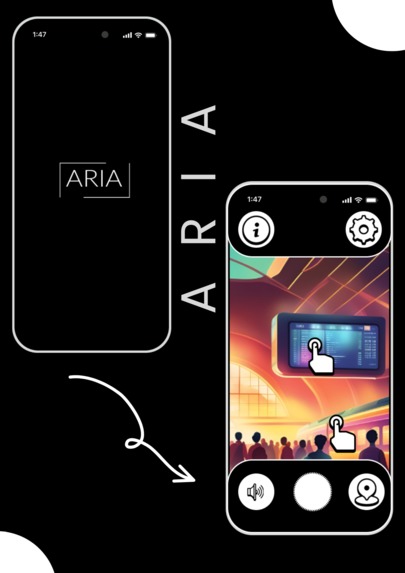
To ensure ARIA is as accessible as possible, I’ve conducted thorough research on UI design for visual impairments. I’ve used color schemes that are high-contrast yet visually comfortable, with options to adjust contrast for users with different vision levels. The buttons have simple, clear shapes to avoid confusion, with a design that’s tactile-friendly for users with limited mobility. I’ve also carefully considered font size and style, opting for larger, Lato fonts that are easy to read, and placed buttons in intuitive locations to make them easily reachable for all users.
Built With
- canva
- figma
- icons8

Log in or sign up for Devpost to join the conversation.