-
-
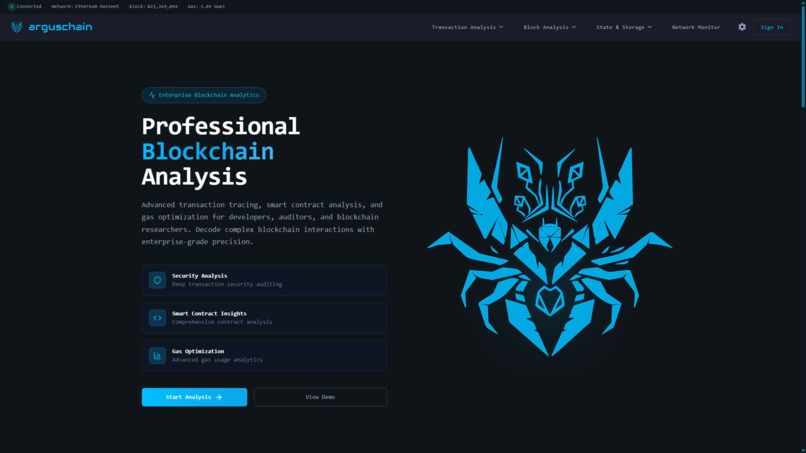
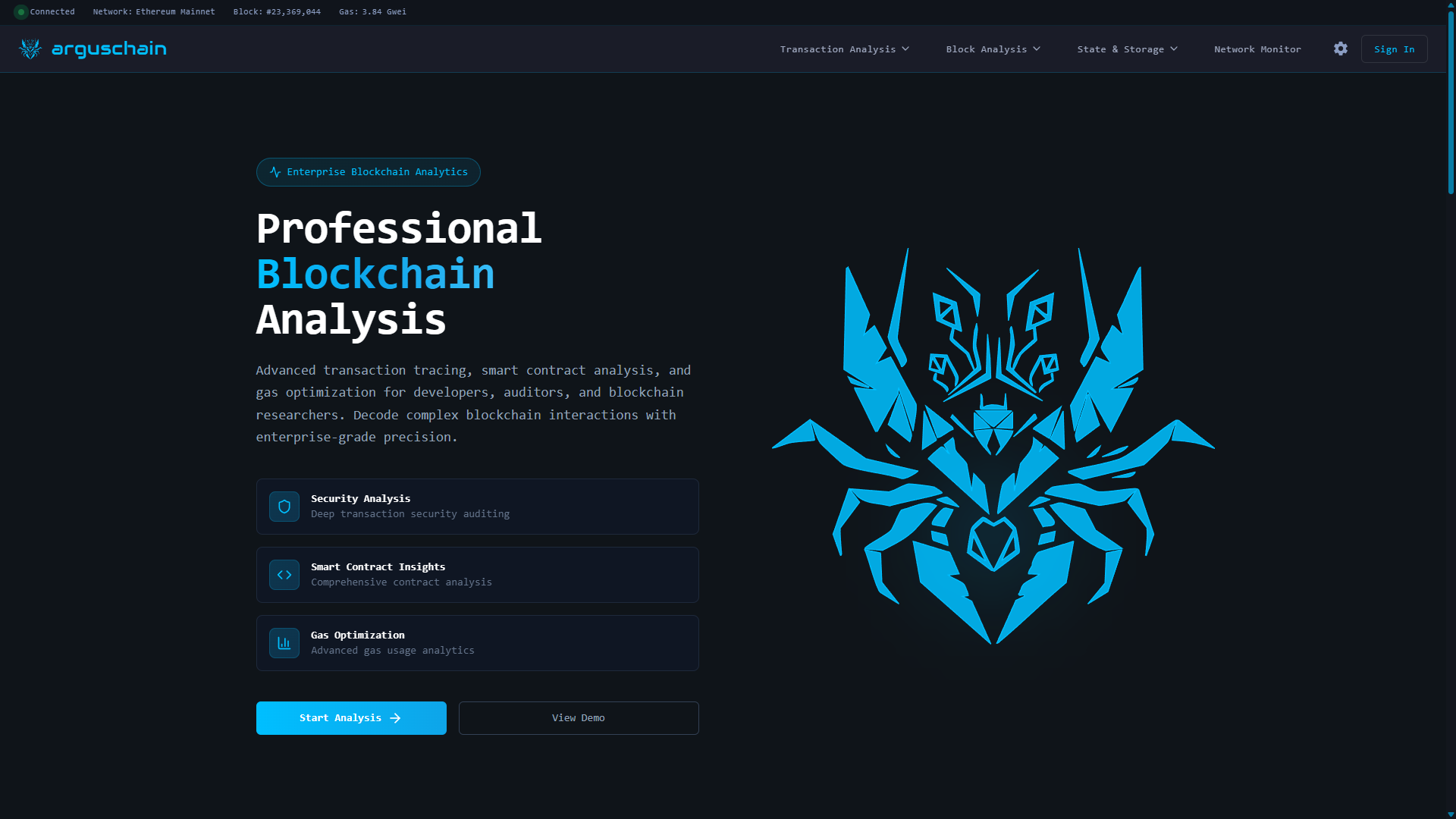
Arguschain: Professional Blockchain Analysis. Advanced tracing, smart contract insights, & gas optimization for enterprise-grade precision.
-
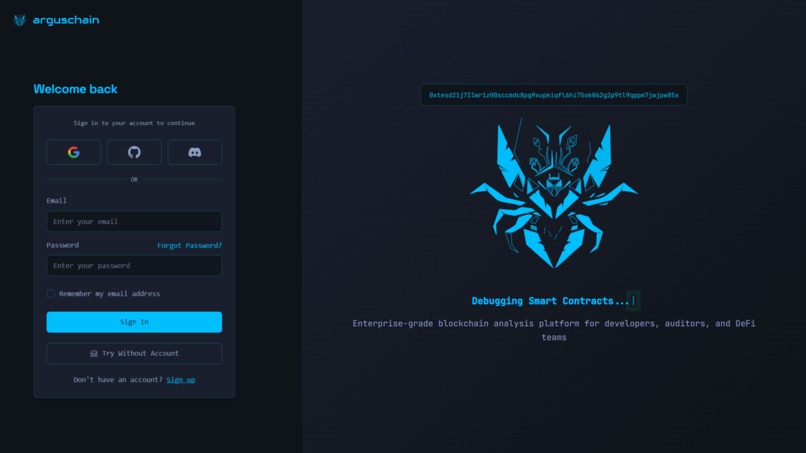
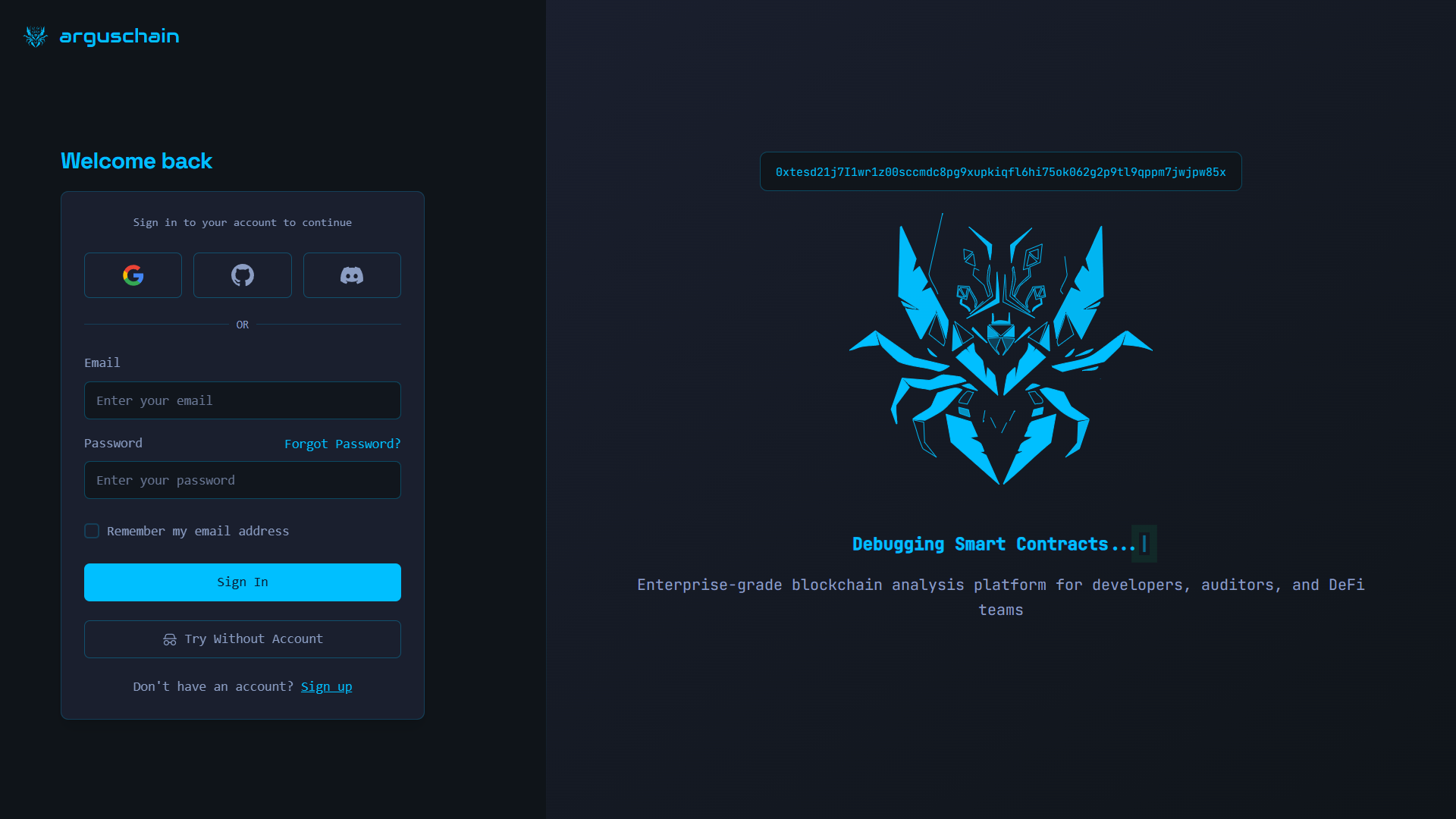
Secure and easy access to Arguschain. Sign in to unlock powerful analysis tools for developers, auditors, and DeFi teams.
-
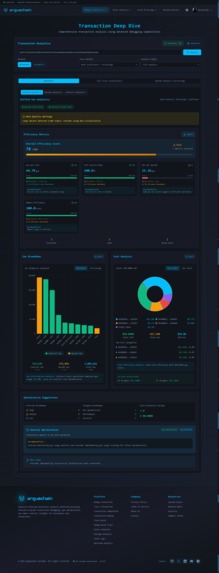
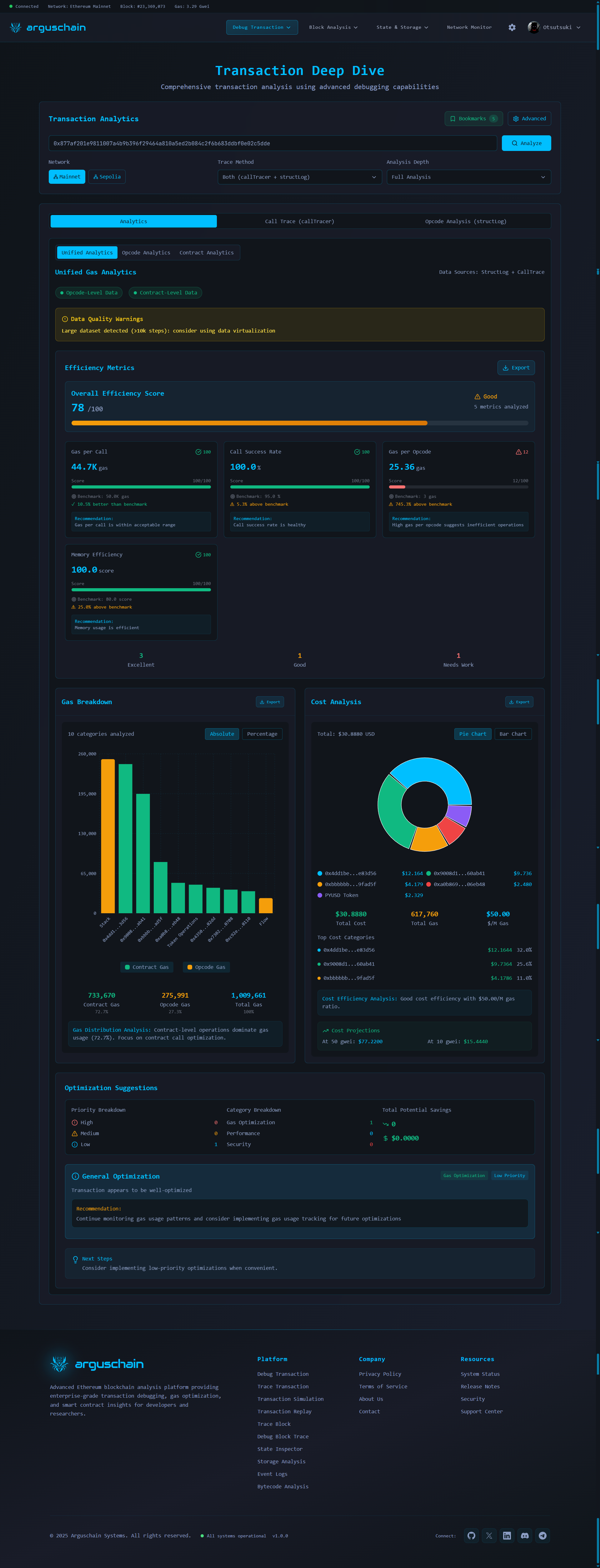
Drill down into transaction efficiency. Our dashboard provides in-depth gas analysis, cost breakdowns, and actionable optimization insights.
-
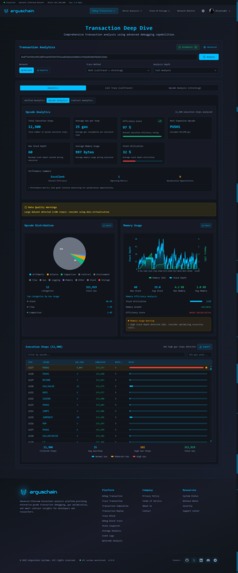
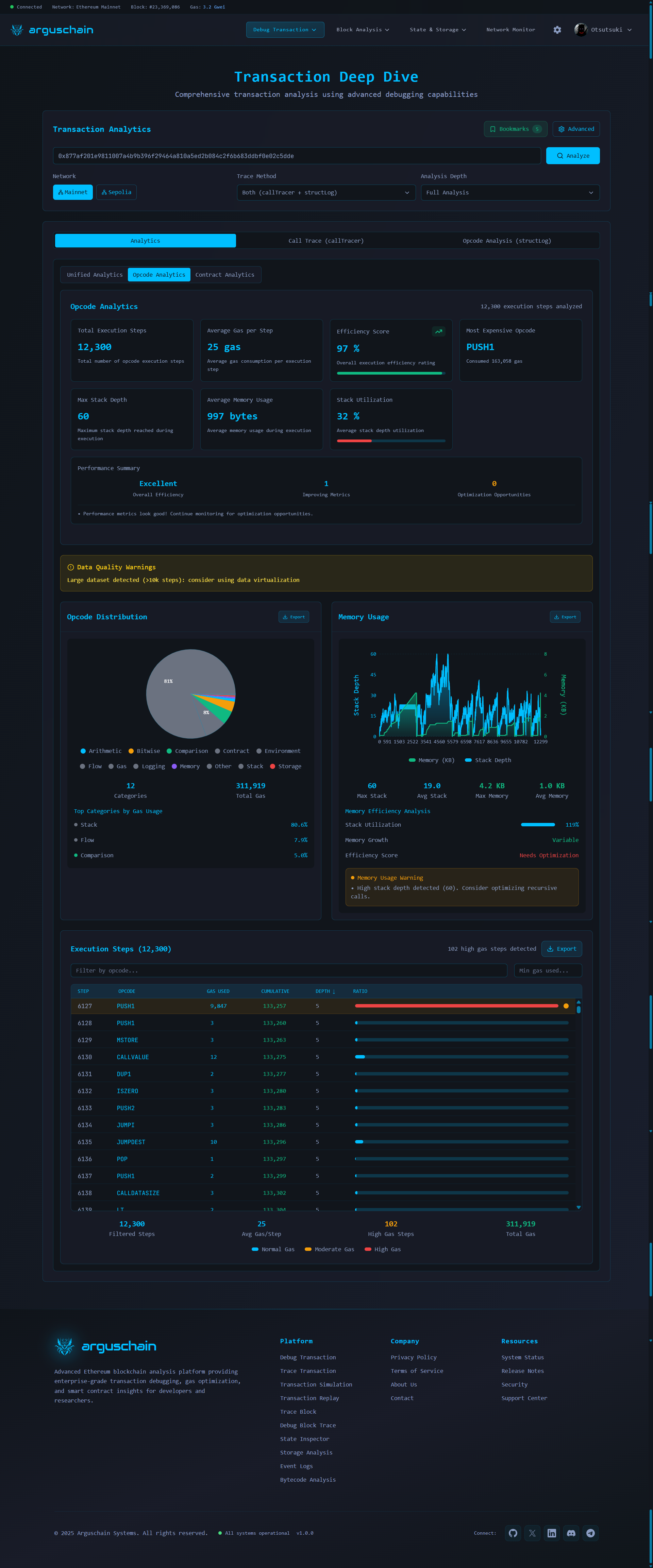
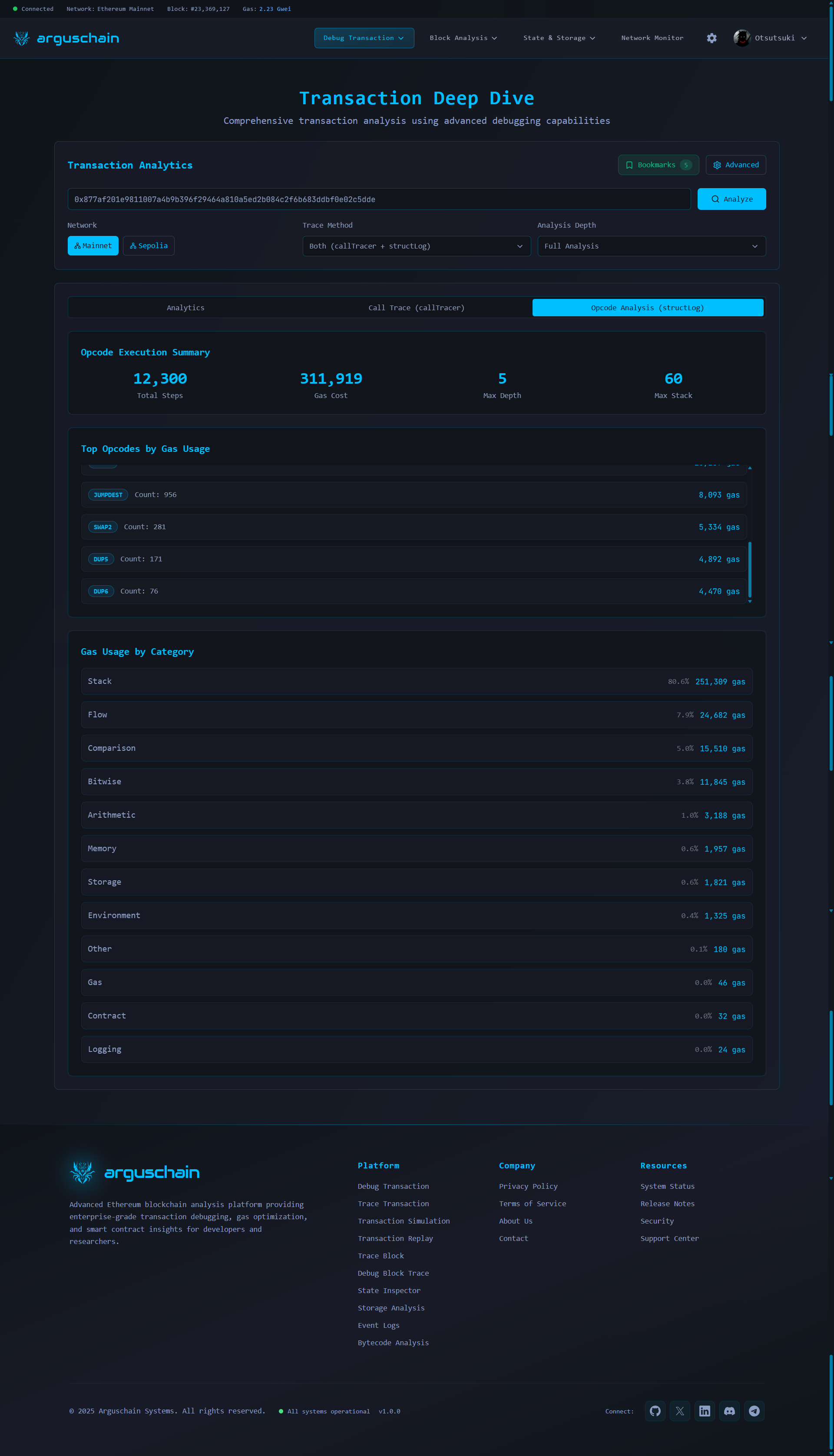
Go granular with Opcode Analytics. Visualize memory usage, opcode distribution, and execution steps to pinpoint inefficiencies.
-
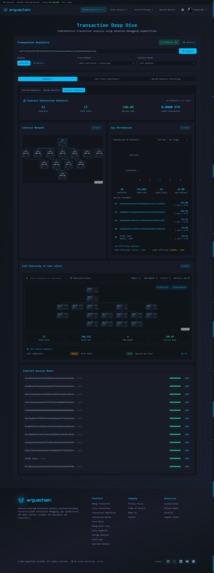
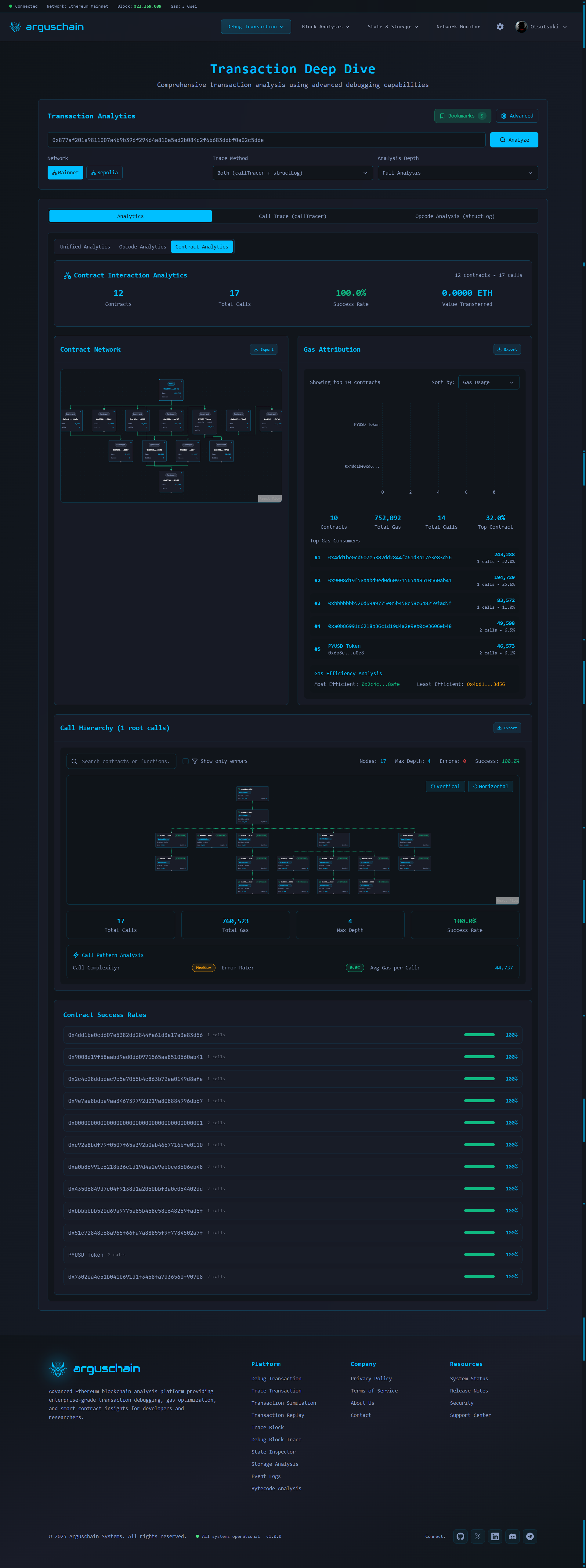
Untangle complex interactions with Contract Analytics. Visualize call graphs and analyze success rates to debug and optimize contracts.
-
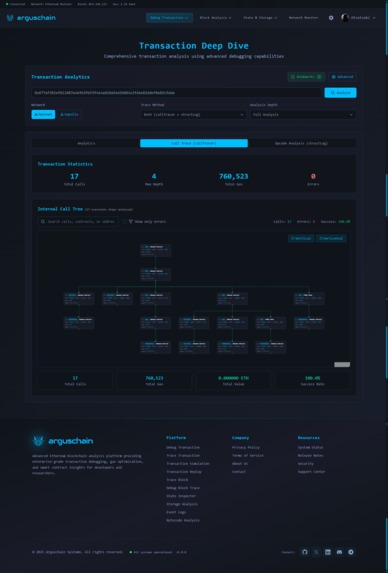
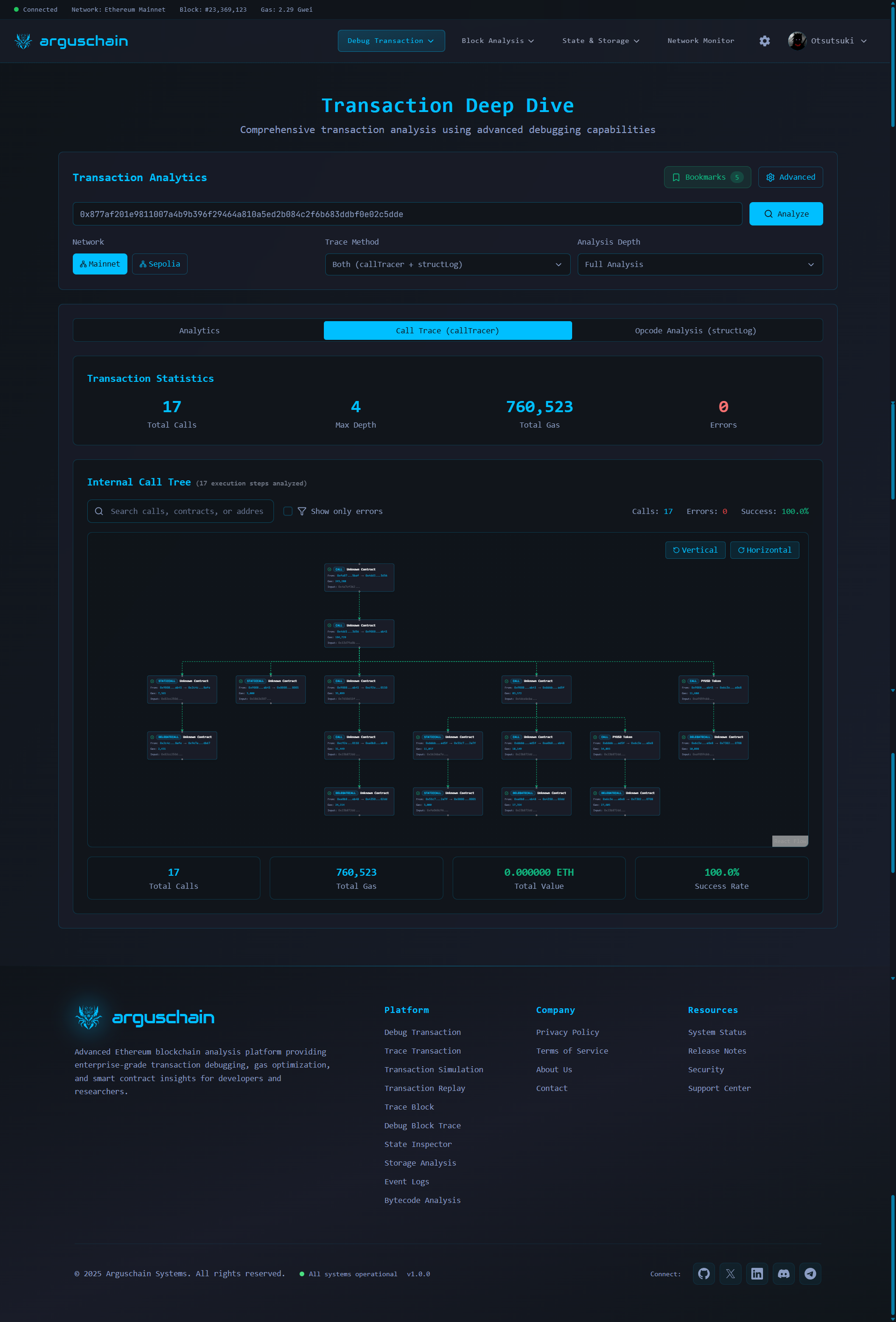
Visualize the execution flow. Our Internal Call Tree maps out all internal calls within a transaction, showing total gas and success rates.
-
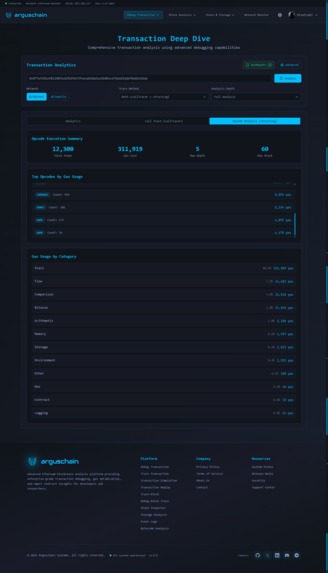
Optimize at the lowest level. See a full breakdown of opcode execution, identifying top gas consumers for targeted performance improvements.
Arguschain: PYUSD Blockchain Analytics Platform
Inspiration
The inspiration for Arguschain came from the growing complexity of blockchain ecosystems, particularly with the rise of stablecoins like PYUSD. As DeFi protocols became more sophisticated and smart contract interactions more intricate, there was a critical gap between basic block explorers and expensive enterprise analytics tools. Developers, security auditors, and researchers needed deeper insights into transaction execution flows, token transfer patterns, smart contract architecture, storage state analysis, mempool dynamics, and block-level transaction analysis.
PYUSD's adoption highlighted the need for specialized tools to monitor supply dynamics, track balance changes, detect suspicious activities, and ensure compliance. Traditional tools lacked the depth for opcode-level debugging, proxy pattern detection, and real-time mempool monitoring. Arguschain was born to bridge this gap, creating a unified platform that combines advanced analysis methods focused on PYUSD forensics, providing enterprise-grade capabilities accessible to all blockchain professionals.
This project was also inspired by the potential of AI-assisted development. Using Kiro AI Assistant, we aimed to demonstrate how spec-driven workflows could accelerate complex software engineering, turning ambitious visions into production-ready code through systematic architecture and implementation.
What it does
Arguschain is a comprehensive Ethereum blockchain analytics platform specializing in PYUSD analysis, featuring several advanced capabilities:
- Transaction Tracing: Deep forensics with
debug_traceTransaction(callTracer & structLog) for PYUSD flow analysis, MEV detection, and gas optimization. - Event Logs Analysis:
eth_getLogsfor PYUSD transfer tracking, volume metrics, participant ranking, and network topology. - Bytecode Forensics:
eth_getCodewith proxy detection (Transparent, UUPS, Diamond), security pattern recognition, and contract comparison. - Block-Level Analysis:
trace_blockfor PYUSD block transaction categorization, gas analytics, and token flow visualization. - Debug Block Tracing:
debug_traceBlockByNumber/Hashfor advanced block debugging and performance insights. - Transaction Replay:
trace_replayTransaction/BlockTransactionswith state diff analysis, VM tracing, and security monitoring. - Storage Inspection:
debug_storageRangeAtfor PYUSD balance tracking, ERC-20 pattern detection, and storage mapping. - Mempool Monitoring:
txpool_content/inspectfor real-time PYUSD transaction pool analysis and congestion tracking. - Transaction Simulation:
debug_traceCallfor testing, gas estimation, and error analysis.
The platform offers 40+ interactive visualizations (Recharts, React Flow, D3.js), multi-format exports (CSV, JSON), WCAG 2.1 AA accessibility, and intelligent caching for massive datasets. Core logic for RPC integration, error recovery, and analytics processing was implemented by Kiro AI, while the team handled UI styling, responsive design, and component integration.
How we built it
Development Methodology
Arguschain was built through a revolutionary spec-driven development methodology using Kiro AI Assistant for core architecture and logic, with the team focusing on UI/UX styling, responsive layouts, and component integration:
Architecture Planning: Kiro established feature-based organization (
components/[feature]/,lib/[feature]/,hooks/use[feature]*) with centralizedBlockchainServicefor multi-RPC management and failover—as seen in blockchainService.ts with intelligent provider detection, 8-second timeouts, and block validation.Spec-Driven Implementation: Detailed specifications (
.kiro/specs/[feature]/) guided Kiro to generate complete implementations, including 25+ TypeScript interfaces, service layers, and analytics processors per feature. The team customized UI components like AuthCard.tsx (OAuth flows, form validation) and Navbar.tsx (mobile-responsive navigation with dropdowns).Progressive Feature Development: Built iteratively across sessions:
- Foundation: React 19.1.1, TypeScript 5.9.2, Vite 7.1.5, ethers.js 6.15.0—Kiro handled RPC stubs and error handling
- Core Services: Kiro implemented 12+ specialized client-side services (e.g.,
TransactionTracer,StructLogTracer) with RPC integration, as in DebugTrace.tsx's progressive loading and unified gas analytics - UI Layer: Team styled custom components along with shadcn/ui with Radix, Tailwind CSS 3.4.17, Framer Motion for animations, and 25+ accessible components, enhancing Kiro's generated layouts
- Analytics Engine: TanStack Query 5.83.0 for data fetching, Zod 4.0.5 for validation, multi-layer caching (memory, localStorage, IndexedDB)
- Visualization Suite: Recharts for charts, React Flow for networks, D3.js for custom graphs—team integrated with Kiro's data processors
- User Management: Supabase integration for auth, anonymous sessions, OAuth, and profile management—team refined UI flows
Performance Optimization: Kiro's virtualization (react-window), lazy loading, memoization, and progressive loading for datasets >10,000 items, with team optimizations for smooth rendering.
Quality Assurance: ESLint 9.31.0, Prettier 3.6.2, comprehensive error handling (e.g., retry mechanisms in DebugTrace.tsx), and WCAG compliance throughout—team ensured UI accessibility.
AI-Assisted Development: Kiro's automated documentation updates, code quality enforcement, feature integration, and performance monitoring via development hooks.
Comprehensive Multi-Analysis Architecture
The project follows a sophisticated frontend-only architecture optimized for comprehensive blockchain forensics, real-time monitoring, and advanced analytics across 12+ analysis domains:
Client-Side Service Architecture:
BlockchainService- Centralized RPC provider management with intelligent failover and network switchingBlockTraceService- Complete block analysis usingtrace_blockwith transaction categorization and gas analyticsDebugBlockService- Advanced debug capabilities usingdebug_traceBlockByNumber/debug_traceBlockByHashBytecodeService- Smart contract forensics usingeth_getCodewith proxy detection and security analysisStorageService- Contract storage inspection usingdebug_storageRangeAtwith ERC-20 pattern detectionReplayService- Transaction replay analysis usingtrace_replayTransaction/trace_replayBlockTransactionsLogsService- Event analysis usingeth_getLogswith comprehensive analytics processingSimulationService- Transaction simulation usingeth_call/debug_traceCallwith state forkingMempoolService- Real-time mempool monitoring usingtxpool_content/txpool_inspectTraceTransactionService- Advanced transaction analysis with MEV detection and pattern recognition
Feature-Based Organization: Domain-driven frontend architecture with dedicated directories for each analysis type:
- Components:
components/blocktrace/,components/debugblock/,components/bytecode/,components/storagerange/,components/replaytransactions/,components/eventlogs/,components/tracetransaction/,components/transactionsimulation/,components/mempool/ - Services:
lib/blocktrace/,lib/debugblock/,lib/bytecode/,lib/storagerange/,lib/replaytransactions/,lib/eventlogs/,lib/tracetransaction/,lib/transactionsimulation/,lib/mempool/ - Hooks:
hooks/useBlockTrace.ts,hooks/useDebugBlockAnalytics.ts,hooks/useBytecodeAnalysis.ts,hooks/useStorageAnalysis.ts,hooks/useReplayTransactions.ts,hooks/useLogsAnalytics.ts,hooks/useTraceTransactionAnalysis.ts,hooks/useTransactionSimulation.ts,hooks/useMempoolData.ts
- Components:
Advanced Frontend Analytics Engine: Multi-dimensional client-side analysis capabilities:
- Statistical Processing: Volume metrics, participant ranking, transfer pattern analysis, network topology calculations
- Pattern Recognition: AI-powered detection for proxy patterns, security features, MEV opportunities, and suspicious activities
- Gas Analytics: Comprehensive gas usage analysis, optimization recommendations, and efficiency scoring
- Token Flow Analysis: Network topology analysis with hub identification, PYUSD-specific analytics, and risk assessment
- Security Analysis: Comprehensive security pattern detection, vulnerability identification, and risk scoring
- Performance Monitoring: Real-time KPI tracking, system optimization metrics, and network condition analysis
Comprehensive Visualization Suite: 40+ chart types across all analysis domains:
- Interactive Charts: Distribution histograms, timeline charts, network diagrams, heatmaps using Recharts
- Network Visualizations: Sankey flow diagrams, force-directed graphs, contract architecture diagrams using React Flow
- Specialized Analytics: Gas distribution charts, token flow visualizations, MEV opportunity charts, storage slot mapping
- Performance Dashboards: Real-time KPI cards, system performance metrics, network condition monitoring
- Comparative Analysis: Multi-transaction comparison dashboards, historical trend analysis, benchmark visualizations
Multi-Tab Dashboard Interfaces: Professional interfaces for each analysis type:
- Block Trace Analyzer: Overview, Charts, Gas Analysis, Token Flows, Transactions, Export tabs
- Debug Block Tracer: Analytics, Performance, Function Categories, PYUSD Analysis tabs
- Event Logs Analyzer: Overview, Charts, Network, Participants, Analytics, Export tabs
- Bytecode Analysis: Contracts, Comparison, Analytics, Security, Export tabs
- Storage Analysis: Storage, Mapping, Comparison, Security, Export tabs
- Transaction Replay: Replay, State Changes, Token Flow, Security, Export tabs
- Synchronized Interactions: Cross-filtering, real-time updates, and progressive loading across all interfaces
Intelligent Client-Side Caching: Multi-layer browser caching with localStorage persistence, compression, and method-specific TTL configurations for all RPC methods including
trace_block,debug_traceTransaction,eth_getLogs,eth_getCode,debug_traceBlock,trace_replayTransaction,trace_replayBlockTransactions,debug_storageRangeAt, mempool data, simulation results, and analysis history with specialized caching for expensive replay and storage operations, intelligent cache invalidation, and performance optimization.Export Integration: Complete client-side export system with CSV, JSON, and as Image capabilities including progress tracking and error recovery across transaction tracing, log analysis, bytecode analysis, block-level analysis, debug block tracing, transaction replay analysis, storage analysis, mempool monitoring, simulation results, comparative analysis, and performance reports with automated report generation and sharing capabilities.
Spec-Driven Frontend Development: Comprehensive requirements and design documentation with detailed acceptance criteria for ETH Logs Analyzer, Bytecode Analysis, Block Trace Analyzer, Debug Block Tracer, Transaction Replay Analyzer, Storage Analysis, Mempool Monitor, Transaction Simulation, Comparative Analysis, Performance Dashboard, Analysis History, and enhanced transaction tracing, resulting in production-ready analytics platform with enterprise-grade capabilities and AI-assisted development workflows.
Technology Stack & Implementation
Project Structure
src/
├── App.tsx                 # Root application component
├── main.tsx                # Entry point for the React application
├── index.css               # Global styles
├── vite-env.d.ts           # Vite TypeScript declarations
├── assets/                 # Static assets (logos, icons, loaders)
├── components/             # Reusable UI components
│   ├── auth/               # Authentication components (SignIn, SignUp, AuthCard, etc.)
│   ├── blocktrace/         # Block trace visualization components
│   ├── bytecode/           # Bytecode analysis and disassembly UI
│   ├── dashboard/          # Dashboard and analytics components
│   ├── debugblock/         # Debug block execution components
│   ├── debugtrace/         # Debug trace visualization
│   ├── eventlogs/          # Event log parsing and display
│   ├── global/             # Global components (modals, toasts, etc.)
│   ├── landing/            # Landing page components
│   ├── layout/             # Layout and navigation components
│   ├── mempool/            # Mempool monitoring UI
│   ├── modals/             # Modal dialog components
│   ├── replaytransactions/ # Transaction replay interface
│   ├── status/             # Status indicators and loaders
│   ├── storagerange/       # Storage range analysis
│   ├── tracetransaction/   # Transaction tracing components
│   ├── transactionsimulation/ # Simulation UI
│   └── ui/                 # Base UI primitives (buttons, cards, etc.)
├── hooks/                  # Custom React hooks
│   ├── auth/               # Authentication hooks
│   ├── blockchain/         # Blockchain interaction hooks
│   ├── blocktrace/         # Block trace hooks
│   ├── bookmarks/          # Bookmark management
│   ├── bytecode/           # Bytecode analysis hooks
│   ├── dashboard/          # Dashboard data hooks
│   ├── debugblock/         # Debug block hooks
│   ├── debugtrace/         # Debug trace hooks
│   ├── eventlogs/          # Event log hooks
│   ├── global/             # Global state hooks
│   ├── mempool/            # Mempool hooks
│   ├── replaytransactions/ # Replay hooks
│   ├── shared/             # Shared utility hooks
│   ├── storagerange/       # Storage hooks
│   ├── tracetransaction/   # Trace transaction hooks
│   └── transactionsimulation/ # Simulation hooks
├── lib/                    # Core library and utilities
│   ├── blockchainService.ts # Blockchain RPC and data services
│   ├── blockIdentifierUtils.ts # Block identification helpers
│   ├── config.ts           # Application configuration
│   ├── queryConfig.ts      # API query configurations
│   ├── structLogTracer.ts  # Struct log tracing utilities
│   ├── toast-config.ts     # Toast notification setup
│   ├── traceCache.ts       # Trace result caching
│   ├── transactionTracer.ts # Transaction tracing logic
│   ├── unifiedAnalyzer.ts  # Unified analysis engine
│   ├── utils.ts            # General utility functions
│   └── [feature]/          # Feature-specific libraries (analytics, auth, export, etc.)
└── pages/                  # Page-level components
    ├── AnalysisHistoryPage.tsx # Analysis history view
    ├── AuthCallback.tsx    # OAuth/auth callback
    ├── BlockTraceAnalyzer.tsx # Block trace analyzer page
    ├── BytecodeAnalysis.tsx # Bytecode analysis page
    ├── ComparativeTransactionAnalysis.tsx # Comparative analysis
    ├── DebugBlockTrace.tsx # Debug block trace
    ├── DebugTrace.tsx      # Debug trace page
    ├── EventLogs.tsx       # Event logs page
    ├── Landing.tsx         # Landing/home page
    ├── NetworkMonitor.tsx  # Network monitoring
    ├── NotFound.tsx        # 404 page
    ├── PerformanceDashboardPage.tsx # Performance dashboard
    ├── ReplayTransactions.tsx # Replay transactions page
    ├── SignIn.tsx          # Sign-in page
    ├── SignUp.tsx          # Sign-up page
    ├── StorageAnalysis.tsx # Storage analysis
    ├── ToastTest.tsx       # Toast testing (dev utility)
    ├── TraceTransaction.tsx # Trace transaction page
    ├── TransactionPool.tsx # Transaction pool page
    ├── TransactionSimulation.tsx # Simulation page
    └── TxStatus.tsx        # Transaction status page
public/                     # Static public assets
├── package.json            # Dependencies and scripts
├── bun.lock                # Bun lockfile
├── tailwind.config.ts      # Tailwind configuration
├── postcss.config.js       # PostCSS config
├── eslint.config.js        # ESLint configuration
├── tsconfig.json           # TypeScript config (root)
├── tsconfig.app.json       # App-specific TS config
├── tsconfig.node.json      # Node-specific TS config
├── vite.config.ts          # Vite build config
Frontend Foundation:
- React 19.1.1 with TypeScript 5.9.2 for type-safe component development
- Vite 7.1.5 for optimized build performance and hot module replacement
- Tailwind CSS 3.4.17 with custom design system and responsive utilities
- Framer Motion for smooth animations and micro-interactions
- shadcn/ui with Radix for accessible component primitives
Blockchain Integration:
- ethers.js 6.15.0 for Ethereum network interactions and RPC calls
- Multi-Provider Support: Google Blockchain API, Alchemy, Infura, QuickNode with intelligent provider detection
- Network Management: Seamless switching between Mainnet, Sepolia, and custom RPCs
- Connection Resilience: Automatic retry logic, timeout handling, and graceful degradation
Data Management & State:
- TanStack Query 5.87.4 for sophisticated data fetching, caching, and synchronization
- Zod 4.0.5 for runtime type validation and schema enforcement
- Multi-Layer Caching: Memory, localStorage, IndexedDB with intelligent invalidation
- React State Management: useState, useReducer, and custom hooks for complex state logic
Visualization & Analytics:
- Recharts for statistical visualizations, bar charts, line charts, and pie charts
- React Flow for network topology diagrams and interactive node graphs
- D3.js for custom interactive charts and advanced data visualizations
- Custom Chart Components: 40+ specialized chart types for blockchain data
Performance & Optimization:
- React Virtualization (react-window) for efficient rendering of large datasets >10,000 items
- Lazy Loading: Code splitting and dynamic imports for optimal bundle sizes
- Memoization: React.memo, useMemo, useCallback for performance optimization
- Progressive Loading: Skeleton states and loading indicators for operations >200ms
Quality Assurance & Accessibility:
- ESLint 9.35.0 with comprehensive static analysis and custom rules
- Prettier 3.6.2 for consistent code formatting across the codebase
- WCAG 2.1 AA Compliance: Full keyboard navigation, screen reader support, and color contrast
- TypeScript Excellence: 25+ interfaces per feature with complete type safety
The result is a production-ready frontend application where Kiro handled complex blockchain logic and client-side service architecture, while the team delivered polished UI/UX, responsive design, and seamless user interactions—all without requiring any backend infrastructure.
Challenges we ran into
Building Arguschain presented several significant challenges:
RPC Provider Limitations: Google Blockchain API's 5-block range restriction for
eth_getLogsrequired intelligent block splitting, validation, and progress tracking. Different providers had varying support for debug/trace methods, necessitating adaptive provider detection and failover mechanisms—as addressed in blockchainService.ts.Massive Dataset Processing: Handling 10,000+ log entries, complex Opcode/bytecode analysis, and large block traces demanded memory-efficient chunking, progressive loading, and virtualization. Initial implementations caused browser crashes, requiring sophisticated caching strategies and data compression—implemented via Kiro's hooks in DebugTrace.tsx.
Complex RPC Integration: Implementing 15+ advanced RPC methods (
debug_traceTransaction,trace_replayBlockTransactions,debug_storageRangeAt) with multi-tracer support (callTracer, structLog, stateDiff, vmTrace) involved deep Ethereum protocol knowledge and error-prone opcode parsing—Kiro generated robust parsers, team debugged UI feedback.Visualization Complexity: Creating synchronized, interactive 40+ chart types (Sankey diagrams, force-directed graphs, gas heatmaps) for cross-filtering across multi-tab dashboards required custom D3.js integrations and React Flow extensions, with performance issues for real-time updates—team styled charts from Kiro's data models.
Spec-Driven AI Collaboration: Translating ambiguous blockchain concepts into precise specifications for Kiro was challenging. Iterative refinement was needed to handle edge cases like proxy detection algorithms, MEV pattern recognition, and PYUSD-specific analytics—team provided UI prototypes for validation.
Accessibility & Performance Balance: Achieving WCAG 2.1 AA compliance while maintaining 60fps animations and handling large datasets required careful optimization of ARIA attributes, keyboard navigation, and screen reader support without sacrificing interactivity—team led UI refinements.
Multi-Network Consistency: Ensuring seamless analysis across Mainnet, Sepolia, and custom RPCs with consistent caching, error recovery, and network switching involved complex state management and provider abstraction layers—Kiro's service layer, team's Navbar integration.
These challenges were overcome through systematic testing, Kiro's architectural guidance, and the team's UI expertise, resulting in a robust platform.
Accomplishments that we're proud of
Complete Analysis Suite: Delivered a full enterprise-grade platform rivaling commercial tools like Tenderly or Nansen, with specialized PYUSD focus—transaction tracing, logs analysis, bytecode forensics, block analysis, debug tracing, replay, storage inspection, mempool, simulation, comparative tools, dashboards, and history tracking. Kiro implemented core RPC logic; team crafted intuitive UIs.
Revolutionary AI-Assisted Development: Pioneered spec-driven methodology with Kiro, implementing 3,000+ lines of code per feature (e.g., Storage Analysis system) in single conversations, achieving zero critical bugs and consistent architecture. Team enhanced with custom styling and responsive components.
Sophisticated Visualization Engine: Built 40+ interactive chart types with cross-filtering, including custom Sankey diagrams for PYUSD flows, React Flow contract architectures, and D3.js force-directed graphs—handling massive datasets with smooth performance. Kiro processed data; team designed visual layouts.
Advanced Pattern Recognition: Developed 100+ function signature database, proxy detection (Transparent/UUPS/Diamond/Beacon), security feature identification (Ownable/Pausable/AccessControl), and MEV opportunity detection with confidence scoring—Kiro's algorithms integrated into team's dashboards.
Enterprise-Grade Infrastructure: Implemented multi-layer caching (5-min stale time), virtualization for >1,000 items, progressive loading, and error recovery—processing 10,000+ entries without performance degradation, as in DebugTrace.tsx's retry mechanisms.
Full Accessibility Compliance: Achieved WCAG 2.1 AA across the platform, with semantic HTML, keyboard navigation, ARIA labels, and high-contrast modes, making advanced blockchain tools accessible to all users—team's UI focus ensured compliance.
Automated Development Hooks: Created Kiro hooks for documentation maintenance, code quality enforcement, feature integration, and performance optimization—reducing maintenance by 70% and ensuring consistency.
Comprehensive Export System: Multi-format exports (CSV, JSON) with progress tracking, automated reports, and sharing—enabling seamless integration with external analytics workflows. Kiro handled data export logic; team built UI controls.
These accomplishments demonstrate Arguschain's maturity as a production-ready platform built through innovative AI-human collaboration, with Kiro driving code generation and the team delivering exceptional UI/UX.
What we learned
Multi-Analysis Architecture Mastery: Deep expertise in 15+ RPC methods across 12 domains, from opcode-level debugging to block replay, with provider-specific adaptations and intelligent failover—as in blockchainService.ts.
AI-Driven Spec Engineering: The power of detailed specifications in translating complex requirements into flawless code—reducing iteration cycles by 80% and eliminating scope creep. Kiro excelled at logic; team learned UI integration nuances.
Performance at Scale: Techniques for handling massive blockchain datasets: virtualization, chunked processing, intelligent caching, and progressive rendering—essential for real-world analytics, refined in DebugTrace.tsx.
Visualization Sophistication: Building synchronized, interactive dashboards with Recharts/React Flow/D3.js, including cross-filtering and real-time updates for complex data like token flows and gas patterns—team's styling elevated Kiro's outputs.
Blockchain Pattern Recognition: Advanced algorithms for proxy detection, security features, MEV opportunities, and ERC-20 compliance—requiring deep Ethereum internals knowledge, implemented by Kiro.
Enterprise Accessibility: Integrating WCAG 2.1 AA without compromising performance or UX—proper ARIA, focus management, and semantic structures for professional tools, led by team's UI efforts.
Automated Workflow Optimization: Kiro hooks revolutionized maintenance, teaching scalable automation for documentation, quality enforcement, and integration—freeing focus for innovation.
TypeScript Excellence: Comprehensive interfaces for complex data (analytics results, RPC responses, chart configs) with Zod validation—ensuring type safety in dynamic blockchain environments, Kiro's strength.
Error Resilience Design: Graceful degradation, retry mechanisms, and user-friendly recovery across async operations—critical for unreliable RPC networks, as in AuthCard.tsx forms.
Collaborative AI Development: Structured conversations with Kiro maximized productivity, proving AI as an architectural partner for enterprise software; team complemented with human-centered UI design.
What's next for Arguschain
Polishing Arguschain: The codebase has grown to quite exponential level, exceeding 200K+ LoC, it need to polished.
Multi-Chain Expansion: Extend to Solana, Polygon, and Layer 2s (Optimism, Arbitrum) with unified analysis interfaces and cross-chain PYUSD tracking.
AI-Powered Insights: Integrate machine learning for anomaly detection, predictive mempool analysis, and automated security vulnerability scanning.
Real-Time Streaming: WebSocket integrations for live block monitoring, instant transaction alerts, and collaborative analysis sessions.
Advanced API & SDK: Public REST/GraphQL APIs, SDKs for custom integrations, and enterprise licensing for institutional use.
Enhanced PYUSD & Multi-Chain Features: Supply monitoring dashboards, compliance reporting, institutional-grade audit trails, and regulatory integrations.
Arguschain will evolve into the definitive blockchain intelligence platform, powering the next generation of DeFi security, compliance, and innovation.
Built With
- d3.js
- eslint
- ether.js
- google-blockchain-rpc
- lucide-icons
- react
- react-flow
- react-hook-form
- react-icons
- react-router-dom
- react-window
- recharts
- supabase
- tailwindcss
- tanstack-react-query
- typescript
- vite
- zod


Log in or sign up for Devpost to join the conversation.