-
-
Dashboard
-
Argus
-
Analytics
-
Agents
Inspiration
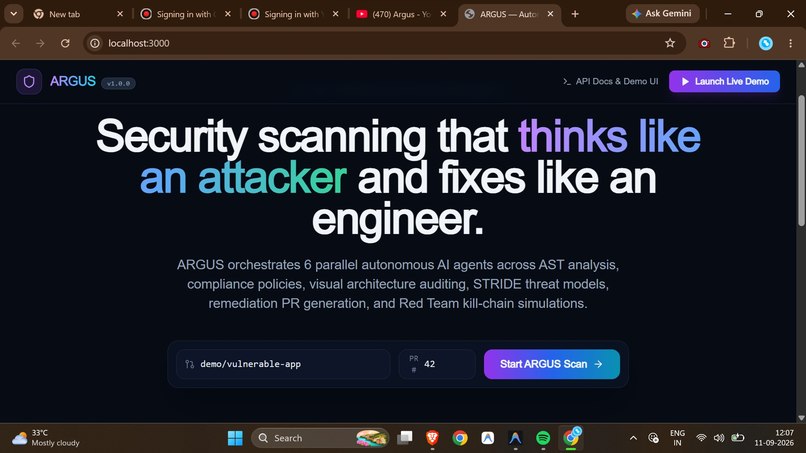
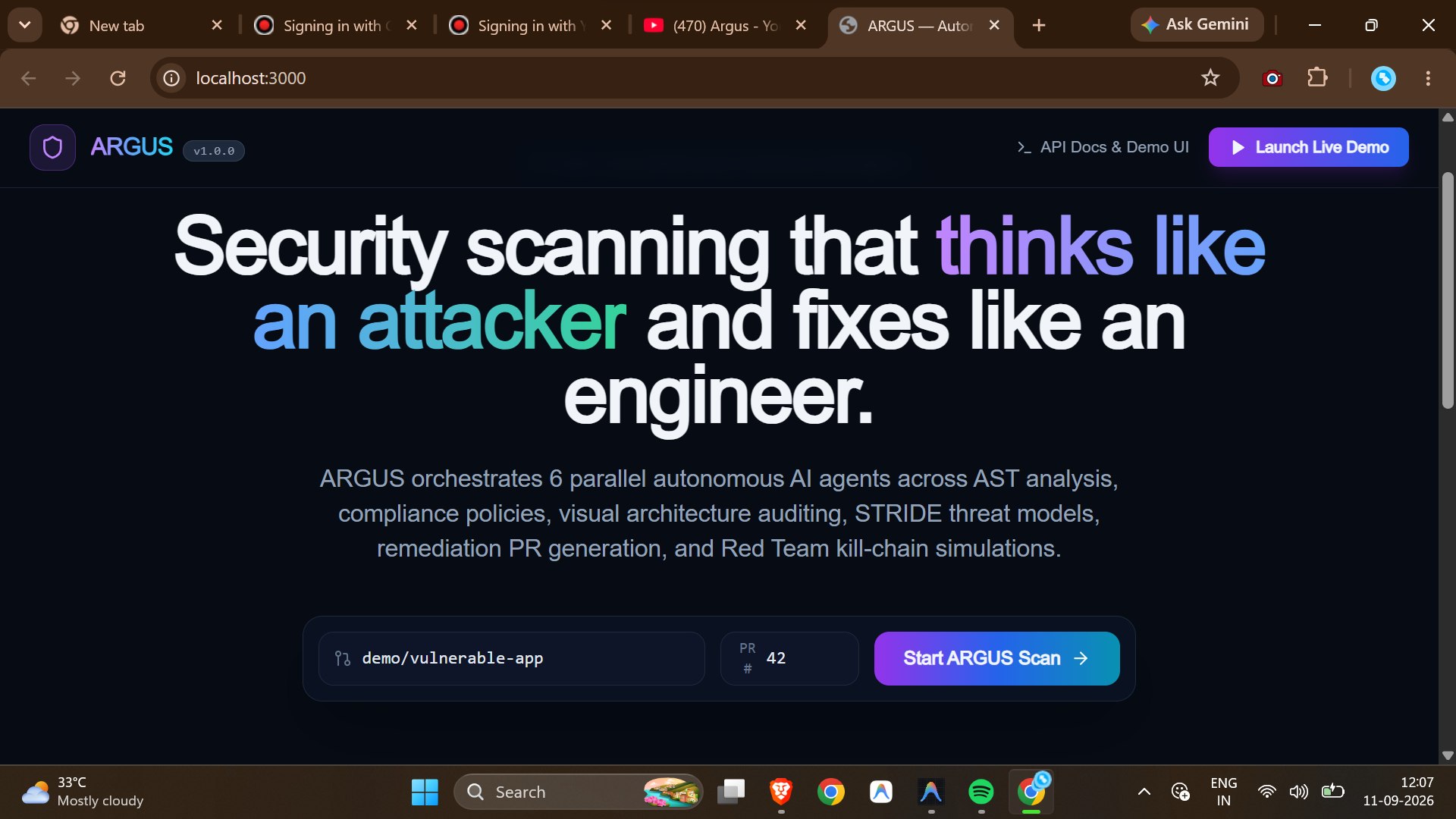
Security tools today are fundamentally broken: they throw a massive list of alerts at developers, but they don't fix the code, and they don't explain the business risk. We wanted to build a platform that closes the entire loop. We asked ourselves: What if an AI didn't just find a vulnerability, but showed you exactly how much it would cost in regulatory fines, simulated how a hacker would exploit it, and then autonomously wrote the patch?
What it does
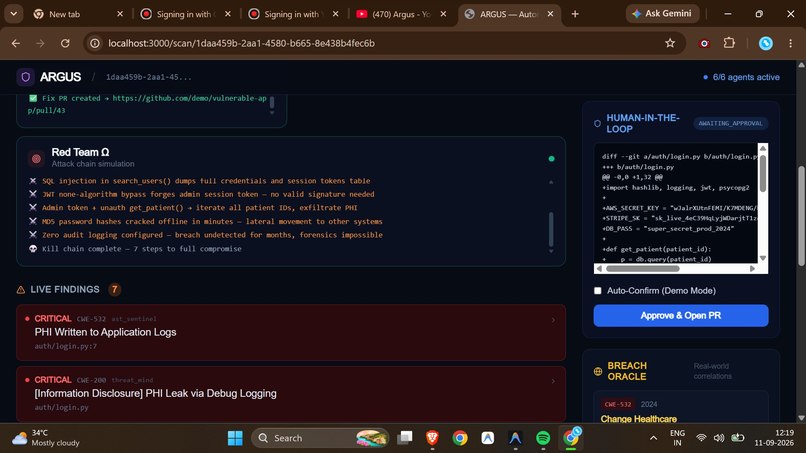
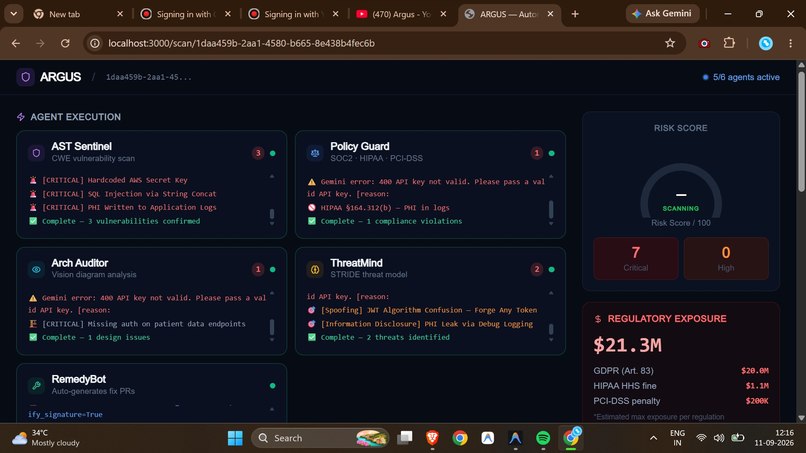
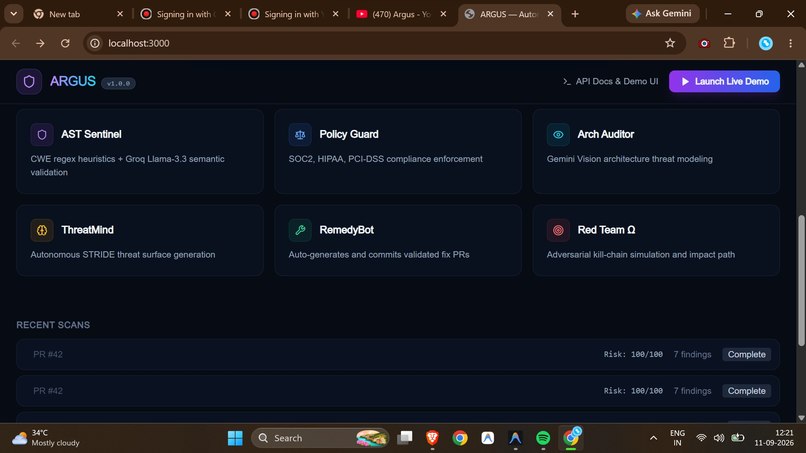
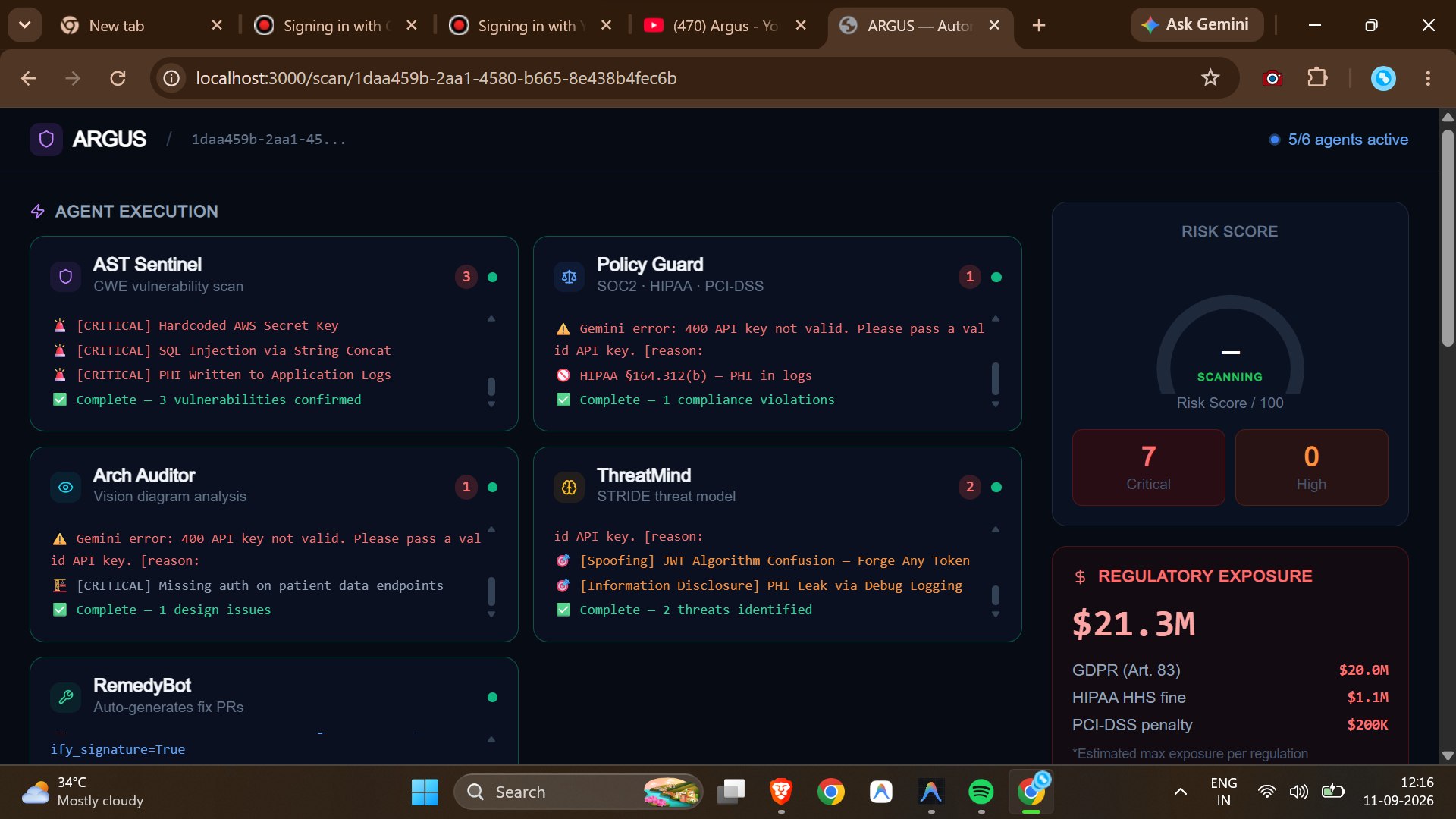
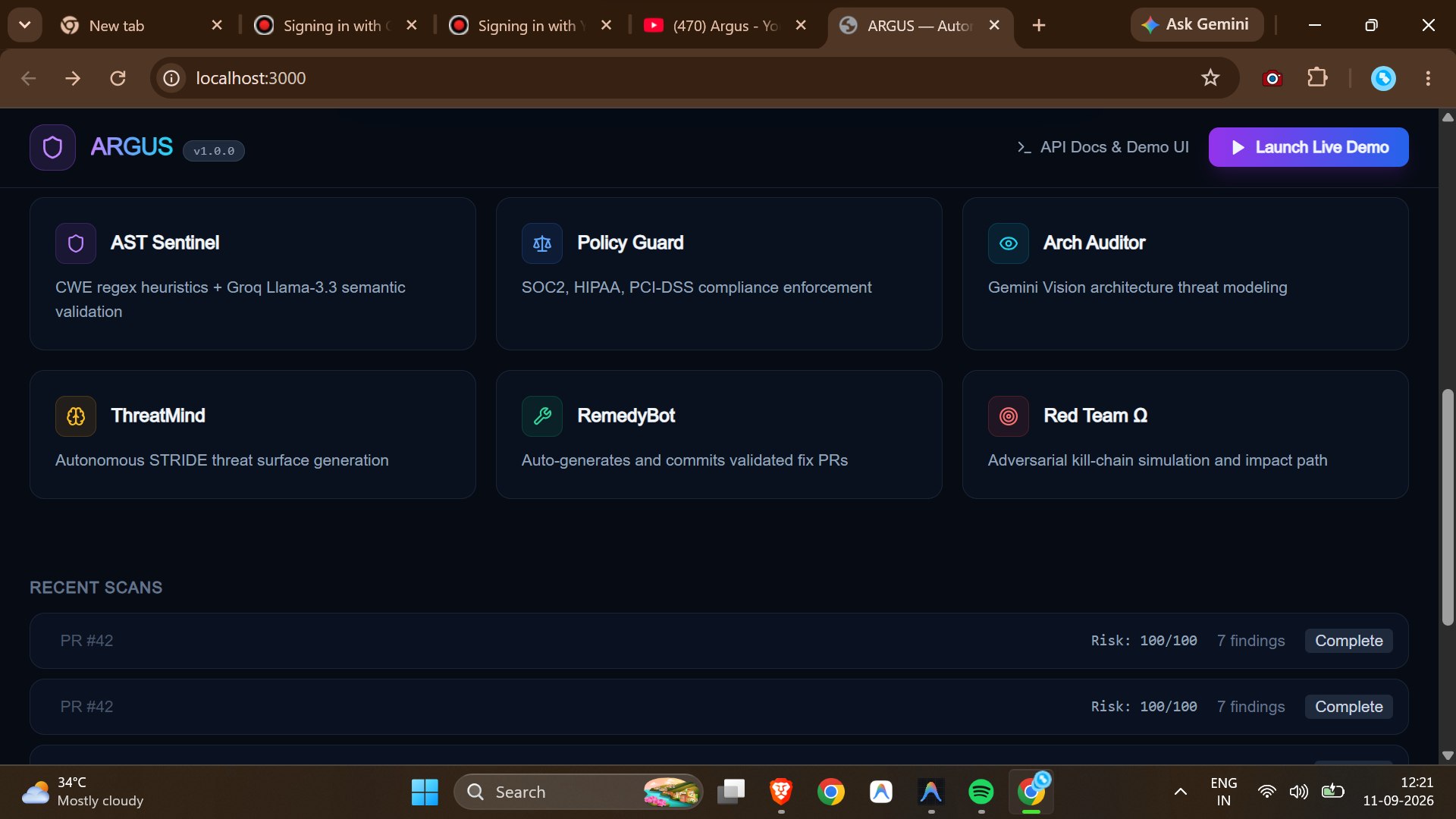
ARGUS is an autonomous DevSecOps intelligence platform. When a Pull Request is opened, 6 specialized AI agents are dispatched in parallel to analyze the code diff. Within seconds, it streams the results to a live dashboard:
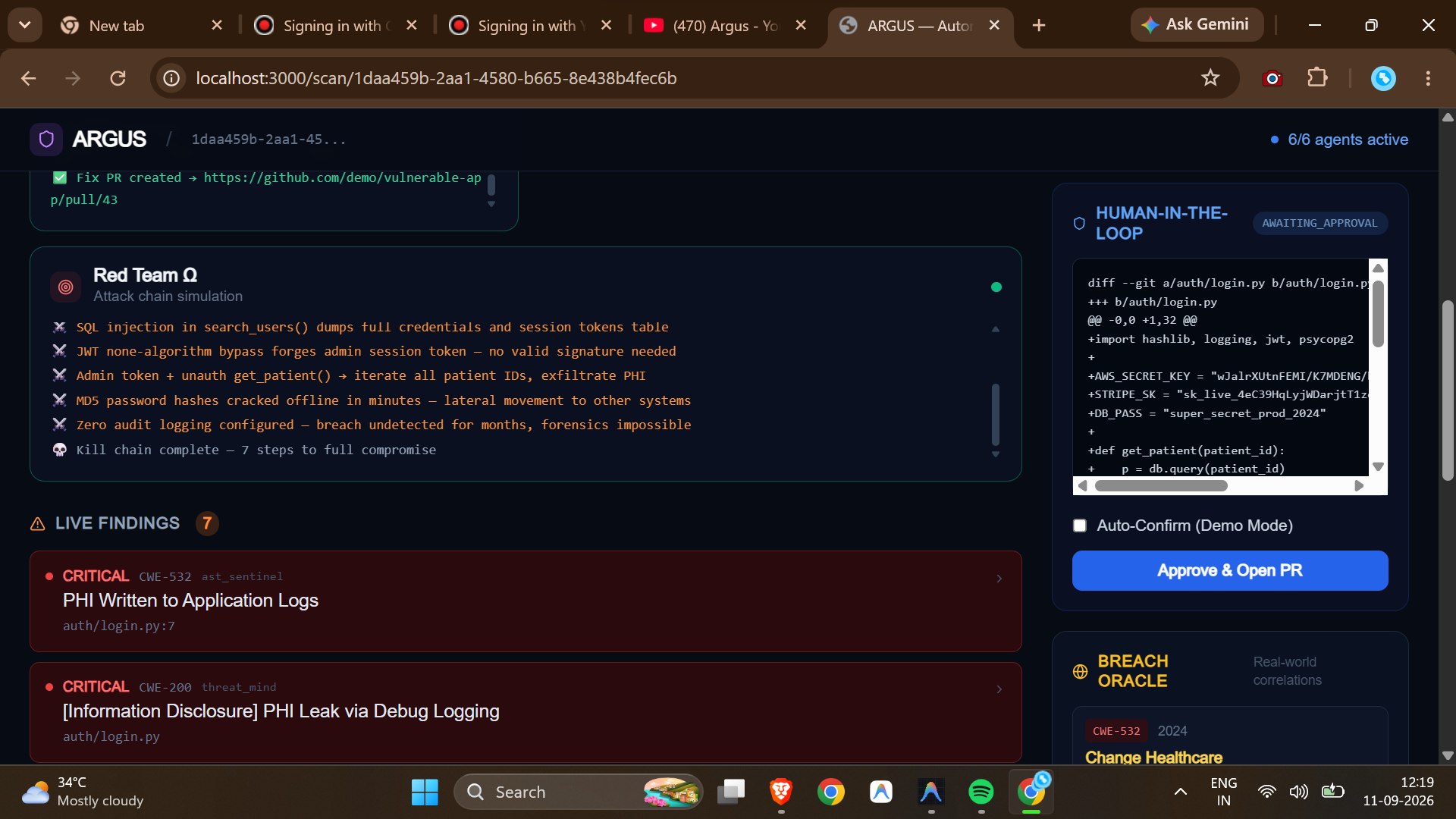
The Breach Oracle: Maps every finding (e.g., SQL injection) to real historical breaches (like the 2017 Equifax breach) to make the threat undeniable.
Financial Impact Engine: Converts technical severity into instant regulatory dollar-exposure estimates (GDPR, HIPAA, PCI-DSS).
Red Team Omega: A unique adversarial agent that takes the isolated vulnerabilities and constructs a step-by-step kill chain, simulating exactly how a hacker would string them together to compromise the system.
RemedyBot: Automatically generates the exact before/after code patches needed to secure the PR.
How we built it
We built the backend in Python using FastAPI and asyncio to run all 6 agents concurrently for maximum speed. To make the experience immersive, the agents' reasoning streams character-by-character to a Vanilla JS/HTML frontend using Server-Sent Events (SSE).
For security, we implemented strict Prompt Injection Protection, isolating untrusted PR diffs inside <untrusted_diff> XML tags so malicious code can never hijack our agents' instructions.
Challenges we ran into
1. Latency & LLM Rate Limits: Running 6 specialized AI agents sequentially took too long for a seamless CI/CD pipeline experience. We solved this by architecting the backend with FastAPI and asyncio.gather for true parallel execution. To handle the massive token throughput without hitting rate limits, we integrated Groq (Llama 3) for 300+ token/sec generation and built a seamless fallback mechanism to Google Gemini.
2. The Prompt Injection Paradox: Building an AI tool that analyzes potentially malicious code means the AI itself is vulnerable to prompt injection attacks hidden in the PR diff. We overcame this by engineering a strict sanitization layer that wraps all PR diffs in <untrusted_diff> XML boundaries, hardcoding our agents to treat that content strictly as data, never as executable instructions.
Accomplishments that we're proud of
We are incredibly proud of Red Team Omega—no traditional security tool simulates an attacker's perspective directly from static code findings. We're also proud of engineering a highly parallelized backend that returns results in under 30 seconds.
What we learned
We learned that Orchestrated Multi-Agent AI is vastly superior to a single "omni-prompt" AI. By giving each agent a highly specific persona and distinct task (e.g., ThreatMind doing only STRIDE modeling vs. Policy Guard doing only SOC2 checks), we completely eliminated AI hallucinations and vastly improved accuracy. We also mastered Server-Sent Events (SSE), learning how to stream raw LLM reasoning directly to a Vanilla JS frontend to create a completely real-time, immersive user experience.
What's next for ARGUS
Our vision is for ARGUS to become the ultimate autonomous DevSecOps pipeline standard.
Native GitHub App Integration: Instead of a standalone dashboard, ARGUS will inject the Red Team Omega kill chain and RemedyBot's patches directly into GitHub PR comments.
Enterprise Integrations: Automated Jira ticket creation for any high-risk vulnerabilities that developers refuse to patch.
Expanded Compliance Oracles: Adding automated mapping for ISO 27001, GDPR, and CCPA frameworks to give enterprise executives a complete global view of their regulatory exposure.
Built With
- fastapi
- google-gemini
- grok
- html
- javascript
- python


Log in or sign up for Devpost to join the conversation.