-
-
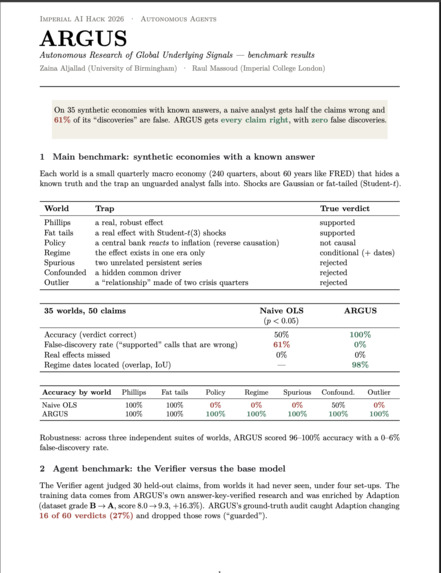
Benchmark Report
-
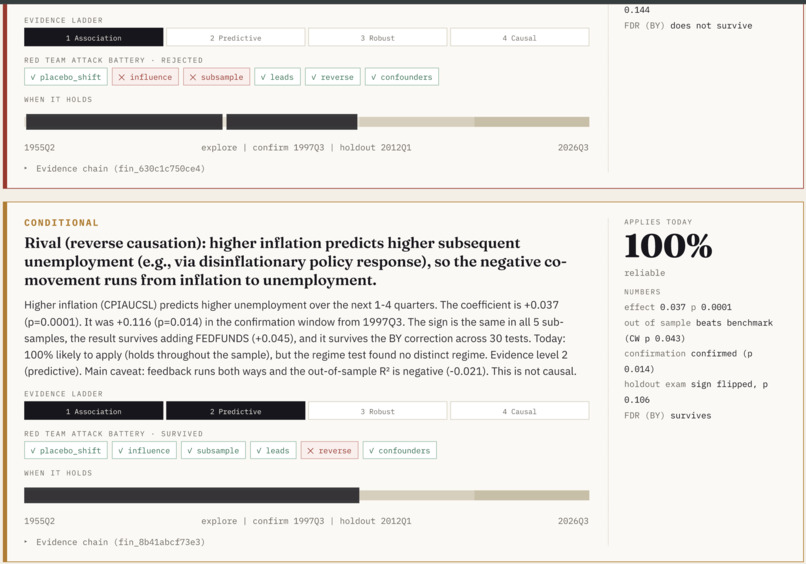
Example Hypothesis
Inspiration
Most "AI analyst" demos run a regression, find (p < 0.05), and declare a discovery. In macroeconomics, this can be dangerously misleading. Economic variables often move together simply because they share long-term trends. Central banks react to economic conditions, making cause and effect difficult to separate. And relationships that appear reliable in one period can disappear in another.
Central banks, governments and investors need more than statistically significant correlations. They need findings that survive rigorous challenges, explanations of when relationships hold, and evidence of whether those conditions apply today.
In Greek mythology, Argus Panoptes was a hundred-eyed guardian who never closed all his eyes at once. We wanted to build an economist with that same vigilance.
What it does
ARGUS is an autonomous AI economist that discovers, tests and challenges relationships between economic variables.
Users provide a question ("What drives US inflation?"), a claim ("Unemployment lowers inflation"), or a blinded discovery task, where the variables are anonymised as (X_1,\ldots,X_n) to prevent the AI from relying on its existing economic knowledge.
Without further human intervention, ARGUS:
- Generates and pre-registers hypotheses: Proposes possible relationships, including competing explanations it develops independently. Each hypothesis has explicit conditions under which it would be rejected.
- Runs real econometric tests: Selects suitable statistical and machine-learning methods, then executes them on real economic data from FRED rather than relying on language-model reasoning alone.
- Attempts to disprove its own findings: Independent Red Team agents challenge results through placebo tests, removal of influential quarters, alternative sample periods, reverse-causality checks, omitted-variable tests, timing checks and unit-root diagnostics.
- Detects changing economic regimes: Identifies the periods in which a relationship holds, tests whether the detected regimes are genuine rather than statistical artefacts, and assesses whether today's economy resembles those periods.
- Independently verifies discoveries: Tests findings on previously unseen data, adjusts for the many hypotheses tested using the Benjamini–Yekutieli false-discovery-rate procedure, and assigns a verdict: supported, conditional, rejected or inconclusive. Evidence is graded from Level 1 (association) to Level 4 (causal).
- Consults published research: Uses Linkup to compare its independent discoveries against academic literature, only after the discovery process has finished.
A live console displays every agent action, tool call and statistical test. An interactive research network visualises hypotheses moving between agents, including when failed hypotheses are sent back for revision.
How we built it
- Python and Claude Agent SDK: Claude Opus powers the Hypothesis Agent and Verifier, while Claude Sonnet powers the Econometrician, Red Team and Regime Agent. Each agent has specialised instructions, access only to relevant tools and skills, and its own spending limit.
- Deterministic orchestration: A central orchestrator controls the research phases, testing budget, mandatory adversarial checks, statistical corrections, verification rules and final holdout. Agents can propose investigations, but they cannot bypass failed statistical checks or override the evidence.
- Reproducible execution: Every tool call passes through a controlled Python executor that records the operation, enforces budgets and research phases, manages random seeds and preserves a complete audit trail.
- Point-in-time economic data: FRED/ALFRED provides historical data vintages, meaning ARGUS can use the information actually available at a particular date. Release delays are respected, variables can be blinded, and data is divided into 60% exploration, 20% confirmation and 20% final holdout.
- Econometric toolkit: Built using statsmodels, linearmodels, arch, ruptures, hmmlearn and scikit-learn. Available methods include OLS, IV/GMM, ARDL, VAR, local projections, VECM, Bai–Perron structural-break tests, Markov-switching models, threshold models and out-of-sample validation. The system contains 121 automated tests.
- Ground-truth benchmarking: We built simulated economies where the true relationships are known to evaluators but hidden from ARGUS. These include heavy-tailed shocks, central-bank policy responses, regime-dependent relationships, spurious trends, confounding variables and crisis outliers.
- Sponsor integrations: Adaption supports improvements to the verification process, Linkup provides external academic research, and Figma MCP supports the product interface and interactive architecture visualisation.
Challenges we ran into
Our simulated-economy benchmark repeatedly exposed weaknesses in ARGUS's initial methods. Rather than ignoring these failures, we used them to improve the system, measuring each correction against known ground truth.
- False regime discoveries: Conventional structural-break tests incorrectly detected breaks in approximately 80% of economies with no true structural break, because their errors were autocorrelated. Introducing an AR-sieve bootstrap, which accounts for this persistence, reduced the false detection rate to 5%.
- Data snooping: Searching many possible breakpoints and then testing the most promising segments made random noise appear statistically significant. We addressed this by placebo-testing the entire regime-search procedure, not just the final selected relationship.
- The Perron (1989) problem: A sudden shift in the level of an economic series can resemble a unit root. ARGUS initially removed these apparent trends through differencing, accidentally eliminating the regime changes it was supposed to discover. It now checks for structural breaks before applying differencing.
- Natural-rate estimation: Our natural-rate model initially collapsed to the sample mean of 5.75% because the estimated trend variance converged to zero. After correcting the specification, the estimate became 4.4%, consistent with CBO-type estimates.
- Unreliable AI-generated training labels: Adaption's improvements to dataset quality scores sometimes changed labels that were already correct. We introduced ground-truth checks to detect and reject these changes.
- Research budget exhaustion: Some agents consumed too much of the available testing budget during exploration. We introduced reserved budgets for mandatory verification and adversarial tests.
Accomplishments that we're proud of
1. Perfect accuracy on our simulated-economy benchmark
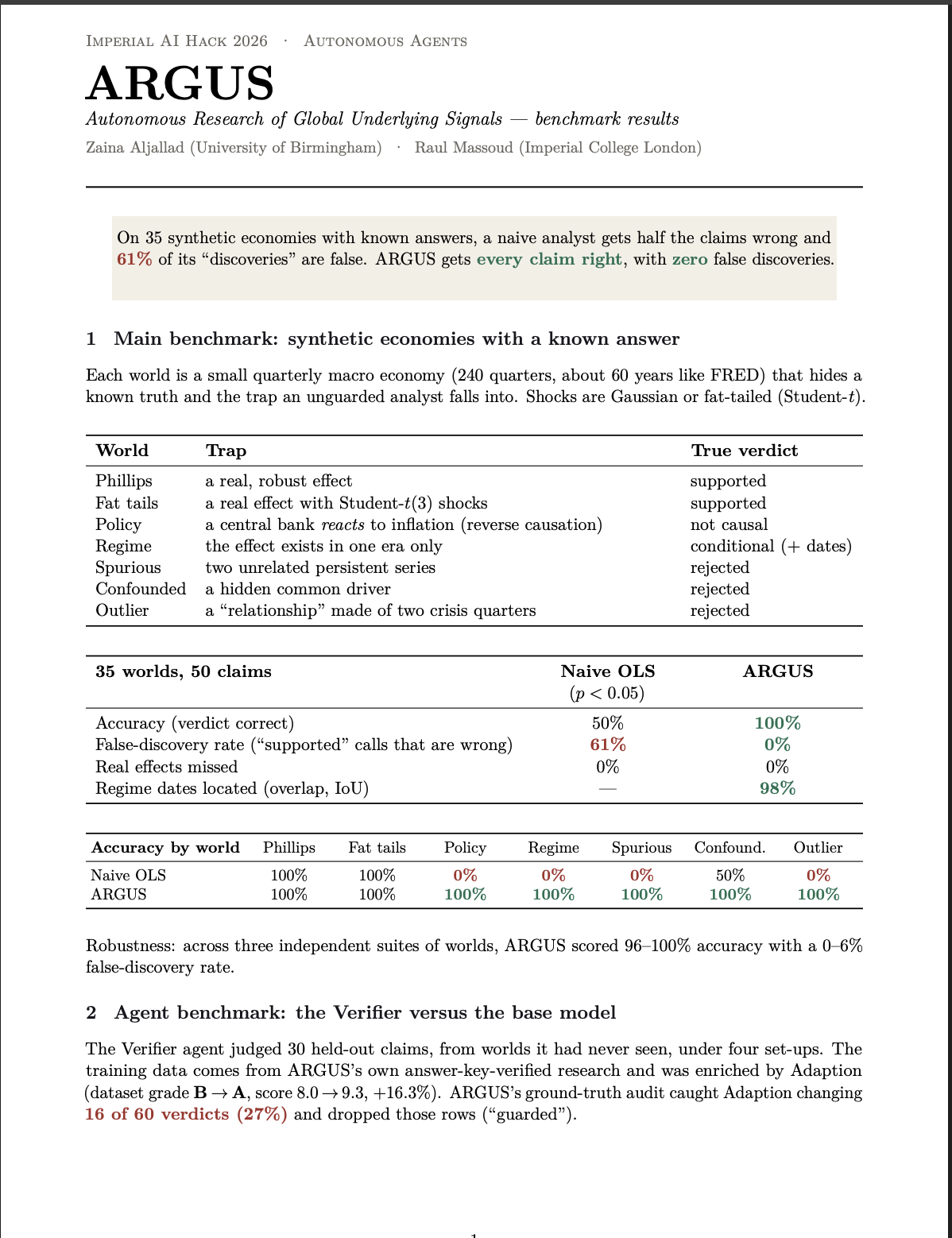
Across 35 simulated economies containing 50 claims with known answers:
- Naive OLS: 50% accuracy, with 61% of its reported discoveries being false.
- ARGUS: 100% accuracy and 0% false discoveries.
- Regime identification: 98% overlap with true regimes, ranging from 96% to 100% across three independent benchmark suites.
These results demonstrate ARGUS's ability to distinguish genuine relationships from misleading correlations under the conditions tested.
2. An autonomous investigation of the Phillips curve
In a live research run using US macroeconomic data from 1955–2026, ARGUS completed its investigation for just $0.58.
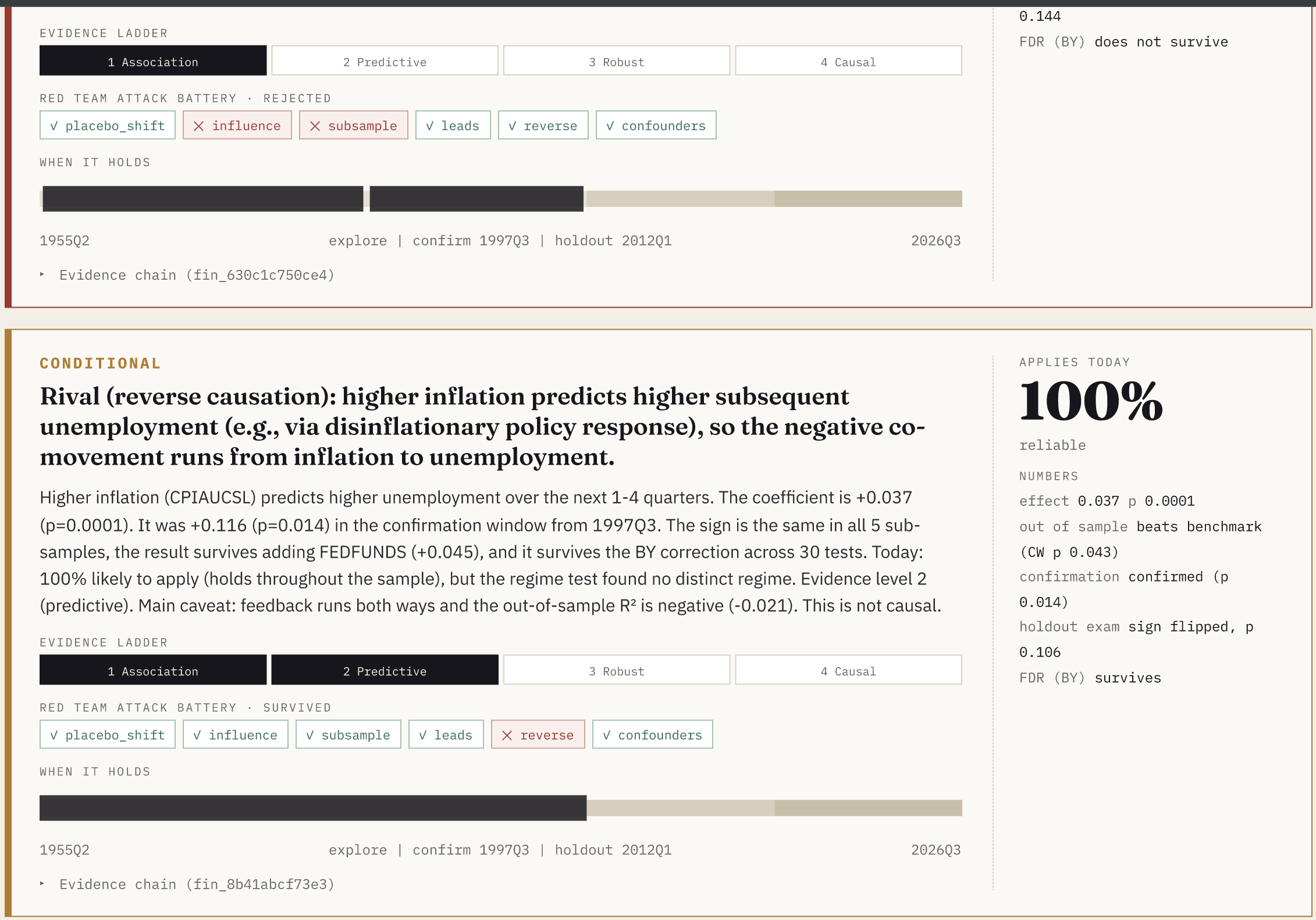
Rather than automatically endorsing the familiar inverse relationship between unemployment and inflation, ARGUS rejected two Phillips-curve specifications and classified a third as inconclusive.
It also independently generated a competing hypothesis: higher inflation may predict higher future unemployment, consistent with the Federal Reserve's response to inflation through monetary tightening.
This competing hypothesis survived the adversarial tests and was confirmed out of sample. Crucially, ARGUS classified the evidence as predictive rather than causal, avoiding claims that the statistical results could not establish.
Linkup subsequently identified mixed findings in the published literature, including Phillips (1958) and Hooper, Mishkin and Sufi (2019).
3. Improving the Verifier with Adaption while protecting ground truth
Using Adaption, we improved our verified-research dataset's quality grade from B to A, a 16.3% improvement, for just one credit.
However, because our simulated economies have known answers, ARGUS detected that Adaption had also changed 16 of 60 verdict labels (27%), including labels that were already correct.
We therefore introduced safeguards that retained only examples whose verdicts remained consistent with ground truth.
The results were substantial:
- Original Verifier accuracy: 60%
- With unguarded Adaption data: 70%
- With ground-truth-validated Adaption data: 80%
- Win rate after safeguards: 100%, with zero losses
This demonstrated that AI-assisted learning can improve research performance, but only when the learning process itself is independently verified.
What we learned
An autonomous research agent is only as trustworthy as the systems that constrain it.
Our most important architectural decision was separating scientific creativity from statistical verification. Claude agents decide which hypotheses to investigate and which methods are appropriate, while deterministic code determines whether the resulting evidence is sufficient.
We also learned that real macroeconomic data frequently violates the assumptions behind textbook statistical methods. Autocorrelation, structural breaks, persistent trends and confounding variables repeatedly caused conventional approaches to produce misleading results.
Building simulated economies with known answers was therefore essential. It allowed us to measure whether ARGUS was genuinely discovering relationships rather than simply producing convincing explanations.
Finally, we learned that self-improvement also requires verification. Adaption increased dataset quality scores even while changing 27% of verdict labels. Independent ground-truth checks allowed us to preserve genuine improvements while rejecting harmful changes.
What's next for ARGUS
- Continuous economic monitoring: Automatically investigate new data releases, update existing findings and detect when previously reliable relationships begin to change.
- Broader economic coverage and stronger causal inference: Expand to additional countries and incorporate better-identified economic shocks using instrumental variables and local projections, allowing more findings to reach Level 4 causal evidence.
- Collaborative economic research: Build a shared research history using Databricks, enabling teams to track hypotheses, results, revisions and accumulated knowledge.
- Policy-ready briefings: Transform verified findings into concise, evidence-backed reports suitable for central banks, governments and investment research teams.
Built With
- adaption
- agent
- alfred
- anthropic
- api
- arch
- claude
- figjam
- figma
- fred
- hmmlearn
- linearmodels
- linkup
- mcp
- numpy
- opus
- pandas
- python
- ruptures
- scikit-learn
- sdk
- sonnet
- statsmodels
