Inspiration
Building a robot often starts with scattered requirements, spreadsheets, component catalogs, and CAD tools. That makes it difficult to answer basic questions early: What can this robot actually do, what will it cost, and which assumptions still need engineering review? Argus Labs brings those decisions into one workspace.
What it does
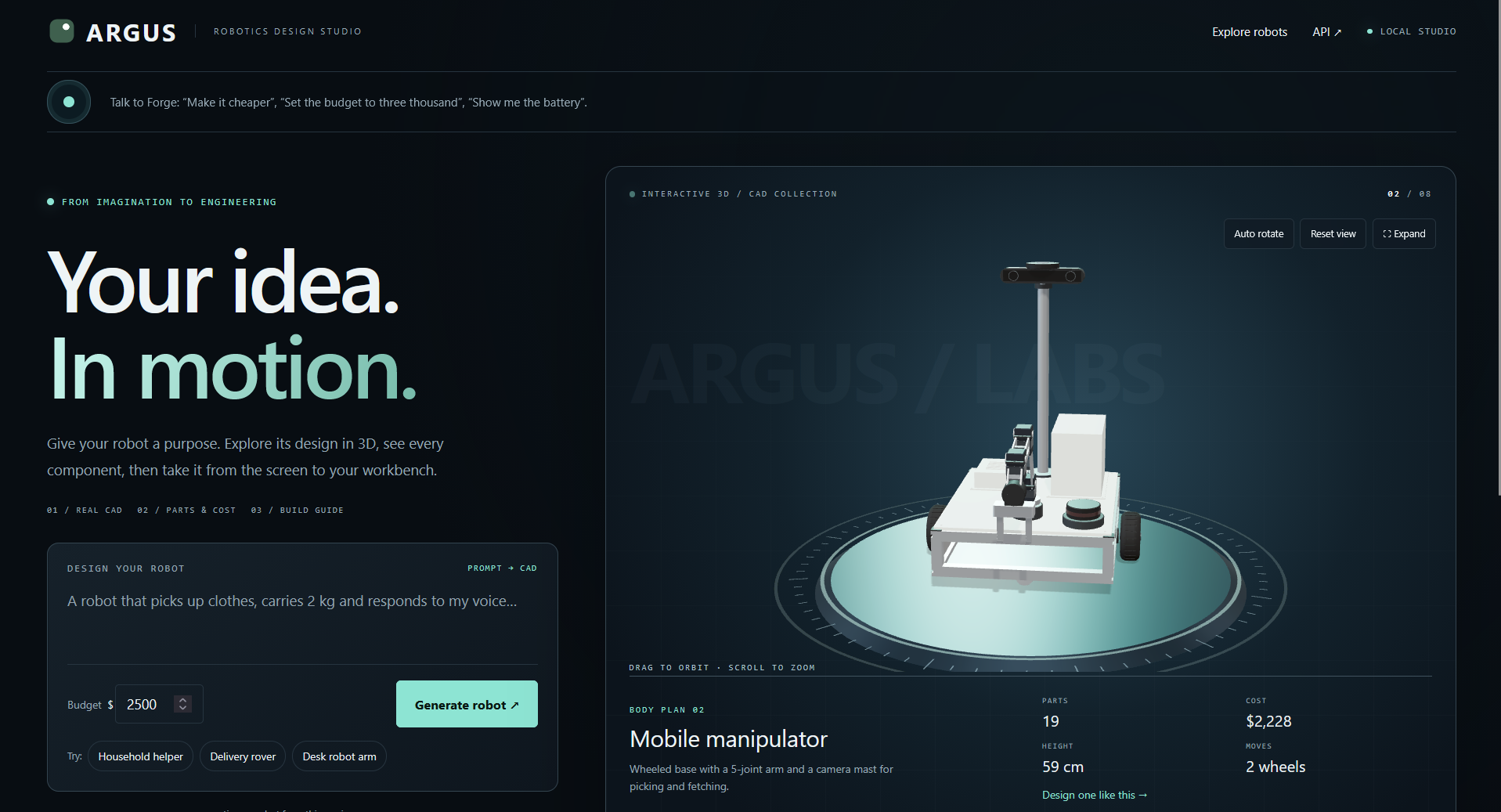
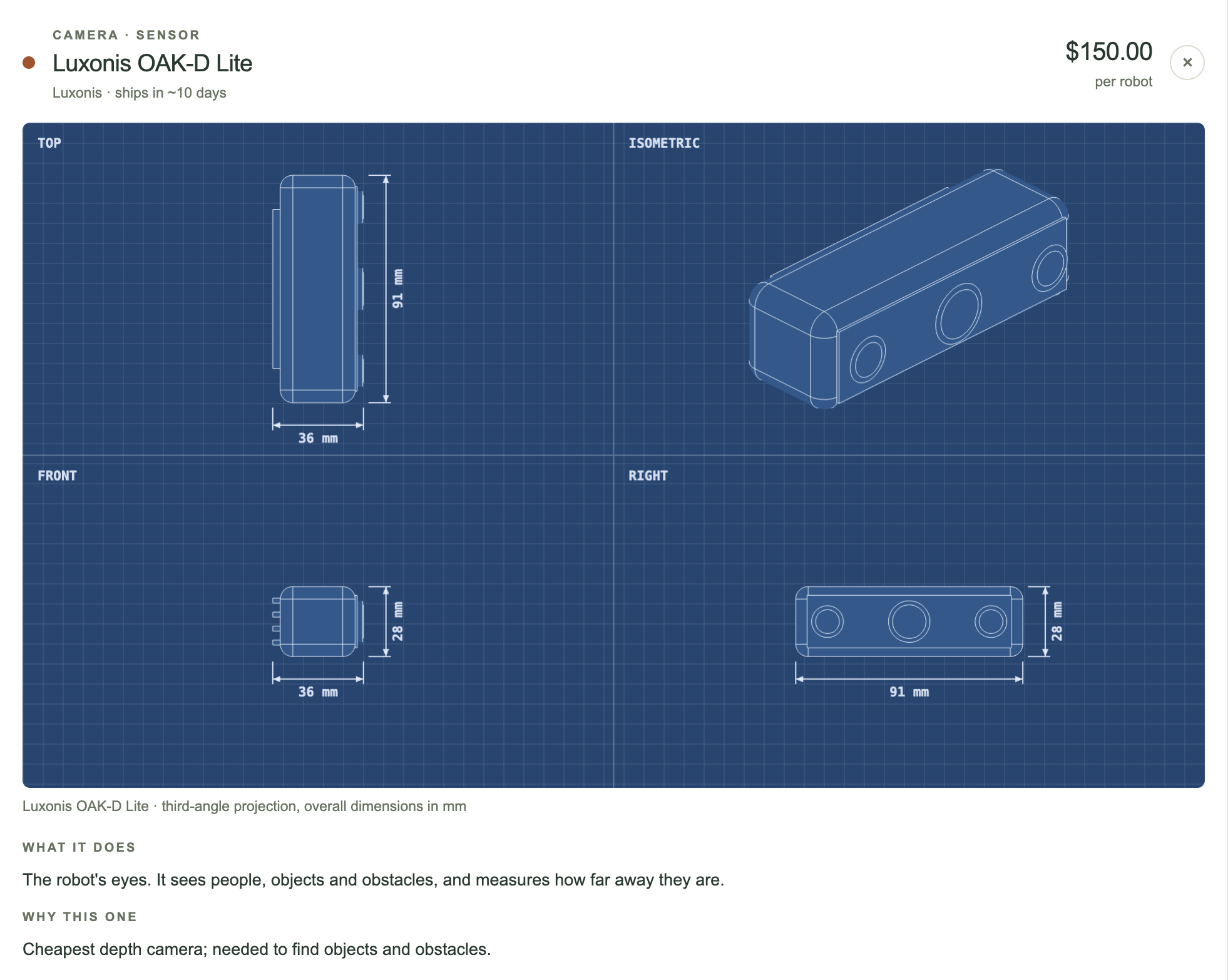
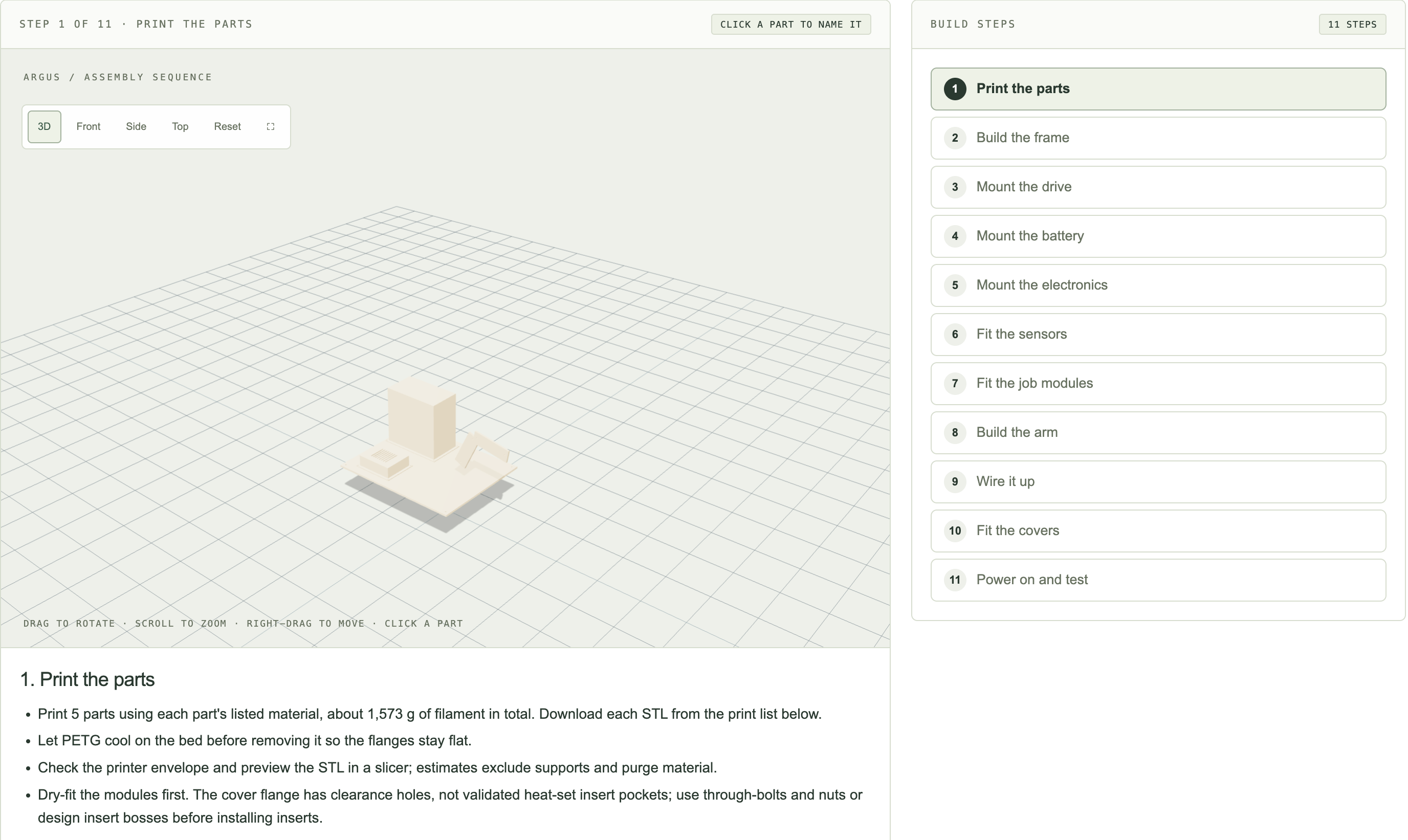
Argus Labs turns a natural-language brief into a budget-aware robot concept. A user can describe a job such as moving packages, inspecting an office, cleaning floors, or assisting at a desk. The system identifies a supported ground-robot architecture, sizes a candidate parts list, calculates a bill of materials, and presents an interactive 3D assembly. Users can inspect each part, compare alternatives, adjust the budget, and download CAD artifacts.
The product is intentionally explicit about uncertainty. Catalog prices are estimates, component sizing is a screening calculation, and fabrication fit, strength, printability, and vendor compatibility remain verification tasks rather than hidden assumptions.
How we built it
The backend is a Python and FastAPI service with Pydantic schemas and a revisioned project model. A deterministic configuration engine maps the brief to an archetype, then selects catalog components that satisfy payload, motor torque, battery-energy, and budget constraints. The finance layer creates an itemized BOM, calculates contingency, identifies lower-cost substitutions that preserve critical specifications, and estimates ownership economics.
For generative capabilities, a Baseten-hosted GLM 5.3 adapter produces structured robot concepts and CAD prompt interpretations. Responses are validated against the same schemas used by the application before they can affect a design. The live Forge copilot uses Gemini through ElevenLabs Agents for conversational robot design, while ElevenLabs provides real-time voice, speech-to-text, and speech synthesis.
The CAD pipeline uses reviewed parametric templates for chassis plates, arm links, and motor brackets. It exports STEP, STL, and GLB artifacts, then reopens generated geometry to verify positive-volume solids, expected envelopes, bore locations, and dimensions. The browser interface is a buildless HTML, CSS, and JavaScript application served by FastAPI, with a Three.js viewer for the assembled robot.
Tiger Data provides optional time-series storage and rollups for simulated telemetry. Presage is used only with explicit current-session consent to adapt interface guidance from coarse session state. No raw video, biometric values, or recordings are stored by Argus Labs.
Financial research
The investment-research panel helps analysts investigate robotics and automation businesses using public annual filings for Teradyne and NVIDIA. It calculates revenue growth, flags trends for further research, and produces a short AI note with filing citations. Consolidated company revenue is kept separate from robotics segment revenue and component price estimates.
The backend supports SEC Company Facts retrieval and a clearly labeled historical snapshot when live access is blocked. Annual USD observations are grouped by actual fiscal period end, with quarterly values excluded. A retrospective walk-forward evaluation compares a revenue-trend estimate with an unchanged-revenue baseline over held-out annual periods. Both errors are shown, including cases where the baseline wins. It does not claim to predict stock returns.
For each robot revision, users can compare lower, base, and higher savings assumptions across three-year ownership cost, payback, and ROI. These calculations run deterministically in Python. The question and savings inputs are editable, the public sources are visible, and the full research report can be downloaded as JSON.
Challenges we ran into
The main challenge was making a generative interface useful without allowing it to overstate engineering certainty. We separated idea generation from deterministic selection and validation. The AI can propose a buildable concept, but the catalog, BOM, budget checks, and geometry checks remain the authority for what the prototype displays.
Another challenge was turning individual CAD parts into a coherent robot view. The current assembly uses representative geometry for catalog components and clearly labels the layout as illustrative. Generated parts are placed using their actual exported geometry, while final clearances and structural analysis are kept as future verification work.
What we learned
Robotics software becomes more trustworthy when it exposes tradeoffs. Showing the selected parts, cost, assumptions, warnings, and next best upgrade gives people a way to reason about a design instead of accepting a black-box answer. We also learned that consent and data minimization must be designed into voice and adaptive experiences from the start.
What is next
Next steps include persistent project storage, a durable CAD job queue, supplier-linked pricing and availability, fit and interference checks, richer assembly constraints, and hardware-in-the-loop validation.
Built With
- baseten
- build123d
- cadgen
- elevenlabs
- fastapi
- glm-5.3
- google-gemini
- javascript
- postgresql
- presage-smartspectra
- pydantic
- python
- three.js
- tiger-data
- timescaledb
- you.com


Log in or sign up for Devpost to join the conversation.