Inspiration
Many factories still use analog gauges to monitor pressure, temperature, and other equipment conditions. Workers have to check these gauges regularly, which can take a lot of time.
I wanted to build a system that could help automate these inspections. However, reading a gauge is not always easy. Glare, vibration, blur, and poor lighting can cause incorrect measurements.
My main idea was to create a system that not only reads gauges but also knows when it should not trust its own results.
What it does
ARGUS is an intelligent industrial gauge inspection prototype built with OpenCV 5.
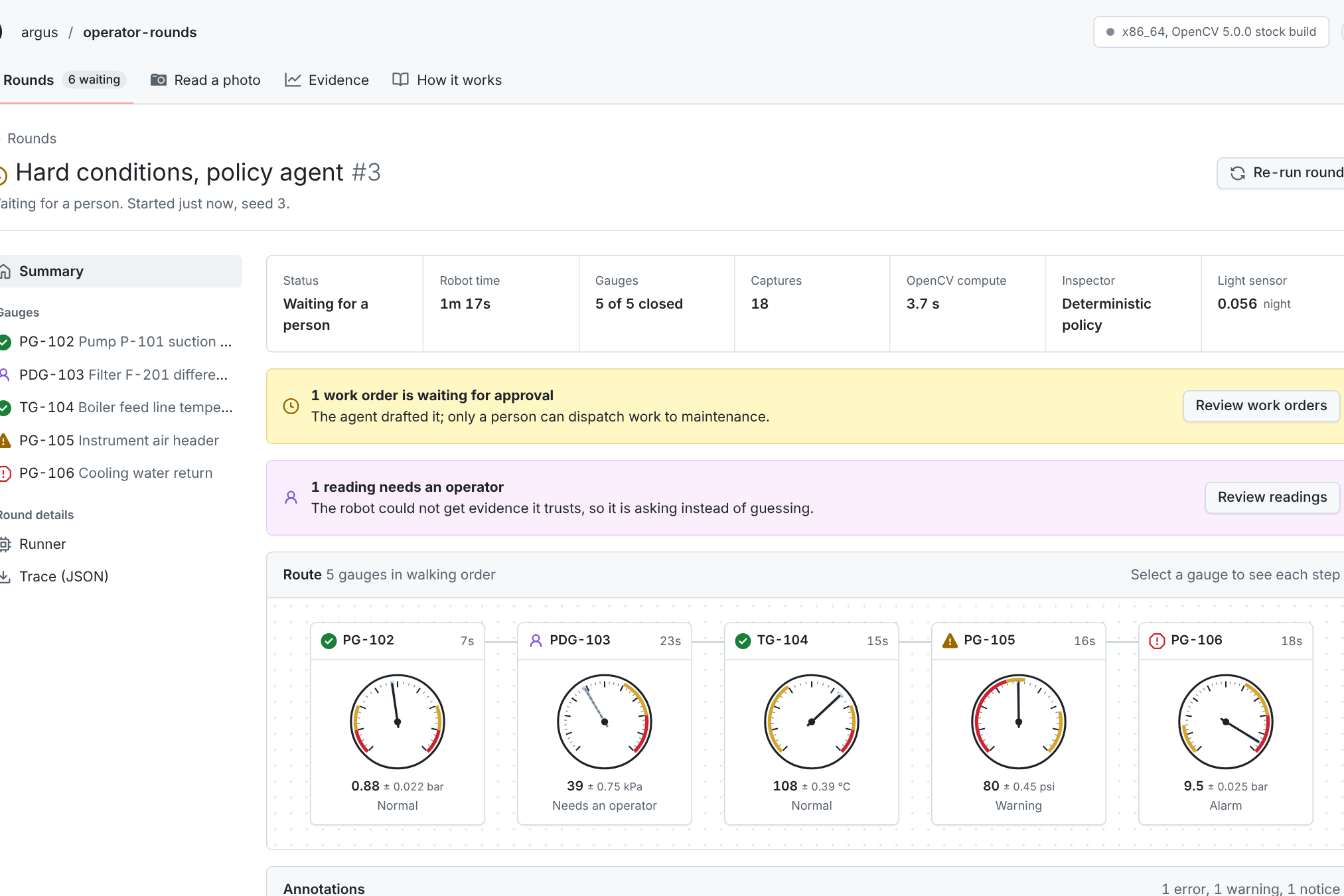
It simulates a robot moving between different gauges, capturing images, reading measurements, and checking for abnormal conditions.
The system can:
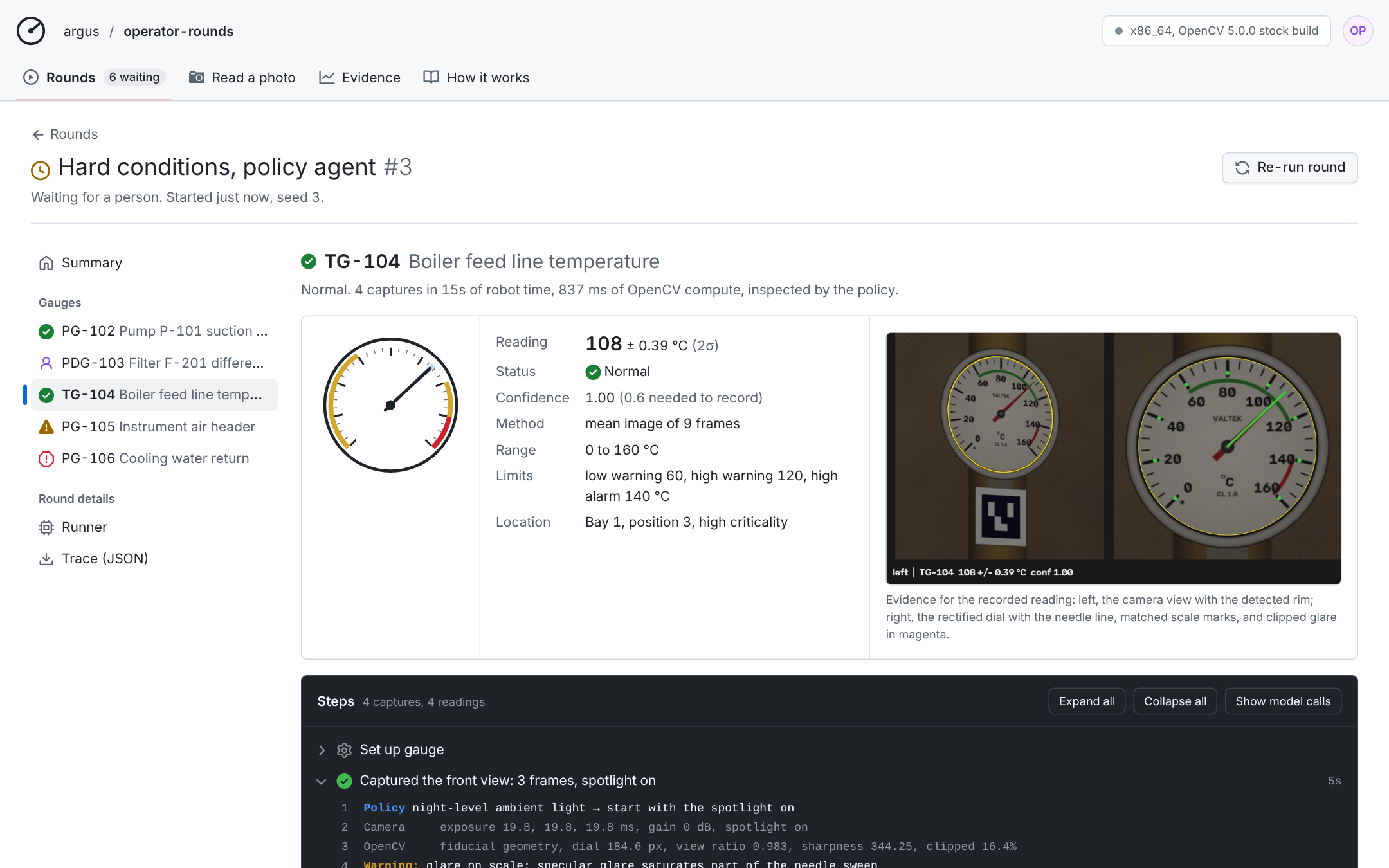
- Detect analog gauges and measure their needle positions.
- Identify problems such as glare, blur, and poor lighting.
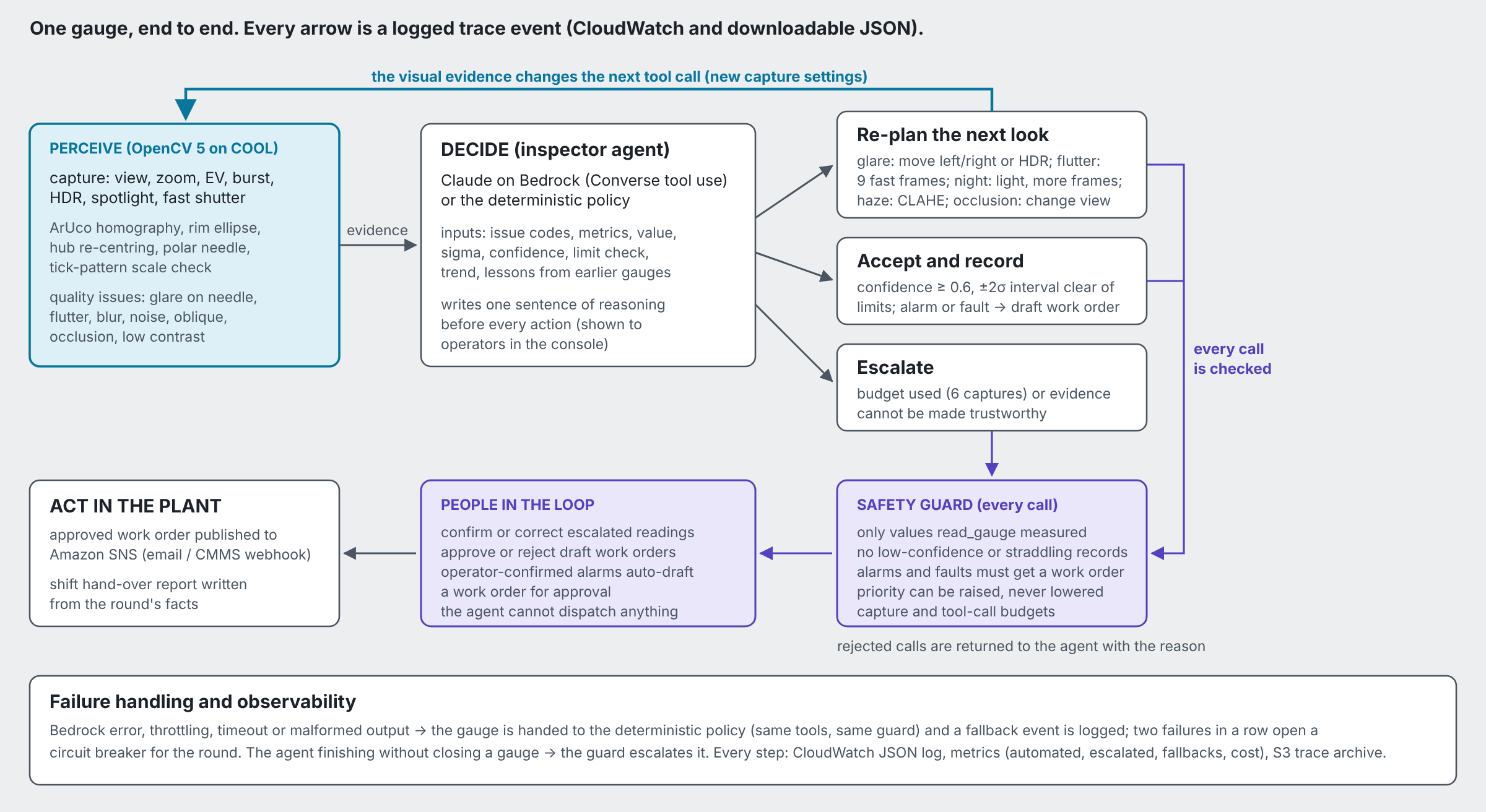
- Take additional simulated captures when the first reading is unreliable.
- Detect warnings and possible equipment faults.
- Ask a human operator to review uncertain readings.
- Create work orders that require human approval.
- Show inspection steps, decisions, and evidence images.
- Read uploaded photographs of gauges.
I also built a web dashboard inspired by GitHub Actions. Users can start inspection rounds, follow the robot's progress, examine individual measurements, and review decisions.
How I built it
I developed ARGUS using Python, OpenCV 5, FastAPI, NumPy, JavaScript, HTML, and CSS.
OpenCV 5 handles image processing, gauge detection, needle measurement, and confidence estimation.
I created a physics-based simulation that generates gauge images under different conditions, including glare, vibration, low lighting, and occlusion.
The system uses a deterministic policy agent. Instead of always accepting the first result, it looks at the evidence and decides whether to take another image, change its inspection approach, or request human review.
I also implemented safety rules to prevent unreliable measurements from being accepted automatically.
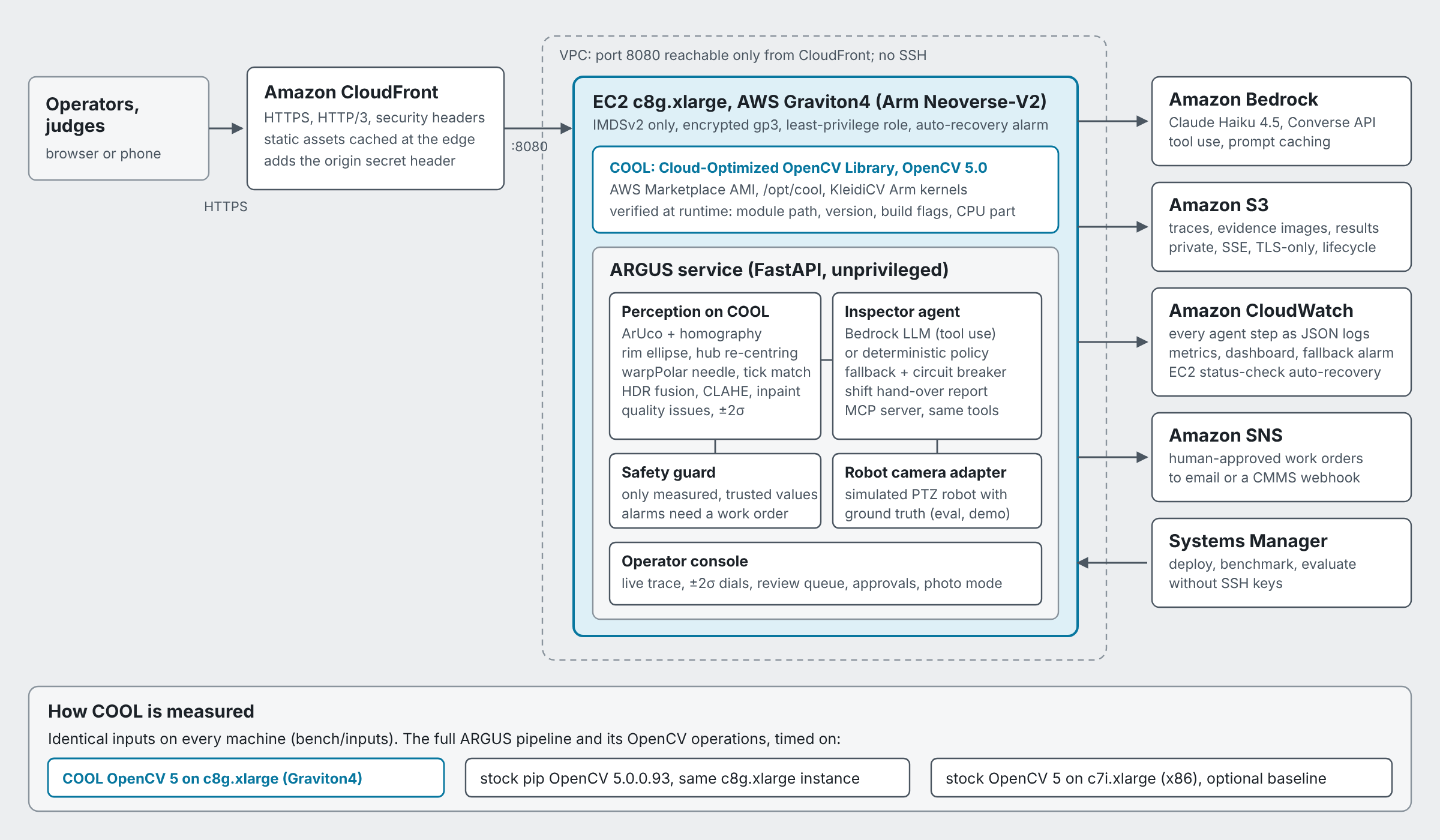
The project includes deployment code for AWS Graviton4, OpenCV COOL, and Amazon Bedrock. However, my AWS account is still undergoing verification, so I have not completed or validated that cloud deployment.
Challenges I faced
One challenge was making the system read gauge needles accurately, especially when the images had glare or movement.
Another challenge was measuring confidence correctly. Sometimes the system could produce a number, but the image was not clear enough to trust that result.
I worked on making ARGUS recognize these situations and respond appropriately instead of simply giving an answer.
I also faced difficulties with AWS account verification near the submission deadline, which prevented me from completing the planned cloud deployment.
Accomplishments
I completed a working local prototype with an interactive inspection dashboard.
In a controlled simulation covering 300 gauge inspections, the deterministic policy agent achieved:
- 0 silent failures.
- 0 missed critical conditions among 69 critical gauges.
- 92% automatic reading rate.
- 99.6% of recorded readings within 1% of the gauge span.
- 98% coverage of true values within the reported uncertainty intervals.
These results are from simulated inspections, not real-world industrial deployment.
I also successfully tested the local website, ran complete inspection rounds, examined evidence images, and tested the photo-reading feature.
What I learned
This project taught me that computer vision is not only about detecting objects or predicting numbers.
A good vision system should also understand when its results are unreliable and decide what to do next.
I learned how to combine image processing, simulation, automated decision-making, and human approval into one application.
What's next
I want to finish the AWS deployment and benchmark OpenCV COOL against standard OpenCV 5.
I also plan to test the AI agent with Amazon Bedrock, evaluate the system using real industrial gauge photographs, and eventually explore integration with physical inspection robots.
My long-term goal is to make industrial inspection safer, easier, and more reliable.
Built With
- agentic-vision
- computer-vision
- css
- fastapi
- html
- image-processing
- javascript
- numpy
- opencv-5
- python
- simulation

Log in or sign up for Devpost to join the conversation.