-
-
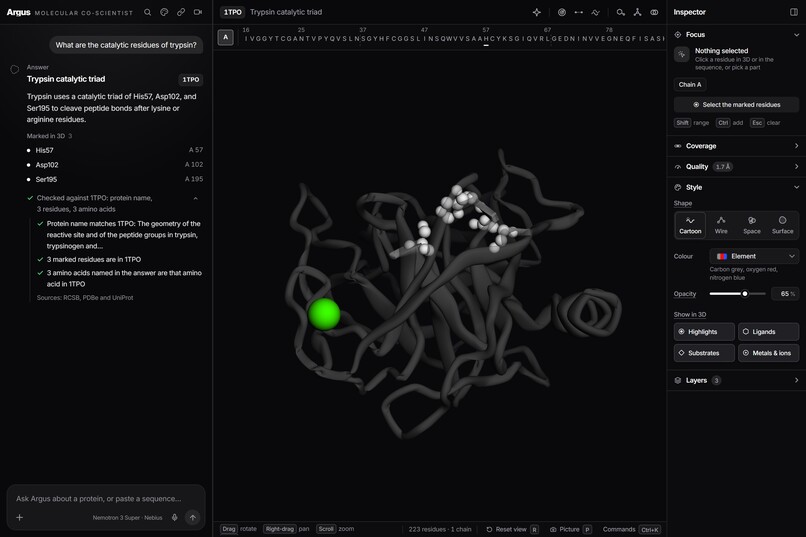
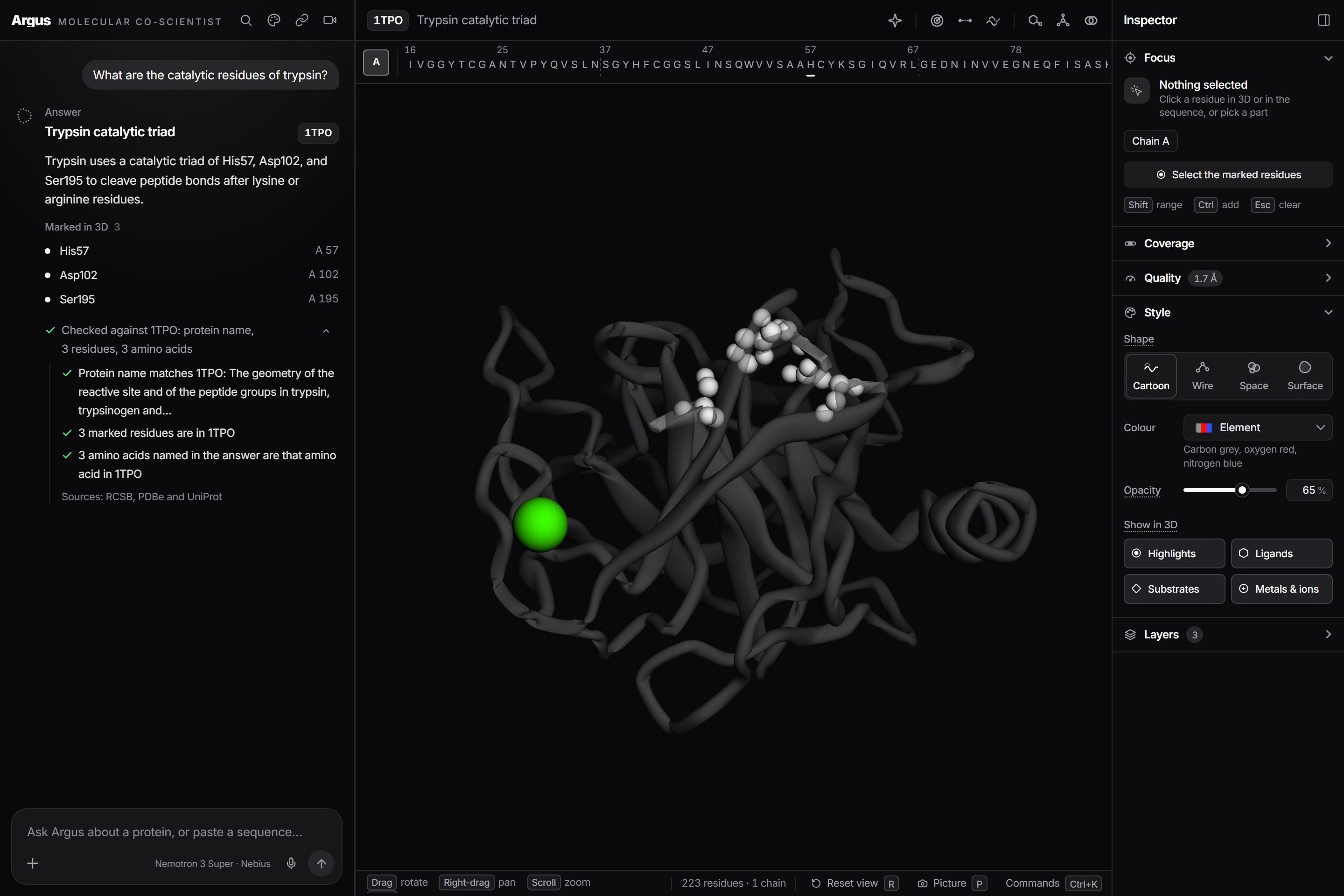
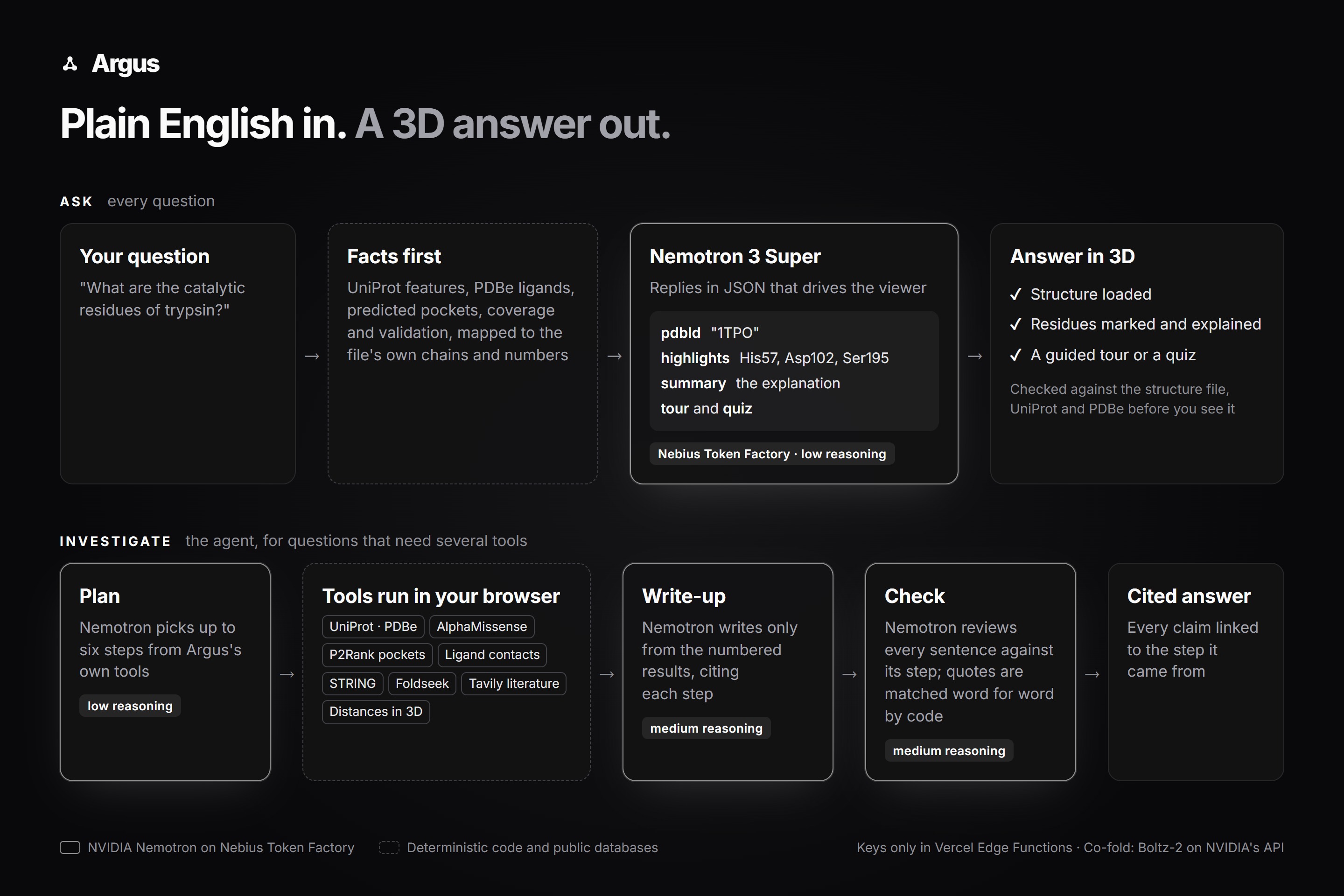
Ask in plain English: Nemotron opens trypsin (1TPO) in 3D, marks its catalytic triad and explains it, with the checks one click away.
-
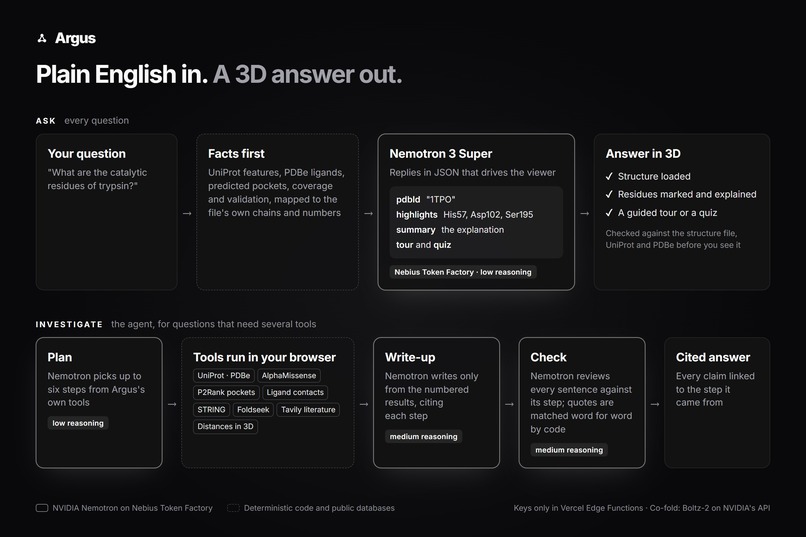
Plain English in, a 3D answer out: Nemotron on Nebius Token Factory replies in JSON that drives the viewer. Below: the Investigate agent.
-
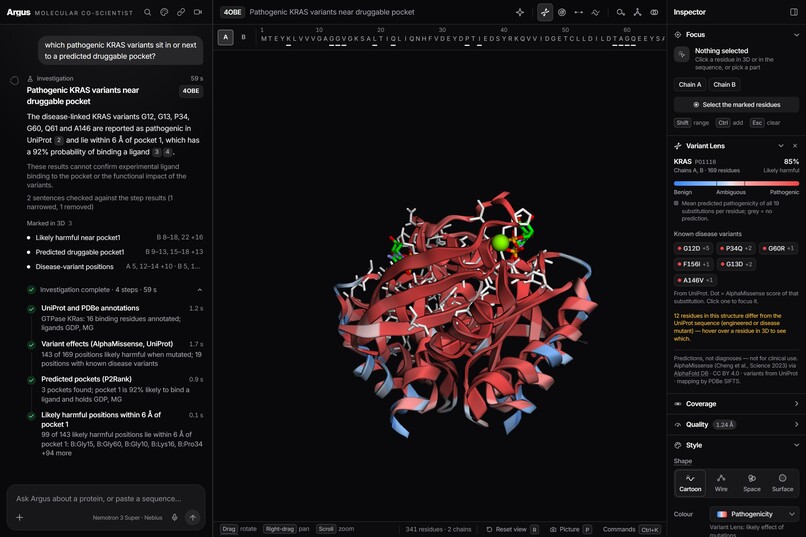
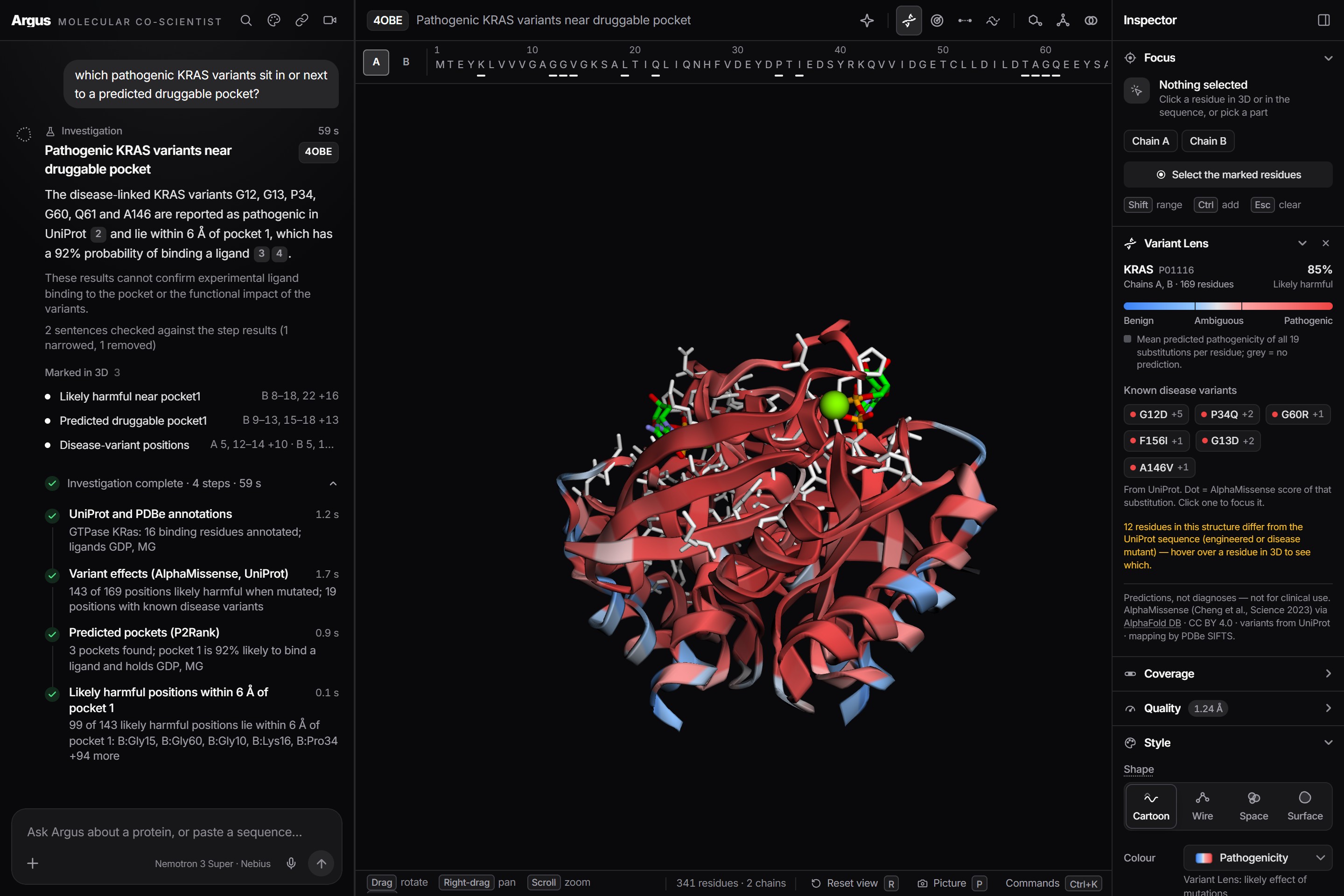
Investigate: Nemotron planned four steps, the browser ran the tools, and the conclusion cites the step behind each claim.
-
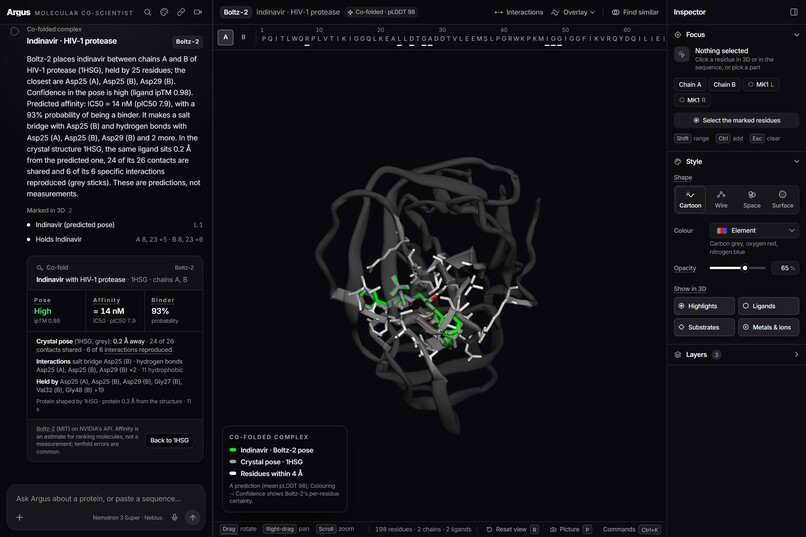
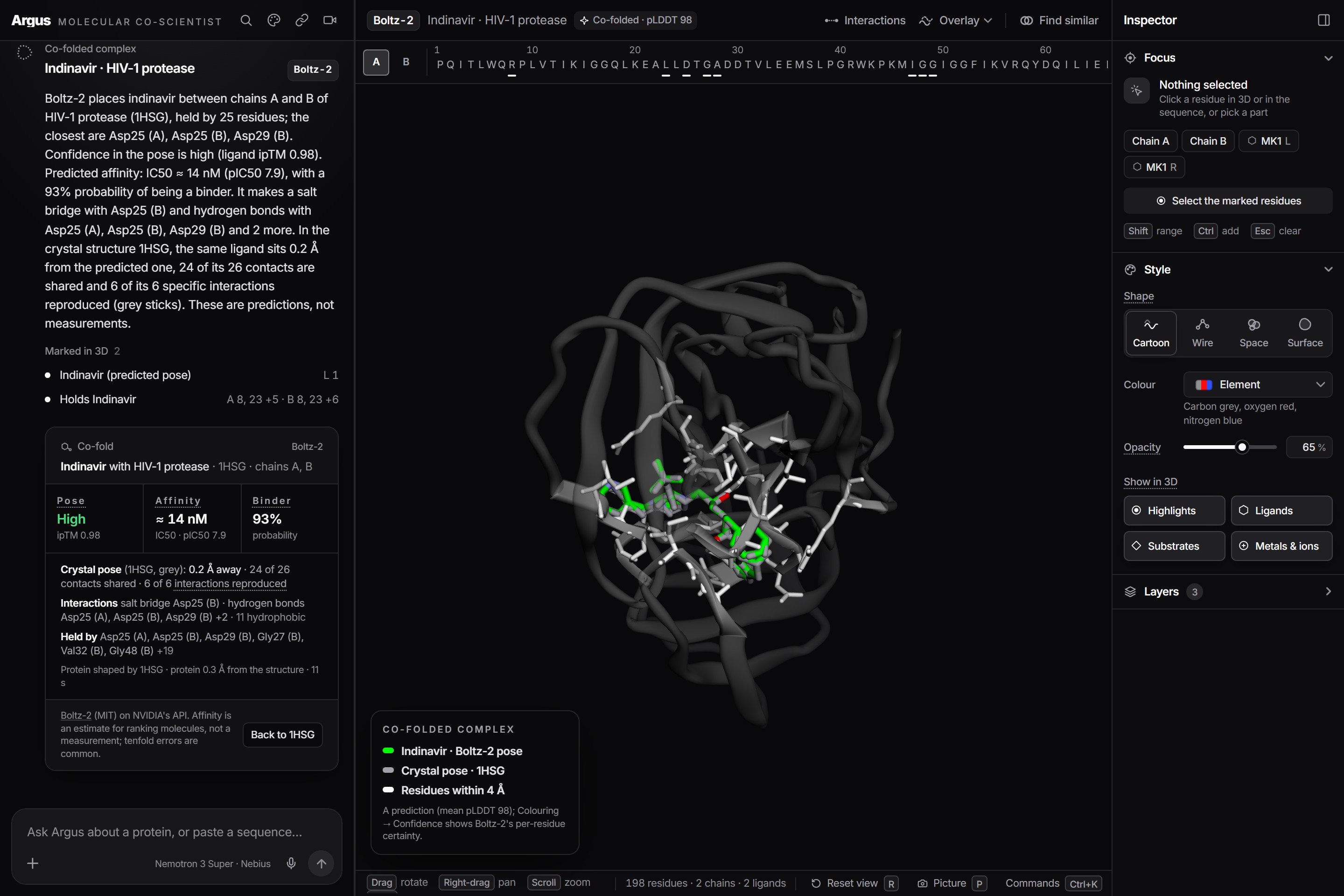
Co-fold with Boltz-2: indinavir lands 0.2 Å from its crystal pose in HIV-1 protease, sharing 24 of 26 contacts in this run.
-
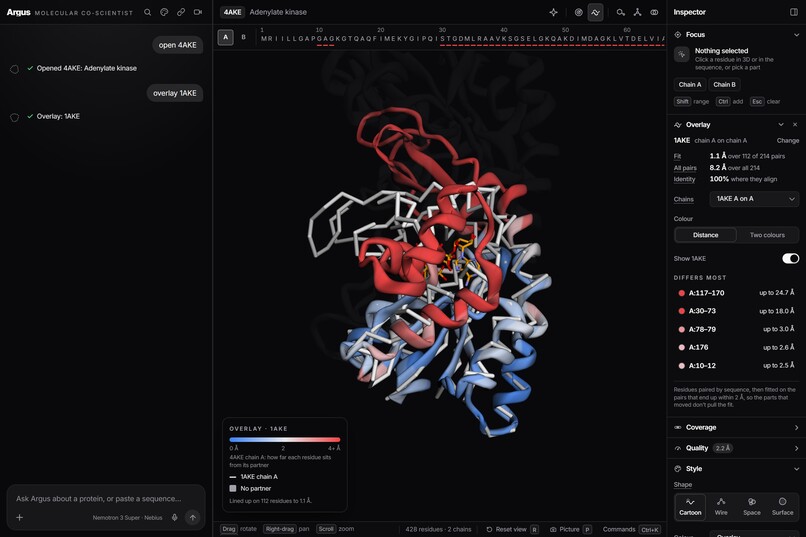
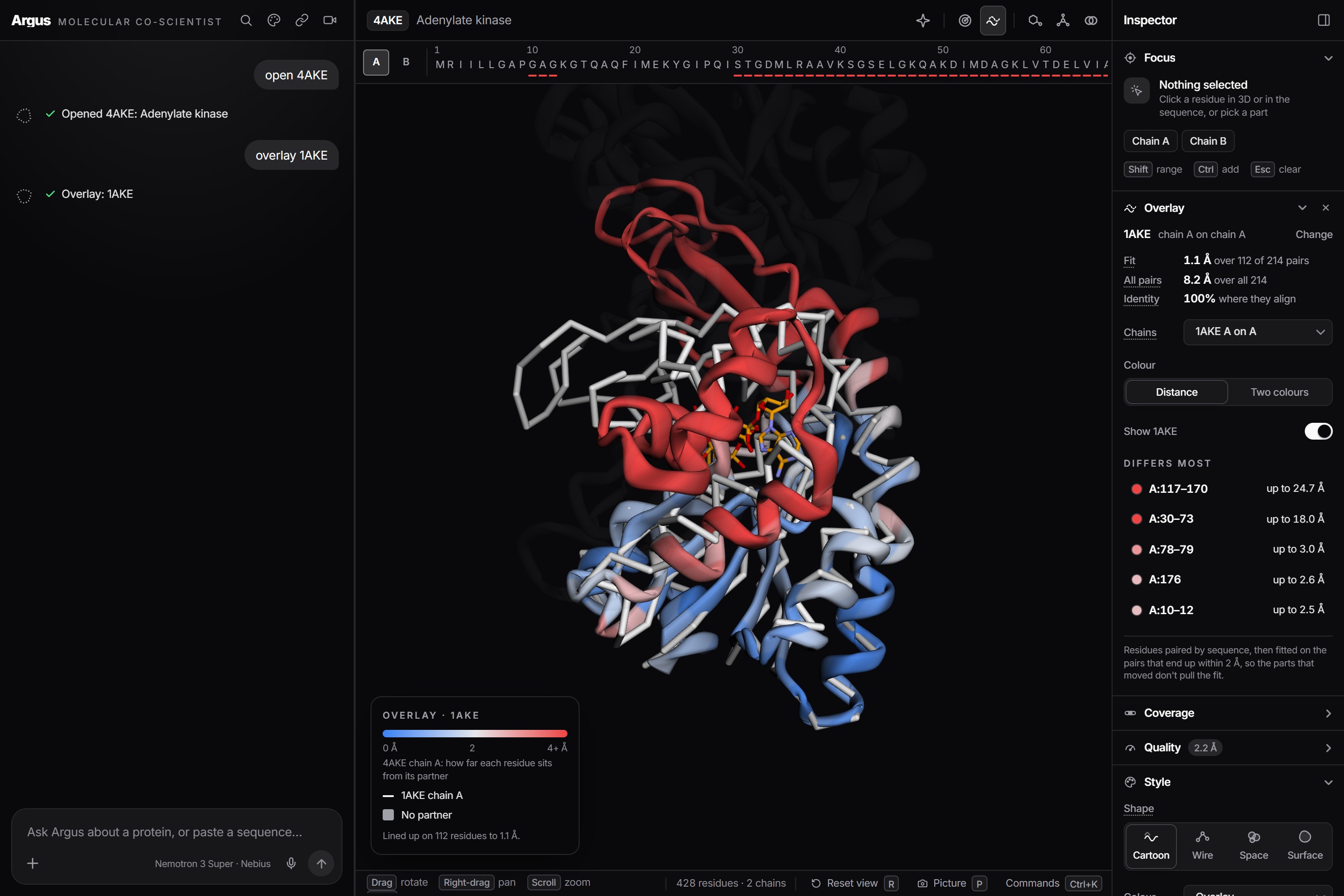
Overlay: adenylate kinase open vs closed, coloured by how far each residue moved. The lid swings up to 24.7 Å.
-
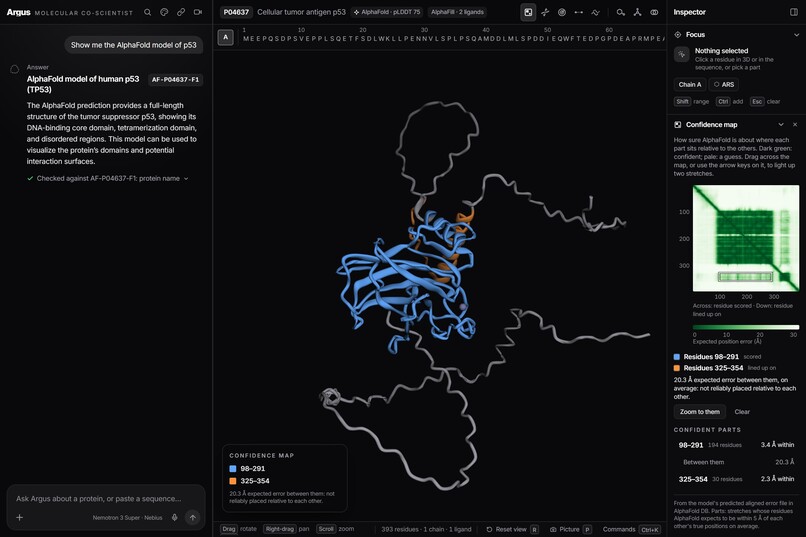
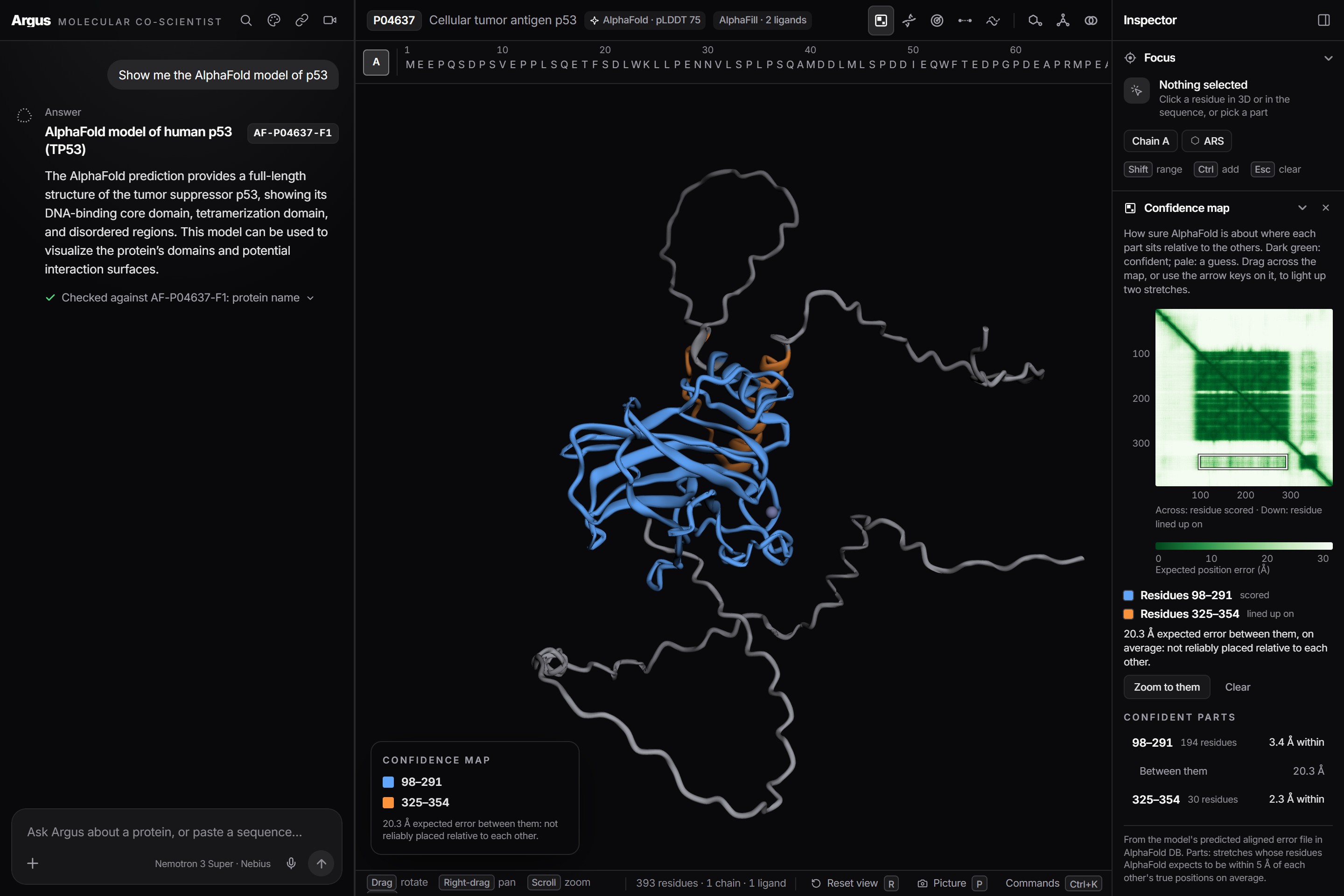
AlphaFold confidence map for p53: both domains are confident, but their arrangement is a guess (20.3 Å expected error).
-
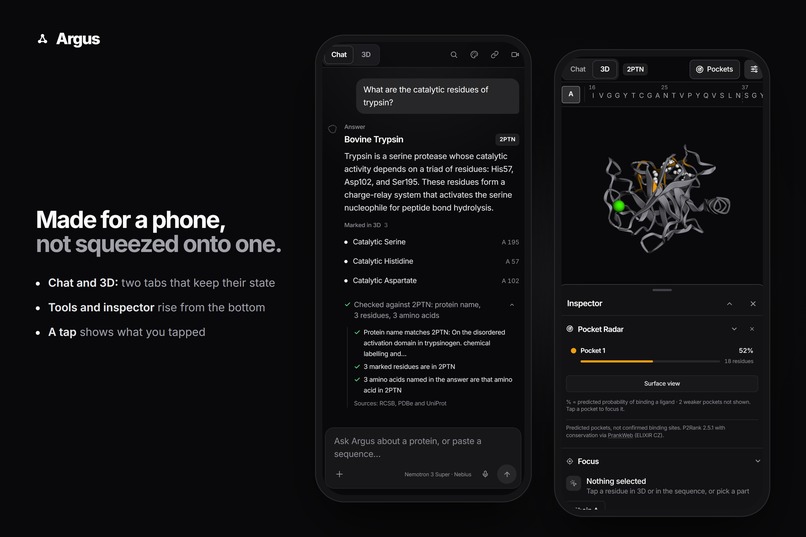
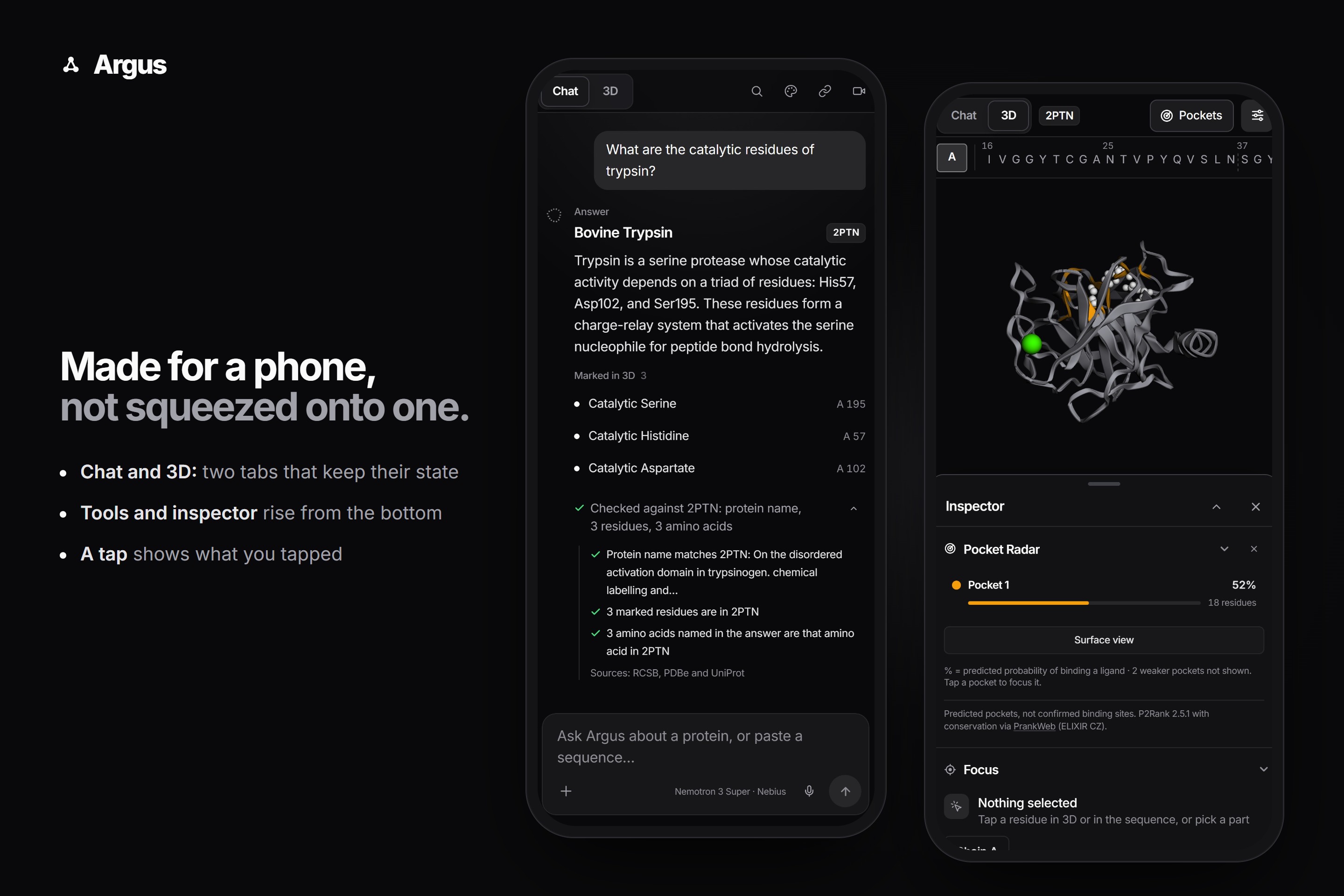
The whole app works on a phone too: chat and 3D as tabs, and the tools in a bottom sheet.
At a glance
- What it is: a protein co-scientist anyone can talk to. Ask in plain English, see the answer on the structure in 3D, and hand harder questions to an agent that runs real science tools.
- NVIDIA open model at runtime: Nemotron 3 Super (
nvidia/nemotron-3-super-120b-a12b) on Nebius Token Factory, inapi/analyze.ts(every answer) andapi/investigate.ts(the agent). - Agent: Investigate mode plans up to six tool steps, runs them, and writes a conclusion that cites the step behind each claim.
- Tavily: a live literature search inside the agent; papers enter an answer only as word-for-word quotes.
- Use it: in any browser, on a phone too, free and with no sign-up.
Inspiration
Protein structures are the clearest picture we have of how life works and how medicines act. The Protein Data Bank holds more than 250,000 of them, free to anyone, yet reading one still takes specialist software and years of training, so most of that knowledge stays out of reach for students, clinicians and biologists outside the field.
I wanted the opposite of expert software: ask a question the way you would ask a colleague, and watch the answer appear on the structure itself. The right protein loaded, the residues that matter marked and explained, and a harder question handed to an agent that runs the same tools a structural biologist would. Nemotron made that practical: an open model quick enough to answer in seconds and capable enough to plan multi-step work. And because a confident wrong answer about a protein is worse than none, Argus checks each answer against the structure before you see it.
What it does
- Ask any protein, see the answer in 3D. "Where does the sickle-cell mutation sit?" Argus picks the right PDB entry or AlphaFold model, opens it in 3D, marks the residues it talks about and explains them in plain English. Nemotron's reply is structured data that drives the viewer: the structure to load, the residues to mark, measurements, a guided tour and a quiz.
- Just say it. "surface, coloured by chain", "open pockets", "overlay 1AKE", "cofold imatinib": the chat drives the viewer too.
- Investigate: the agent. For a question that needs several tools ("Are KRAS's disease mutations near a druggable pocket?"), Nemotron plans the steps from Argus's toolbox: UniProt and PDBe annotations, AlphaMissense variant effects, P2Rank pockets, ligand contacts, STRING partners, Foldseek similar folds, a Tavily search of published research, and a step that measures in 3D how two results relate. The browser runs the steps with a live checklist, and Nemotron writes the conclusion from those results alone, citing the step behind each claim.
- Real science in one workspace. Co-fold (Boltz-2 predicts how a drug binds and how strongly, or compares two drugs), Overlay (lay two structures of a protein over each other to see what moved), Variant Lens, Pocket Radar, Interactions, Find similar, Partners, AlphaFold's confidence map, Coverage, validation Quality, AlphaFill ligands, and ESMFold for any sequence.
- Answers you can trust. Before you see an answer, code checks it against the structure file, UniProt and PDBe: the protein, each residue and chain, each ligand, and every amino acid the text names. A line under each answer says what was checked. In Investigate, a second Nemotron pass checks every sentence against its step, and a paper can only be quoted word for word.
- For anyone, anywhere. Share links reopen the exact view; it works on a phone, in six themes, by keyboard and with a screen reader.
How I built it
Nemotron on Nebius Token Factory is the brain. Every AI call goes to Nemotron 3 Super, NVIDIA's open hybrid Mamba-Transformer mixture-of-experts model built for agentic reasoning, through Token Factory's OpenAI-compatible API, from Vercel Edge Functions, so no key reaches the browser.
- Answers (
api/analyze.ts): one call per question in JSON mode with low reasoning effort, so answers arrive in seconds. The JSON names the structure, the residues to mark, measurements, a tour and a quiz, and the app turns it straight into the 3D view. Before the call, Argus looks up facts (UniProt features, PDBe ligands, predicted pockets, coverage, validation) and sends them along, already mapped to the file's own chain IDs and residue numbers. After it, code checks the answer: small slips are fixed on the spot, and a real mistake goes back to Nemotron once. - The agent (
api/investigate.ts): a planning call at low reasoning effort picks up to six steps; the browser runs them; a write-up call and a check call at medium effort turn the numbered results into a cited conclusion. The literature step calls Tavily at runtime, limited to PubMed, PMC, Europe PMC, the major journals and preprint servers; titles, links and quotes come from the search results, never from the model. - Choosing the model on evidence. I ran Nemotron 3 Super and Nemotron 3 Ultra side by side on Argus's own questions, scored by the app's answer checker. Super made fewer mistakes (3 wrong residues or ligands against 12 over eight questions), answered faster and costs a third as much.
NEMOTRON_MODELswitches models without a code change.
The rest: React 19, TypeScript and Vite, with 3Dmol.js for the viewer and three.js for the landing page. The science databases (RCSB PDB, PDBe, UniProt, AlphaFold DB, Foldseek, PrankWeb, STRING, AlphaFill, ESM Atlas) are called straight from the browser. Co-fold runs Boltz-2 on NVIDIA's API, its input built on the server from the residues the entry actually resolves. Vercel hosts it, with Bot Protection so scripts can't burn the AI credits while every visitor can use everything; Cloudflare R2 keeps shared results behind short links. Unit, live-data, browser (headless Chrome, desktop and phone) and live-site test suites back every change.
Challenges I ran into
- Turning a sentence into the right view. A question names a protein; a structure file has its own chains and numbering. Argus sends database facts already mapped to each file's chain IDs and residue numbers, and checks that residues come back in the file's numbering, not UniProt's (antibody insertion codes like 52A included), so what Nemotron marks lands on the right atoms.
- Picking the right protein. Early on, one answer described a lens crystallin as an insulin hexamer. An identity check now compares the protein an answer describes with the entry it opened: on 47 real answers it flagged the 3 that picked the wrong entry and none of the 44 right ones.
- Checks that don't cry wolf. When a database is slow or down, a checker can call a correct answer wrong. Each check now says "not checked" instead of guessing.
- An agent that sticks to its evidence. Papers reach an Investigate answer only as quotes the app matches word for word, and every other sentence is checked against the step it cites.
- Speed in a browser tab. Overlaying two structures took 5.1 s on the main thread; it now takes 0.16 s. Grouping similar structures went from 14 s to half a second.
- A 3D workspace on a phone, where there is no hover: a tap now shows what you tapped.
Accomplishments that I'm proud of
- Plain English to a marked-up 3D structure in seconds, on a laptop or a phone.
- Tools that agree with the references: Overlay matches RCSB's FATCAT alignment on adenylate kinase (RMSD 7.13 against 7.14 Å), Interactions find 97% of Arpeggio's hydrogen-bonded residues and every metal contact across ten ligands, and the confidence map matches AlphaFold DB's own picture (correlation 0.9995).
- An agent with receipts: up to six real tools chained end to end, every claim cited to the step behind it.
- Answers you can verify, with the evidence one click away.
- Built for everyone: WCAG AA contrast in all six themes, keyboard access, screen reader announcements and a real phone layout.
What I learned
- Structured output turns a model into an interface. Asking Nemotron for JSON instead of prose lets one reply load a structure, mark residues and set up a tour, with no guessing at what the text meant.
- Grounding beats prompting. Giving Nemotron verified facts up front, and checking what comes back, fixed more errors than any prompt wording.
- A faster model plus verification beat a bigger model alone, and cost less.
- Reasoning effort is a dial: low where people wait for an answer, medium where a long, cited write-up has to be right.
What's next for Argus
- Rank a small set of molecules against one binding site, building on Co-fold's comparisons.
- Mutation stability estimates alongside Variant Lens.
- Classroom features: saved tours and quiz sets that a teacher can share with a class.
- Whole papers in Investigate, read within Nemotron's 1M-token context and still quoted word for word.
Built With
- 3dmol.js
- alphafill
- alphafold
- alphamissense
- boltz-2
- esmfold
- foldseek
- nebius-token-factory
- nvidia-nemotron
- nvidia-nim
- p2rank
- pdbe
- pubchem
- rcsb-protein-data-bank
- react
- string-db
- tailwindcss
- tavily
- three.js
- typescript
- uniprot
- vite
- wwpdb

Log in or sign up for Devpost to join the conversation.