Inspiration
Developers and system engineers spend hours every week running repetitive terminal commands, diagnosing broken processes, parsing server logs, and managing infrastructure. While large language models are great at answering text prompts in browser tabs, they have zero native agency inside the developer's local operating system.
I wanted to solve this by exploring a simple idea: what if you could speak to your computer in natural voice and have an intelligent Linux agent plan, execute, sandbox, and verify system tasks in real time? That idea led to the creation of ARGUS, an autonomous voice-native Linux agent daemon designed to act as an intelligent control layer for developers and DevOps workflows.
What it does
ARGUS runs as a background Linux daemon (argusd) and CLI runtime that translates natural spoken voice and text commands into verified system-level actions:
- Neural Voice Interface: Ingests spoken commands through a multi-tier voice cascade and transforms natural language into actionable system intent.
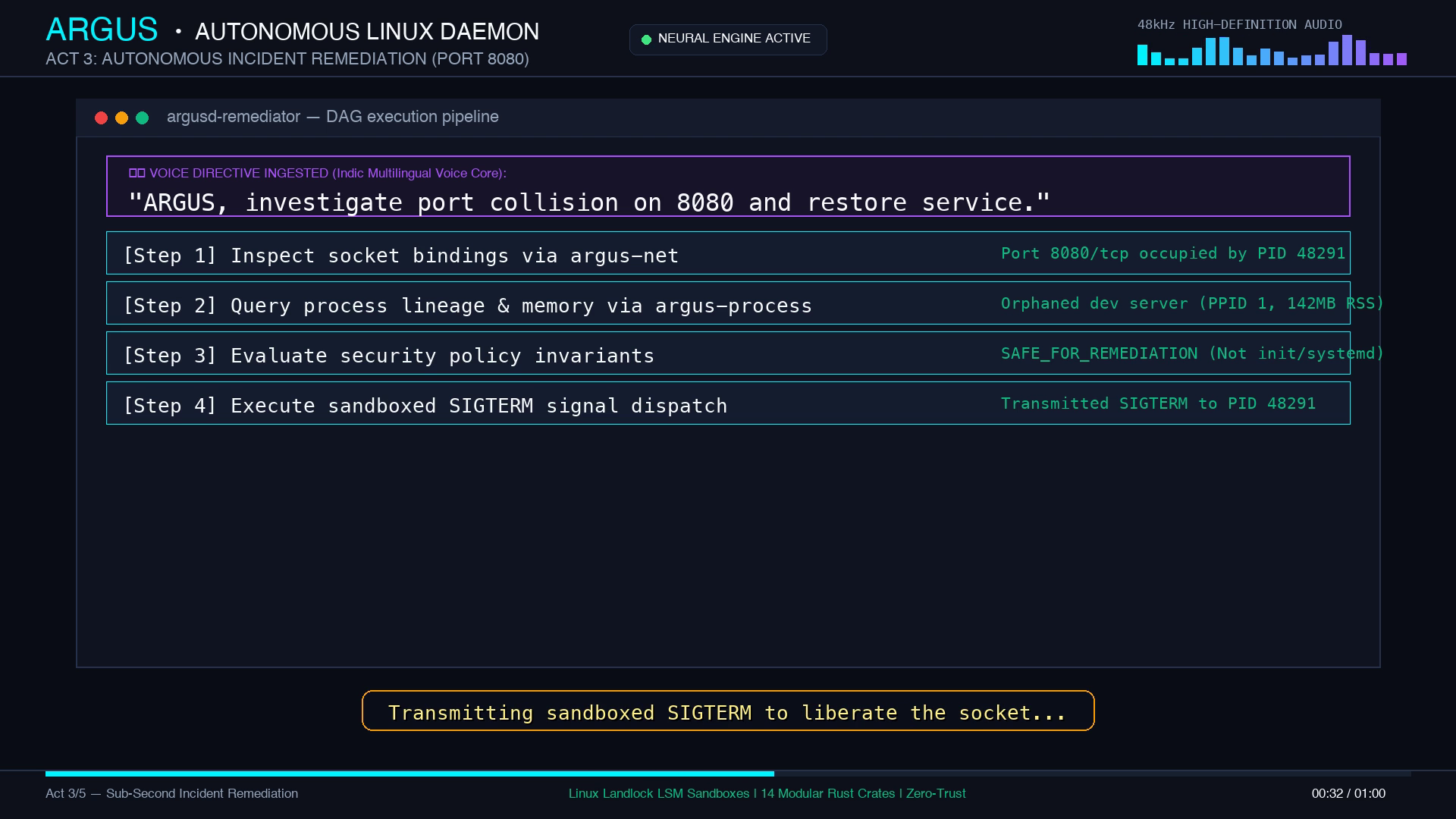
- Autonomous Task Planning: Decomposes high-level instructions (such as finding what process is blocking a port, terminating it, and restarting services) into an execution plan.
- Sandboxed Execution: Runs commands inside an isolated environment with resource constraints to keep the host system safe.
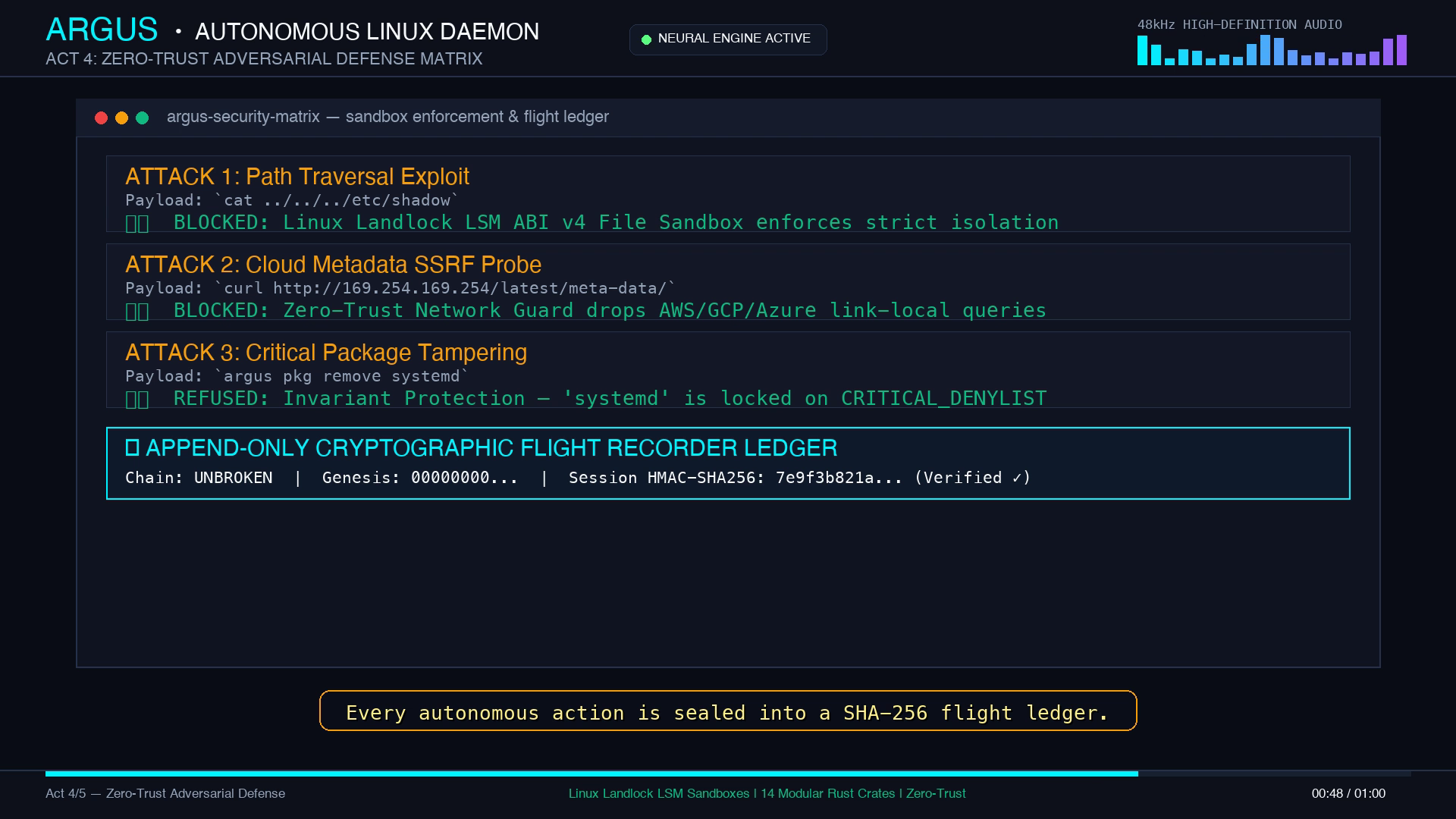
- Security and Verification: Inspects actions against a security suite before execution to prevent destructive commands.
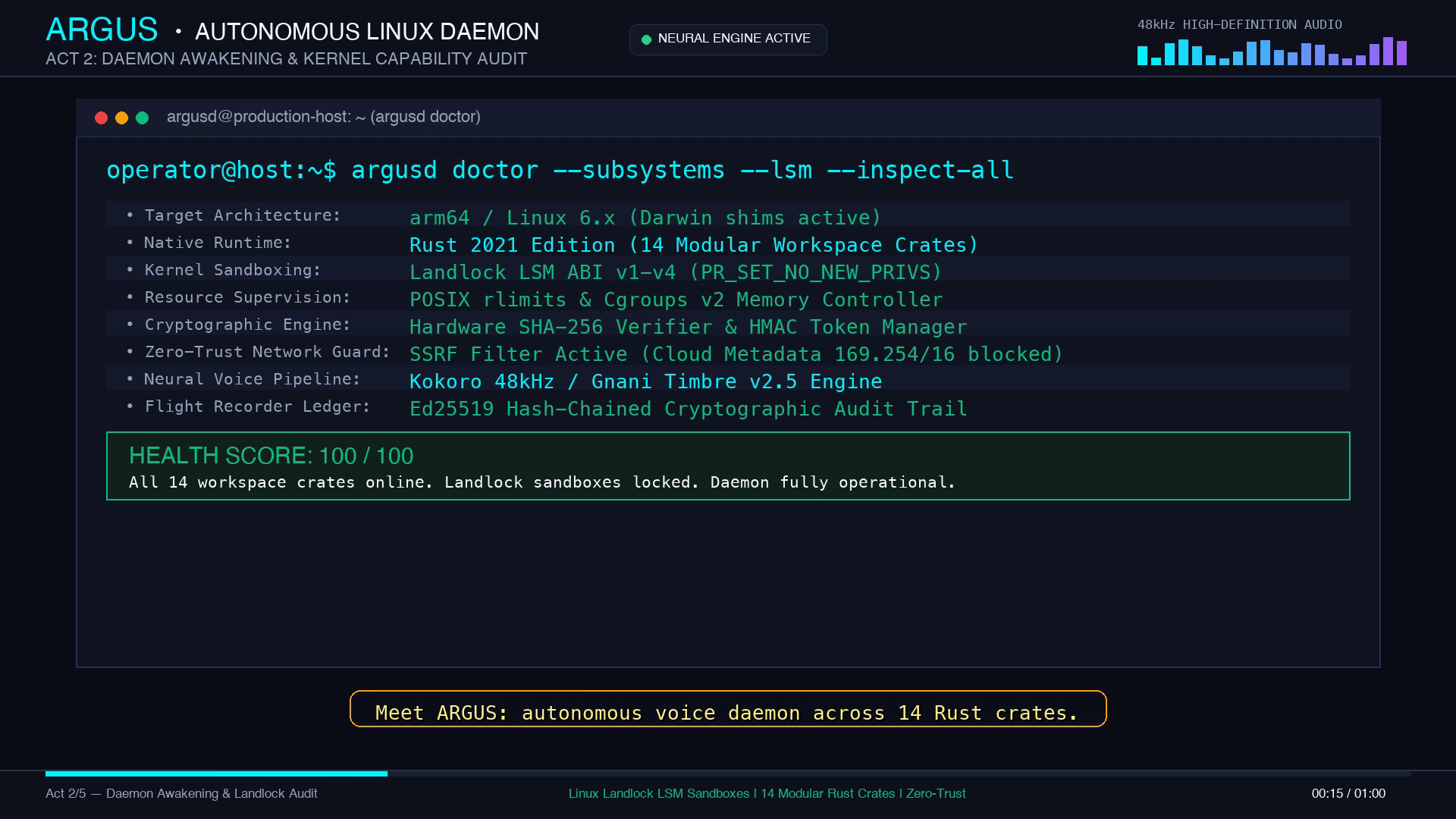
- Terminal Diagnostics: Provides system audits, environment checks, and telemetry directly in the terminal through the argusd doctor command.
How we built it
ARGUS is built across several dedicated modules:
- Core Daemon and Agent: Written in Rust across dedicated crates (argusd, argus-agent, argus-core) for memory safety, low resource overhead, and fast execution.
- Linux Governance: Built with native Linux primitives (argus-linux, argus-sandbox) using process isolation and containment.
- Voice Pipeline: Implemented with an audio processing engine (argus-voice) to handle voice-to-text transcription with low latency.
- Developer Tooling: Paired with terminal CLI tooling and web-based telemetry interfaces built with Next.js and TypeScript.
Challenges we ran into
- Safe Execution: Giving an autonomous agent permission to run shell commands is dangerous. I had to build safety checks, dry-run modes, and sandboxing boundaries to prevent unintentional system damage.
- Voice Latency: Audio capture and transcription can introduce delays. I built a failover pipeline to stream audio chunks and speed up transcription.
- Inter-Process Communication: Connecting the low-level Rust daemon with the CLI required setting up clean Unix domain socket communication.
Accomplishments
- Built a functional modular Rust architecture divided into clear crates for the daemon, sandbox, voice pipeline, and agent runtime.
- Added a 20-point security test suite that catches dangerous commands before they run.
- Achieved fast sub-second response times for everyday terminal tasks and system diagnostics.
What we learned
- Building systems software in Rust requires a deep understanding of Linux processes, signals, and concurrency.
- Voice input is surprisingly efficient for developers when multitasking or monitoring deployments.
- Sandboxing and safety guardrails must be built into the core architecture from day one.
What is next for ARGUS
- Expanding ARGUS to manage multi-node cloud servers and AWS EC2 instances from voice commands.
- Adding Model Context Protocol (MCP) support so ARGUS can interact with external databases and cloud APIs.
- Opening up the plugin system so other developers can add custom commands and integrations.
Built With
- agents
- alexa
- artificial-intelligence
- bash
- devops
- linux
- mcp
- model-context-protocol
- next.js
- rust
- system-architecture
- tailwind-css
- typescript
- voice

Log in or sign up for Devpost to join the conversation.