-
-
Incident Dispatch Queue — Real-time alerts with escalation countdown timers.
-
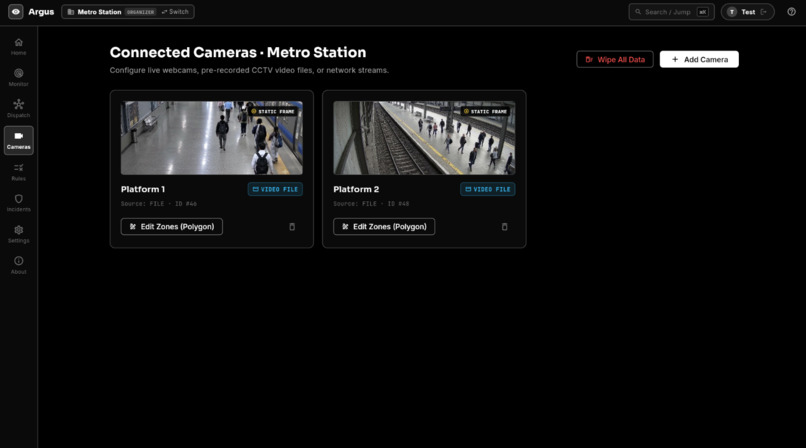
Tactical Control Room — Real-time multi-camera monitoring grid.
-
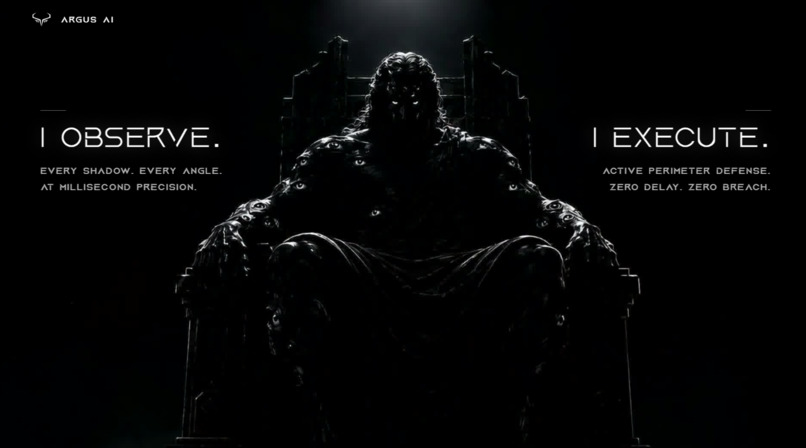
Argus AI — Autonomous tactical vision & perimeter defense.
-
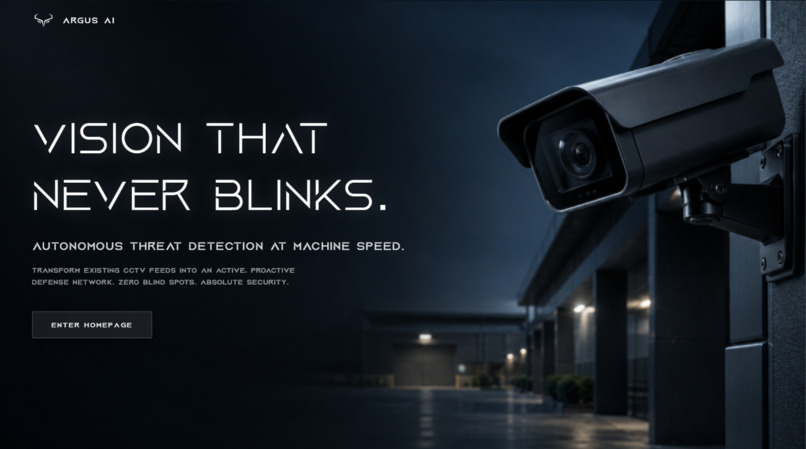
Sub-35ms real-time threat detection transforming passive CCTV streams.
-
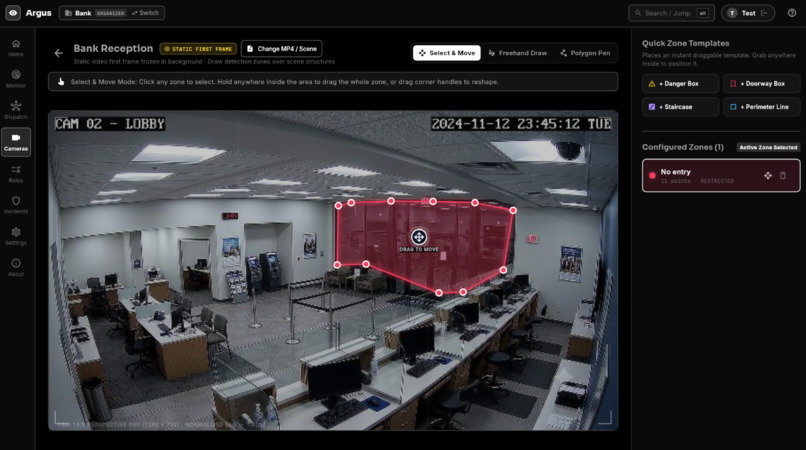
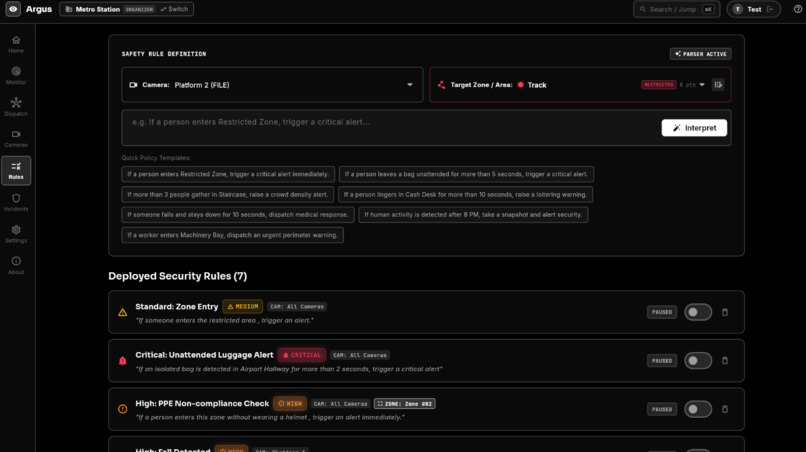
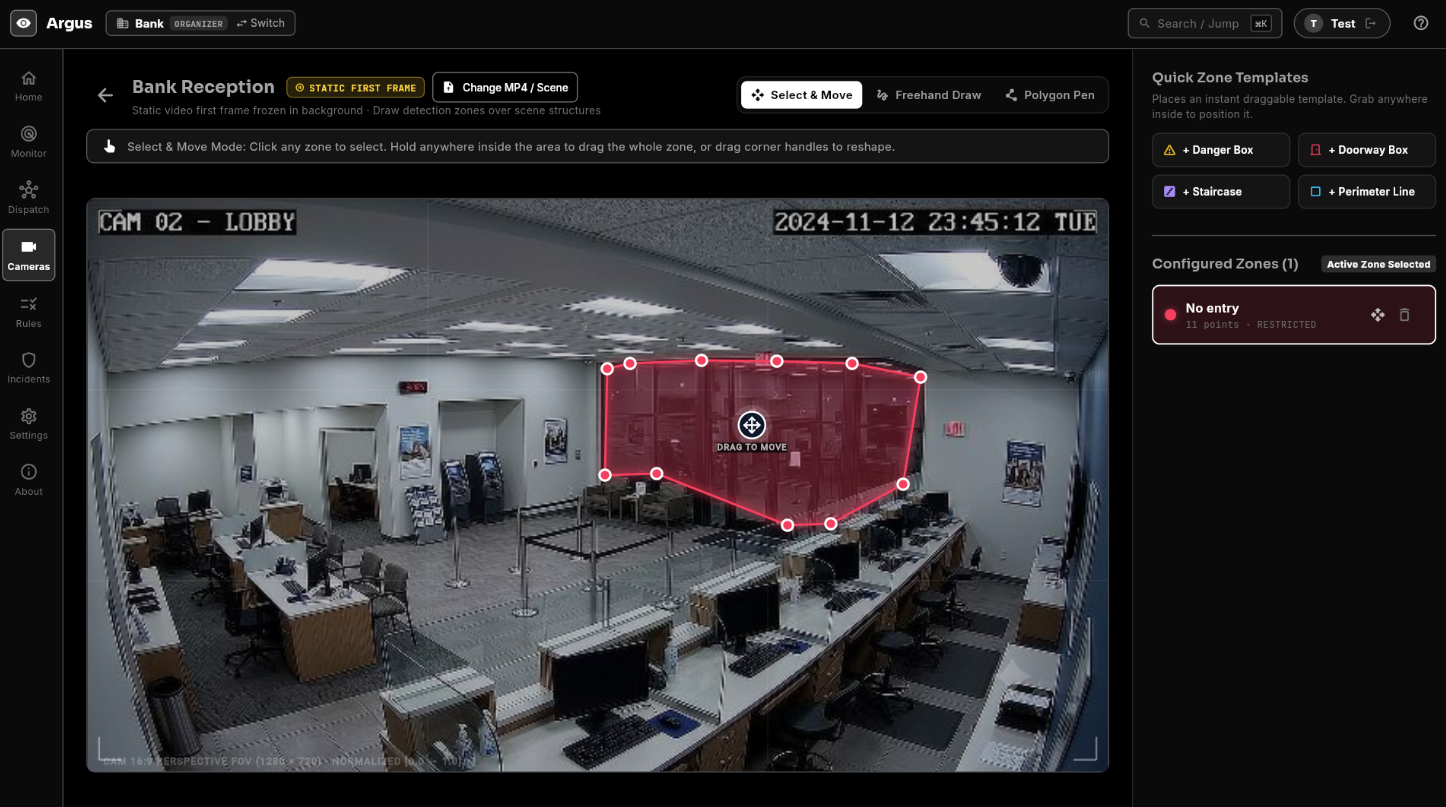
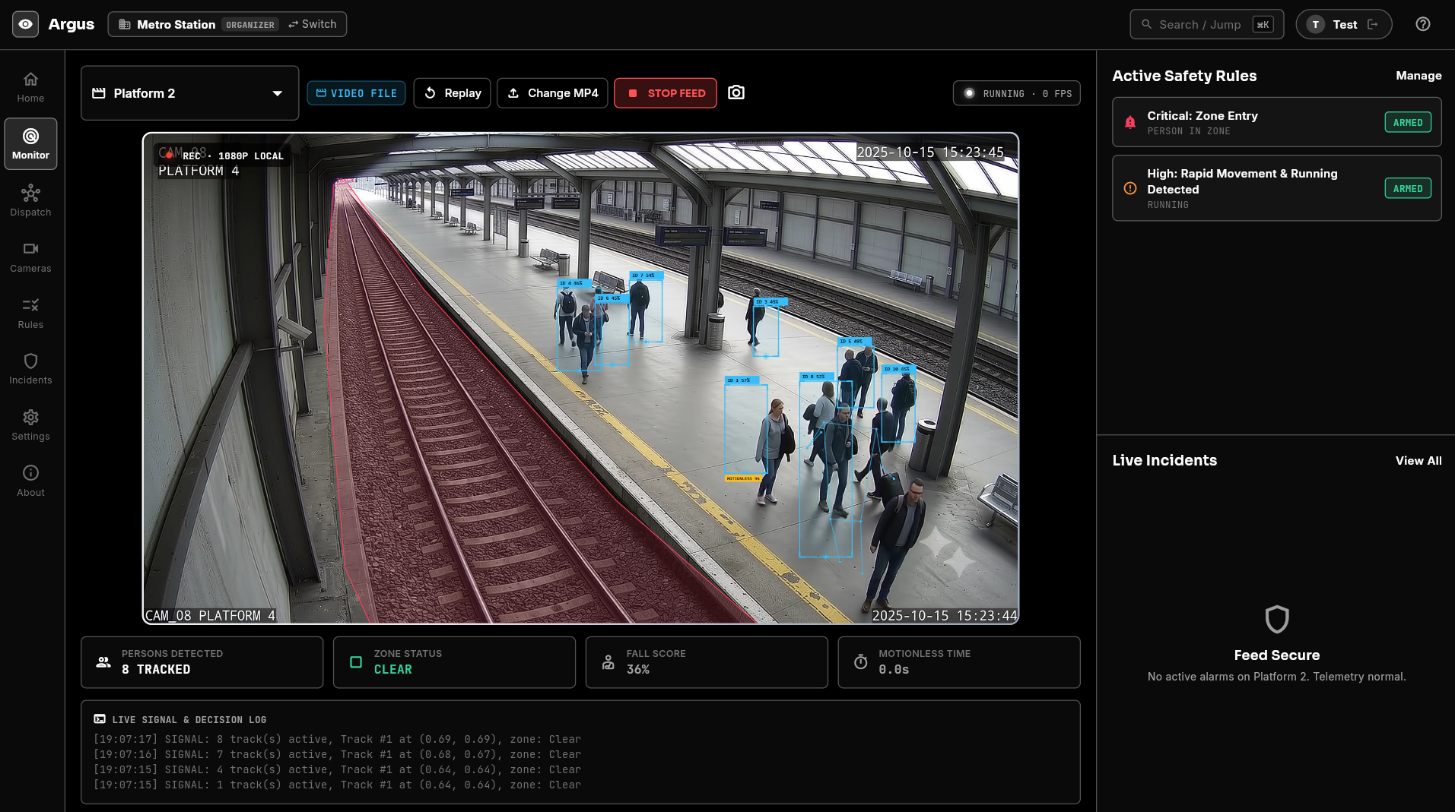
Restricted Zone Protection — Custom spatial boundaries over critical areas.
-
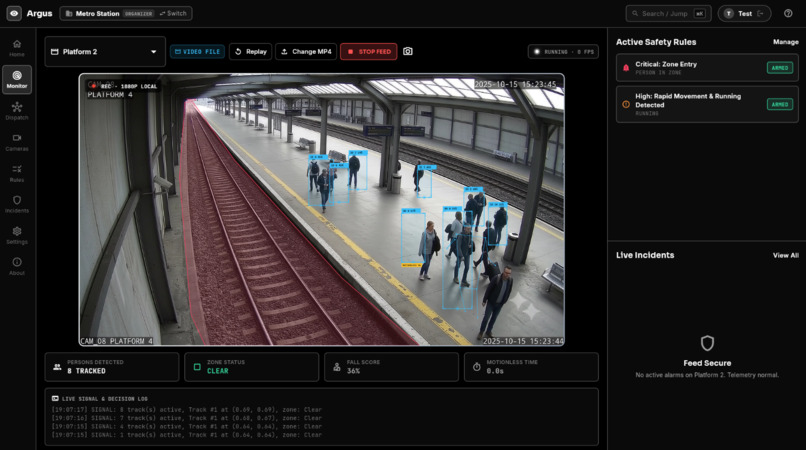
Platform Safety Boundary — Interactive arbitrary polygon geofencing.
-
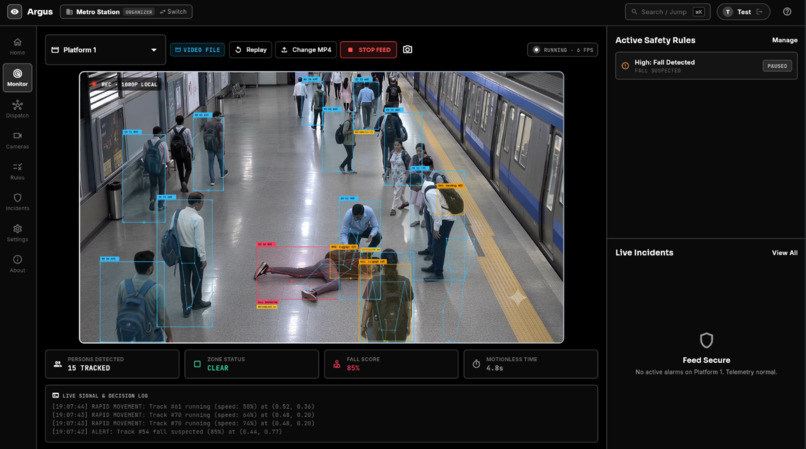
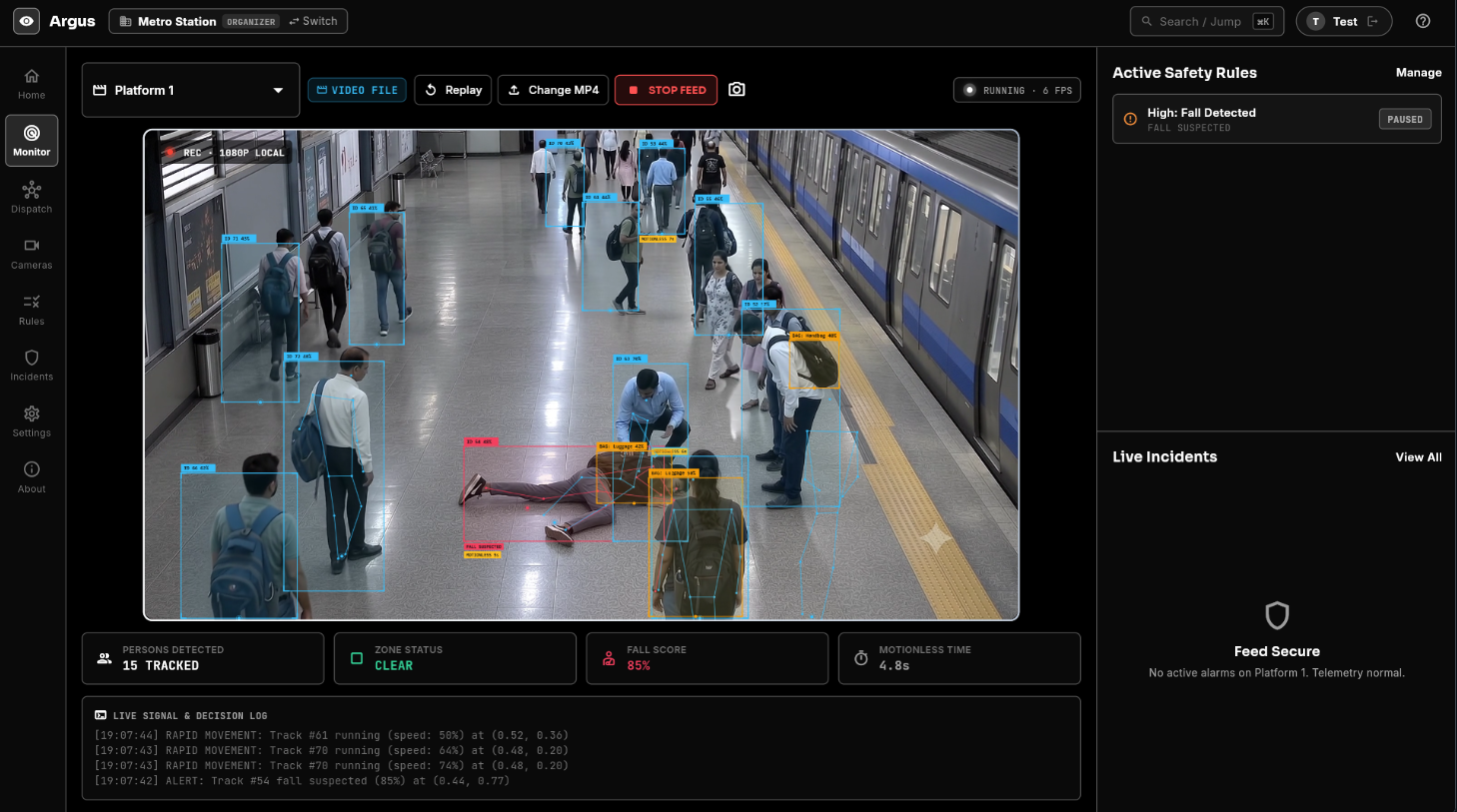
Biomechanical Fall Detection — 33-point skeletal pose tracking at 60 FPS.
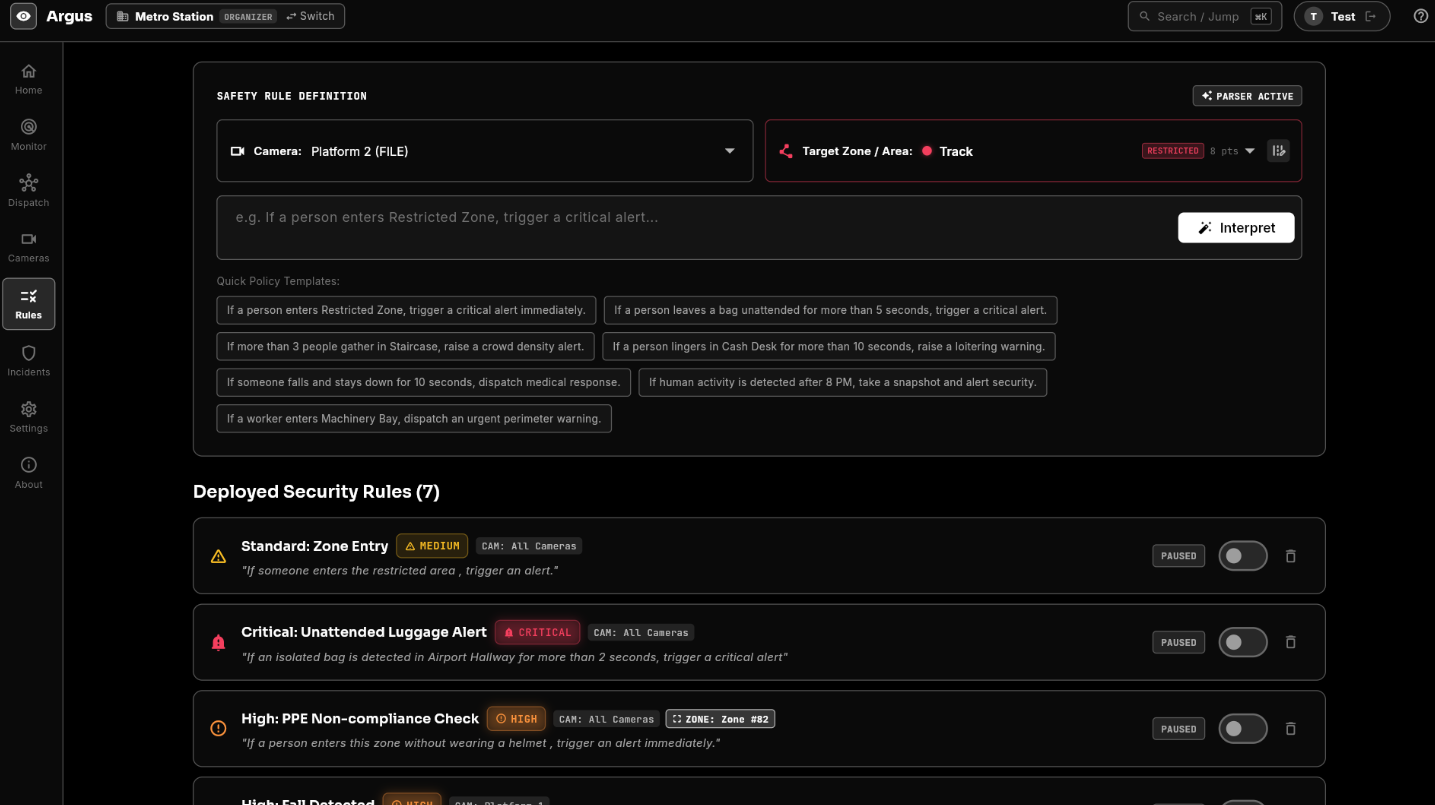
Inspiration
Over one billion surveillance cameras watch the planet today, yet 99% of them operate as passive digital recorders. CCTV only records tragedies—it rarely prevents them. Security personnel and facility managers suffer from severe surveillance fatigue, often missing critical industrial slips, medical falls, and unauthorized perimeter breaches until hours after they occur.
We built Argus AI to transform passive CCTV streams into proactive, tactical sentinels capable of reasoning in sub-seconds and initiating automated, verified incident dispatch within 35 milliseconds.
What it does
Argus AI is an autonomous tactical vision and incident dispatch system engineered for industrial facilities, high-security zones, and smart facilities:
- Interactive Spatial Geofencing: Operators can click and drag vertices directly over live camera streams to create arbitrary $N$-point convex or concave polygon boundaries with sub-pixel precision.
- Biomechanical Skeletal Tracking: Tracks a 33-point pose landmark pipeline at 60 FPS, monitoring human posture and spatial movement without storing sensitive biometric identities.
- Kinematic Fall Scoring: Computes real-time aspect-ratio deformation ($w/h > 1.8$) and center-of-mass velocity shifts to reliably detect sudden falls, slips, and collapses.
- High-Throughput WebSocket Ingestion: Streams high-frequency detection batches directly to a real-time Dart backend for rule verification and database persistence.
- Automated Escalation Timers: Automatically schedules countdown escalation timers for unacknowledged critical alerts, ensuring emergency protocols trigger if an operator does not respond within the SLA window.
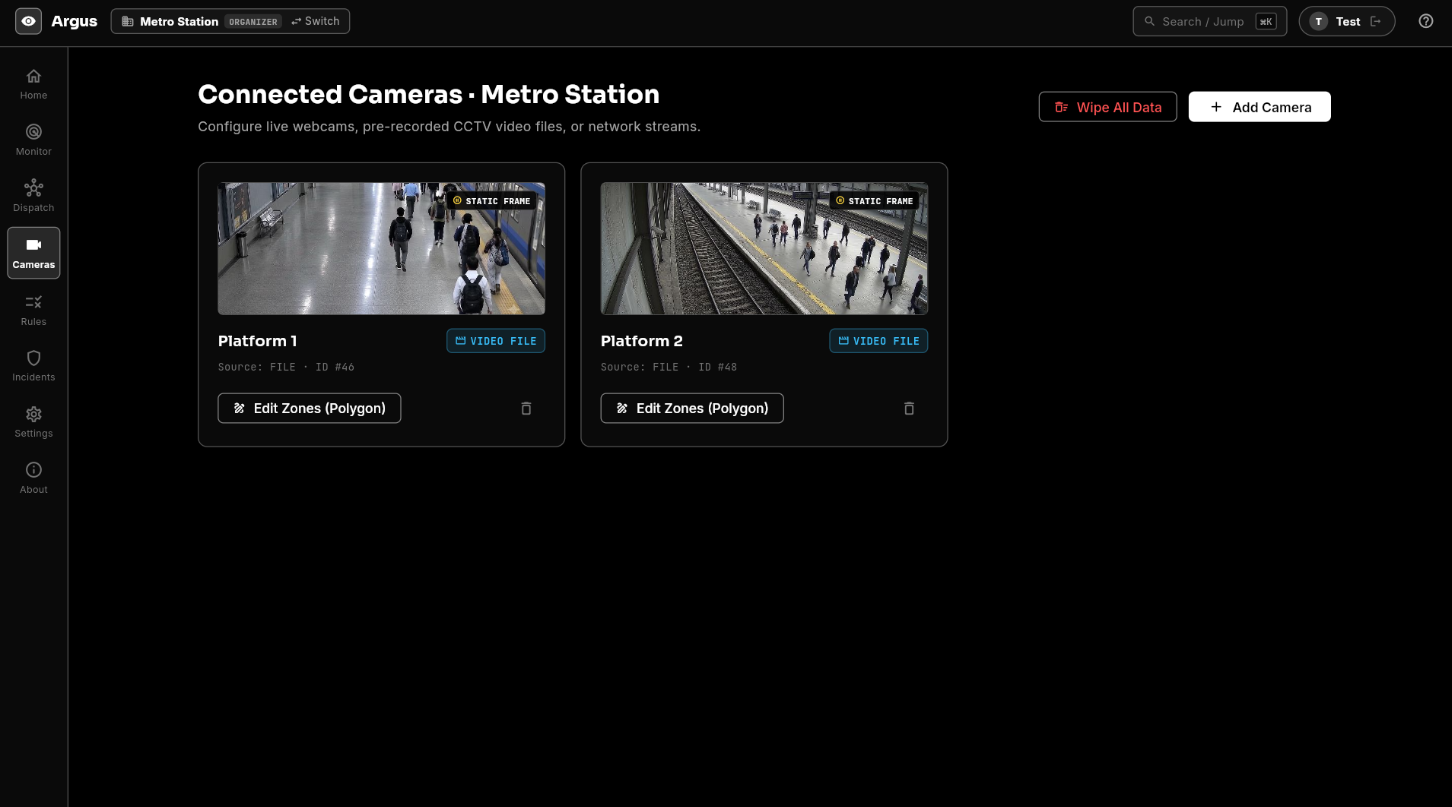
- Tactical Control Room: A high-density dark interface with forensic snapshot modals, active incident queues, and one-click acknowledgment controls.
How we built it
Argus AI is built on a unified Full-Stack Dart & Flutter architecture cleanly separated into three modular packages:
argus_engine: A zero-dependency pure Dart package implementing Jordan curve theorem ray-casting algorithms for arbitrary polygon collision detection and a deterministic natural language rule parser.argus_server: A high-concurrency Dart backend handling streaming WebSocket telemetry batches, PostgreSQL persistence, and asynchronous countdown escalation workers.argus_flutter: A tactical web interface rendered via CanvasKit, featuring 60 FPS skeletal video overlays, interactive polygon zone canvases, and priority-ranked dispatch queues.
Throughout the build, we followed the official Devpost Learn Skill Pack, establishing our initial scope and PRD (devpost/scope.md, devpost/prd.md), technical specification (devpost/spec.md), verified build checklist (devpost/checklist.md), and an interactive architectural companion (devpost/app-map.html).
Challenges we ran into
- Sub-Millisecond Polygon Collision at 60 FPS: Testing 33 skeletal landmarks against arbitrary $N$-point polygons at 60 FPS without dropping frames required optimizing vertex coordinate normalization and implementing axis-aligned bounding box (AABB) pre-filtering.
- Mitigating False Positives in Fall Detection: A person bending over can mimic a horizontal aspect ratio. We incorporated temporal velocity tracking to ensure only rapid descent transitions trigger high-severity fall alarms.
- Spec-Driven Discipline: Adhering strictly to the plan-first curriculum required resisting the urge to build speculative features before verifying our core geometric ray-casting engine with sub-second unit tests.
Accomplishments that we're proud of
- Achieving sub-35ms pipeline latency from camera video frame ingestion to geometric collision detection.
- Engineering a completely unified, type-safe codebase written 100% in Dart and Flutter across client and server layers.
- Creating an interactive CanvasKit polygon editor that allows operators to define custom security zones directly on live video feeds.
- Delivering a fully traceable, production-ready specification suite where every single feature maps back to an approved acceptance criterion.
What we learned
- Contract-First Pure Dart Isolation: Decoupling mathematical domain logic (
argus_engine) from UI and server runtimes allowed us to execute 18 spatial unit tests in under 200ms with complete deterministic confidence. - The Value of Plan-First Engineering: Defining observable behavioral criteria and edge cases in the PRD upfront eliminated architectural drift and saved countless hours of debugging across WebSockets and rendering pipelines.
What's next for Argus-AI
- Multi-Camera Re-Identification: Tracking detected entities and trajectories across distributed physical zones and facilities.
- Edge Gateway RTSP Decoding: Direct hardware ONVIF/RTSP IP camera ingestion on local edge appliances.
- Physical Access Integration: Connecting incident dispatch signals to automated magnetic door locks, industrial sirens, and municipal emergency response webhooks.
Built With
- computer-vision
- dart
- flutter
- machine-learning
- mediapipe
- object-detection
- pose-estimation
- postgresql
- real-time
- surveillance
- websockets


Log in or sign up for Devpost to join the conversation.