Project Argus — Hackathon Submission
Category: Live Agents (Gemini Live Agent Challenge)
Project Description
Argus is a real-time, voice-driven Security Operations Center (SOC) AI agent. It enables SOC analysts to interrogate network security logs through natural speech using the Gemini Live API. The agent queries Google BigQuery for threat intelligence, manages device states in Cloud Firestore, and pushes live visual updates to a React dashboard — all in sync with its spoken responses over a single multiplexed WebSocket connection.
Features and Functionality
- Voice-First Interaction — Speak naturally to query network logs, investigate threats, and issue commands. Supports barge-in (interrupt the agent mid-sentence).
- Real-Time Threat Intelligence — Query BigQuery for high-severity threats, filter logs by IP/port/status, and analyze traffic patterns — all via voice.
- Device Management — View active network connections in real time, block suspicious devices, and filter connections by status (ACTIVE / BLOCKED / SUSPICIOUS).
- Incident Tracking — Each session creates a persistent incident record with full transcripts and tool execution findings, enabling post-session review.
- Parallel UI Sync — When the agent executes a tool, results render on the dashboard before the agent finishes speaking, keeping the visual and audio experience in lockstep.
- Live Audio Streaming — Bidirectional PCM16 audio at 16kHz streamed between the browser and Gemini via WebSocket.
- Image Upload — Share screenshots (e.g., suspicious processes, alerts, or dashboards); Gemini’s vision capabilities analyze the image and you can follow up with voice to query or act on findings.
Technologies Used
| Layer | Technology |
|---|---|
| AI | Gemini Live API (gemini-live-2.5-flash-native-audio) via google-genai SDK |
| Backend | FastAPI (Python 3.13), Uvicorn, WebSockets |
| Frontend | React 19, Vite, Tailwind CSS, Web Audio API |
| Analytics DB | Google BigQuery (argus_soc.network_logs) |
| Operational DB | Google Cloud Firestore (incidents, transcripts, findings, active connections) |
| Frontend SDK | Firebase JS SDK (Firestore real-time listeners) |
| Hosting | Google Cloud Run (containerized backend + frontend) |
| CI/CD | GitHub Actions + Google Cloud Build + Workload Identity Federation |
| Container Registry | Google Artifact Registry |
Third-Party Data Sources
- BigQuery
network_logs— 1,000+ rows of synthetic network traffic generated byscripts/generate_mock_data.pyusing Faker. Rows include source/destination IPs, ports, byte counts, and threat intel status (CLEAN / SUSPICIOUS / MALICIOUS). - Firestore
active_connections— Simulated device connection records created via the/simulate-trafficendpoint or seeded manually.
Code Repository
https://github.com/pratima-sapkota/argus
Architecture Diagram
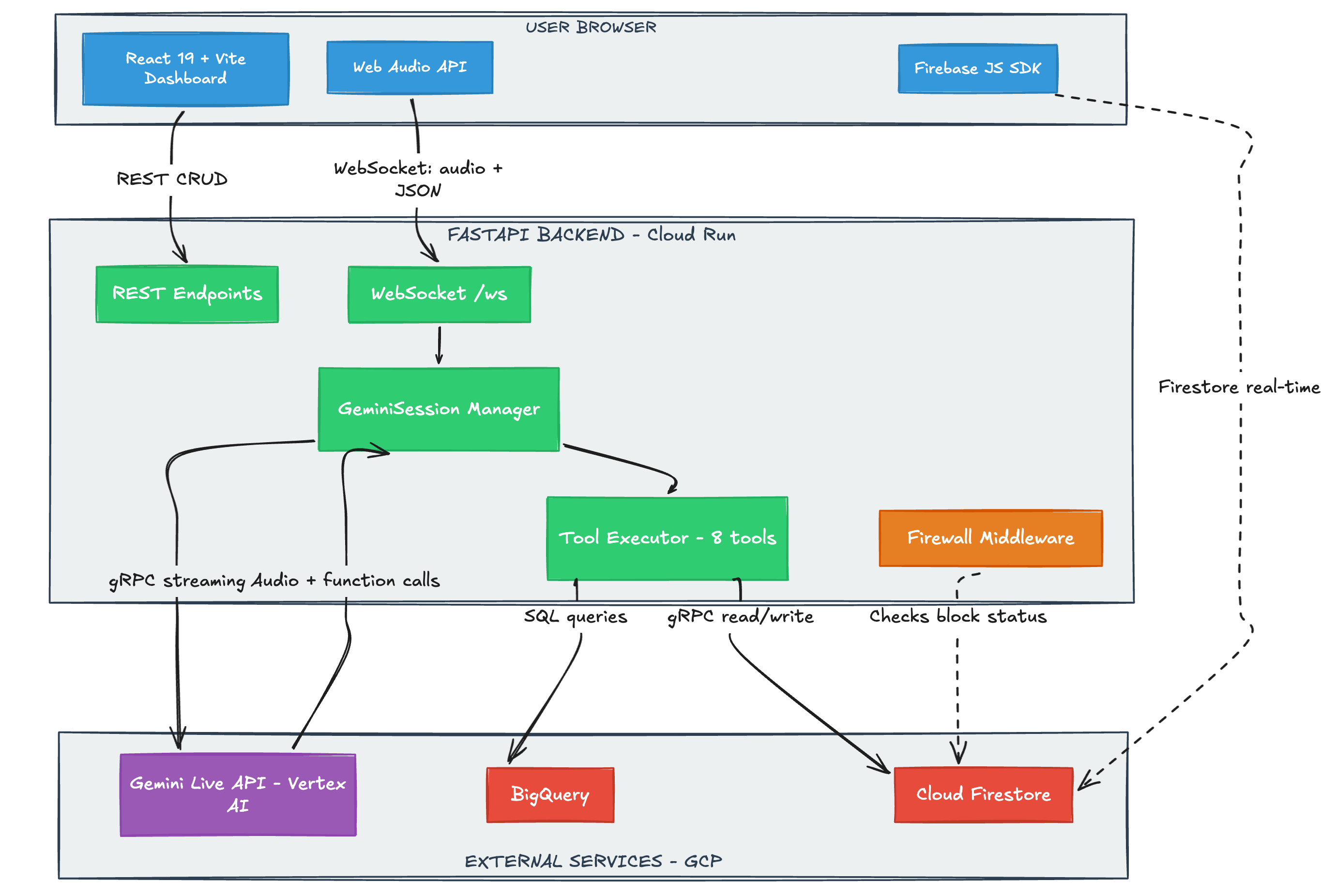
High-level flow:
Browser (React + Web Audio API)
    │
    │  WebSocket (audio + JSON)
    ▼
FastAPI Backend (Cloud Run)
    │
    ├──► Gemini Live API (speech ↔ function calling ↔ speech)
    │
    ├──► BigQuery (network log queries)
    │
    └──► Firestore (incidents, transcripts, findings, device state)
    │
    ▼
Firebase JS SDK ◄── Real-time listeners (active connections)
    │
    ▼
React Dashboard (live threat cards, tables, device panels)
Proof of Google Cloud Deployment
Both the frontend and backend are containerized and deployed to Google Cloud Run via an automated CI/CD pipeline.
Cloud Deployment Proof Video: https://youtu.be/CBoN79BwbEU
- Deployment pipeline: GitHub Actions triggers Google Cloud Build on every push to
main.cloudbuild.yaml— Cloud Build configuration that builds Docker images, pushes them to Artifact Registry, and deploys both services to Cloud Run..github/workflows/deploy.yml— GitHub Actions workflow that authenticates via Workload Identity Federation and submits the Cloud Build job.
- GCP services used:
- Cloud Run — Hosts the FastAPI backend and Nginx-served React frontend as separate services.
- Artifact Registry — Stores container images (
argus-backend,argus-frontend). - BigQuery — Stores and queries the
argus_soc.network_logsdataset. - Cloud Firestore — Real-time operational database for incidents, transcripts, findings, and active device connections.
- Live Frontend URL: https://argus-frontend-215980001921.us-central1.run.app
- Live Backend URL: https://argus-backend-215980001921.us-central1.run.app
GCP Proof (Key Files)
Proof of Deployment: https://youtu.be/CBoN79BwbEU
Code Proofs:
backend/app/gemini.py— Connects to the Gemini Live API via thegoogle-genaiSDK (client.aio.live.connect()), streams bidirectional audio, and dispatches function calls.backend/app/tools.py— Executes parameterized queries against BigQuery (bigquery.Client) and writes device state to Cloud Firestore (firestore.AsyncClient).backend/app/config.py— Initializes the Google Cloud BigQuery and Firestore clients used throughout the backend.cloudbuild.yaml— Cloud Build pipeline that builds, pushes to Artifact Registry, and deploys to Cloud Run.scripts/setup_gcp.sh— Enables required GCP APIs and creates the BigQuery dataset.scripts/generate_mock_data.py— Seeds the BigQueryargus_soc.network_logstable with synthetic data.
Automated Cloud Deployment
Deployment is fully automated via GitHub Actions + Google Cloud Build:
- Every push to
maintriggers the.github/workflows/deploy.ymlworkflow. - GitHub Actions authenticates to GCP using Workload Identity Federation (no service account keys stored in CI).
- Cloud Build executes
cloudbuild.yaml, which:- Builds Docker images for backend and frontend
- Pushes them to Google Artifact Registry
- Deploys both services to Google Cloud Run
- Injects the backend Cloud Run URL into the frontend build at build time
Setup script for Workload Identity Federation: scripts/setup_wif.sh
Demonstration Video
Findings and Learnings
- Gemini Live API native audio eliminates the need for separate STT/TTS services — the model handles speech-to-speech natively with sub-second latency, including built-in barge-in support.
- Parallel UI sync is critical for perceived responsiveness. Sending tool results to both Gemini (for the spoken response) and the WebSocket (for the visual update) simultaneously makes the dashboard feel instantaneous even while the agent is still formulating its verbal answer.
- A single multiplexed WebSocket carrying both audio frames and JSON control messages keeps the architecture simple and avoids the complexity of managing multiple connection channels.
- BigQuery parameterized queries with
QueryJobConfigprevent SQL injection while allowing the AI agent to construct flexible filters based on user voice commands. - Firestore real-time listeners on the frontend (via Firebase JS SDK) enable live device status updates without polling, which is essential for the "block device" workflow where the UI must reflect state changes immediately.
- Cloud Build's multi-step pipeline (build backend → capture URL → inject into frontend build → deploy) solves the chicken-and-egg problem of the frontend needing the backend's Cloud Run URL at build time.
Built With
- ci/cd
- docker
- fastapi
- firebase
- gemini-live-api
- google-bigquery
- google-genai
- javascript
- python
- react
- web-audio
- websockets

Log in or sign up for Devpost to join the conversation.