Inspiration
Every day, companies spend millions securing their networks from the unknown. But physical access remains the most overlooked vulnerability in cybersecurity. Small businesses and those on a tighter budget has little to no way to detect and identify unauthorized personnel in real time. We wanted to build what every spy headquarters already has: an intelligent surveillance system that doesn't just record, but thinks.
What it does
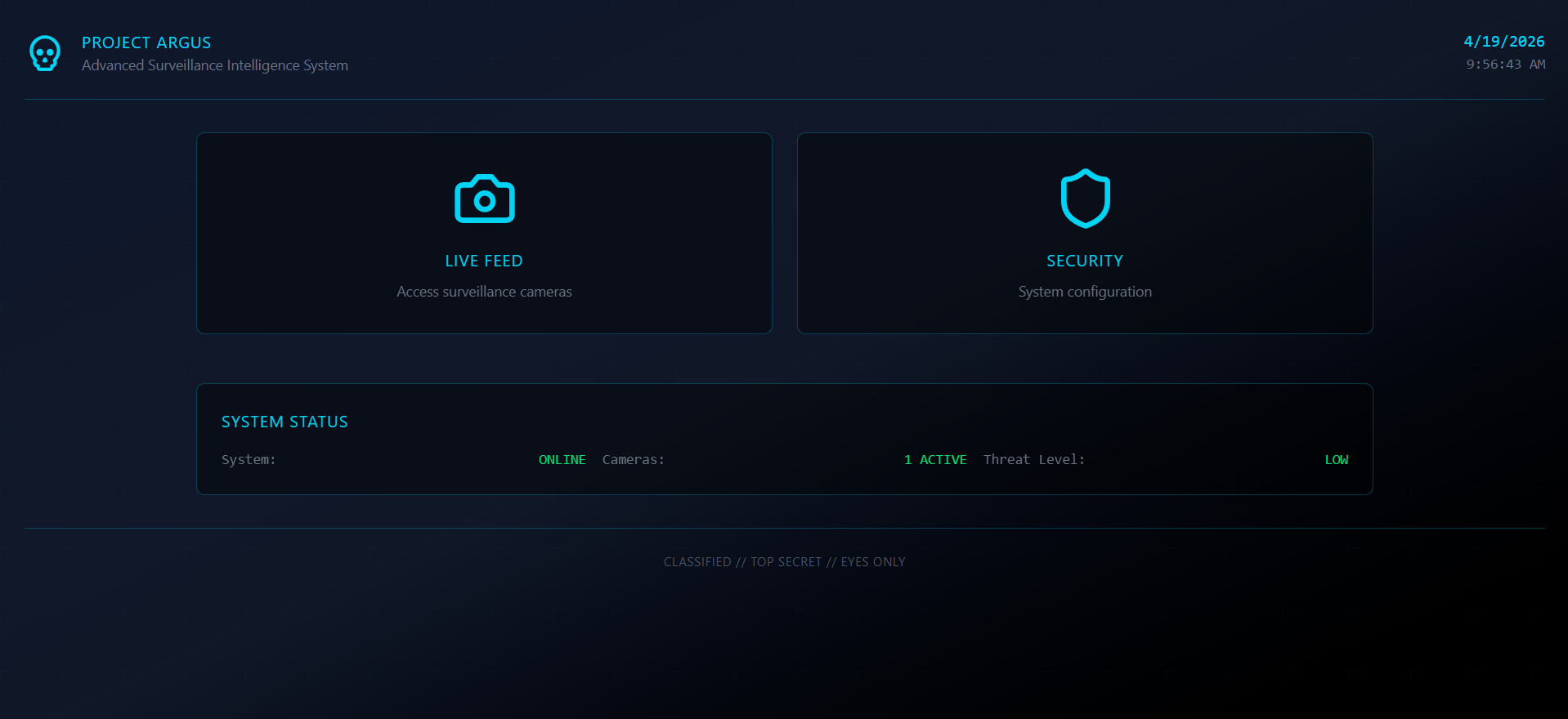
ARGUS is a physical AI-powered surveillance station. When someone approaches, a PIR motion sensor triggers the system, which captures their photo, runs face recognition to check if they're an authorized agent, generates a real-time threat profile using the Gemini Vision API, and delivers an audio briefing via ElevenLabs, which is all displayed live on a spy-themed dashboard. Authorized agents are welcomed. Unknown subjects trigger an intruder alert.
How we built it
- Arduino + PIR sensor detects motion and signals our Python backend over USB serial
- OpenCV captures the photo and runs face recognition against our authorized agents database
- Google Gemini Vision API analyzes the captured photo and generates a classified threat briefing
Challenges we ran into
Finding the right libraries to install for the goals we wanted proved to be very, very difficult. We also ran into webcam latency issues, having to scrap a part and reevaluate as a group. The motion sensor's construction was the most difficult, since it was not as accurate initially.
Accomplishments that we're proud of
Honestly, this whole project done in the timeframe of 24 hours is a very rewarding achievement. Working and growing under pressure as a team was very memorable.
What we learned
We learned how to integrate hardware with software using serial communication, how classical ML face recognition works under the hood, and how to rapidly debug dependency issues under time pressure.
What's next for Argus
Hopefully, we will be able to replace the laptop with a Raspberry Pi for a fully standalone unit. Some more goals include adding persistent logging to a database, deploying multiple units across a facility connected to a central dashboard, and improving face recognition accuracy with more training photos per person.


Log in or sign up for Devpost to join the conversation.