-
-

Home Page
-
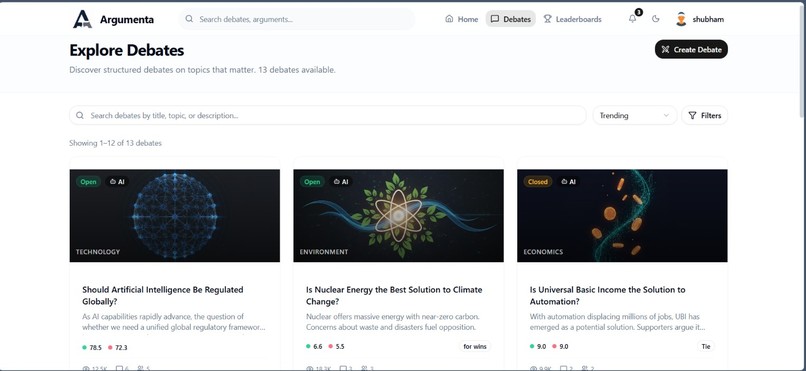
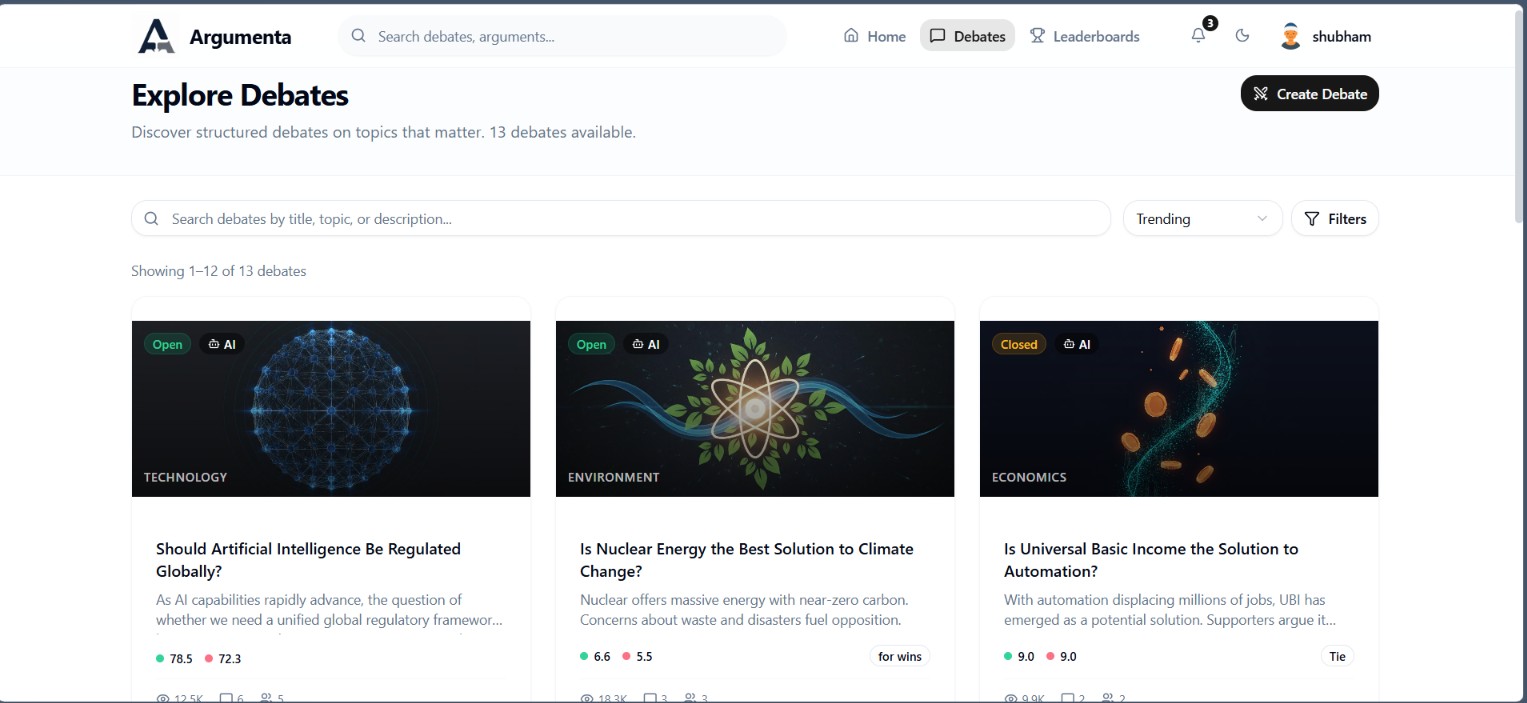
Debate Gallery
-
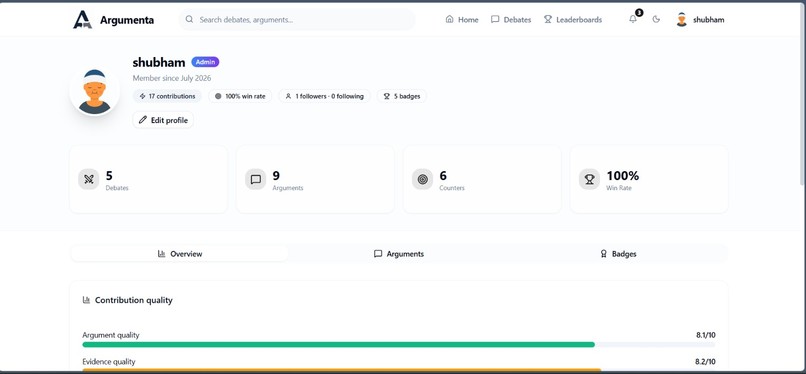
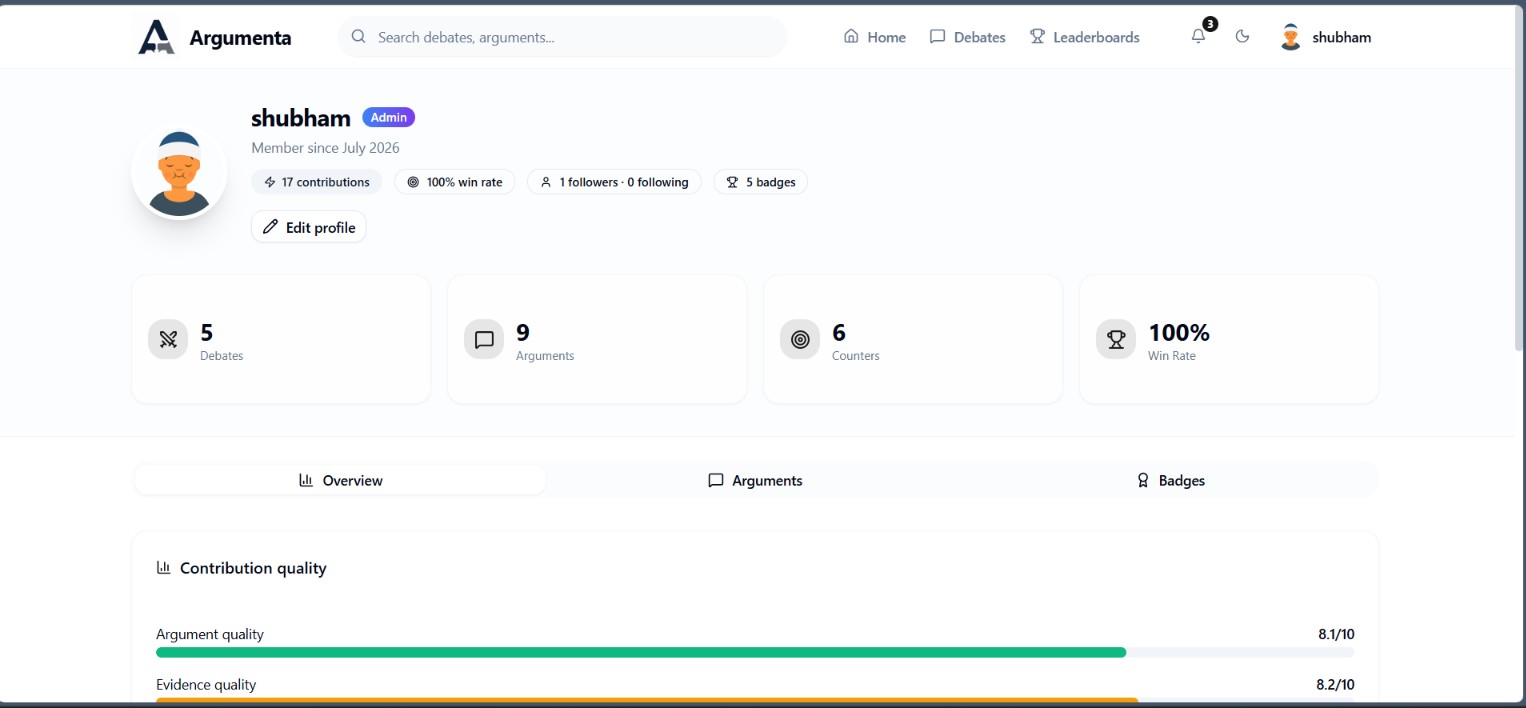
Profile Page
-
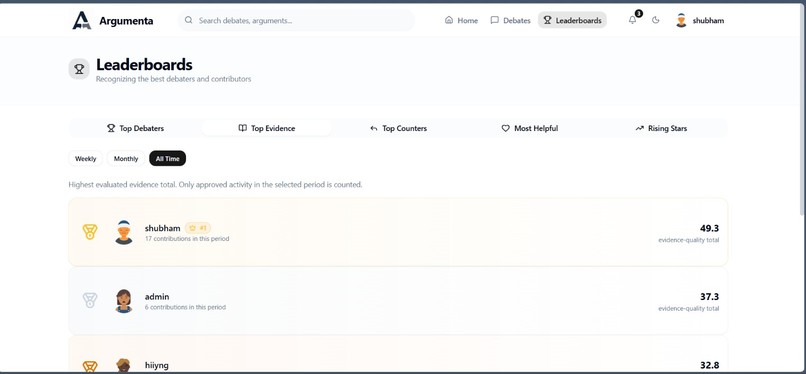
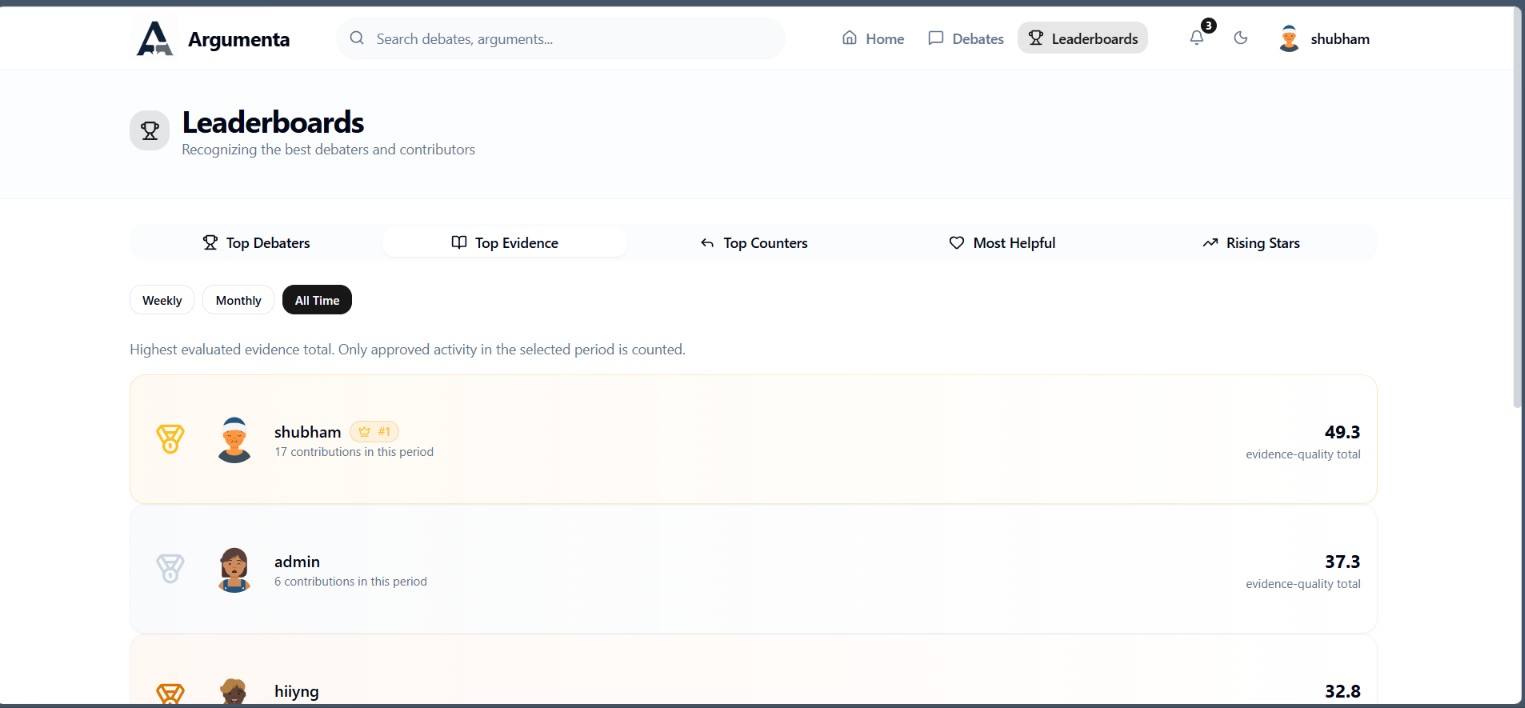
Leadersboard Page

Inspiration
Every day, billions of conversations happen online, yet meaningful discussions are becoming increasingly rare. Social platforms reward outrage, speed, and polarization instead of evidence, reasoning, and thoughtful dialogue. Complex issues are reduced to one-liners, while nuanced perspectives are buried beneath algorithms optimized for engagement.
I wanted to challenge that reality.
Argumenta wasn't created as another discussion platform—it was built to reimagine how people debate in the age of AI. My vision was to create a place where ideas compete on logic rather than popularity, where AI doesn't replace human thinking but strengthens it, and where technology encourages intellectual curiosity instead of division.
This project was built during the OpenAI Build Week Challenge using GPT-5.6 and Codex as engineering accelerators—not as replacements for software engineering. I invested countless hours designing a production-grade architecture because I wanted to build something people could genuinely use long after the hackathon ends.
What it does
Argumenta is an AI-powered platform designed to transform online debates into structured, insightful, and evidence-driven discussions.
Instead of endless comment chains, users participate in organized debates where every argument contributes to a larger conversation.
The platform includes:
- Structured Debate Engine that organizes discussions into logical argument trees.
- AI Analysis Pipeline that processes debates asynchronously for summaries, insights, and moderation without affecting user experience.
- Rich User Profiles & Leaderboards that reward thoughtful participation instead of engagement farming.
- Beautiful, Responsive Interface optimized for speed, accessibility, and usability.
- Scalable Infrastructure capable of handling thousands of debates without blocking application performance.
The goal isn't simply to let people argue.
It's to help them argue better.
How we built it
Although this was a hackathon submission, I deliberately engineered Argumenta like a production system instead of a prototype.
Frontend
- React 19
- TypeScript
- Vite
- React Router 7
- Tailwind CSS
- shadcn/ui
- TanStack Query
- tRPC Client
This combination provides an exceptionally responsive user experience while maintaining complete end-to-end type safety.
Backend
Rather than relying on heavyweight frameworks, I built the backend around:
- Hono
- tRPC Server
- Drizzle ORM
- MySQL
- JWT Authentication
- AWS S3
Every API contract is fully typed from the database to the browser, dramatically reducing bugs and improving developer velocity.
The Engineering Highlight — Durable AI Pipeline
The biggest technical investment was designing a resilient AI processing architecture.
Instead of directly calling AI models inside request handlers—which doesn't scale and risks data loss—I implemented a Transactional Outbox Pattern.
Every database mutation writes an event into an outbox within the same SQL transaction, guaranteeing that no AI task can ever be lost.
Dedicated workers then:
- continuously poll the outbox,
- publish events into BullMQ,
- claim durable execution leases,
- renew heartbeats while processing,
- recover automatically after crashes,
- retry failed jobs safely,
- ensure every debate is eventually processed exactly as intended.
Even if the API crashes, workers restart, or Redis becomes temporarily unavailable, Argumenta recovers automatically without losing user work.
This architecture is commonly found in enterprise-scale distributed systems—not typical hackathon projects—and it became the foundation that allows AI to operate reliably in the background.
Challenges we ran into
Building a polished application was only half the challenge.
Building one that is reliable was significantly harder.
The biggest challenges included:
Designing fault-tolerant AI infrastructure
AI requests are slow and failures are inevitable. Creating a system that survives crashes without losing work required implementing transactional guarantees, durable queues, leasing mechanisms, retries, and worker recovery.
Maintaining complete type safety
Keeping the database schema, API contracts, backend logic, and frontend perfectly synchronized demanded careful schema design and disciplined engineering. The result is an application with virtually zero runtime contract mismatches.
Building production-quality software in hackathon time
Rather than stopping at a functional MVP, I chose to invest additional time building proper architecture, clean abstractions, polished UI, and scalable infrastructure. That decision dramatically increased complexity—but also transformed the project into something ready for real users.
Accomplishments that we're proud of
I'm especially proud that Argumenta is far more than a demo.
Some highlights include:
- Built entirely as a solo project.
- Designed with production-grade architecture instead of shortcuts.
- Implemented a resilient AI pipeline using enterprise engineering patterns like the Transactional Outbox Pattern and durable workers.
- Achieved complete end-to-end type safety across the entire stack.
- Created a polished, modern user experience that feels like a finished product rather than a prototype.
- Successfully leveraged GPT-5.6 and Codex throughout OpenAI Build Week to accelerate development while personally designing, implementing, integrating, testing, and refining every part of the system.
Perhaps the accomplishment I'm most proud of is building software that I would confidently continue maintaining after the hackathon. Argumenta wasn't built to impress judges for a weekend—it was built to solve a real problem.
What we learned
This project reinforced that building AI products isn't only about integrating language models.
The real challenge is building systems that are reliable enough to trust.
I learned how distributed systems behave under failure, how transactional guarantees eliminate entire categories of bugs, and why asynchronous architectures become essential as products grow.
I also discovered how powerful modern AI-assisted development can be when paired with strong software engineering fundamentals. GPT-5.6 and Codex dramatically accelerated implementation, but transforming ideas into a cohesive, scalable, production-ready application still required careful architectural thinking, rigorous debugging, and countless engineering decisions.
Most importantly, I learned that hackathons don't have to produce disposable prototypes—they can be the birthplace of real products.
What's next for Argumenta
Argumenta is just getting started. Our goal is to build the world's most intelligent platform for structured discussion, critical thinking, and AI-assisted debate.
AI Debate Analyzer for Schools
One of our most exciting upcoming features is an AI Debate Analyzer designed specifically for schools, universities, and debate competitions.
Instead of manually judging debates, organizers will be able to use Argumenta as an AI-powered assistant throughout an entire competition.
The workflow is designed to mirror real debate formats:
- Before the debate begins, organizers assign participants and teams.
- As speakers receive the microphone, speech is automatically transcribed and attributed to the correct participant.
- Organizers classify each speech as a new argument or a rebuttal, with rebuttals linked to the specific argument or participant they challenge.
- Throughout the event, Argumenta builds a complete, structured map of every claim, counterargument, and response in real time.
Once the debate concludes, an AI Judge evaluates the entire discussion—not just individual speeches.
The system analyzes:
- Argument quality and originality
- Logical consistency
- Evidence and factual support
- Rebuttal effectiveness
- Clarity and persuasiveness
- Speaking impact
- Overall debate strategy
It then generates a comprehensive judging report that includes:
- Individual participant scores
- Personalized strengths and improvement suggestions
- Team performance analysis
- The strongest arguments and most effective rebuttals
- Debate-wide insights and patterns
- A reasoned final verdict explaining which side presented the stronger overall case
Our vision is to make high-quality debate coaching and judging accessible to every educational institution, regardless of available resources.
Expanding the Platform
Beyond education, we're building Argumenta into a complete ecosystem for intelligent discussion.
Future plans include:
- Live debates with real-time AI moderation and coaching.
- Organization and enterprise workspaces for structured decision-making.
- Public APIs so developers can integrate Argumenta's reasoning and debate analysis into their own applications.
- Advanced reputation systems that reward evidence, logic, and constructive engagement over popularity.
- Community-hosted tournaments and AI-assisted debate leagues.
- Premium AI features for professionals, educators, researchers, and organizations.
Sustainable Monetization
Our monetization strategy focuses on delivering real value rather than monetizing attention.
We plan to introduce:
- Argumenta Pro with advanced AI analysis and premium debate insights.
- Educational licenses for schools, universities, and debate clubs.
- Enterprise plans for organizations conducting structured discussions, policy reviews, and collaborative decision-making.
- Usage-based AI services for large-scale debate analysis, moderation, and reporting.
Our long-term ambition is simple:
We're not trying to build another social network.
We're building the infrastructure for intelligent discussion on the internet—where AI helps people think more critically, communicate more effectively, and make better decisions together.
Note: The platform encountered an error while uploading my PDF file. Therefore, I have attached the link to my Project Description PDF below for your reference.
Project Description (PDF):
https://drive.google.com/file/d/1lvfvceuy5ZJCHE18gXHX9jEy1EKzrVSr/view?usp=sharing
Built With
- amazon-web-services
- apis
- bullmq
- css
- docker
- drizzle
- eslint
- hono
- jwt
- mysql
- node.js
- openai
- orm
- query
- react
- redis
- rest
- router
- s3
- tailwind
- trpc
- typescript
- vite
- vitest
- zod

Log in or sign up for Devpost to join the conversation.