Inspiration
What it does
How we built it
Challenges we ran into
Accomplishments that we're proud of
What we learned
What's next for Argosy Salvage
Inspiration
Survival games usually make air one meter among many. Here it is the only one. The whole game is the moment before you unplug from the manifold and decide how much air to leave with.
What it does
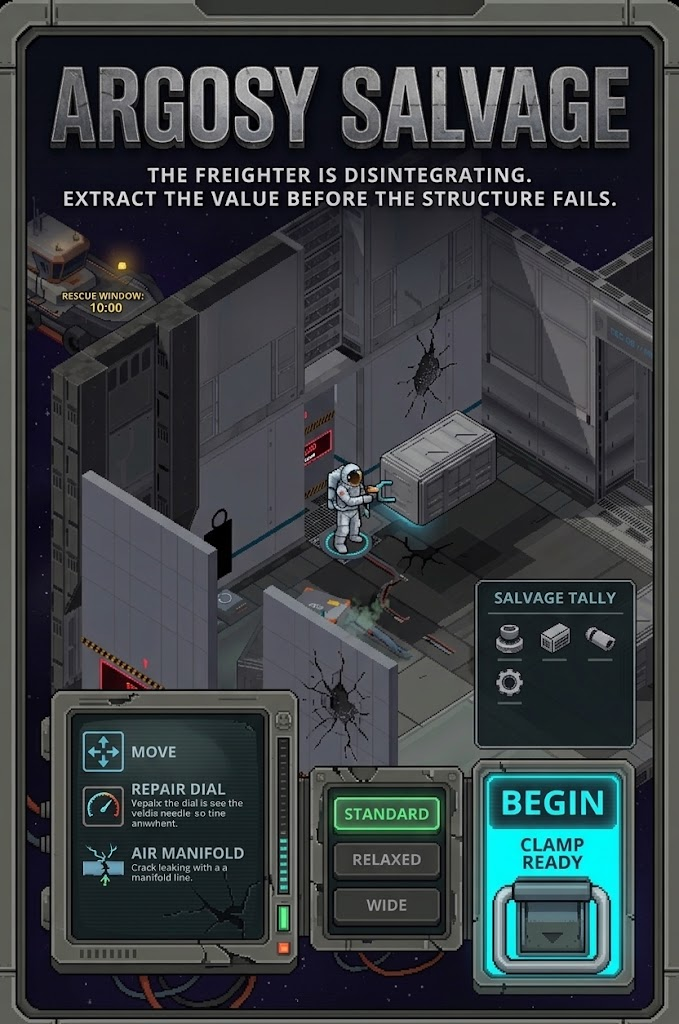
You are the last suited hand aboard the Argosy-10, a station coming apart while a salvage tug closes on it. Every burn of the attitude thrusters breaches a named sector. A repair is a haul (drag a titanium plate onto the ring under the tear) then a two-beat rhythm dial (dog the clamp). Scrap from wreckage, blown plating and stripped wall junctions prints scrubbers at a fabricator. An airlock leads outside to a guide cable on an elastic tether, with thruster plumes to hide from or ride. Seven burns to the tug, then hand the ship over or suffocate. Win, lose and run-again are all present.
How we built it
One readable index.html with three.js in vendor/, no network, all audio synthesised in Web Audio. The rooms were modelled by hand in SketchUp and exported as GLB; the kits weld together by named doorway pads. Everything else, from the character rig to the oxygen model, the dial, the cable physics and the HUD, was written and verified by an AI coding agent through prompting, with every mechanic tested by scripted play in the browser before it shipped.
Challenges
Making a phone-sized isometric ship legible: one room drawn at a time, doors that roll into their headers, and a difficulty curve that escalates by the clock rather than by distance.
What's next
Hull tears that can only be closed from the cable, more kinds of failure, and a larger ship where the route between manifolds is the real decision.
Built With
- affinity
- claude-code
- gltf
- html5
- javascript
- sketchup
- three.js
- web-audio
- webgl


Log in or sign up for Devpost to join the conversation.