Inspiration
What it does
A local, privacy-first system that scans cryptocurrency markets in real time to detect insider trading, market manipulation, and abnormal whale activity before they become public knowledge.
It monitors Ethereum on-chain transfers, Bitcoin mempool activity, and derivatives markets (Binance perpetuals, Hyperliquid) simultaneously, scoring every significant transaction on a 0–100 suspicion scale. When something critical is detected, it fires a webhook to Slack, Discord, or any HTTP endpoint.
Everything runs locally. No cloud dependency. No data leaves your machine.
What it detects
The system is built around one core question: is this transaction driven by information, or by noise?
A $2M ETH transfer from a 3-day-old wallet with no public news catalyst scores very differently from a $2M ETH transfer from Coinbase's hot wallet during a market-wide rally. The pipeline separates these cases by combining statistical anomaly detection, wallet behavioral profiling, macro context, and market microstructure analysis.
Typical signals it surfaces:
- Insider accumulation — large position from an established low-frequency wallet, no public catalyst, token not correlated to BTC move
- Pre-event positioning — smart money entering before a scheduled Fed/CPI/NFP release
- Derivatives market stress — crowded positioning + funding spike + OI surge simultaneously (squeeze risk)
- Bear raids — large short against a bullish trend from an unknown wallet
- Coordinated wallet activity — multiple wallets hitting the same token in a tight time window
- Token security threats — honeypots, rug pulls, mintable scams (Ethereum)
Architecture
The pipeline has three tiers running as independent Docker services:
┌─────────────────────────────────────────────────────────┐
│  LISTENERS  (5 services, always on)                     │
│                                                         │
│  ETH mainnet     Etherscan API, poll every 5 min        │
│  BTC mainnet     mempool.space WebSocket                │
│  Binance perps   Funding rate + OI + L/S anomalies      │
│  Binance spot    Large trades > $1M                     │
│  Hyperliquid     Perpetuals WebSocket                   │
└────────────────────────┬────────────────────────────────┘
                         │
              ┌──────────▼──────────┐
              │   TIER 1: FILTER    │  ~1-2 seconds
              │                     │
              │  Statistical pre-   │
              │  score (0-100):     │
              │  · Volume z-score   │
              │  · Wallet age       │
              │  · Transaction size │
              │  · Market impact    │
              │  · IsolationForest  │
              └──────────┬──────────┘
                         │ escalate=true
              ┌──────────▼──────────┐
              │   TIER 2: COUNCIL   │  ~5 minutes
              │                     │
              │  6-agent LangGraph  │
              │  council (see below)│
              │                     │
              │  Score 0-100        │
              │  + written verdict  │
              └──────────┬──────────┘
                         │
              ┌──────────▼──────────┐
              │  SQLite + Webhook   │
              │  TUI dashboard      │
              └─────────────────────┘
Roughly 85–90% of transactions are filtered at Tier 1 as noise (dust, whitelisted DEX routers, low z-score, exchange wallets). Only genuinely ambiguous or suspicious transactions reach the agent council.
The Council: 6 Specialized Agents
When a transaction is escalated, six agents investigate it in sequence. Each agent answers a specific question. The Supervisor cross-references all answers into a final score.
Security Sentinel (Ethereum only)
Checks the token and sender address against GoPlus and DEXScreener. Detects honeypots, mintable scams, blacklist functions, proxy contracts, low liquidity. A confirmed honeypot or malicious address immediately terminates the investigation with a score of 95 — no further agents run.
OnChain Profiler
Classifies the sending wallet into a behavioral archetype using Etherscan transaction history (ETH) or UTXO patterns (BTC):
| Classification | Profile |
|---|---|
| Insider | Old wallet (> 180d), low tx count (< 200), large move |
| Smart Money | Old wallet (> 365d), moderate activity (100–5000 txs) |
| Whale | Old, high-volume wallet (> 500 txs) |
| Retail FOMO | Young wallet (< 30d) chasing a move |
| Bot / MEV | High-frequency wallet (> 5,000 txs in < 30 days) |
The classification is the single most important input to the final score. An Insider move with no public news is the canonical high-signal event.
Macro Strategist
Fetches global macro context in parallel: Fear & Greed index, traditional markets (SPX, DXY, VIX), yield curve, commodities, news headlines. Determines whether public news exists that could explain the move (has_news). Results are cached 12 hours — the macro agent calls the LLM at most twice per day.
The has_news field is critical: an Insider move with no news scores 80/100. The same move with news scores 60/100. The system distinguishes "someone knows something" from "someone is reacting to something."
Micro Analyst
Extracts token-specific market KPIs: 24h price action, BTC correlation (Pearson r over 30 days), funding rate, open interest, long/short ratio. A whale move that correlates strongly with BTC (r > 0.7) is likely just beta exposure — market noise, score 20. A whale move decoupled from BTC is potentially informational — score 55.
Quant Analyst (pure Python, no LLM, ~50ms)
Computes statistical features from OHLCV data and on-chain transfer distributions:
- Shannon entropy of volume distribution (< 0.4 = trading concentrated in few candles)
- Gini coefficient of transfer amounts (> 0.7 = few addresses dominate)
- Hurst exponent (H > 0.5 = trending regime — adds conviction)
- GARCH(1,1) volatility regime forecast
- IsolationForest ML anomaly score on the 4-feature filter vector
The Quant report adds up to +10 points to the final score when an ML anomaly is confirmed with high confidence.
Supervisor (deterministic Python + LLM narrative)
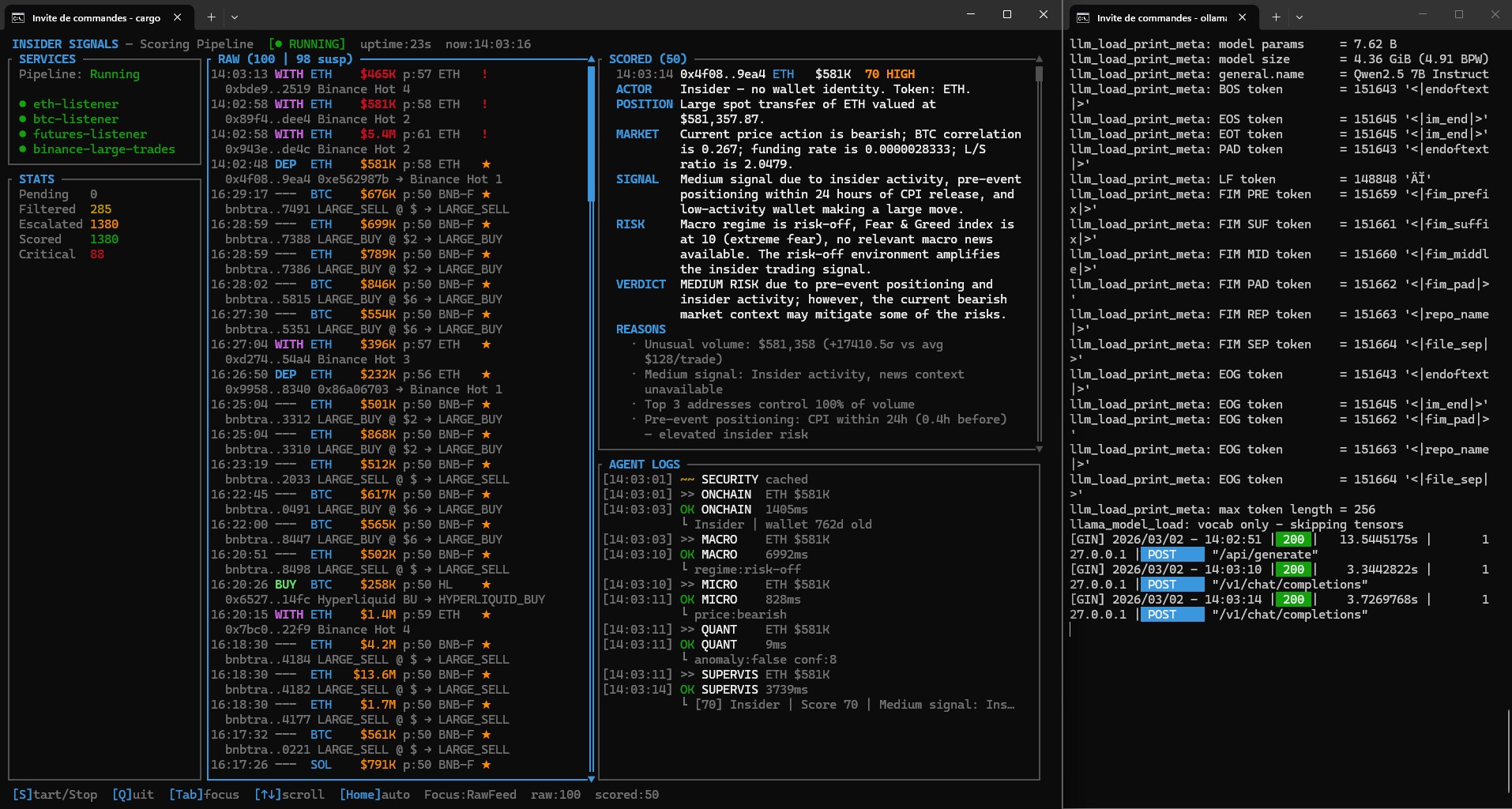
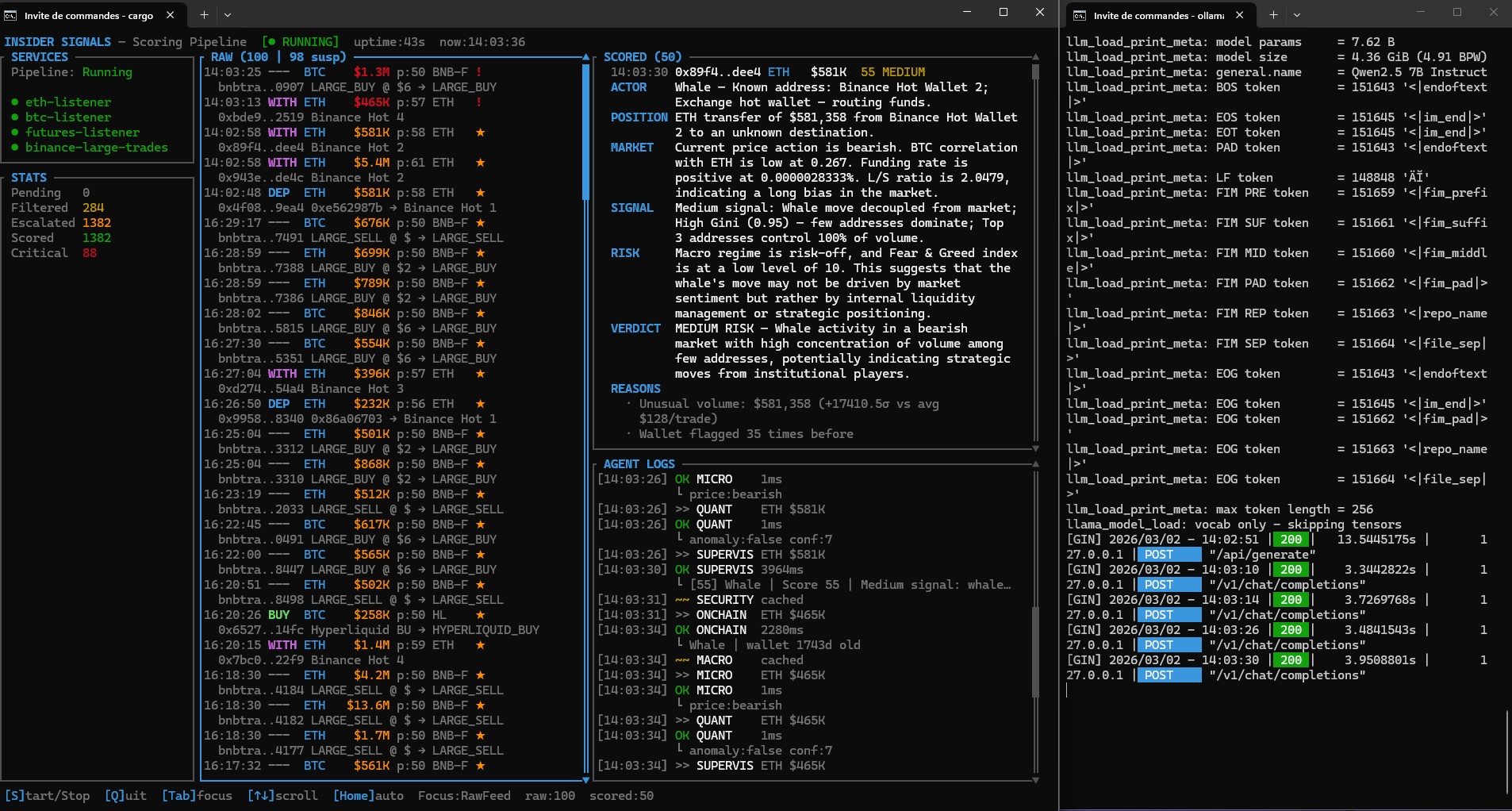
Cross-references all agent reports through a scoring matrix loaded from config/scoring_rules.yaml. Zero randomness — the score is fully reproducible for identical inputs. After the score is fixed, a local LLM (qwen2.5:3b) writes a 6-section investigation narrative:
ACTOR:    wallet profile and behavioral classification
POSITION: transaction value, token, direction
MARKET:   price action, BTC correlation, funding rate, OI
SIGNAL:   top scoring reasons, news context
RISK:     macro regime, Fear & Greed, macro context
VERDICT:  risk level, score, main reason
If the LLM times out, a deterministic fallback generates the same format from the structured data.
Score Scale
| Score | Verdict | Interpretation |
|---|---|---|
| 0–20 | noise |
Automated pattern, BTC-correlated move, exchange routine |
| 21–40 | low_signal |
Weak or ambiguous signal, monitor |
| 41–60 | medium_signal |
Notable activity, contextually ambiguous |
| 61–80 | high_signal |
Strong signal — warrants close attention |
| 81–100 | critical |
Highest-confidence signal — webhook always fires |
Worked Example: $500M BTC Short on Hyperliquid
Context (February 28, 2026): BTC is up +5.2% on the day. Fear & Greed is at 72 (Greed). At 14:23 UTC, a 1-day-old wallet opens a $500M short on BTC perpetuals via Hyperliquid — directly against the trend.
What the listeners detected:
- Pattern:
HYPERLIQUID_SELL— large taker short - Anomaly tags:
CROWDED_SHORT_3.2x,HIGH_FUNDING_SHORT,FUNDING_SPIKE_VS_BASELINE,OI_SURGE_18pct
Tier 1 Filter — Derivatives fast path (no wallet/volume check needed):
Base (large directional trade):   55 pts
Size premium ($500M > $1M):      +10 pts
Pre-score:                        65/100  →  escalate=true
Tier 2 Council — Derivatives scoring path:
Futures base (sell into crowded short):       55
+ selling into crowded short (L/S=0.31):     +10
+ large sell during risk-on regime:           +8
+ high OI market ($8.2B):                    +5
CROWDED_SHORT_3.2x:                          +12
HIGH_FUNDING_SHORT:                           +8
FUNDING_SPIKE_VS_BASELINE:                    +5
OI_SURGE_18pct:                               +7
Interaction: crowded + funding spike:         +8
Interaction: crowded + OI surge:              +5
4 simultaneous anomalies (systemic stress):   +5
                                             ----
                           Capped at:      100/100  →  critical
Why 100/100? A $500M position is ~6% of total BTC perpetual open interest. A 1-day-old wallet. No news catalyst. BTC trending up. Crowded short with 3.2x the normal short concentration, funding spiking, OI surging 18% in one hour — four simultaneous independent anomaly signals. This is the exact pattern of a coordinated bear raid or a large actor with advance knowledge of a price-moving event.
Full annotated trace: docs/demo.md
Terminal UI
A Rust TUI (tui/) provides a live dashboard of the pipeline without any web server:
┌─ Services ─────┐ ┌─ Raw Transactions ──────────────┐ ┌─ Scored + Logs ──────┐
│ eth-listener ✓ │ │ [RED]    0xabc... BTC $500M SHORT│ │ 0xdef... ETH  95/100 │
│ btc-listener ✓ │ │ [GRAY]   0xdef... ETH $1.2M SWAP │ │ 0x123... BTC  42/100 │
│ filter-worker✓ │ │ [YELLOW] 0x123... BTC $50k  UTXO │ │                      │
│ agent-worker ✓ │ │ [GREEN]  0x456... ETH $200k BUY  │ │ [agent logs...]      │
│                │ │                                  │ │                      │
│ Scored: 1,247  │ │                                  │ │                      │
│ Critical: 12   │ │                                  │ │                      │
└────────────────┘ └──────────────────────────────────┘ └──────────────────────┘
Color coding: Red = flagged, pending council. Orange = investigated suspect. Green = scored, normal. Yellow = filtered out (noise). Gray = below threshold.
Webhook Alerts
When a transaction scores above the threshold (default: 70), the system fires a POST request to any configured URL. Works with Slack incoming webhooks, Discord webhooks, or any custom HTTP endpoint.
SCORING_WEBHOOK_URL=https://hooks.slack.com/services/...
SCORING_WEBHOOK_THRESHOLD=70   # fire on high_signal and critical
Payload includes tx_hash, token, chain, score, verdict, value_usd, and the top scoring reasons.
Local-first design
The system uses Ollama to run LLMs locally (qwen3.5:4b for the council pipeline, qwen3.5:9b for macro analysis). No API keys for LLM inference. No transaction data sent to external services.
External API calls are limited to:
- Etherscan / mempool.space — on-chain data (public)
- CoinGecko (free demo tier), Binance (public), GoPlus (free tier) — market data
- FRED (optional, free) — US economic event calendar
- Yahoo Finance — market indices and news (via yfinance, no key required)
Getting Started
See docs/start.md for setup instructions, configuration reference, GPU options, and development commands.
Documentation
| Document | Contents |
|---|---|
| docs/start.md | Setup, configuration, Docker, GPU variants, tests, ML model training |
| docs/architecture.md | Pipeline internals, LangGraph topology, SQLite schema |
| docs/scoring.md | Every scoring formula and threshold with rationale |
| docs/agents.md | Per-agent tools, classification rules, output schemas |
| docs/providers.md | Per-provider API reference and constants |
| docs/demo.md | Full annotated trace of a $500M BTC short through the pipeline |
Tech Stack
| Component | Technology |
|---|---|
| Pipeline orchestration | Python 3.11, LangGraph, asyncio |
| LLM inference | Ollama (qwen3.5:4b / qwen3.5:9b) |
| ML anomaly detection | scikit-learn IsolationForest |
| Persistence | SQLite + aiosqlite (WAL mode) |
| Containerization | Docker Compose (8 services) |
| Terminal UI | Rust + Ratatui |
| Data validation | Pydantic 2 |
| Structured logging | structlog |
Built With
- docker
- langgraph
- ollama
- python
- ratatui
- rust
- scikit-learn
- sqlite

Log in or sign up for Devpost to join the conversation.