-
-
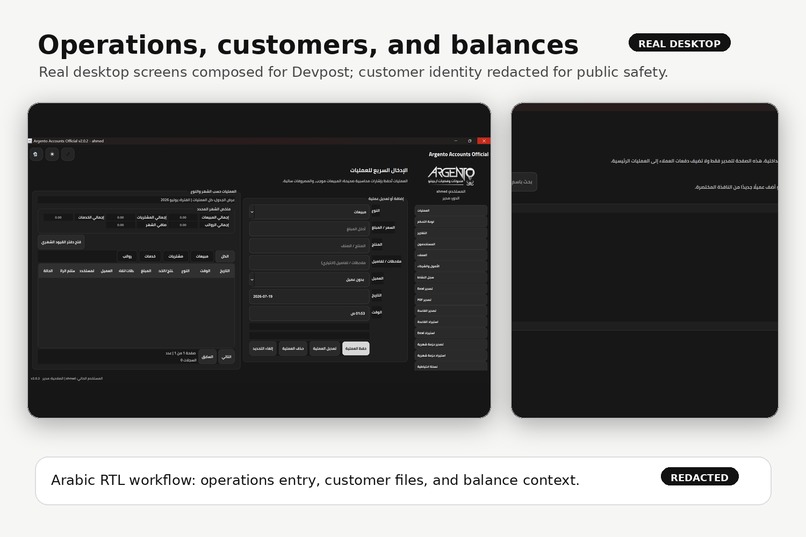
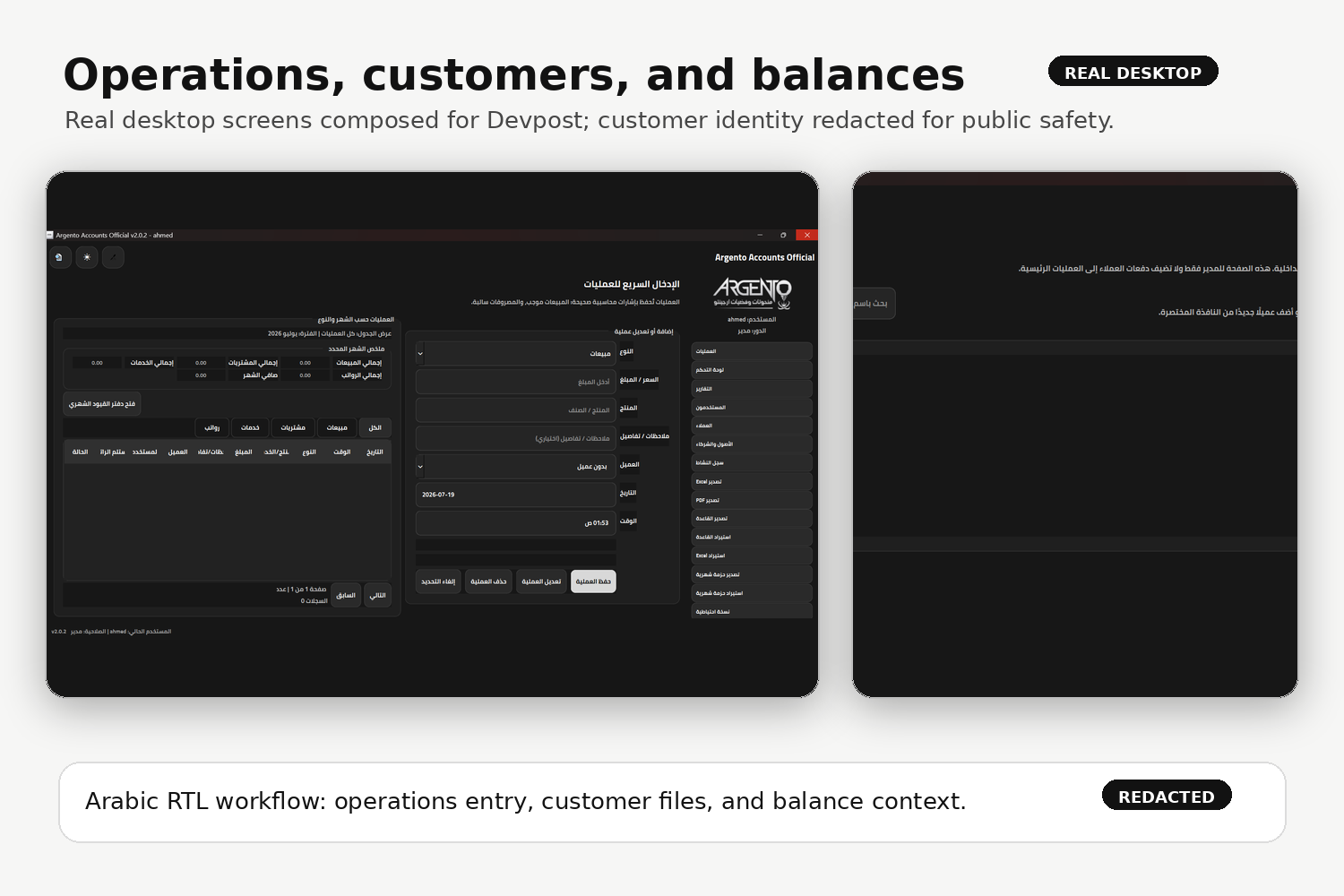
Arabic RTL operations, customers, and balances view using demo data and real product screenshots.
-
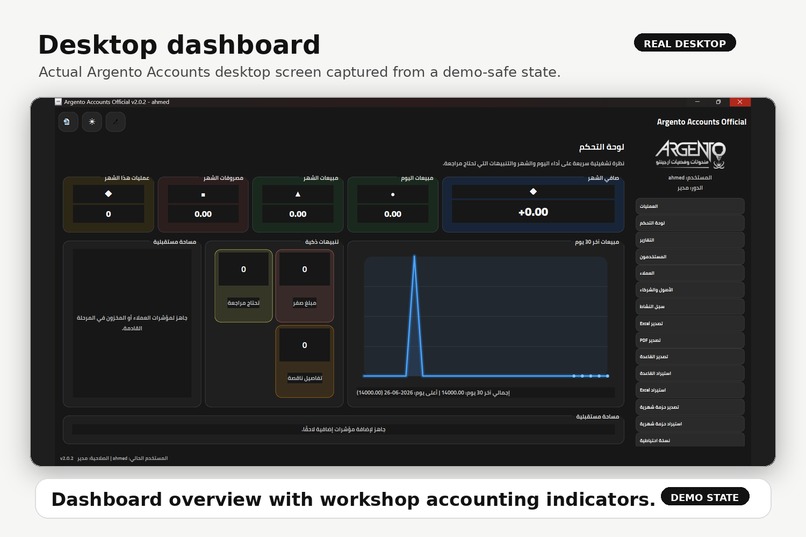
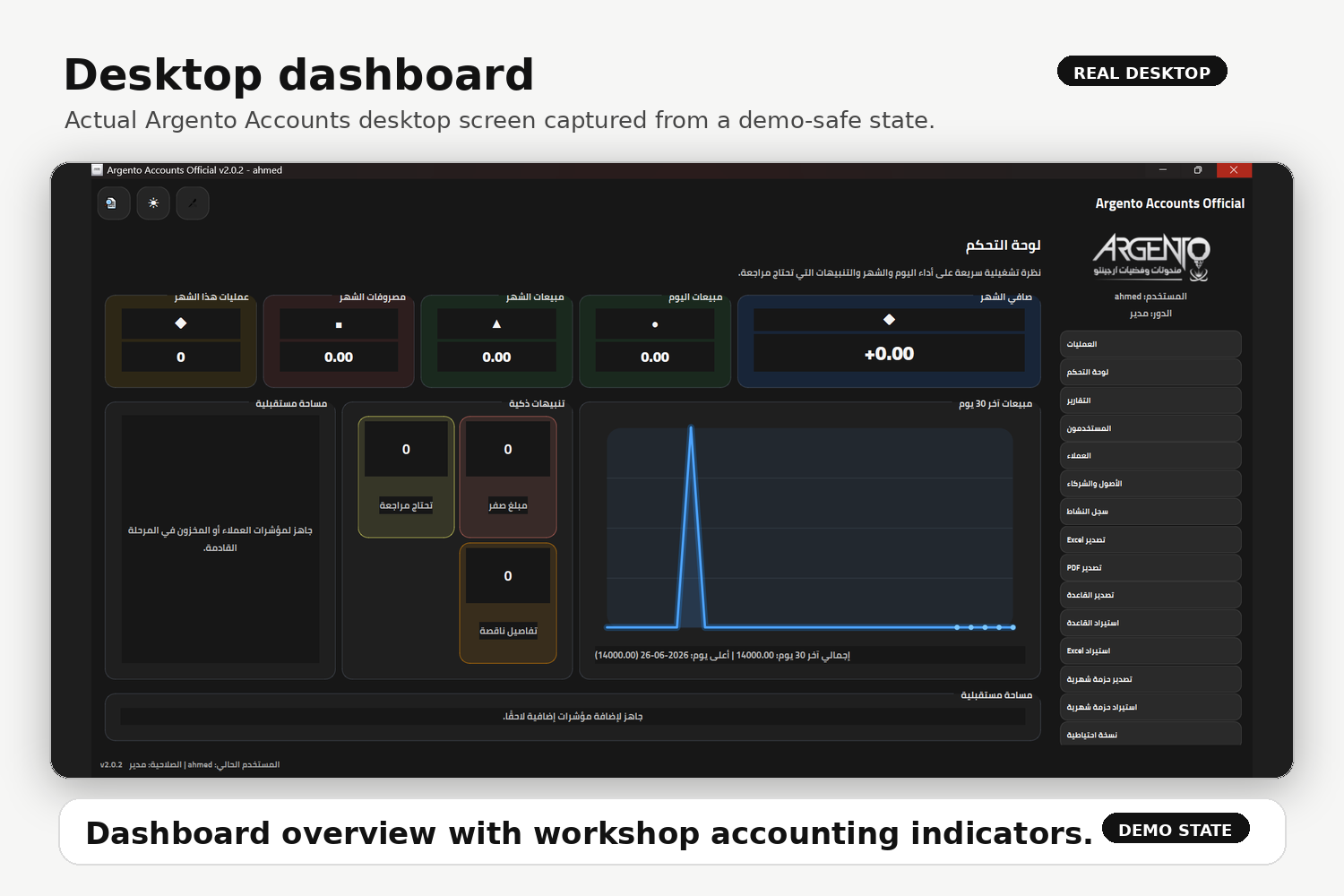
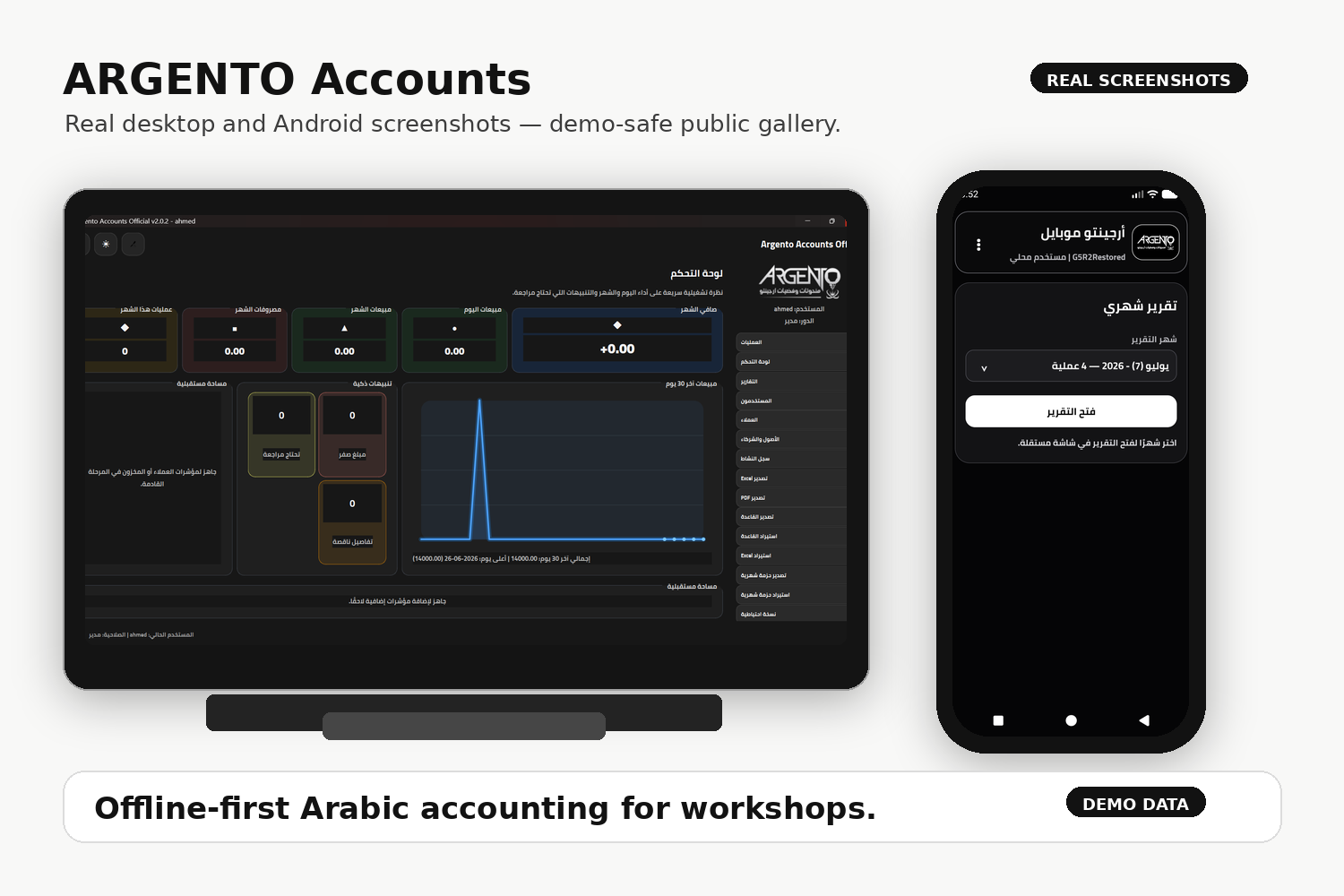
Desktop dashboard showing workshop indicators, monthly totals, alerts, and reports with demo accounting data.
-
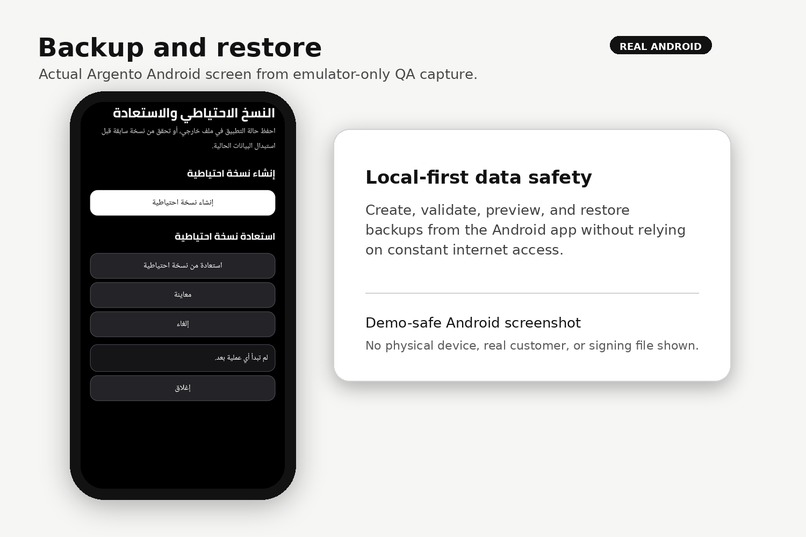
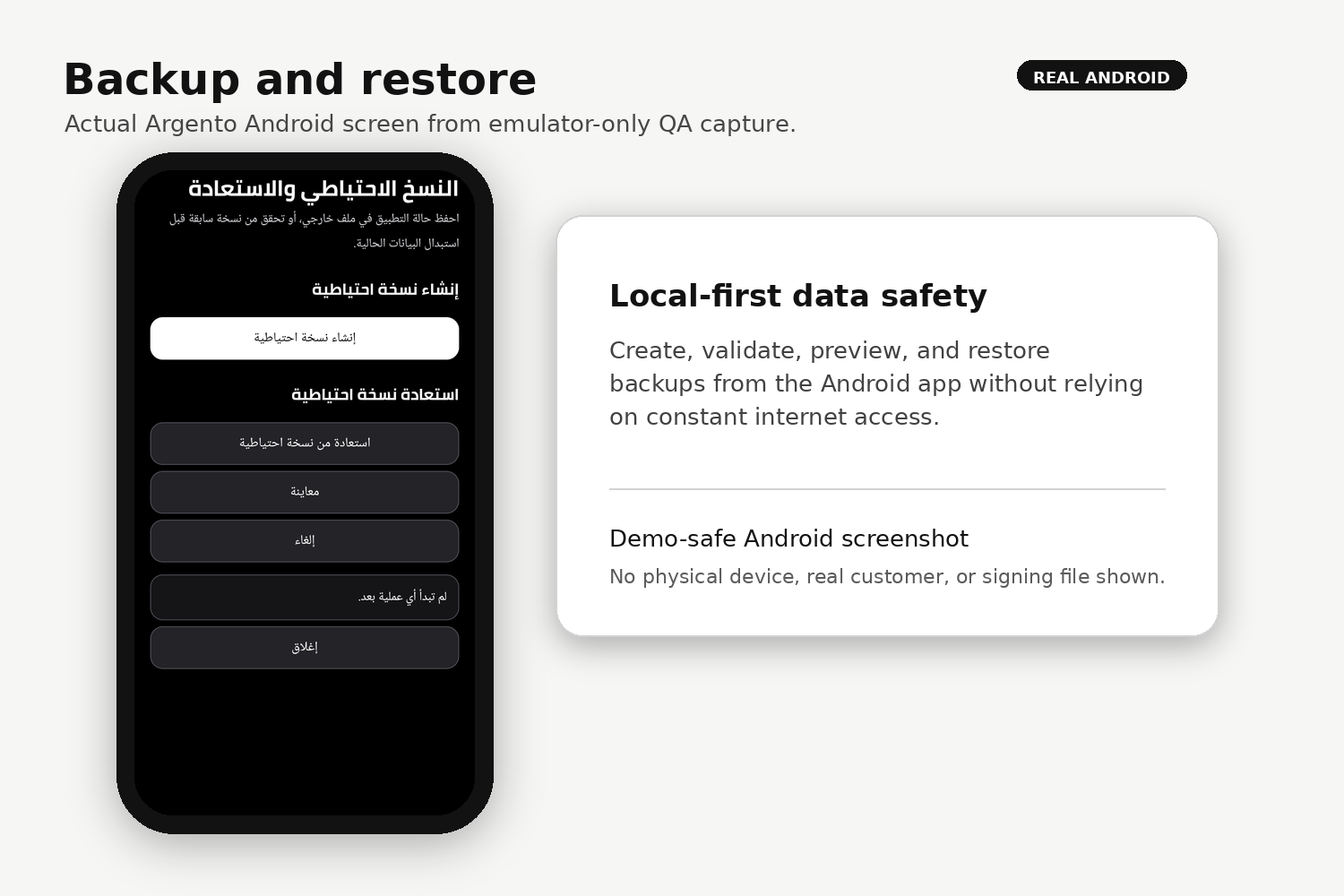
Real Android backup and restore screen for local-first accounting, captured from a safe demo/emulator workflow.
-
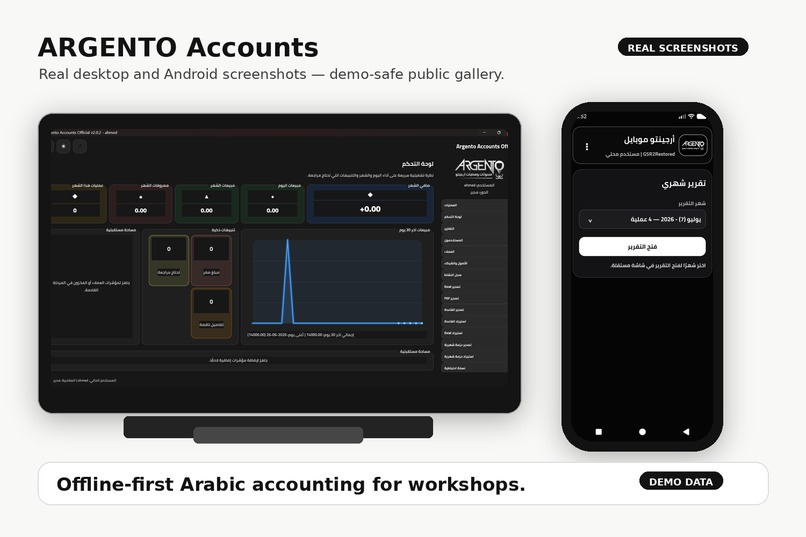
Argento Accounts desktop and Android views: offline-first Arabic accounting for workshops and small businesses.
-
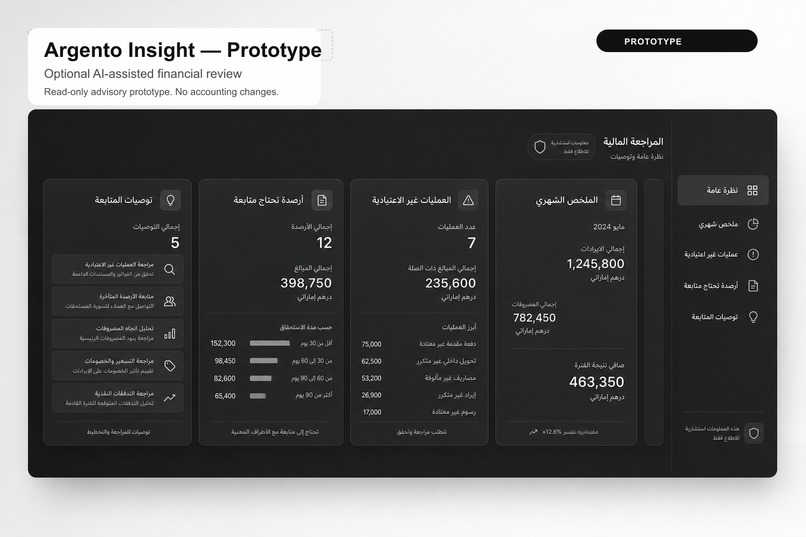
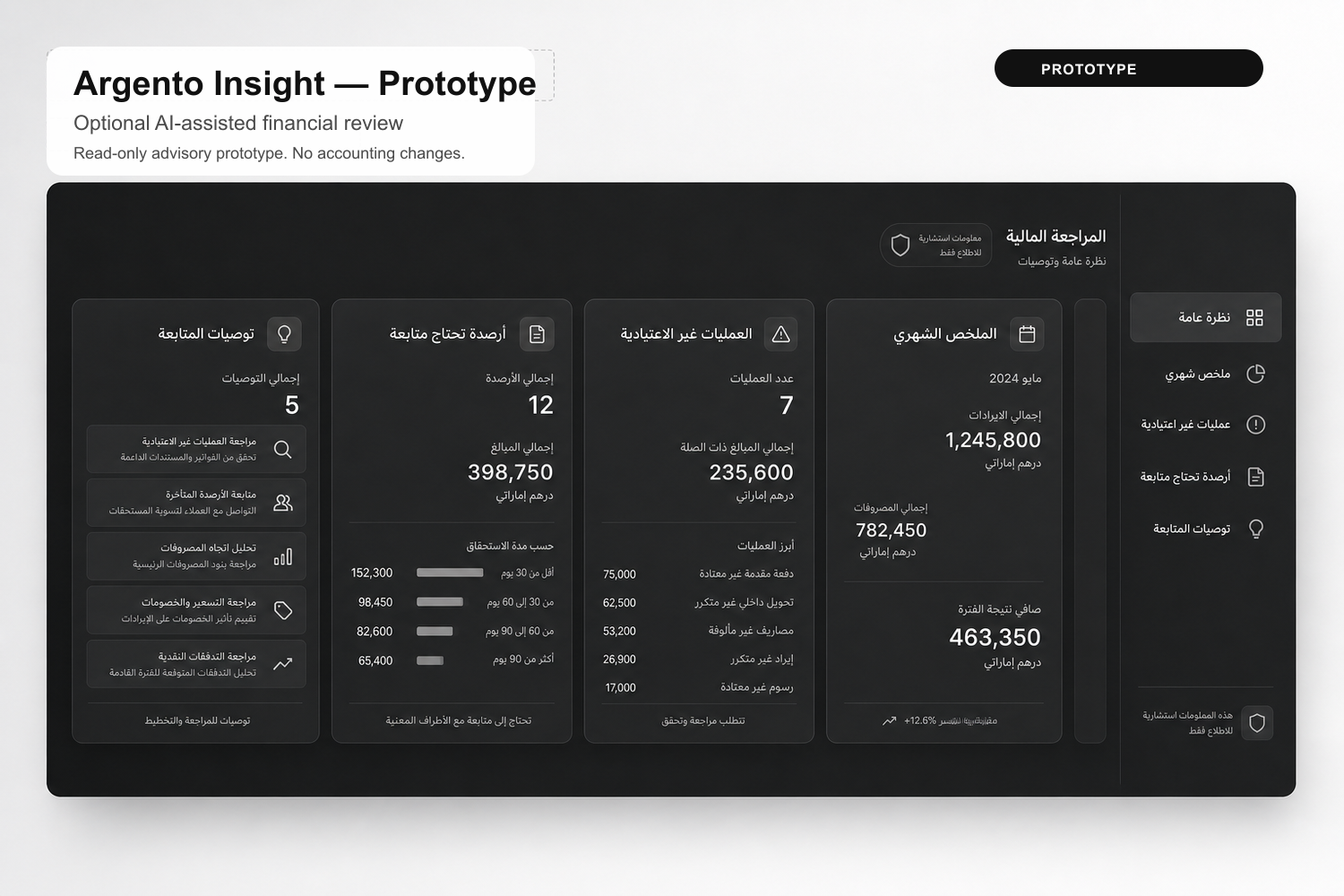
Argento Insight prototype: read-only AI-assisted financial review with summaries, anomalies, and follow-up suggestions.
Inspiration
Argento Accounts started from a real problem inside my own laser cutting and engraving workshop in Sana'a, Yemen.
I needed a simple, reliable accounting system that matched the way my workshop actually works: daily sales, purchases, services, customer balances, payments, reports, exports, and backups. Most existing tools were either too generic, not comfortable for Arabic RTL workflows, dependent on cloud access, or not designed around the small workshop environment I was managing every day.
The project also has a personal side. I was studying architecture, but after being diagnosed with lymphoma, I had to pause that path. Instead of stopping, I redirected my energy into learning software development and building practical tools from real needs. Argento Accounts became one of those tools: a product built not as an abstract idea, but as a response to a real business problem I was living with.
What it does
Argento Accounts is an offline-first Arabic accounting app for workshops and independent businesses.
It includes a desktop version and an Android companion app. The system helps manage:
- sales, purchases, services, salaries, and expenses;
- customers, payments, and balances;
- monthly reports and filtered operation views;
- Excel import and export;
- PDF and Excel reports;
- Android backup and restore;
- local Android operations that can later be exported to the desktop app;
- Arabic RTL interfaces designed for real daily use.
The core accounting behavior is deterministic and local-first. The app does not depend on an always-online connection, which is important in environments where internet access is not always stable.
For OpenAI Build Week, the project also introduced the direction for Argento Insight, an optional AI-assisted financial review feature. Argento Insight is designed to provide read-only summaries, unusual-transaction hints, balance follow-up suggestions, and monthly review notes. It is advisory only: it does not modify transactions, balances, payments, or accounting records.
How we built it
The desktop app was built with Python, PySide6, Qt Widgets, SQLite, pandas, openpyxl, ReportLab, and pytest.
The Android app was built with Kotlin, Android SDK, Room, JUnit, JSON, SHA-256-based validation concepts, and Arabic RTL UI rules.
Codex was used as a development partner for focused implementation, architecture review, testing strategy, backup/restore validation, UI improvements, and risk analysis. Instead of using AI to replace accounting logic, I used it to help reason about software structure, review edge cases, write safer implementation plans, and improve confidence through tests and documentation.
A major part of the work was keeping the system local-first and safe. For example, Android backup and restore were designed so that data can be preserved before risky transitions, and exported or deleted records are treated carefully so old records do not accidentally reappear or affect business totals.
Challenges we ran into
One of the biggest challenges was Arabic RTL support. Building a usable Arabic accounting interface is not only about translating labels. Tables, reports, forms, date fields, navigation, and PDF/Excel outputs all need to feel natural in right-to-left usage.
Another challenge was data safety. Accounting records are sensitive, and even a small mistake in import, export, backup, restore, edit, or delete behavior can create real business confusion. This required strict rules around what can be edited, what can be exported, what can be restored, and how deleted records should behave.
Backup and restore were especially important. The Android app needed a way to preserve user data safely before moving toward official signing and future deployment. We also had to handle the difference between debug builds and future production-signed builds, because Android signatures affect whether an app can update in place.
A final challenge was deciding how AI should fit into an accounting product. I did not want AI to change accounting records or make hidden financial decisions. The result was a clear boundary: AI can help summarize and advise, but the accounting system remains deterministic and controlled by the user.
Accomplishments that we're proud of
I am proud that Argento Accounts is a real product built from a real business need, not just a demo.
The project now has:
- a working Arabic desktop accounting app;
- a working Android companion app;
- transaction, customer, payment, balance, and report workflows;
- offline-first behavior;
- Android backup and restore;
- export/import concepts between Android and desktop;
- safe edit and soft-delete behavior for unexported operations;
- local operation numbering;
- test coverage and structured QA phases;
- a documented path toward production signing;
- a public Build Week presentation package with sanitized screenshots and no real customer data.
I am also proud that the project shows how AI can support a solo builder. Codex helped me move through complex engineering decisions, but the product direction, data-safety rules, and business context came from real workshop experience.
What we learned
The most important lesson was that AI is most useful when the human owner defines clear rules.
Codex helped with architecture, implementation plans, tests, and documentation, but the project still needed strict product decisions: what is allowed, what is forbidden, what data must never be exposed, and where automation must stop.
I also learned that local-first software needs careful thinking. Backup, restore, export, deletion, and signing are not small details; they are part of the trust model of the product.
Another lesson was that Arabic RTL products deserve first-class design. Supporting Arabic properly affects layout, reports, labels, input behavior, and the overall feeling of the app.
What's next for Argento Accounts
The next step is to continue preparing the Android app for a safe official signed build, while keeping backups and migration safety as a priority.
After that, I want to improve the public demo experience, refine the Android and desktop workflows, and continue developing Argento Insight as a read-only advisory feature.
Future work may include better reporting, safer data migration, optional sync planning, improved onboarding, and eventually a version that can help other small workshops and independent businesses facing similar accounting problems.
Argento Accounts began as a tool for my own workshop, but the long-term goal is to turn it into a practical Arabic-first accounting solution for real-world small businesses.


Log in or sign up for Devpost to join the conversation.