-
our project logo
-
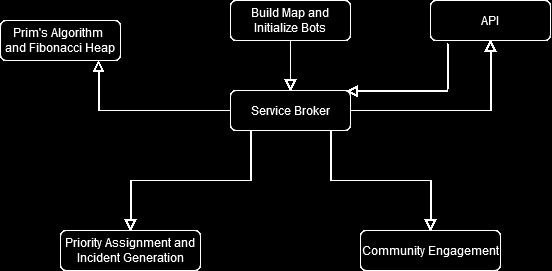
our workflow

Inspiration
The inspiration for this project is we would like to innovate the way our cities handle emergency services
What it does
ARES is an adaptive emergency routing and resource allocation system. The backbone of ARES is a Python program that takes in a sample dataset that contains open-sourced government data to simulate our user input.
How we built it
We built this project using python 3.11, using tools like VScode, Google Colab, as well as creating a csv file filled with sample emergency services data. If ARES was fully functioning properly, it would be able to read data from this csv and run an algorithm based on the urgency of the call in order to dispatch the appropriate emergency units.
Challenges we ran into
The scale of the project was a big challenge, figuring out how to scale the project down just enough without sacrificing any functionality of what would be a full-functioning emergency management system is extremely difficult. Take Richmond as an example, there are 34 zip codes, 1 city, and 4 counties; we have to take into account all this data for just the location. Next, you have to consider the jurisdictions of the fire departments, the police precincts, and the Richmond ambulance authorities.
Accomplishments that we're proud of
We are proud of being able to work together and brainstorm efficiently to visualize how a system like this could be theoretically built. Even though our finished product is much smaller in scope, the core idea of developing a scalable emergency system that utilizes algorithms such as an MST and a Fibonacci Heap in order to efficiently dispatch emergency units could definitely be expanded upon if given enough time.
What we learned
We learned that there are a lot of factors that go into an emergency management system The scale of the system can vary, we researched many different types of systems that are in use today. Some of the systems include the VCU alert system, the wireless emergency alerts that are sent out by authorized government agencies such as FEMA, fcc, Homeland Security etc. Some alerts are by zip codes, for example, if you live in Richmond VA you would not get an amber alert for Arlington VA. In comparison, tornado watches and flood watches are sent out by counties instead of zip codes. Understanding how the different emergency systems work was very interesting.
What's next for ARES
If given the opportunity we would like to scale up ARES and work with the Richmond Department of Emergency Communications as well as the local Richmond police precincts and local fire departments near Virginia Commonwealth University; to fully integrate ARES into their systems or into a new system to aid with future emergencies.
Built With
- figma
- google-colab
- gpu
- python
- t4


Log in or sign up for Devpost to join the conversation.