Inspiration
Developers lose focus when they constantly switch between editors, terminals, documentation, issue trackers, files, voice tools, and repetitive project tasks. Ares began as an attempt to replace that fragmented workflow with one assistant that understands the project, remembers important context, and can take carefully controlled action.
What it does
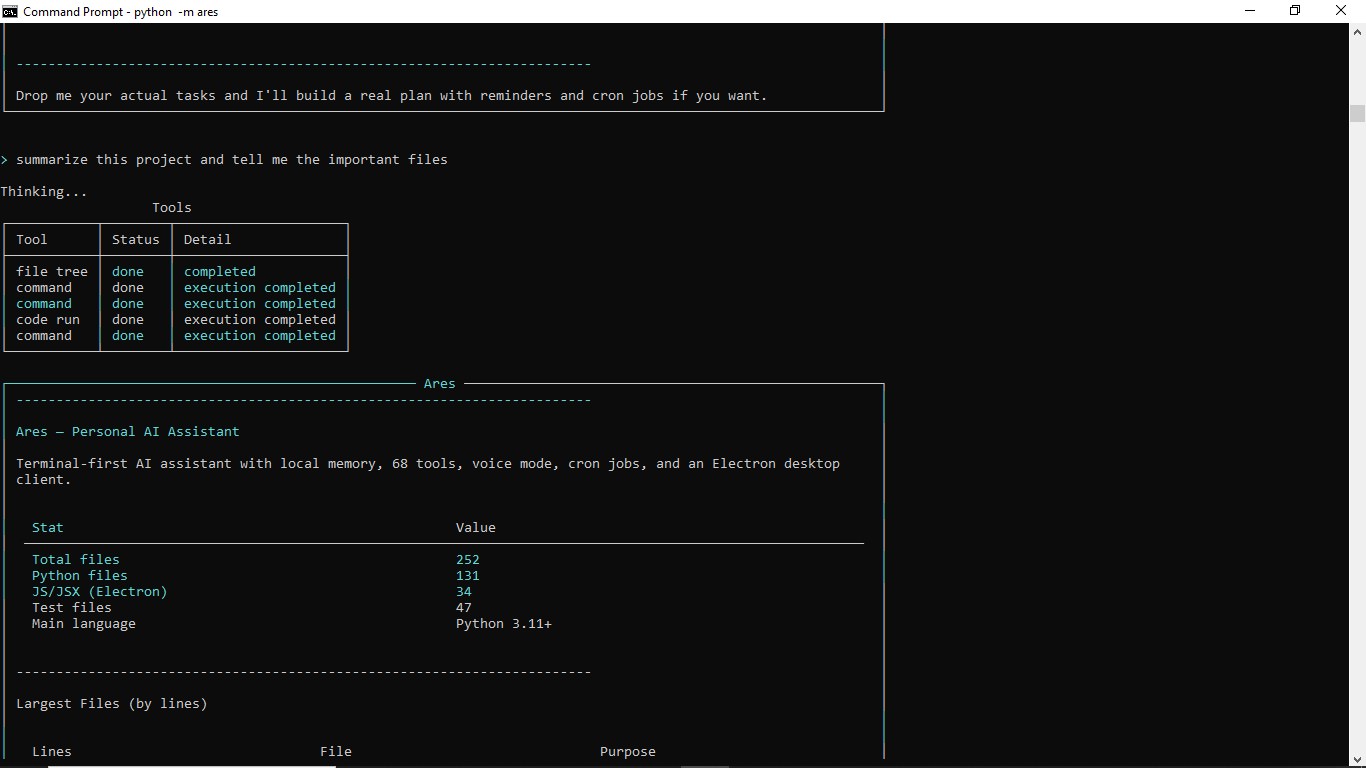
Ares is a local-first, terminal-first AI assistant with a separate Next.js power workspace, an optional local WebSocket API, voice support, an Android bridge, and an allowlisted Telegram channel.
It can:
- search durable memories, conversations, structured people, and archived sessions;
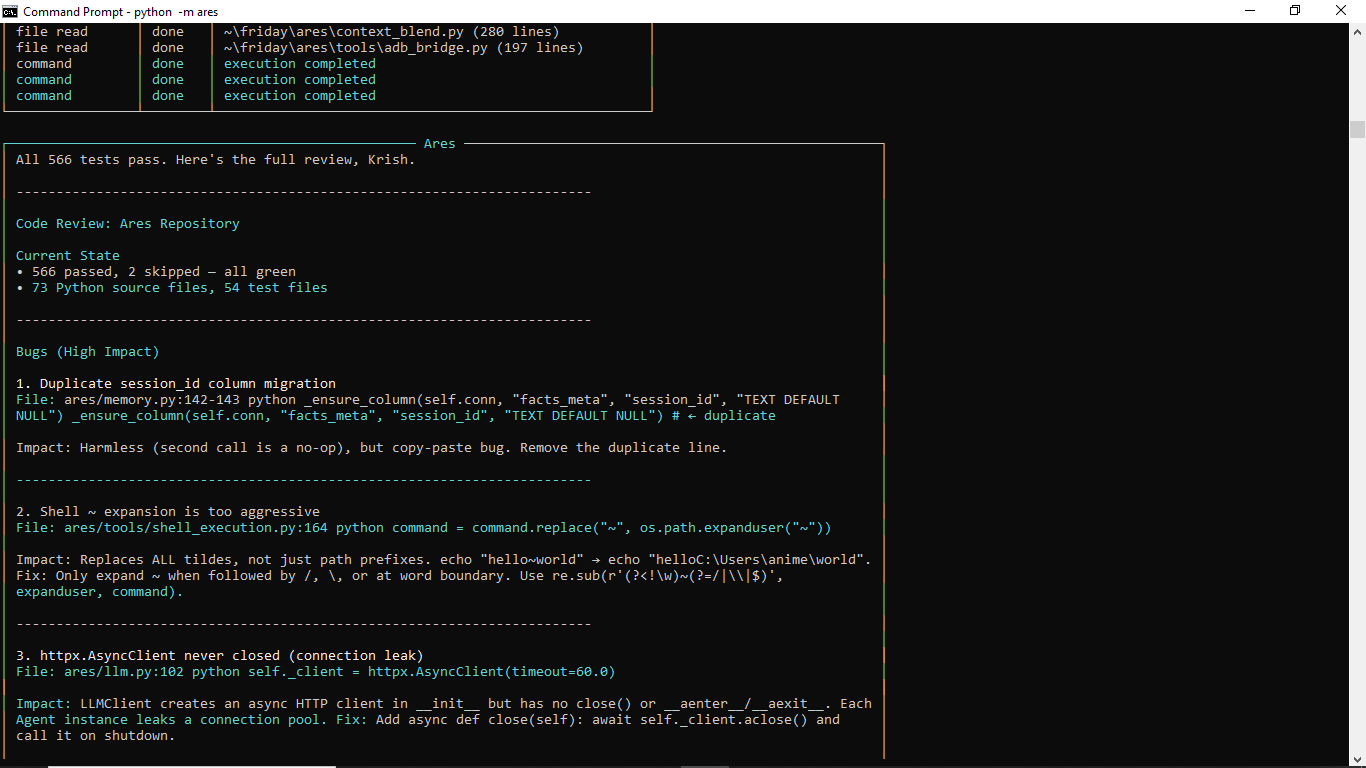
- inspect and modify project files through controlled tools;
- run configured project checks and assist with coding workflows;
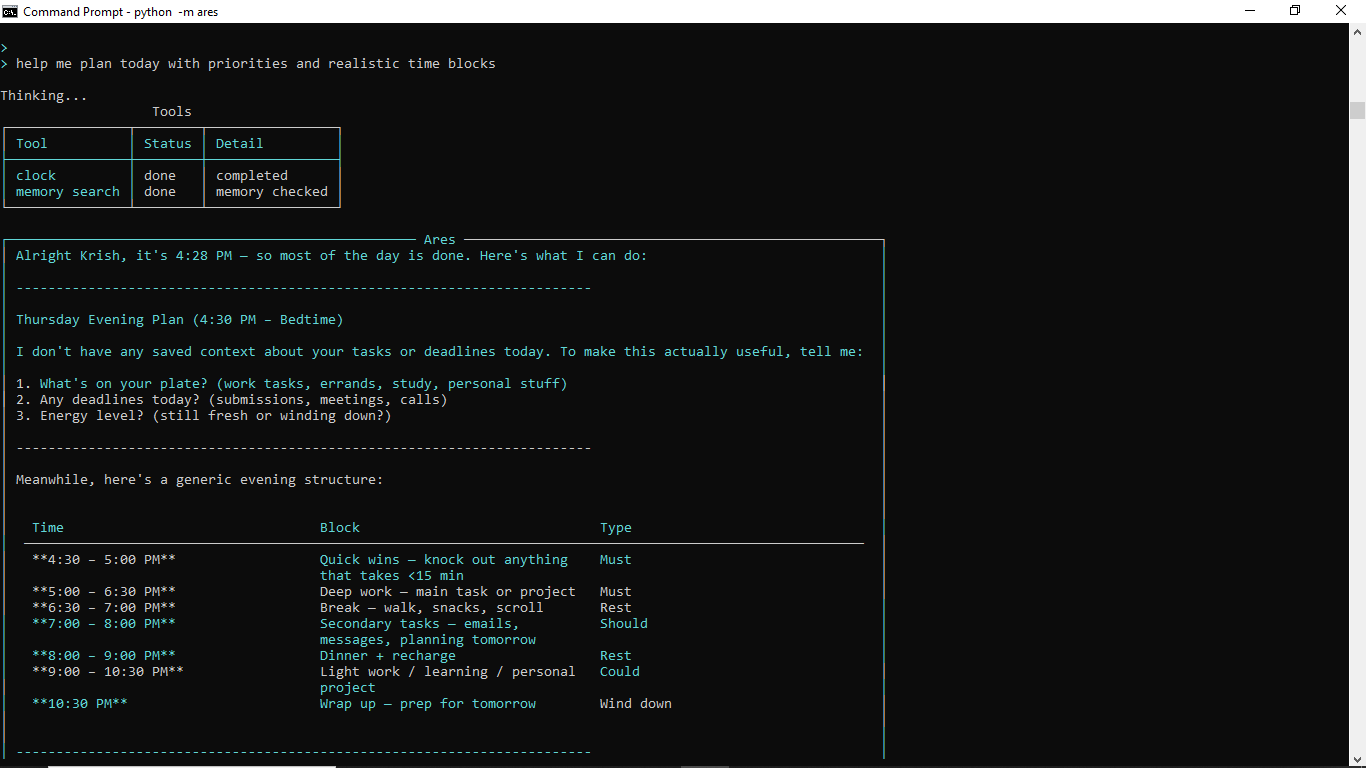
- create goals, tasks, recurring jobs, and proactive watchers;
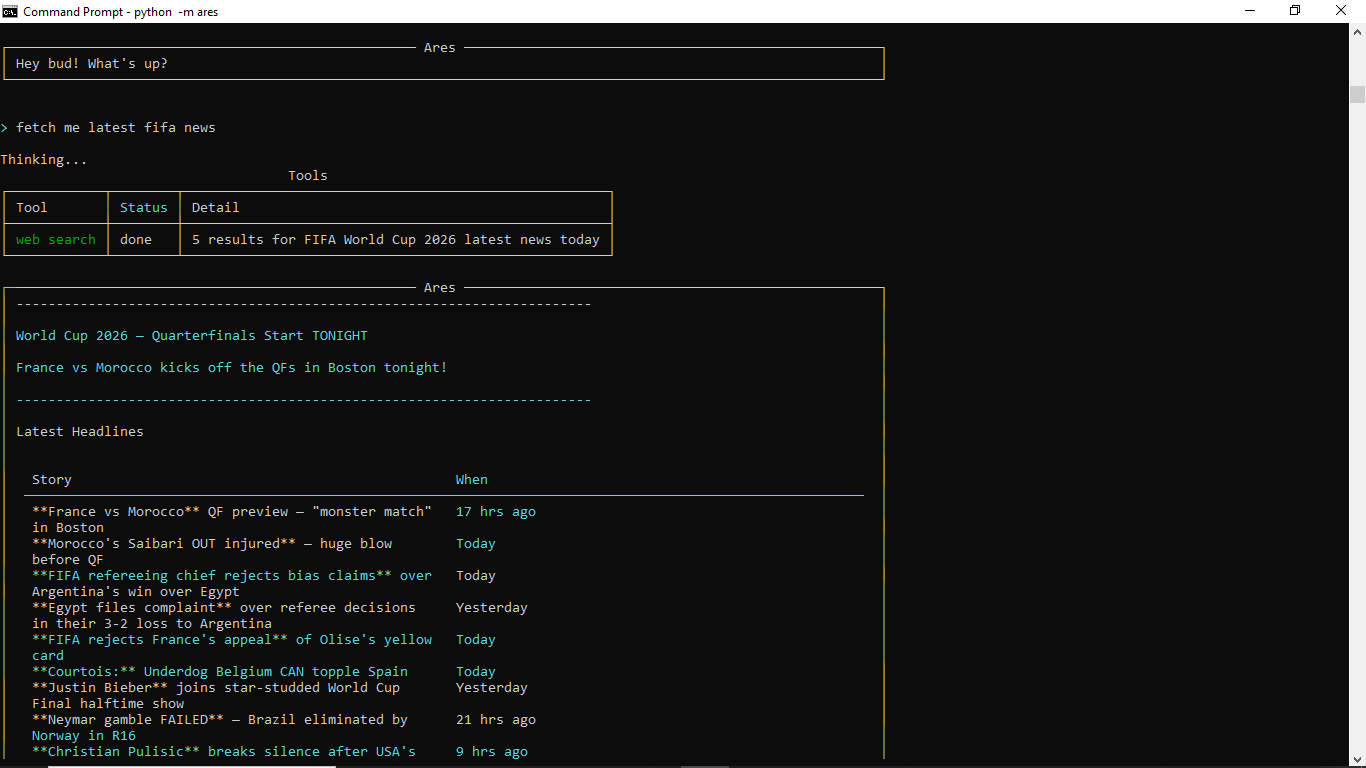
- connect to MCP servers for GitHub, browser, Windows, fetch, and custom integrations;
- delegate bounded work to isolated specialist agents for research, analysis, implementation, review, and synthesis;
- show tool traces, agent progress, generated artifacts, and saved context in one workspace.
How it works
Ares combines a Python agent runtime with a local SQLite data layer, append-only JSONL session history, reusable SKILL.md playbooks, MCP integrations, a Next.js workspace, and a broad but permission-aware tool surface.
The native multi-agent supervisor runs independent tasks concurrently when safe, executes dependencies in waves, isolates child histories and tool access, and keeps the root agent responsible for the final result. Consequential actions remain confirmation-gated, and builder changes are returned as reviewable patches rather than being applied silently.
Its proactive system connects long-term goals, durable memories, reflection follow-ups, commitments, and watcher signals. Ares can surface relevant next steps without automatically changing goal state or repeatedly nagging the user.
Meaningful Build Week extensions
During the OpenAI Build Week submission period, Ares was substantially extended with Codex-assisted development. The dated repository history separates this work from the pre-existing project. Major additions include:
- native multi-agent orchestration and specialist execution;
- hardened capability grants, tool allowlists, timeouts, and patch review boundaries;
- goal-aware watcher signals and research artifact delivery;
- proactive memory follow-ups and a durable retrieve-decide-act-update workflow;
- LiveKit-based voice sessions and workspace voice controls;
- workspace, goal, memory, and runtime reliability improvements.
The repository preserves dated commits, pull requests, design notes, and focused test results for these additions.
Challenges
The hardest part was not simply connecting a model to tools. A useful developer assistant needs reliable context retrieval, bounded autonomy, clear progress feedback, safe mutation boundaries, recovery from partial failures, and enough speed to become part of a real workflow.
Multi-agent execution added another layer of difficulty: parallel work had to remain truthful, isolated, cancellable, dependency-aware, and safe around shared files and stateful tools.
Accomplishments
We built a working local AI workspace rather than a chat-only prototype. Ares now includes durable memory, proactive goal support, multi-agent execution, voice and remote channels, project-aware tools, MCP integrations, artifact previews, and extensive regression coverage.
What we learned
Agent quality depends as much on orchestration, context management, safety, and product feedback as it does on model intelligence. The assistant must know when to act, when to ask, when to stay quiet, and how to prove what actually happened.
What's next
Next steps include simplifying installation, publishing a judge-ready packaged build, improving onboarding and demo data, expanding evaluation coverage, and making the workspace easier for other developers to customize and extend.
Built With
- codex
- fastapi
- livekit
- mcp
- next.js
- openai-compatible-apis
- python
- react
- sqlite
- telegram-bot-api
- typescript
- websockets

Log in or sign up for Devpost to join the conversation.