-
-
Autonomous Research & Decision Agent
Inspiration
ARDA-agent was inspired by the amount of time people spend doing repetitive research online. A single question often turns into opening many tabs, comparing sources, reading long articles, and manually writing notes. I wanted to build an agent that could make this process faster by searching the web, collecting useful sources, and turning them into a clear research summary.
The idea was to create something more useful than a basic chatbot. Instead of only answering from memory, ARDA-agent uses live search results and then analyzes them. This makes it better suited for topics that change often, such as stocks, technology trends, market news, and recent developments.
What it does
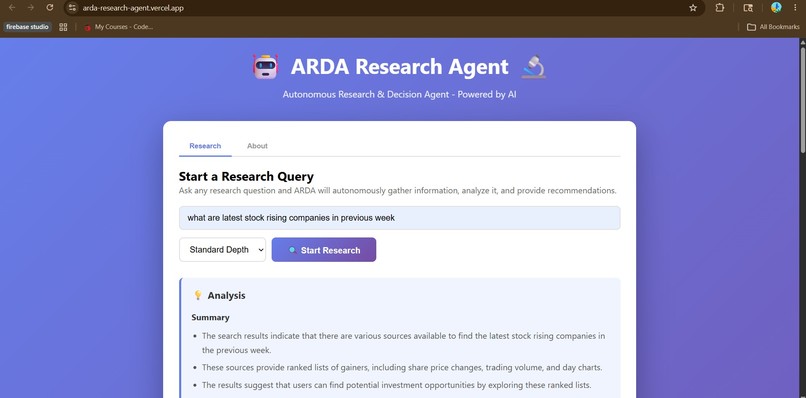
ARDA-agent lets users enter a research question and receive a structured response. It searches the web for relevant results, displays the sources it found, and generates an analysis based on those results.
The output is organized into sections such as:
- Summary
- Companies or sources mentioned
- Caveats
- Next steps
For example, if a user asks about rising stocks from the previous week, ARDA-agent searches for recent stock gainer pages, extracts relevant links, and produces a readable analysis instead of showing only raw search links.
How we built it
We built ARDA-agent as a lightweight web application with a FastAPI backend and a simple frontend using HTML, CSS, and JavaScript.
The backend handles the research request, performs web search using ddgs, and sends the search results to Groq for AI analysis. The frontend provides the user interface where people can type research questions, choose a research depth, and view the structured results.
The project was designed to work on Vercel, so we created a lightweight serverless API that avoids heavy local dependencies. The deployed version focuses on search and LLM analysis, while the broader project structure also explores agentic ideas like planning, execution, reflection, memory, and reporting.
Challenges we ran into
One major challenge was making the project work reliably on Vercel. Some dependencies that work locally are too heavy or unnecessary for a serverless deployment, so we had to simplify the production API.
Another challenge was handling API failures gracefully. At one point, an invalid Groq API key caused the entire research request to fail. We improved the system so search results can still be shown even if AI analysis fails.
We also had to improve the quality of the generated analysis. Early responses were sometimes too vague or included placeholder text like [insert company names]. To fix this, we made the prompt more strict and required the model to return a structured format grounded only in the search results.
Accomplishments that we're proud of
We are proud that ARDA-agent is not just a static demo. It performs real web searches, returns live source links, and generates structured analysis from those results.
We are also proud of making the app deployable as a lightweight Vercel project. The final version is simple enough to run serverlessly but still demonstrates the core idea of an autonomous research assistant.
Another accomplishment is the improved user experience. Instead of showing a wall of text, ARDA-agent now formats the response into readable sections, bullet points, and tables.
What we learned
We learned that building useful AI apps is not only about connecting to an LLM. The surrounding system matters a lot: search quality, prompt design, error handling, deployment constraints, and frontend formatting all affect the final user experience.
We also learned that structured prompts produce much better results than open-ended prompts. By clearly defining the output format, the agent becomes easier to read and more reliable.
Another important lesson was that production apps need fallbacks. APIs can fail, keys can expire, and search providers can behave differently across environments. A good app should still provide partial value instead of breaking completely.
What's next for ARDA-agent
Next, we want to make ARDA-agent more powerful and more accurate. Some future improvements include:
- Adding better source ranking
- Supporting financial APIs for stock-specific data
- Showing dates, prices, and percentage changes for market queries
- Adding citations directly inside the analysis
- Supporting deeper multi-step research workflows
- Saving previous research sessions
- Adding memory so the agent can learn from earlier queries
- Improving the UI with filters, export options, and clearer source previews
Long term, ARDA-agent could become a full research workspace where users can ask complex questions, compare sources, track findings, and make better decisions faster.
Built With
- css3
- faiss
- fastapi
- groq
- html5
- jac
- javascript
- llama
- python
- vercel


Log in or sign up for Devpost to join the conversation.