-
-
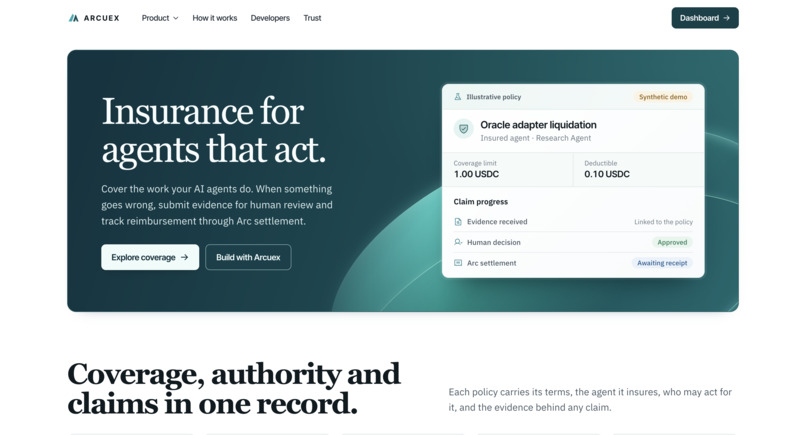
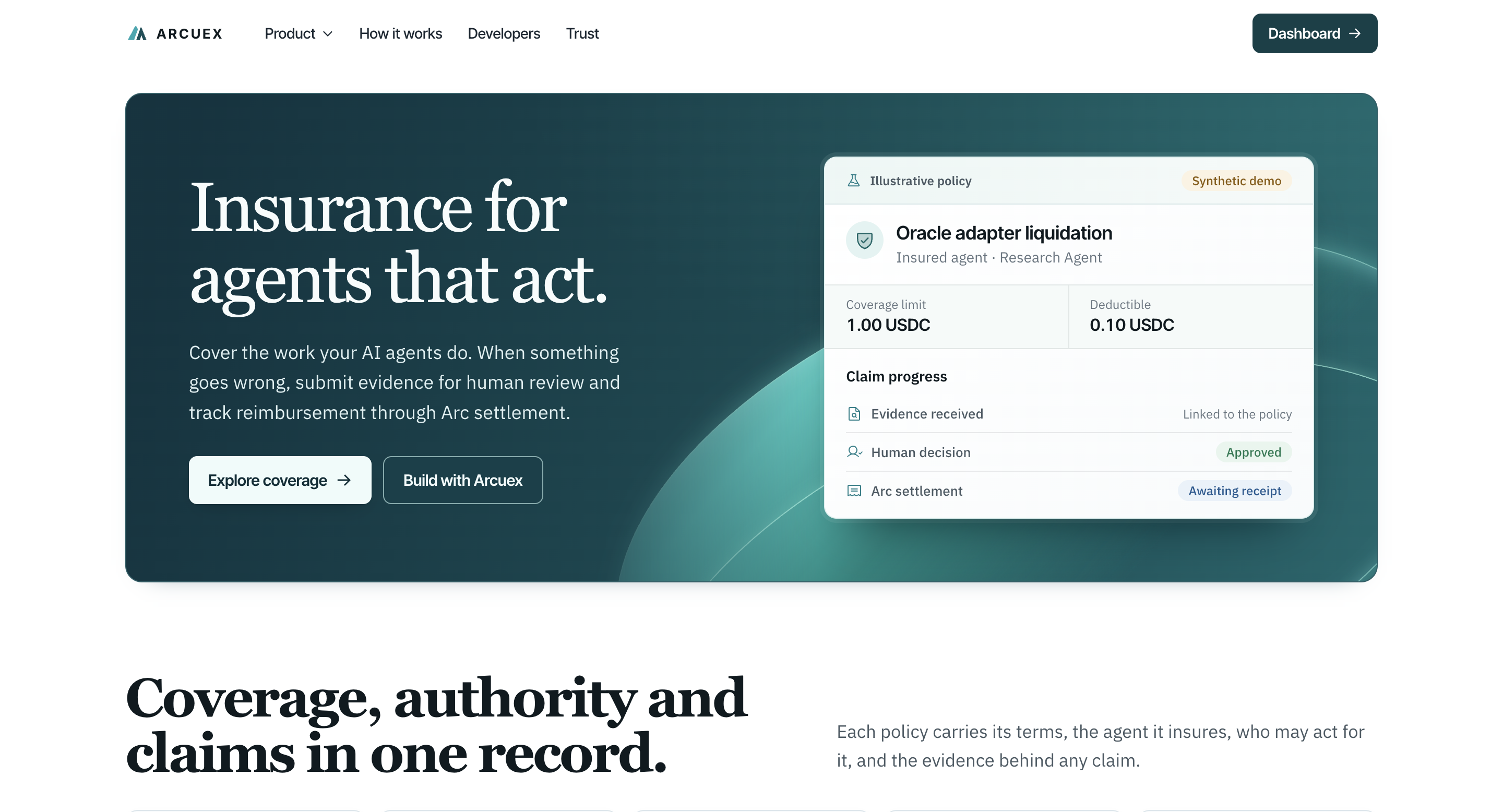
Homepage
-
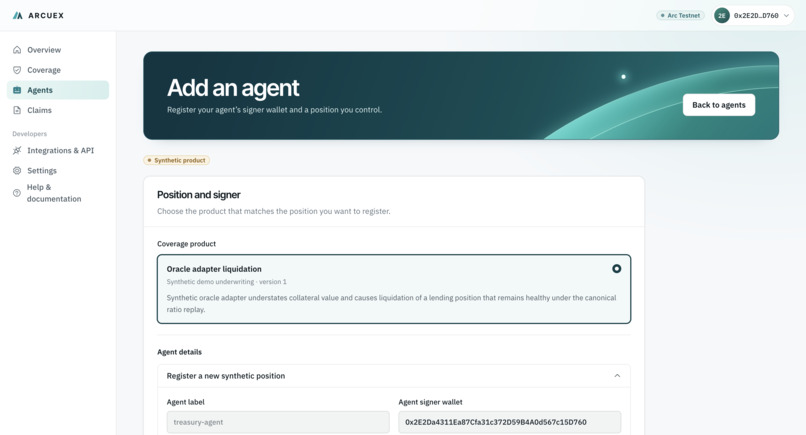
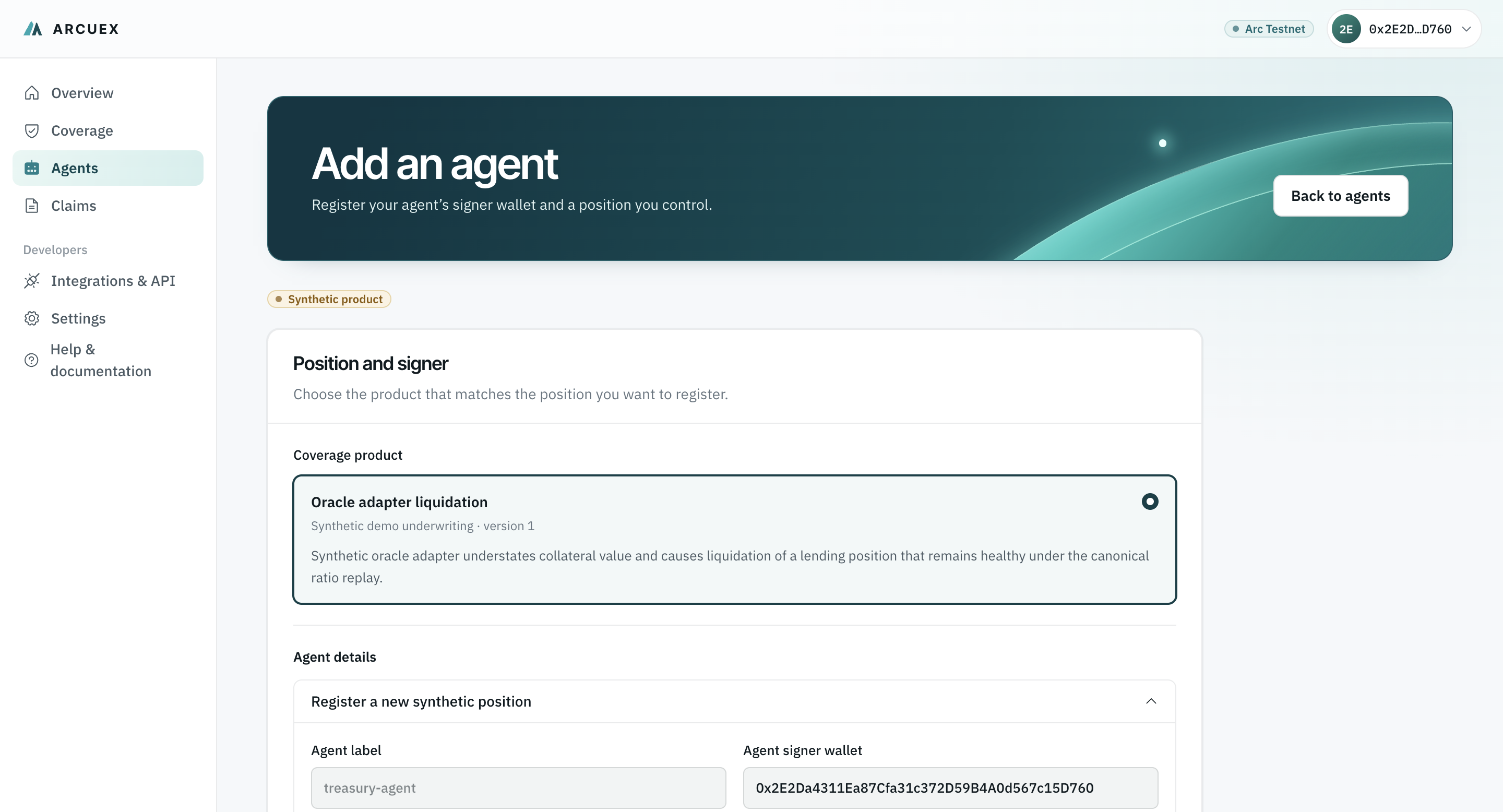
Add agent
-
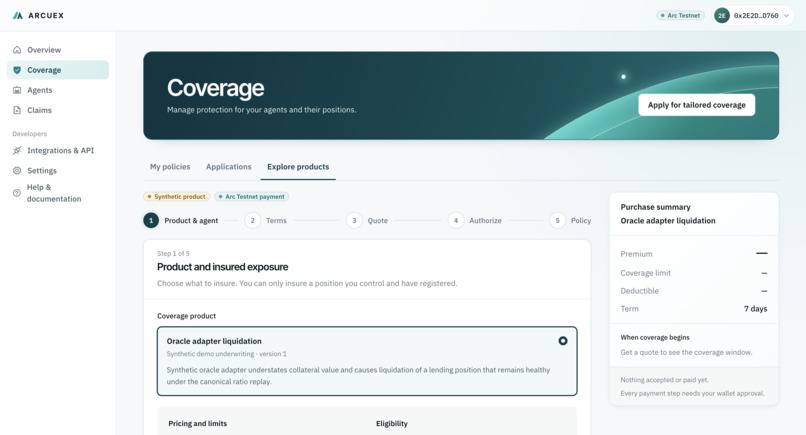
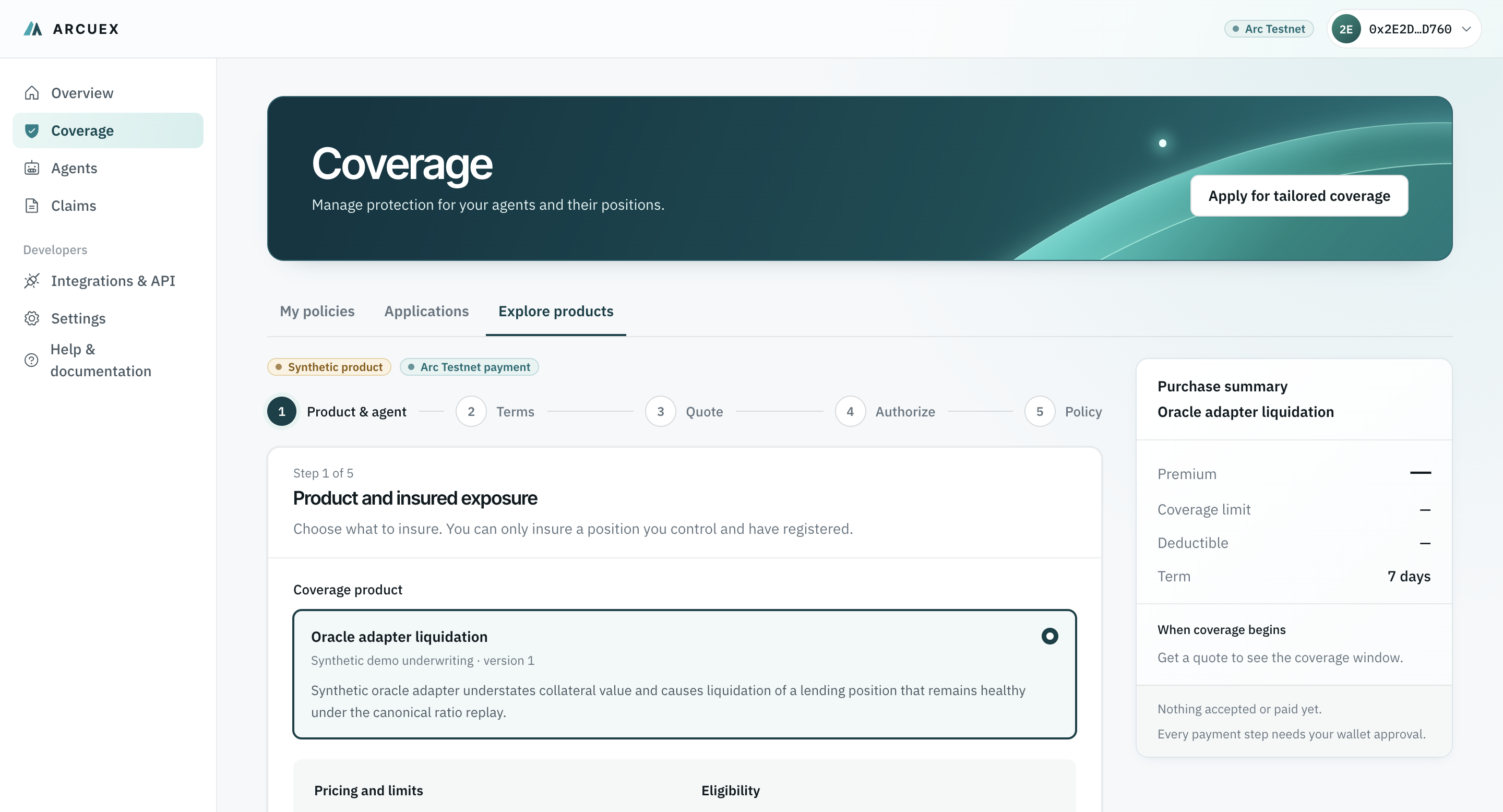
Add coverage
-
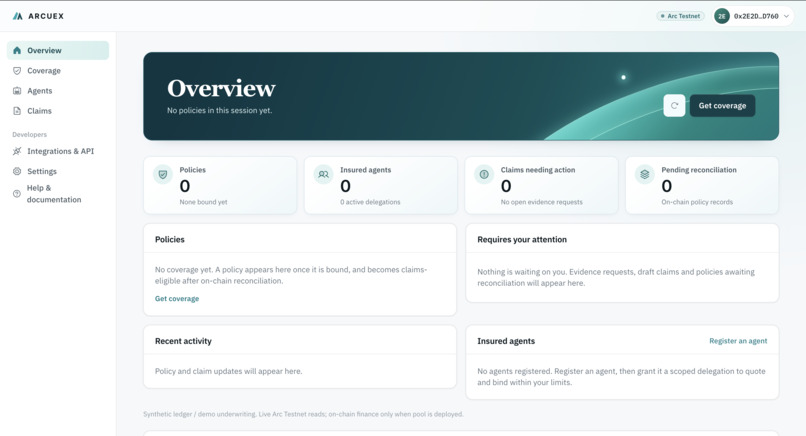
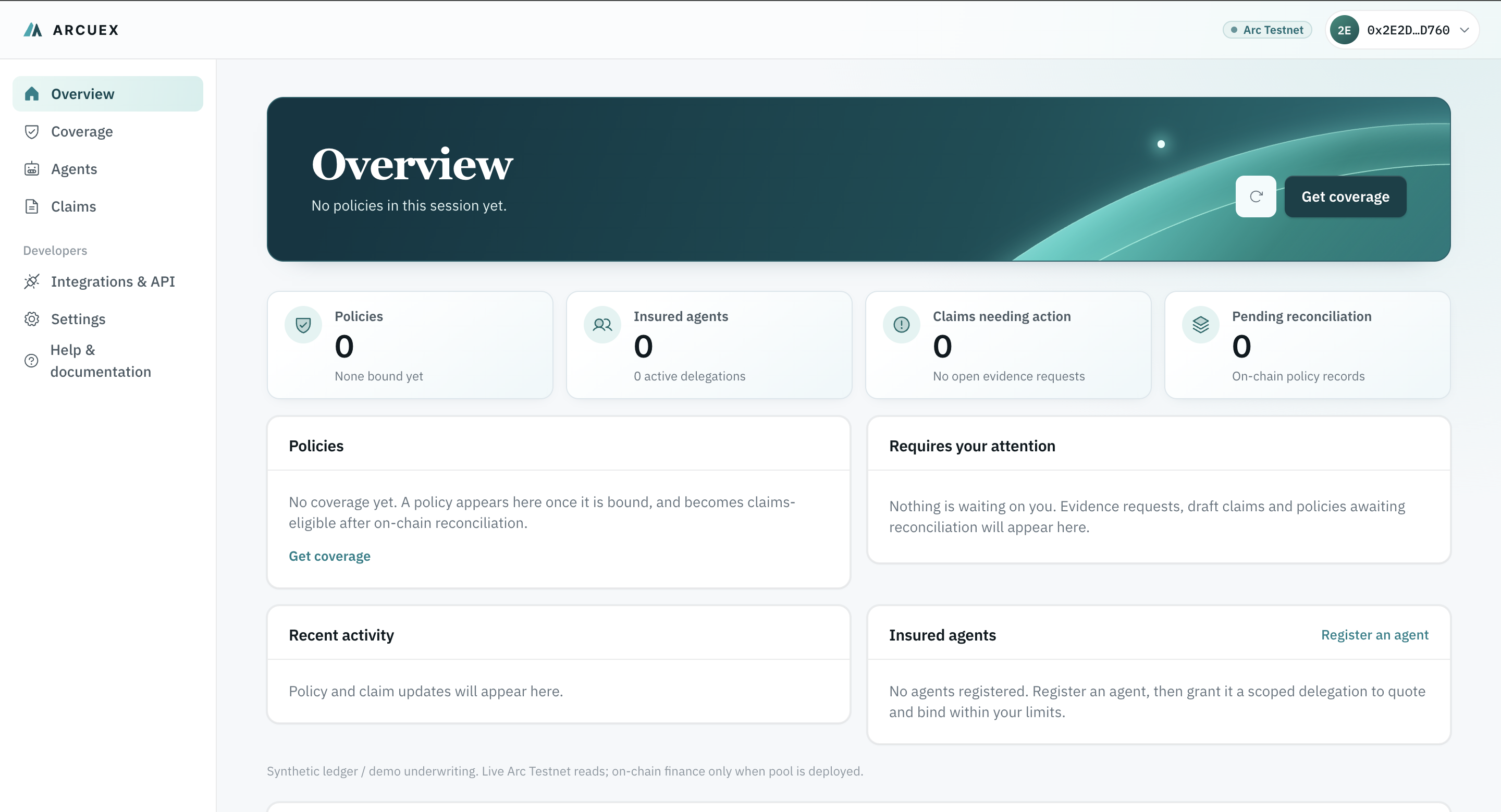
Overview
Inspiration
AI agents are becoming increasingly capable of managing financial assets, interacting with decentralized protocols, and executing transactions autonomously. But as we give agents more financial responsibility, an important question emerges: what happens when something goes wrong?
If an agent manages a lending position that gets liquidated because of an oracle error, who bears the loss? How can its operator prove what happened? And how would an insurance provider determine whether the loss should be reimbursed?
These questions inspired Arcuex, a project exploring programmable financial protection for an economy where autonomous agents increasingly manage financial activity.
What it does
Arcuex is a programmable insurance prototype built on Arc Testnet. It connects AI agents, policyholders, and human reviewers through a common insurance workflow.
Agents can interact with Arcuex through an SDK or Model Context Protocol (MCP) server to discover insurance products, request coverage quotes, initiate authorized purchases, file claims, submit evidence, and respond to requests for additional proof.
Policyholders can manage their agents, inspect policy terms, configure delegated permissions, and follow claims through investigation and resolution.
When an agent submits a claim, Arcuex combines deterministic evidence verification with AI-assisted examination. The AI examiner identifies gaps and suggests follow-up questions, while an authorized human reviewer makes the final claims decision.
The platform also distinguishes claim approval from actual reimbursement. A claim is only considered paid after an authorized settlement has been reconciled against a confirmed onchain receipt.
How we built it
We built Arcuex using Next.js, React, TypeScript, SQLite, Solidity, Foundry, and Arc Testnet.
The frontend provides interfaces for coverage procurement, policy management, agent registration, claims investigation, and human review. The backend manages quotes, delegation, policy records, evidence, decisions, and settlement reconciliation.
We developed an agent SDK and an MCP server so autonomous agents can interact with existing insurance workflows programmatically, while remaining subject to the same authorization rules as human users.
Our Solidity insurance pool manages testnet USDC reserves and supports authorized settlement. Arc Testnet provides the blockchain infrastructure for policy-related financial transactions and payment verification.
For the claims demonstration, we use a controlled synthetic scenario involving an oracle-related liquidation. The agent submits evidence, an AI examiner identifies missing information, a human reviewer requests additional proof, and the agent responds before the claim is reconsidered.
Challenges we ran into
One of the biggest challenges was building the different parts of the system independently while ensuring they worked together.
I developed Arcuex largely on my own, which made coordinating smart contracts, frontend development, backend services, agent integrations, and testing overwhelming at times. Each component introduced its own problems, and getting them to behave as one coherent application required considerable iteration.
Another challenge was blockchain transaction finality. A wallet can submit a transaction before the chain confirms it, and the backend may observe that confirmation later. We had to distinguish transaction submission, confirmation, and reconciliation to avoid displaying incorrect policy or payment states.
Claims introduced similar complexity. Submitted evidence, AI recommendations, human determinations, and actual reimbursements are fundamentally different things. We had to ensure that the interface and backend treated them separately.
Agent permissions were another difficult area. We wanted agents to operate independently, but registering an agent should not automatically give it unlimited authority to spend funds or authorize financial outcomes.
Accomplishments that we're proud of
I'm particularly proud of building an insurance workflow that AI agents can interact with directly.
Rather than creating a chatbot demonstration, we implemented actual SDK and MCP integrations that connect agents to coverage discovery, delegated procurement, claim filing, and evidence exchange.
We also built an iterative investigation process where an agent can submit evidence, receive a request for additional proof, respond, and have its claim reverified before a human decision.
Another accomplishment was making the financial states explicit. An approved claim is not automatically a reimbursed claim, and an unconfirmed transaction is not treated as a completed payment.
The integrated prototype passed extensive automated tests and browser acceptance checks, and we deployed an isolated, acceptance-gated version to Railway.
What we learned
This project taught me that building financial infrastructure for autonomous agents involves much more than connecting AI models to smart contracts.
Trust comes from clearly defined authority, verifiable evidence, and reliable financial records.
AI can help analyze complex information, but it should not independently determine insurance liability or authorize payments. Similarly, blockchain transparency is valuable, but an onchain transaction alone does not establish that a claim is valid.
I also learned a great deal about system integration, testing, failure recovery, and designing interfaces that make technically complicated workflows understandable.
Most importantly, building Arcuex independently pushed me to think beyond individual features and focus on how the entire system behaves.
What's next for Arcuex
Our next goal is to move beyond synthetic claims demonstrations toward insurance backed by independently authenticated real-world and onchain evidence.
We plan to expand agent-specific underwriting by analyzing the protocols, positions, workflows, and oracle dependencies that agents interact with. This would allow insurance premiums and coverage limits to better reflect each agent's actual financial exposure.
We also want to strengthen insurer-facing tools for underwriting, evidence investigation, and settlement operations.
Longer term, we envision Arcuex as infrastructure through which different risk providers can offer programmable financial protection to autonomous agents.
Our goal is to make autonomous financial activity more insurable, transparent, and accountable.
Built With
- arc
- foundry
- next.js
- react
- solidity
- sqlite
- typescript
- usdc
- viem
- wagmi


