Inspiration
Most AI agents today operate as passive chatbots: they wait for human prompts, require continuous oversight, and immediately halt when centralized API credits run out. We built ARCOX Fleet to create an economically self-sustaining multi-agent swarm running 24/7 in the background across Google Cloud and Arc Network (Layer-1 EVM with native USDC gas). The swarm actively monitors on-chain liquidity, pays for paywalled intelligence via micropayments, and replenishes its own AI compute runway on-chain without human intervention.
What It Does
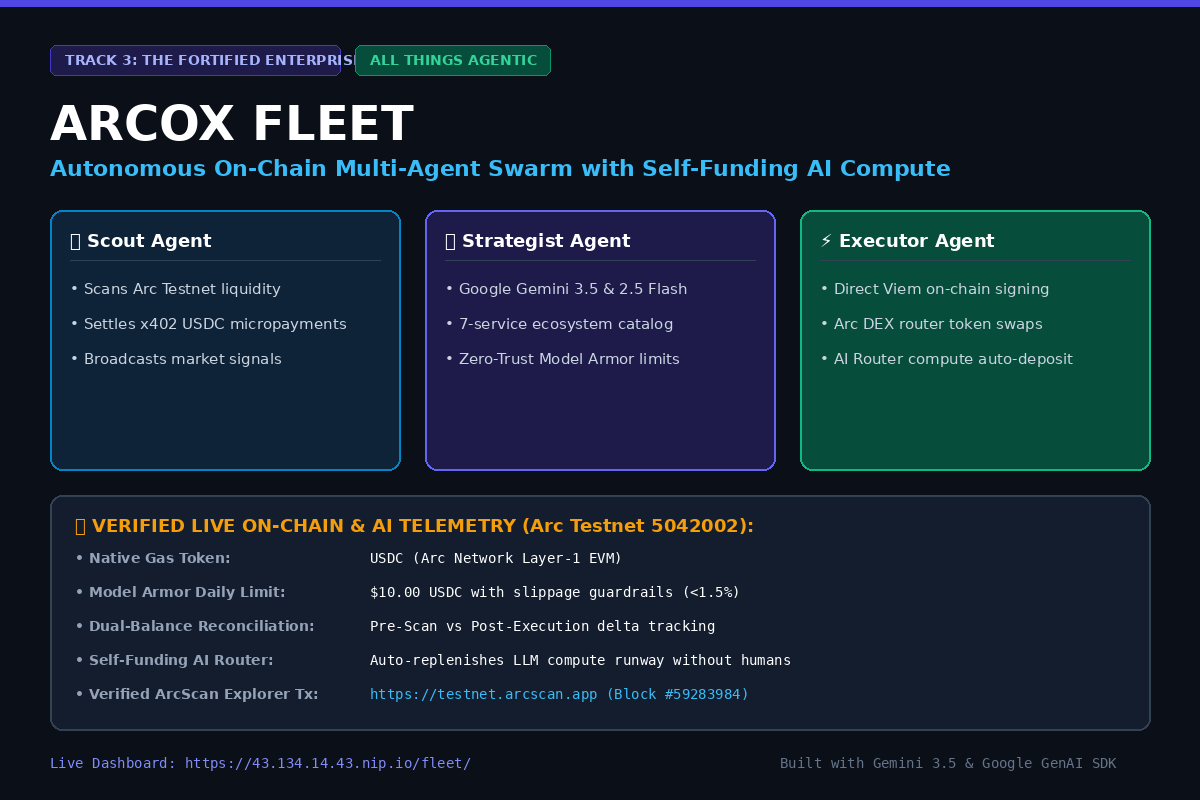
ARCOX Fleet operates on an autonomous 60-second heartbeat loop coordinated by three decoupled agents:
- Scout Agent (Market & Data Scanner): Continuously scans Arc Testnet pools for liquidity spreads \Delta P and settles x402 on-chain USDC memo micropayments to unlock restricted intelligence endpoints.
- Strategist Agent (Multi-Model Gemini Brain): Employs Google Gemini 3.5 Flash and Gemini 2.5 Flash (via @google/genai) to evaluate an ecosystem catalog of 7 financial services. It enforces strict Zero-Trust Model Armor guardrails, automatically discarding any transaction where slippage S > 1.5\% or cumulative daily expenditure E_{\text{day}} > \$10.00\text{ USDC}.
- Executor & Treasury Agent (On-Chain Dispatcher): Dispatches DEX swaps and contract calls using Viem on Arc Testnet (RPC Chain ID 5042002). When LLM compute runway drops below the critical threshold R_{\text{AI}} < \$0.05\text{ USDC}, it executes an autonomous on-chain top-up to the ARCOX AI Router Unified Balance to maintain perpetual uptime.
How We Built It
- AI Reasoning Engine: Integrated the Google GenAI SDK (@google/genai) using dynamic multi-model cascading:
This hierarchy guarantees continuous reasoning throughput even during unexpected upstream rate limits.
- Agent Swarm Architecture: Implemented the Google Agent Development Kit (ADK) Swarm pattern for strict separation of concerns between data discovery, risk reasoning, and transaction dispatching.
- Blockchain Layer: Connected directly to Arc Network Layer-1 EVM (https://rpc.testnet.arc.io) with Viem handling deterministic transactions and native USDC gas accounting.
- Telemetry & Reconciliation: Built dual-balance telemetry tracking to verify net on-chain balance deltas:
where B_{\text{pre}} and B_{\text{post}} represent treasury states and G_{\text{tx}} is the exact gas fee. All audit logs stream to Google Cloud Firestore with OpenTelemetry compliance.
- Commander Dashboard: Developed a dark-mode real-time operator interface hosted on Vercel and cloud compute with live log streaming and daemon controls (start, pause, rebalance). Challenges We Ran Into
Repetitive Action Churn: Early autonomous runs executed swaps on every cycle regardless of market viability. We resolved this by embedding Action History Memory into the Strategist's context window, allowing Gemini to analyze previous cycle outcomes and choose HOLD_AND_MONITOR when expected net yield was sub-optimal:
Sub-Second Financial Reconciliation: Variable RPC latency occasionally caused state desynchronization. We implemented deterministic receipt polling using waitForTransactionReceipt before computing financial deltas and persisting states.
API Rate-Limit Resilience: High-frequency reasoning cycles occasionally hit burst limits. The multi-model fallback cascade resolves this by dynamically switching model versions without interrupting the heartbeat cycle. Accomplishments We're Proud Of
100% Real Live On-Chain Execution: Every DEX swap, intelligence micropayment, and treasury top-up produces verifiable on-chain transactions on ArcScan.
Closed-Loop Self-Funding: The swarm autonomously pays for its own Gemini API compute runway directly from realized on-chain treasury balances.
Deterministic Accounting: Complete financial transparency with automated pre-scan and post-execution balance reconciliation on every loop.
What We Learned
- Providing structured historical action memory alongside an explicit service catalog to Gemini yields far more disciplined, risk-averse financial reasoning than rigid heuristic rule engines.
- Operating on an EVM chain with native USDC gas (Arc Network) drastically simplifies multi-agent balance management by eliminating secondary token fee conversion logic.
What's Next for ARCOX Fleet
- Implementing cross-chain liquidity rebalancing via Circle CCTP across Base Sepolia and Ethereum Sepolia.
- Integrating standardized agent task markets compliant with ERC-8004 and ERC-8183 specifications. .
Built With
- arc-network
- blockchain
- express.js
- gemini-3.5-flash
- google-cloud
- google-cloud-firestore
- google-cloud-run
- google-genai-sdk
- javascript
- node.js
- smart-contracts
- tailwindcss
- viem
- x402-protocol

Log in or sign up for Devpost to join the conversation.