-
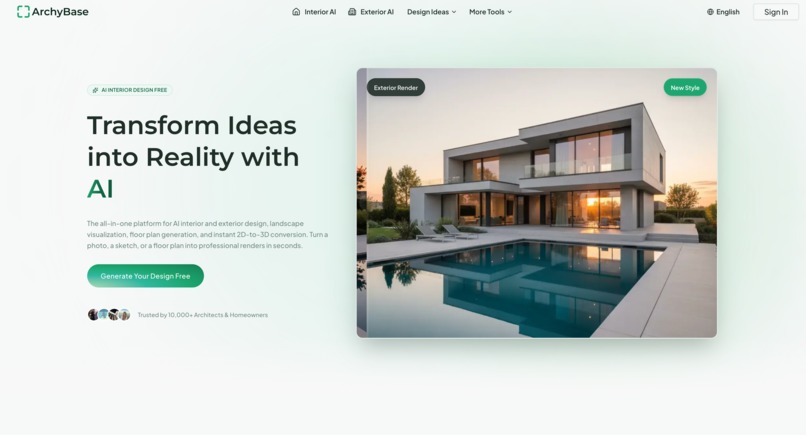
Home Screen
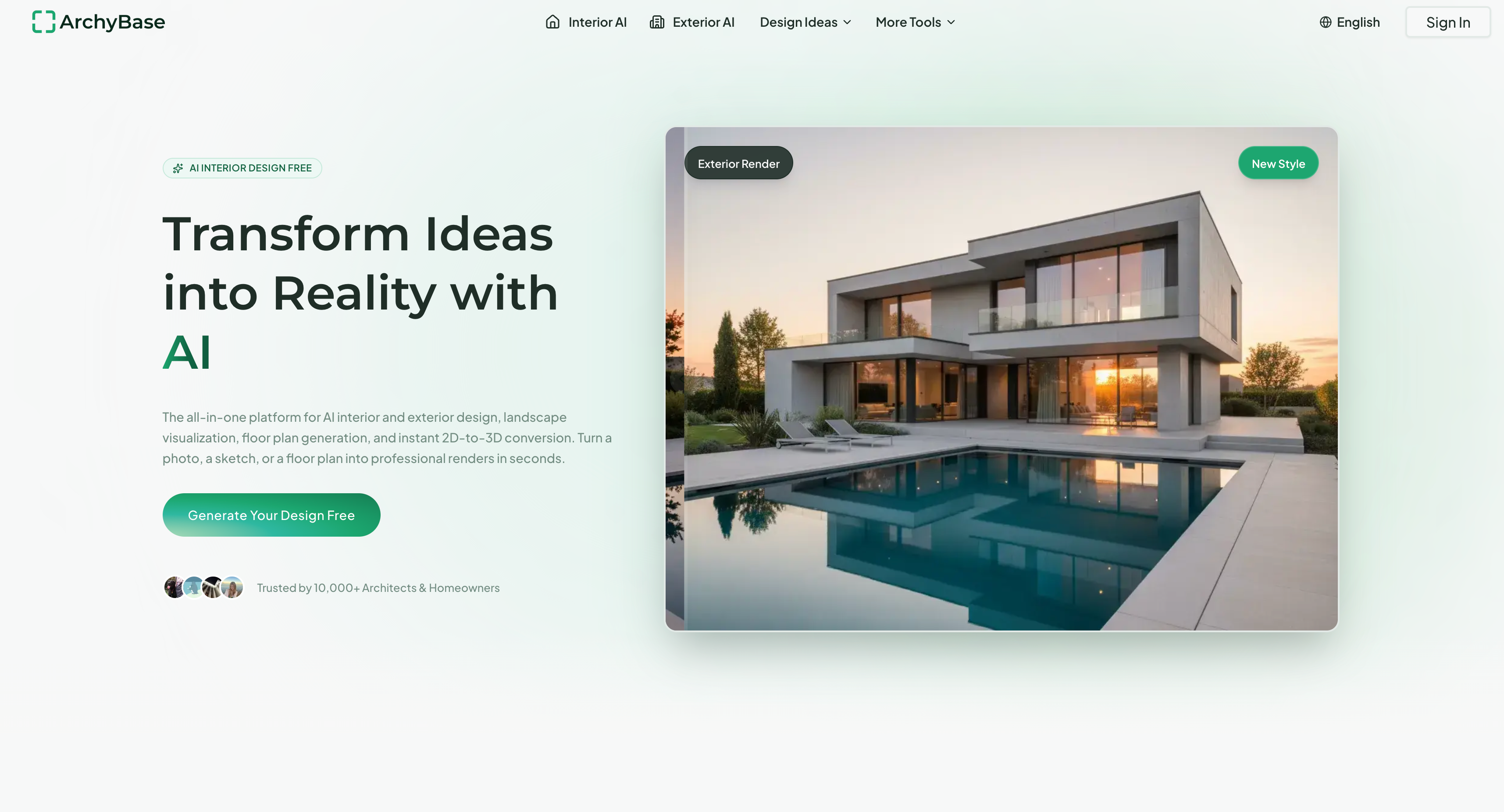
Inspiration
Architectural ideas often start as rough sketches, floor plans, or simple references. Turning those early ideas into realistic visualizations usually requires specialized software, technical skills, and a significant amount of time.
We wanted to make that process much more accessible.
ArchyBase is built around the idea that anyone should be able to take an architectural idea and quickly explore what it could look like in the real world.
What it does
ArchyBase is an AI-powered architecture and interior design platform that helps users turn early-stage design ideas into visual concepts.
Users can work with different types of architectural and design inputs, including sketches, floor plans, reference images, and existing property photos.
The platform can be used for:
- AI interior design
- Architectural visualization
- Sketch-to-render workflows
- AI floor plan generation
- Exterior and facade concepts
- Landscape design
- Living room, bedroom, kitchen, and bathroom design
- Exploring different materials, styles, and design directions
Instead of starting from a blank canvas, users can provide an existing idea or space and use AI to explore multiple possibilities.
How we built it
We built ArchyBase as a web-based AI design platform combining a modern frontend with an image-generation pipeline.
The application handles image uploads, user instructions, design parameters, AI generation, asynchronous processing, and result delivery.
A major part of the product is translating relatively simple user requests into structured instructions for AI image-generation models.
For example, a user can provide a room sketch and request a specific interior style, materials, lighting, or architectural direction. The system combines these inputs into a generation workflow designed to produce a realistic visualization while respecting the information contained in the original reference.
Challenges
One of the hardest parts was dealing with the ambiguity of architectural images.
A sketch does not explicitly describe every material, dimension, object, or spatial relationship. An AI model needs to interpret the visual information while still following the user's instructions.
Another challenge was finding the right balance between creativity and fidelity.
A good visualization should improve the presentation of an idea without completely changing the underlying design.
We therefore focused on building workflows around the image-generation models rather than treating the model as a simple text-to-image tool.
What we learned
Building ArchyBase taught us that AI can be especially useful during the early stages of architectural design.
The value is not only in producing a final-looking image. It is in allowing people to quickly explore alternatives.
A designer can test different materials. A homeowner can explore different interior styles. A developer can visualize an exterior concept. An early sketch can become something that is much easier to discuss with other people.
This makes AI a useful exploration layer between an initial idea and a more detailed architectural workflow.
What's next
We are continuing to improve the consistency and controllability of AI-generated architectural visualizations.
Future improvements include better support for floor plans and architectural references, more precise design controls, improved iteration between different design versions, and workflows that allow users to move from early concepts toward more complete projects.
Our goal is to make architectural visualization faster and more accessible without requiring users to master complex design software first.
Explore ArchyBase: https://archybase.com/
Built With
- ai
- cloudflare
- css
- gemini
- generation
- image
- next.js
- openrouter
- postgresql
- prisma
- r2
- react
- supabase
- tailwind
- typescript
- vercel

Log in or sign up for Devpost to join the conversation.