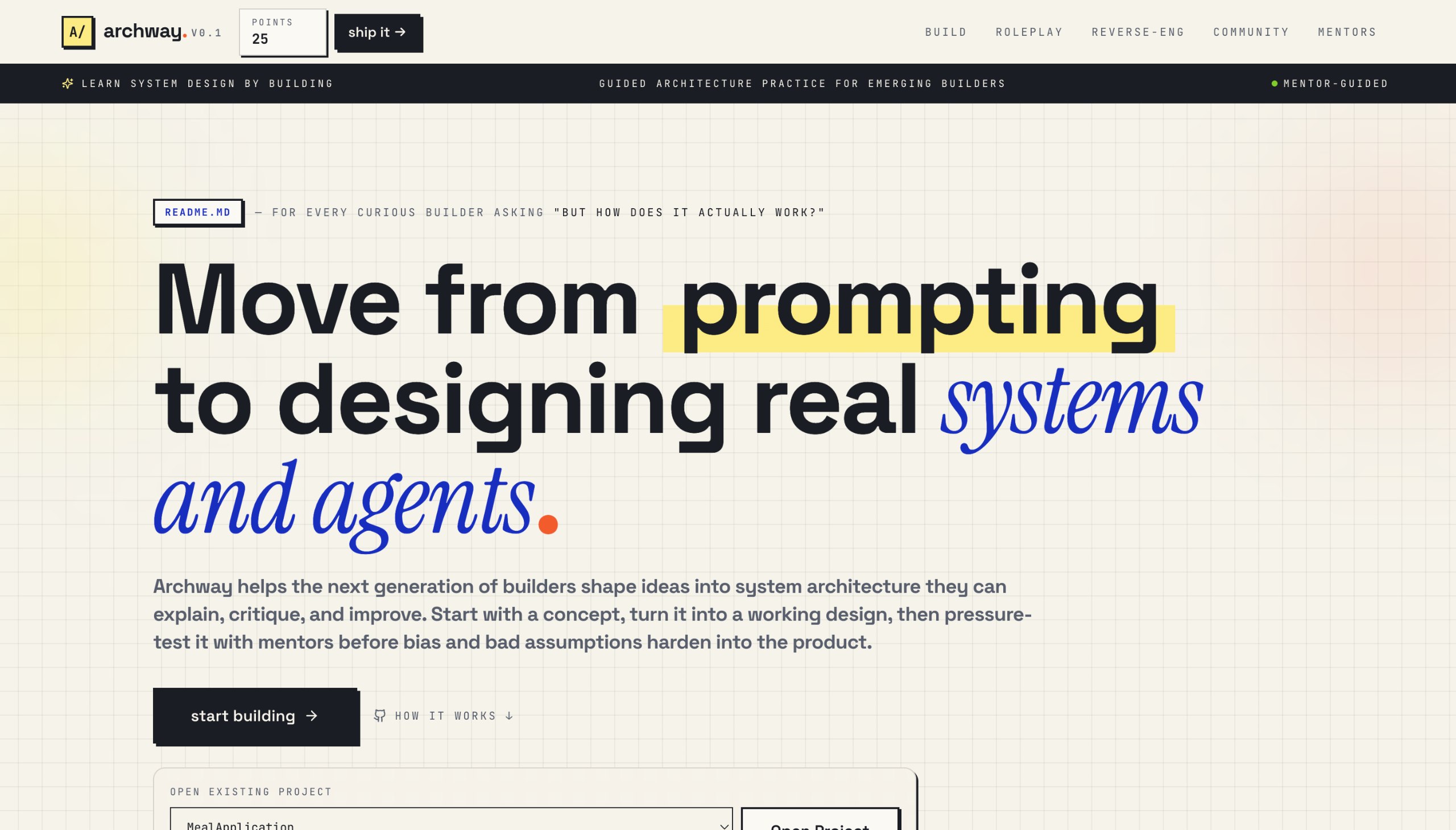
Archway
Inspiration
The gap in tech is not just about who can code, but who gets to design systems. As AI tools become easier to use, the advantage shifts to those who can architect workflows, data pipelines, and AI systems.
Existing system design tools are either too academic, too intimidating, or assume prior engineering thinking.
We observed a gap: many young adults, especially women, can use AI tools but struggle to build systems with them. Current tools either provide no guidance or overly generic tutorials. Neither supports real learning.
Archway bridges this gap with a guided playground that starts from your idea and helps you build a real architecture while preserving curiosity.
What It Does
Archway is a system design playground for beginners learning to think architecturally.
Users answer three questions about their idea, users, and workflows. Archway then generates a live architecture diagram with components like frontends, APIs, backends, and databases.
Learning happens through three lenses:
- Product Manager: prioritize features and map user flows
- Engineer: think about scale, databases, and failure points
- Ethical Advisor: audit bias and inclusion with a live bias score
Additional features:
- Deconstruction: reverse-engineer real apps through guided questions
- Community: publish, fork, and collaborate on architectures like GitHub
- Mentorship: experienced builders guide learners
- Gamification: points and rewards, with incentives for inclusive design
How We Built It
- Frontend: Next.js with a grid-based design system
- LLM pipeline: generates initial architecture from onboarding inputs
- Node-based canvas: interactive components with AI explanations
- Persistent AI mentor: scoped to each user’s idea
- Dynamic lessons: role-based exercises tied to the user’s architecture
Challenges
The main challenge was avoiding generic AI outputs. We refined prompting to ensure all content stays specific to the user’s idea.
We also reduced technical complexity to balance accessibility for beginners with meaningful depth for intermediate users.
Accomplishments
- Bias Score: surfaces fairness issues at the architecture level in real time
- Three-Lens Learning: mirrors real-world collaboration across product, engineering, and ethics
What We Learned
Beginners struggle with system design due to lack of clear starting points. Generating a first draft architecture makes learning easier by enabling critique and iteration.
We also learned that incentives shape behavior. Embedding inclusive design into rewards drives better engagement than separating it into standalone modules.
What’s Next
- Real mentor matching with asynchronous feedback
- Community forks with design diffs
- Database schema and relationship generation
- Exportable technical specifications for MVP development
Vision
To build a generation of creators who ask “who is missing from this system” before they build it.
Built With
- css
- express.js
- mongodb
- node.js
- openai
- radix
- react
- replit
- tailwind
- typescript
- vite
- zustand


Log in or sign up for Devpost to join the conversation.