-
-

-
Problem Statement
-

Solution
-

Inspiration
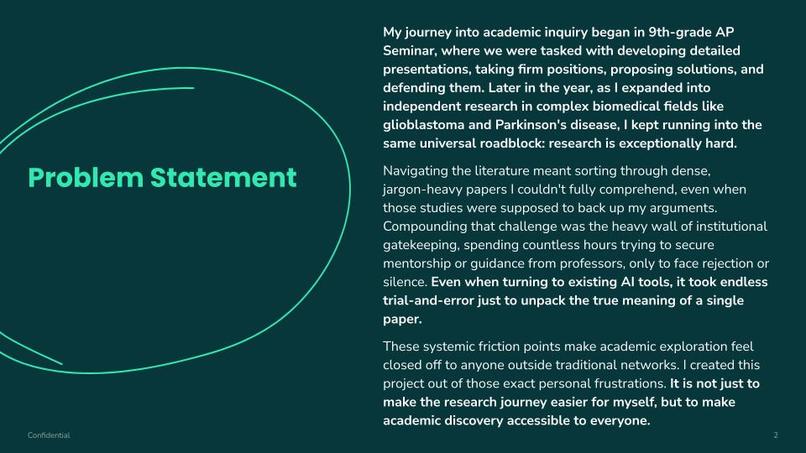
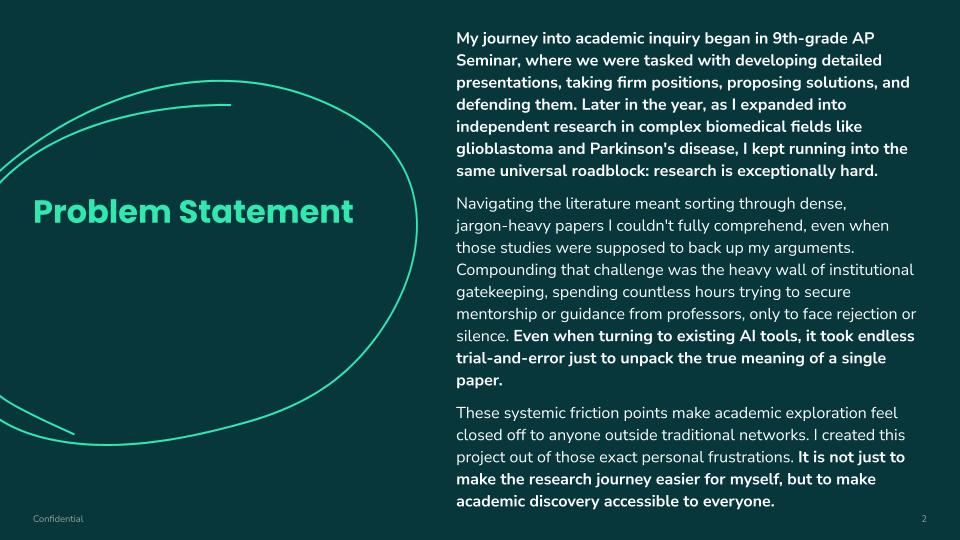
My project is called ArchSearch, and this tool was created to solve a problem that many students face in research section of education: finding research opportunities, papers, and understanding a research paper in-depth. My journey began in 9th grade. I started this class called AP Seminar, where we had to develop detailed presentations and argue a position and solution and defend it. Later on in the year, I also started doing research in glioblastoma and parkinsons, and I found something common in everything. Research was hard. I didn't understand some of what I was reading different papers to support my argument, took thousands of hours to just get a professor to just get rejected. And reading papers and not even understanding what they are saying because of the amount of complex words they used! This is why I created this project, to not just make research easier for me, but make it accessible to everyone.
Demo Video
For the Blueprint Hackathon, this is the submission video: https://youtu.be/r1R5FwqlQAk. I actually had two different demo videos: one for the Blueprint Hackathon and another for the July Hackathon. I didn't know that I was unable to submit different ones for each one under the same project.
What it does
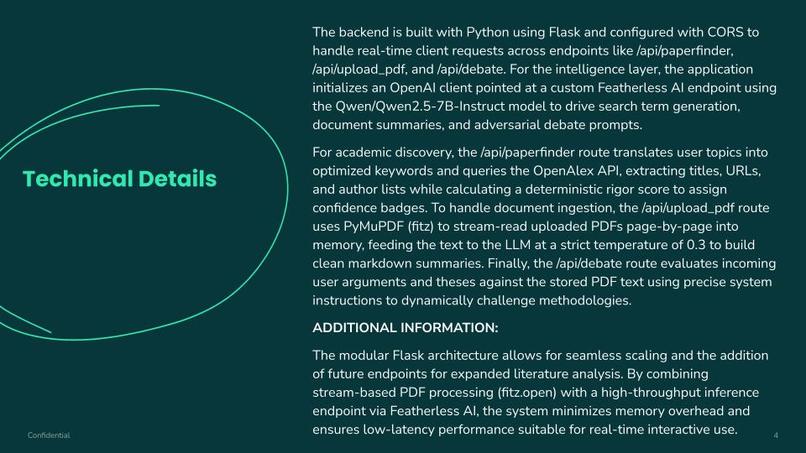
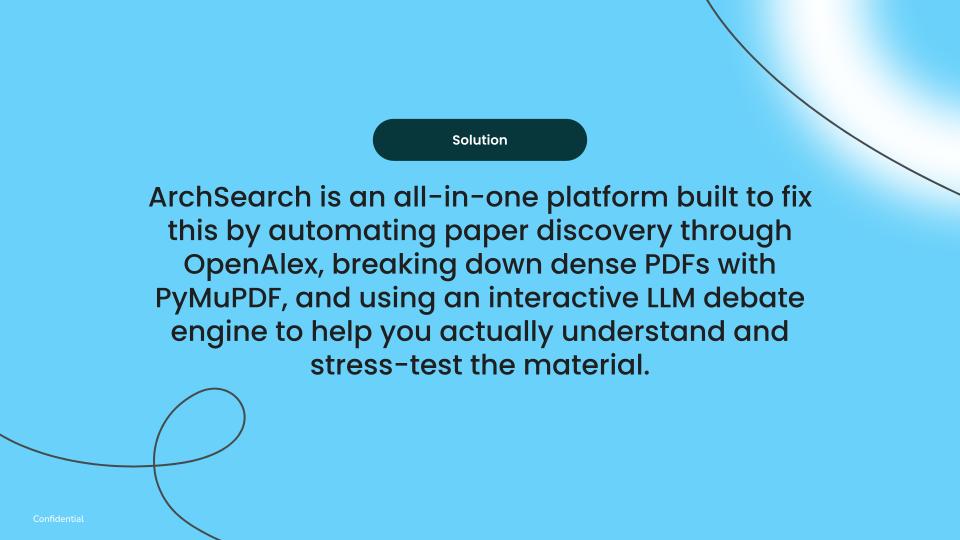
ArchSearch first takes a short survey asking the student for their name, email, and any feature suggestions they might want to add to the tool. Then, it loads you into the main website, where you can enter a topic or question to find relevant research papers and experienced professors using OpenAlex, an extensive global research library. To help you choose the best sources for your work, it also provides reliability and confidence scoring on each paper. Once you download a paper, you can feed it directly into a PDF uploader agent that summarizes the text, allowing you to analyze it further by answering questions from the debate agent. If you don't know an answer, you can simply say so, and it will explain the concept to you. Furthermore, the platform automatically generates a simple, executable Python simulation code based on the specific paper you uploaded.
How we built it
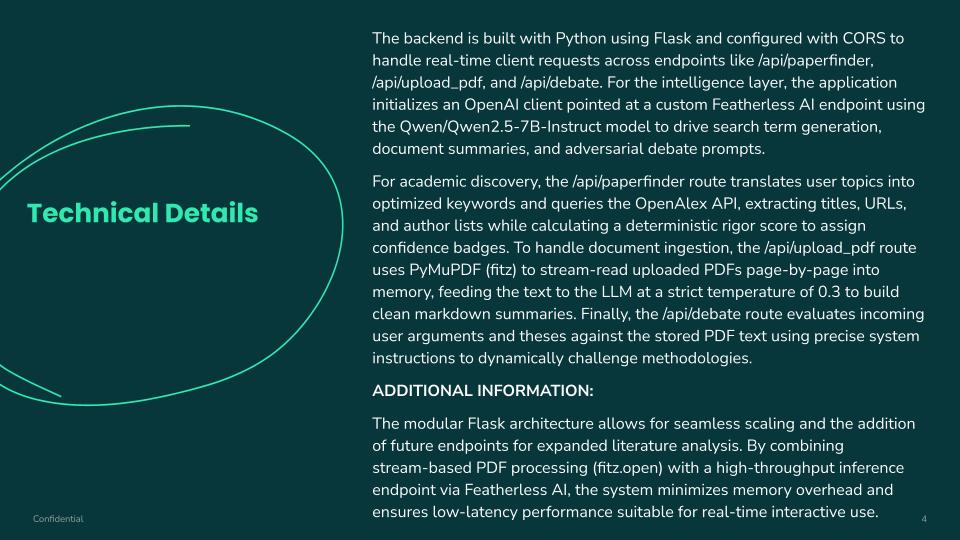
I built ArchSearch using a Python (Flask) backend connected to an HTML/CSS/JS frontend. The backend uses OpenAlex to fetch real-time papers and professors. I used featherless.ai to power a multi-agent system: a PDF parser and summary agent, an interactive Q&A agent, and a code-generation agent that creates Python simulations from research concepts from the pdf uploaded.
Challenges we ran into
One issue was figuring out how to parse dense, complex academic papers accurately and feed them into the agents without losing important context. I also had to refine our integration with OpenAlex to filter out noise and ensure the professors and papers returned were relevant to a student's specific query.
Accomplishments that we're proud of
I am proud to have built a tool that doesn't just summarize a paper, but actively quiz you through a debate agent and generate Python simulation code based on the context of the PDF uploaded. Above all, I am proud to use my own experiences to make academic research more accessible for other students.
What we learned
Throughout the hackathon, I learned new technologies and concepts while building the project, including AI integration and full-stack development. I improved a lot of my technical skills and demonstrated the value of combining AI with a proper user experience. I got a better understanding about APIs, such as using them for communication between the frontend and backend.
What's next for ArchSearch
Moving forward, I want to implement more databases than OpenAlex, and enhance our simulation engine so it can generate more advanced, multi-variable models (such as agent-based or kinetic simulations). Ultimately, I plan to gain credibility from actual universities and organizations to prove the reliability of the webiste, while adding features that allow professors to hop on calls, create one-on-one lessons, and mentor students directly.
Built With
- css
- html
- javascript
- python
- vercel


Log in or sign up for Devpost to join the conversation.