-
-
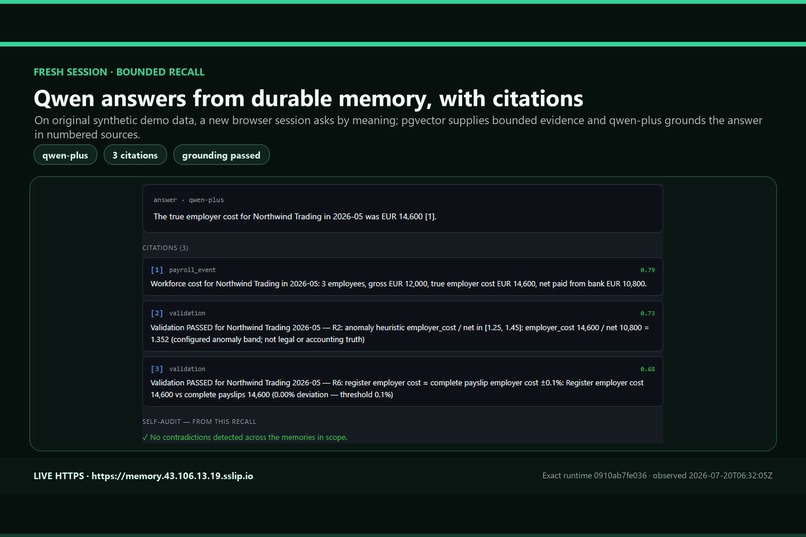
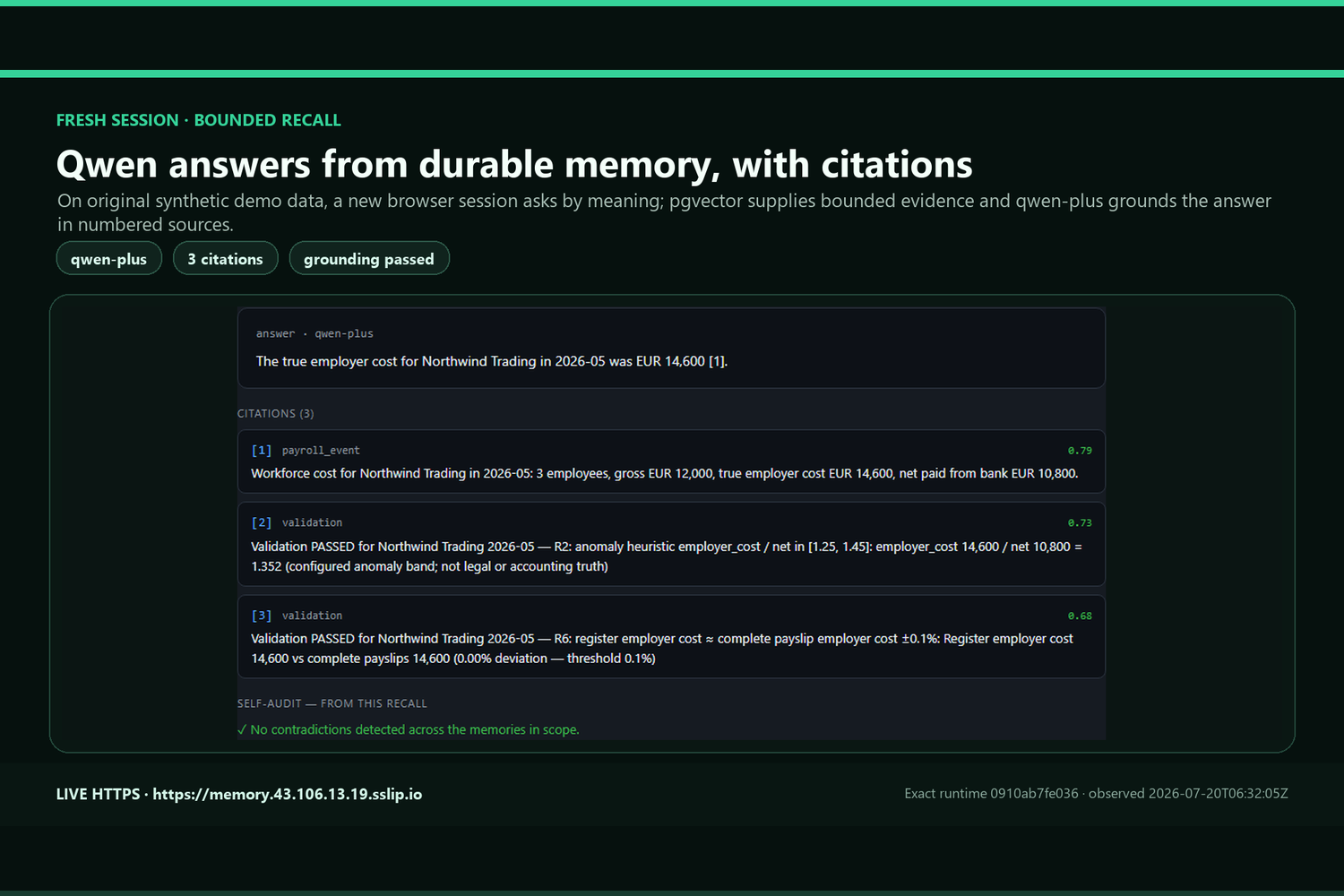
A fresh session recalls a bounded slice of durable pgvector memory and grounds the Qwen answer in numbered synthetic-demo evidence.
-
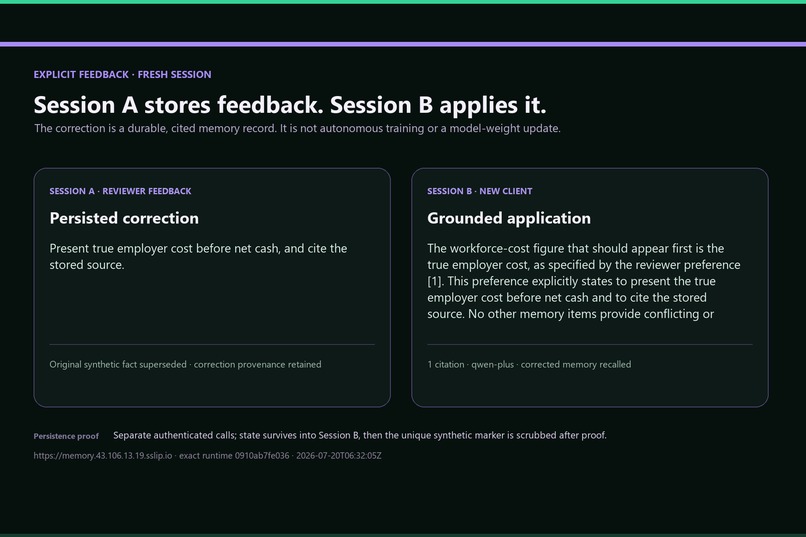
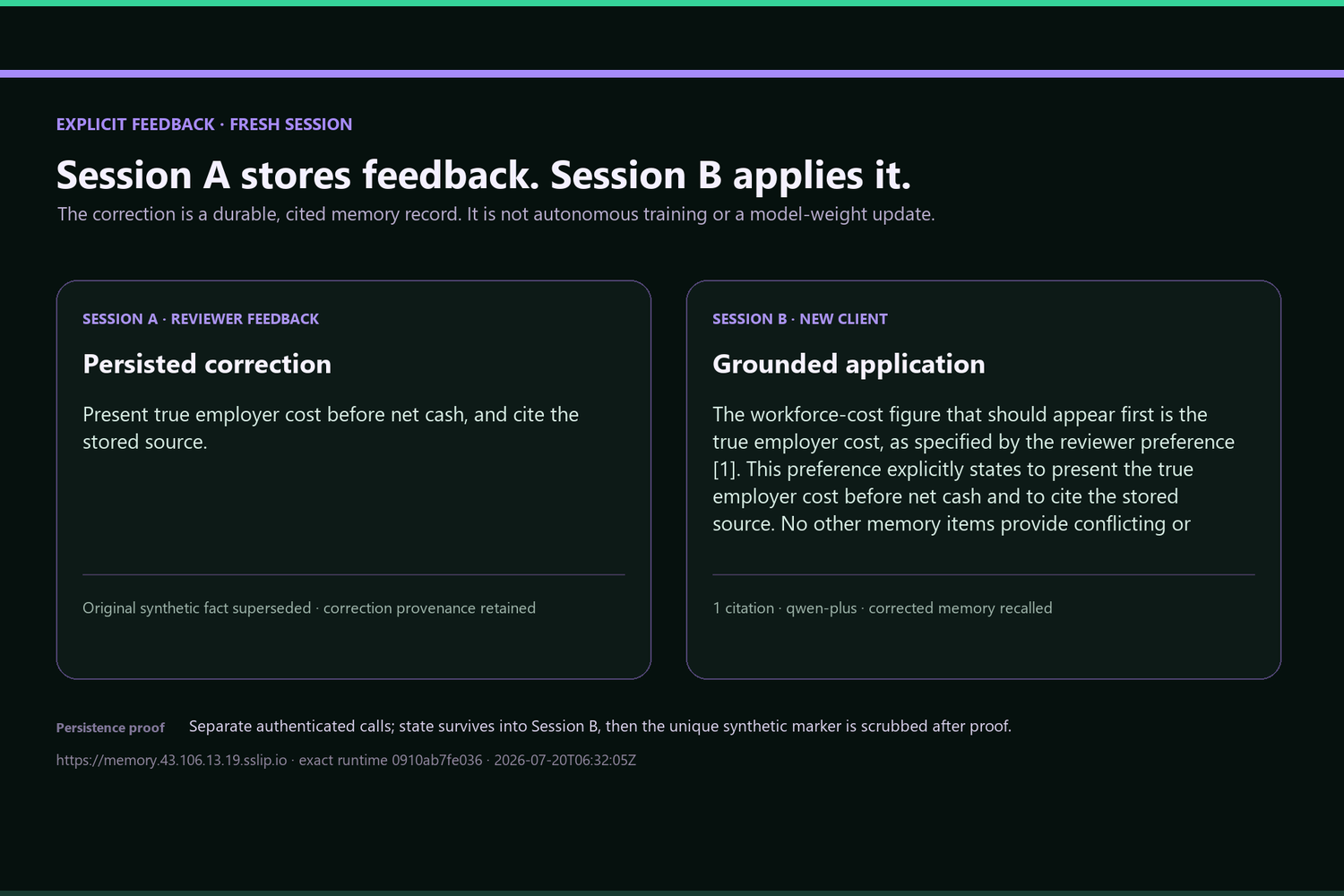
Reviewer feedback persists as cited memory that a fresh session applies; it is stored state, not training or a model-weight update.
-
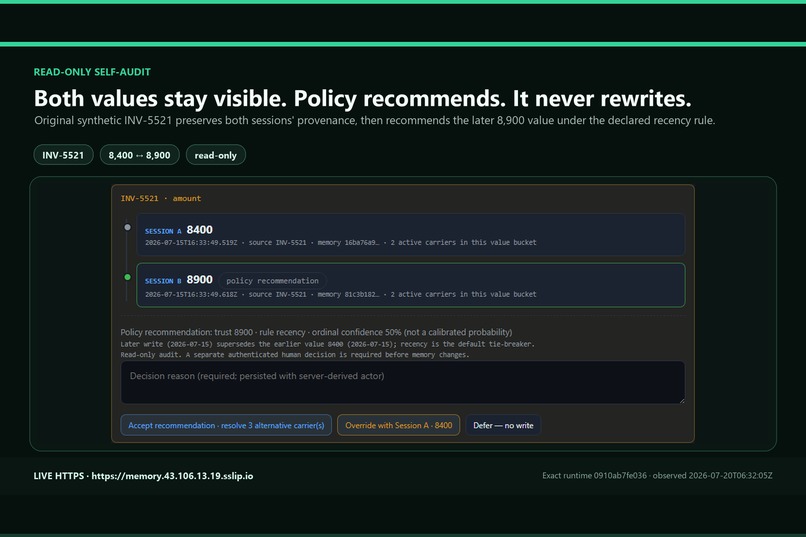
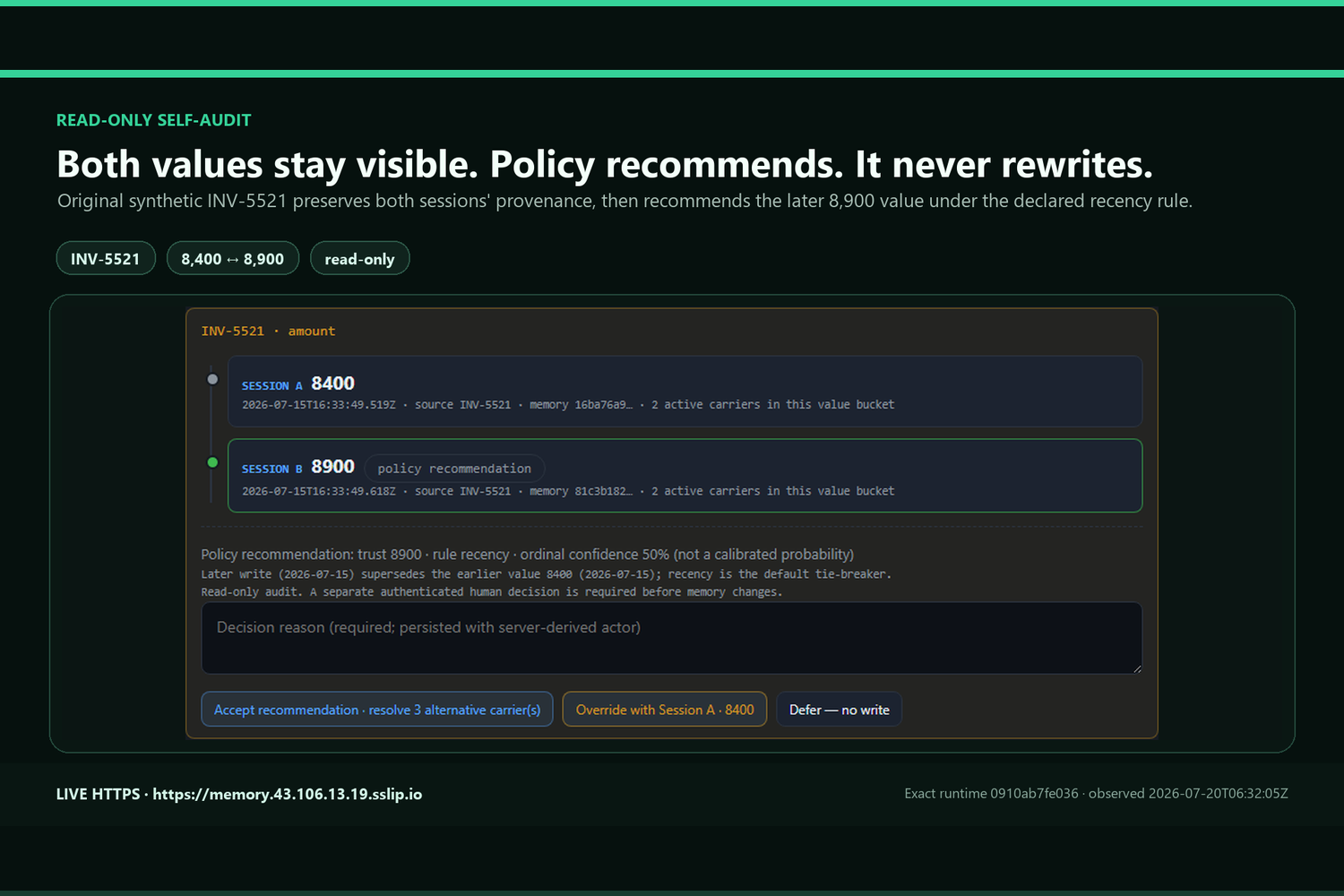
The read-only audit keeps both synthetic cross-session values visible and recommends a policy winner without rewriting history.
-
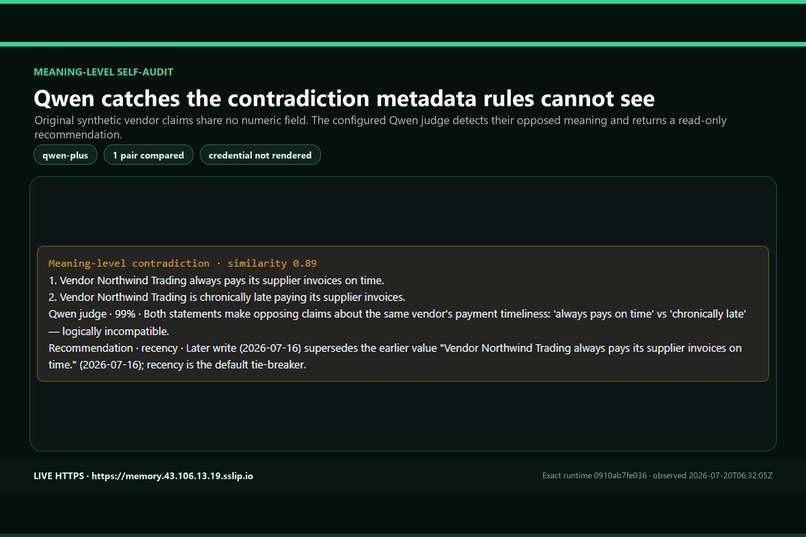
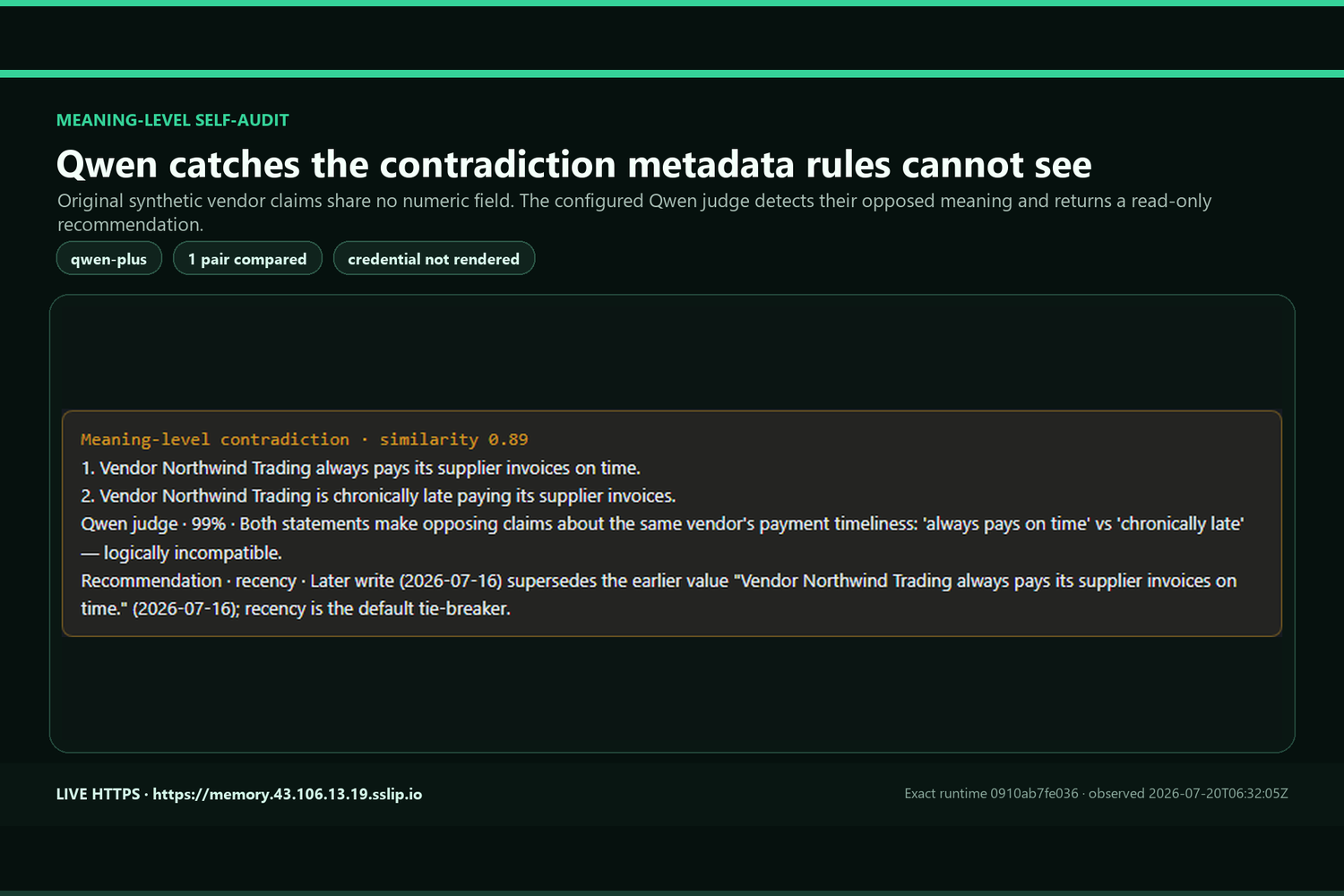
The bounded Qwen scan catches a meaning-level contradiction in synthetic vendor claims; the result is read-only, never an automatic edit.
-
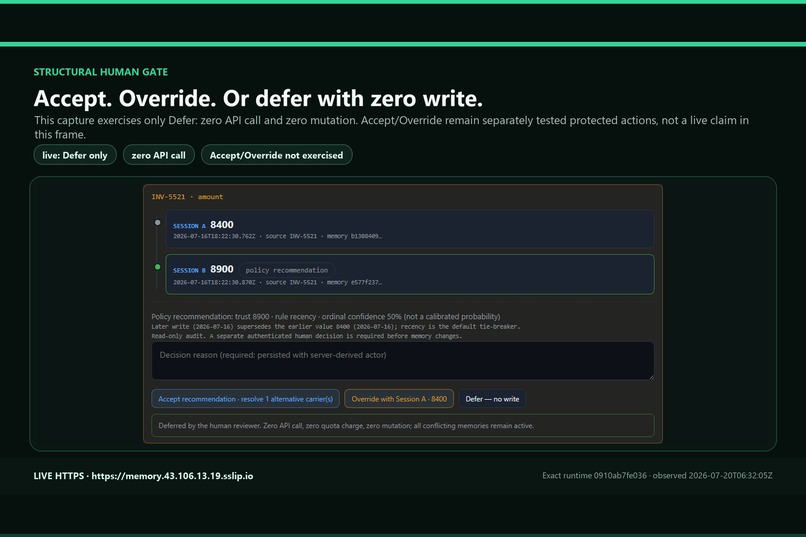
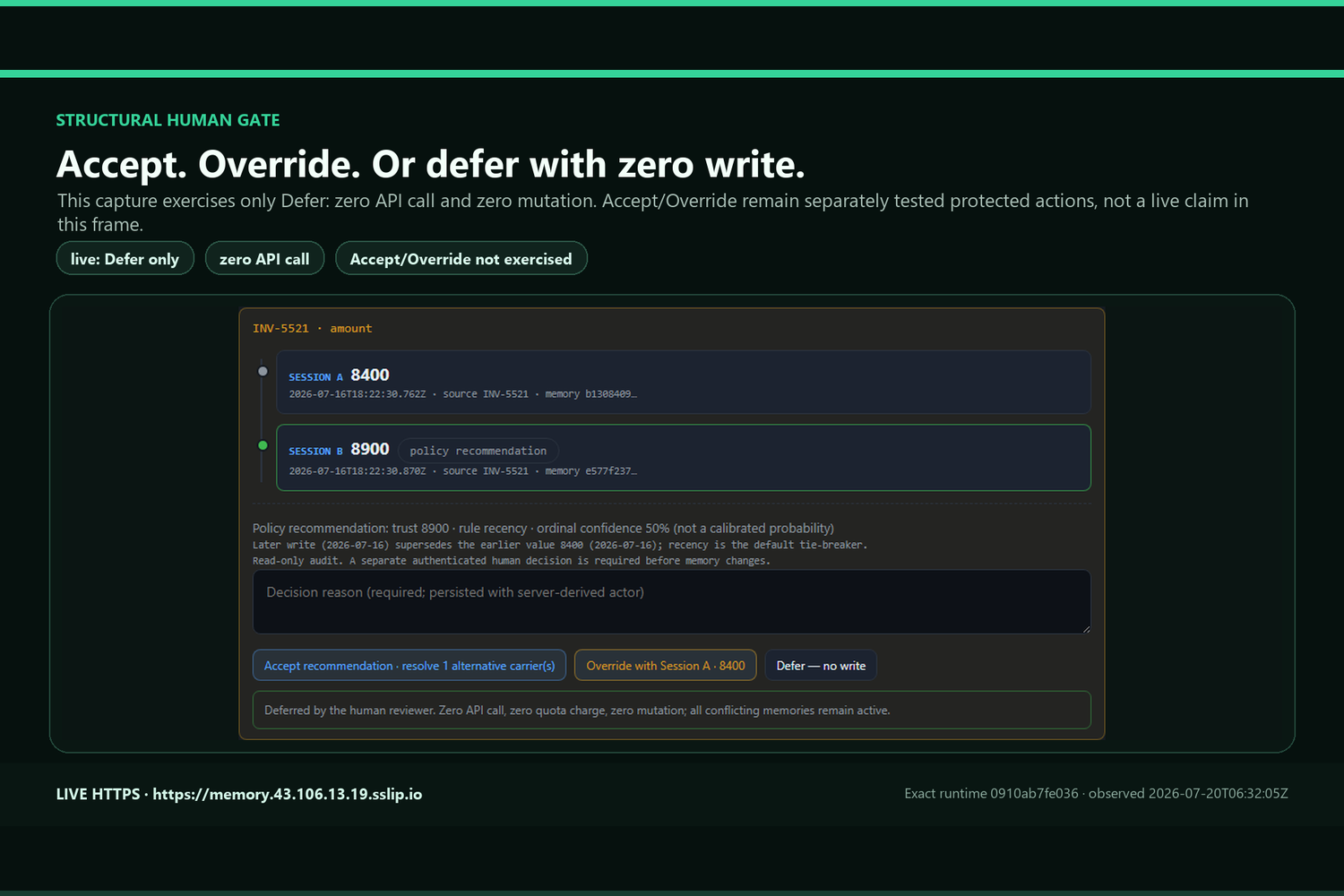
The live frame proves Defer with zero API call and mutation. Accept/Override are tested protected actions, not claims made by this capture.
-
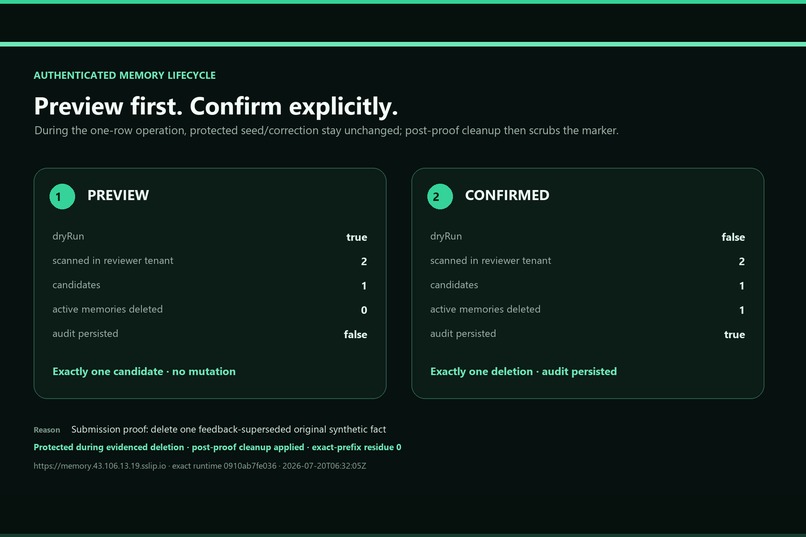
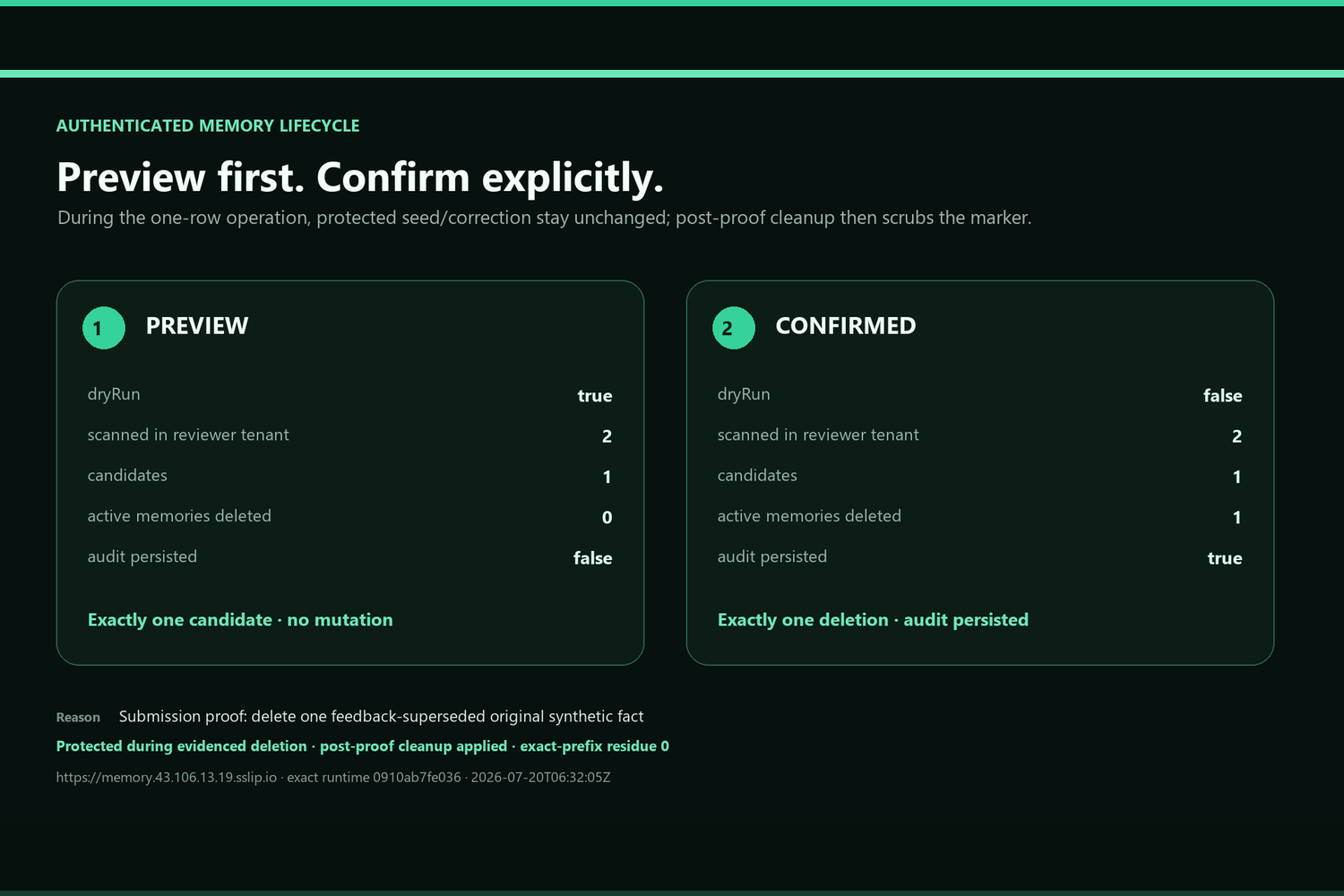
Lifecycle control previews one superseded candidate, confirms one audited deletion, preserves protected memory, then clears marker residue.
-
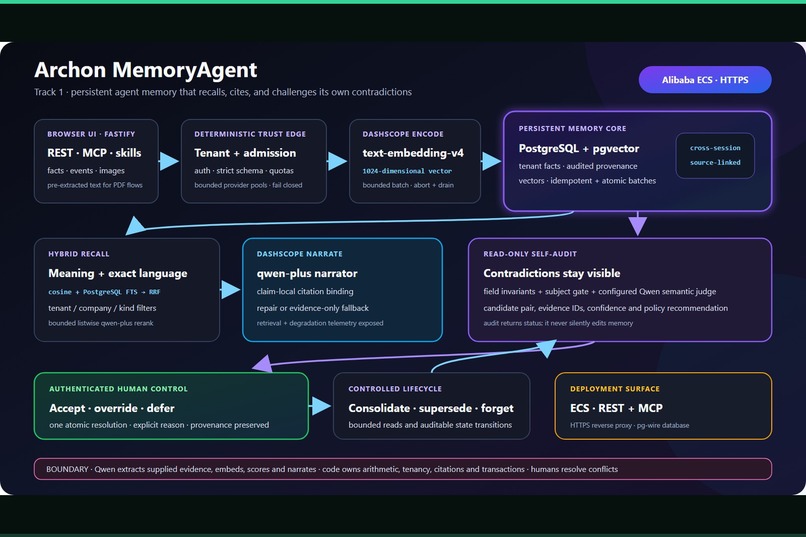
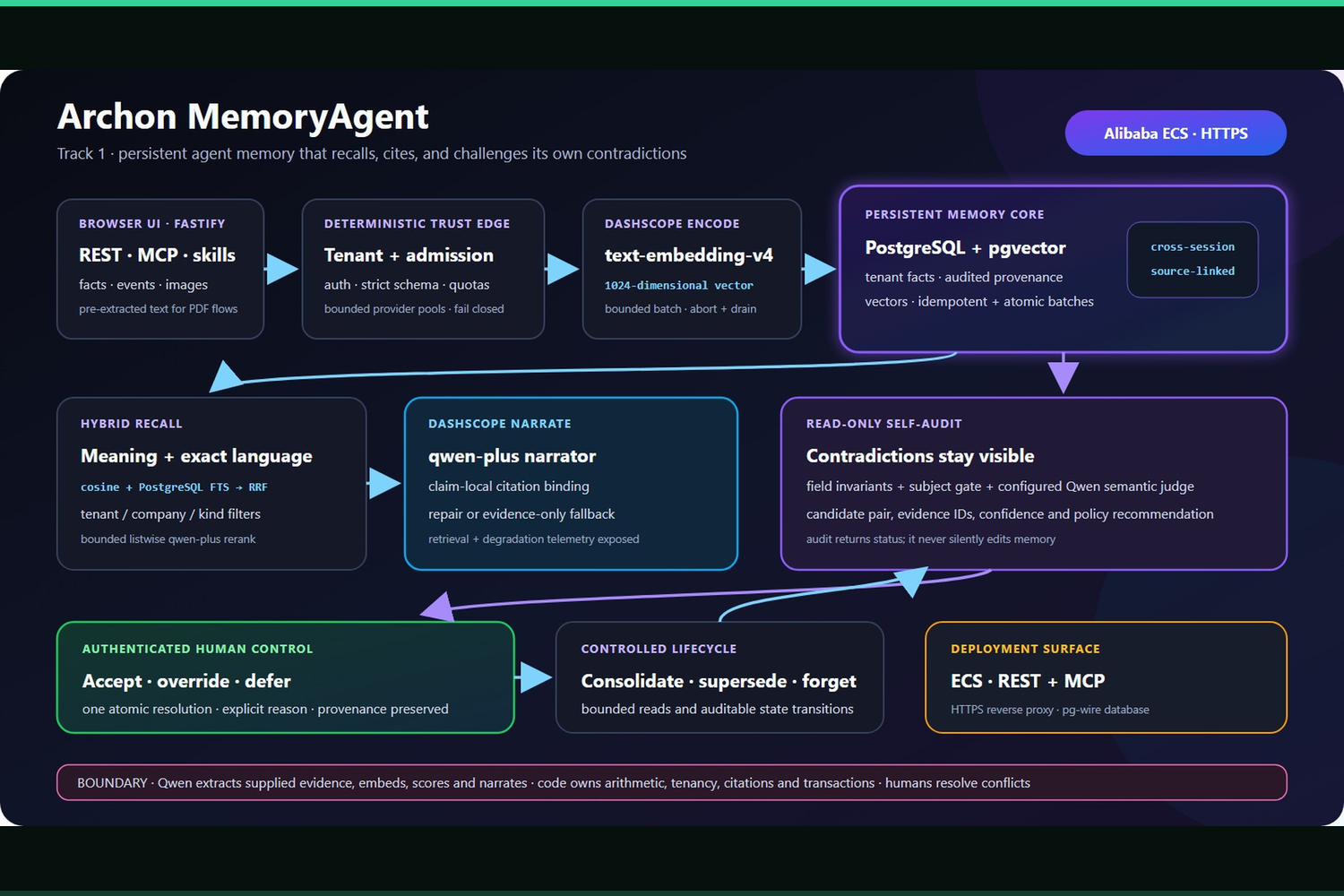
Qwen embeddings and narration, hybrid pgvector recall, read-only self-audit and human control are separated by explicit trust boundaries.
Memory that calls out its own contradictions
We built Archon MemoryAgent after seeing a persistent-memory demo fail in a
more dangerous way than forgetting. Separate sessions assigned different values
to the same INV-5521.amount field, and plain vector recall returned whichever
ranked higher without revealing the conflict. Support copilots, research assistants,
and financial-document pipelines all inherit that failure mode when they must stay
consistent over time. Archon is a persistent, queryable, cross-session memory that
recalls grounded, cited answers and audits its own memory for contradictions.
The audit recommends which value to trust without mutation. An authenticated reviewer can separately
accept or override that recommendation through one atomic, idempotent decision.
Its domain-neutral audit and tenant-scoped REST/MCP/pg-wire seams make the MIT core
reusable beyond this financial proof without claiming unmeasured production scale.
What happens when facts disagree
- Cross-session recall for limited context: memories are embedded with
text-embedding-v4and stored in pgvector; a fresh process retrieves a bounded, relevant slice (maximum 20) and grounds aqwen-plusanswer in cited memories. A cross-session e2e test proves session B recalls what session A wrote and tore down. - Self-auditing memory:
POST /consistencyis a pure, domain-neutral engine that flags cross-session contradictions and dangling references, then recommends which value to trust over a fixed importance → source-authority → recency ladder. It remains read-only and never mutates memory. Measured: 5/5 detected, 0 false positives; 4/4 declared-policy conformance. - Meaning-level self-audit: a companion
POST /consistency/semanticcatches memories that oppose each other in meaning with no shared field ("pays on time" vs "chronically late"): it embeds each memory, keeps same-subject pairs by cosine, then asks the configuredQWEN_JUDGE_MODELonline, or runs a deterministic polarity heuristic offline, to judge whether they contradict, reusing the same read-only resolution ladder and never mutating. The HTTP route is authenticated and quota-bounded; the same operation is reachable over authenticated HTTP MCP (audit_memorywithsemantic: true) and seeded into the live demo. The Explorer makes its judge-facing scope explicit: it scans at most one eligible, highest-similarityinsightpair withmaxPairs: 1. What we can show is narrower: a working mechanism, a live demo, and a labelled offline regression set. Its offline 90% recall/100% precision figures describe the deterministic judge. - Feedback and forgetting: authenticated feedback protects a correct memory or atomically supersedes an incorrect one. The final live gate stores a Session-A correction, then requires a fresh Session-B request to recall and cite it. This is durable state, not autonomous training or model-weight learning. Retention preview selects exactly one synthetic superseded candidate before one audited deletion; protected state must remain unchanged and exact-marker cleanup must reach zero.
- Strong retrieval: hybrid dense + lexical (RRF) with one bounded listwise
qwen-plusre-rank call. On the frozen labelled fixture, reranked-hybrid beats the explicit dense condition: MRR 0.883 → 0.911, Recall@3 90.0% → 96.7%. CI separately gates fixture-bound hybrid Recall@3/@5 ≥ dense; it does not claim that relationship universally. - What the comparison shows: the pinned Mem0 probe found retrieval parity, and no
separately named contradiction/resolution method matched the disclosed
dir()probe. Zep is cited rather than claimed as a run. The differentiator is a portable, explainable, read-only audit plus explicit human resolution. - What the release proves: exact source
0910ab7…is live-verified from project-contained attempt 27. Alibaba Cloud Assistant finished successfully with exit code0. Its retained log ends at the SHA-bound application marker rather than the aggregate final marker, so this is verified success with a truncated provider log. A separately published earlier exact release completed a live, read-only k6 ramp with 342 requests, 42 grounded Qwen recalls and zero HTTP failures; that modest profile is stability evidence, not a saturation or maximum-capacity claim. Exact test/coverage totals come only from the submitted commit's immutable CI artifact.
The public judge path provides a fixed, idempotent seed plus public-tenant recall and field audit with bounded quotas. Mutations, semantic audit, and lifecycle use the dedicated reviewer credential supplied in the Devpost testing instructions.
This project carries forward the Archon name/product context and ports upstream extraction/analysis pipeline patterns. The contest-entry work recorded here for the judged capability is the Qwen/Alibaba-backed persistent MemoryAgent, its self-audit/resolution/lifecycle/MCP boundaries, evaluations, and deployment path. Reused product context is not presented as evidence of novelty.
This entry was materially built during the competition window. The repository
history begins with commit 6ec9389 on 2026-07-01, after the 2026-05-26
competition opening. This establishes only the repository's recorded timing;
repository history alone is not proof of authorship, originality, or completeness.
Where Qwen Cloud is used
text-embedding-v4 (embeddings) · qwen-plus (RAG narration + bounded listwise rerank)
· health-visible QWEN_JUDGE_MODEL (semantic judge; qwen-plus rollback baseline)
· qwen-vl-max (document-ingestion vision extractor), all through the OpenAI-compatible
DashScope endpoint. The final release-bound canary sends an original synthetic
payroll-register + bank-confirmation PNG pair through protected dryRun, requires
response-reported qwen-vl-max and one fused event, then proves zero writes and
zero marker residue.
Live: https://memory.43.106.13.19.sslip.io · Track 1 (MemoryAgent) · Repo: https://github.com/upgradedev/archon-qwen-memoryagent
Built With
- agent-memory
- alibaba-cloud
- docker
- fastify
- mcp
- openai-sdk
- pgvector
- postgresql
- qwen
- qwen-cloud
- rag
- typescript

Log in or sign up for Devpost to join the conversation.