-
-
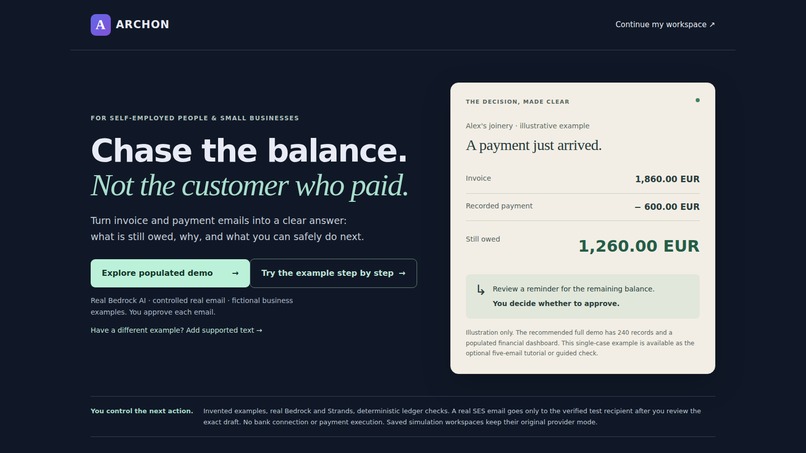
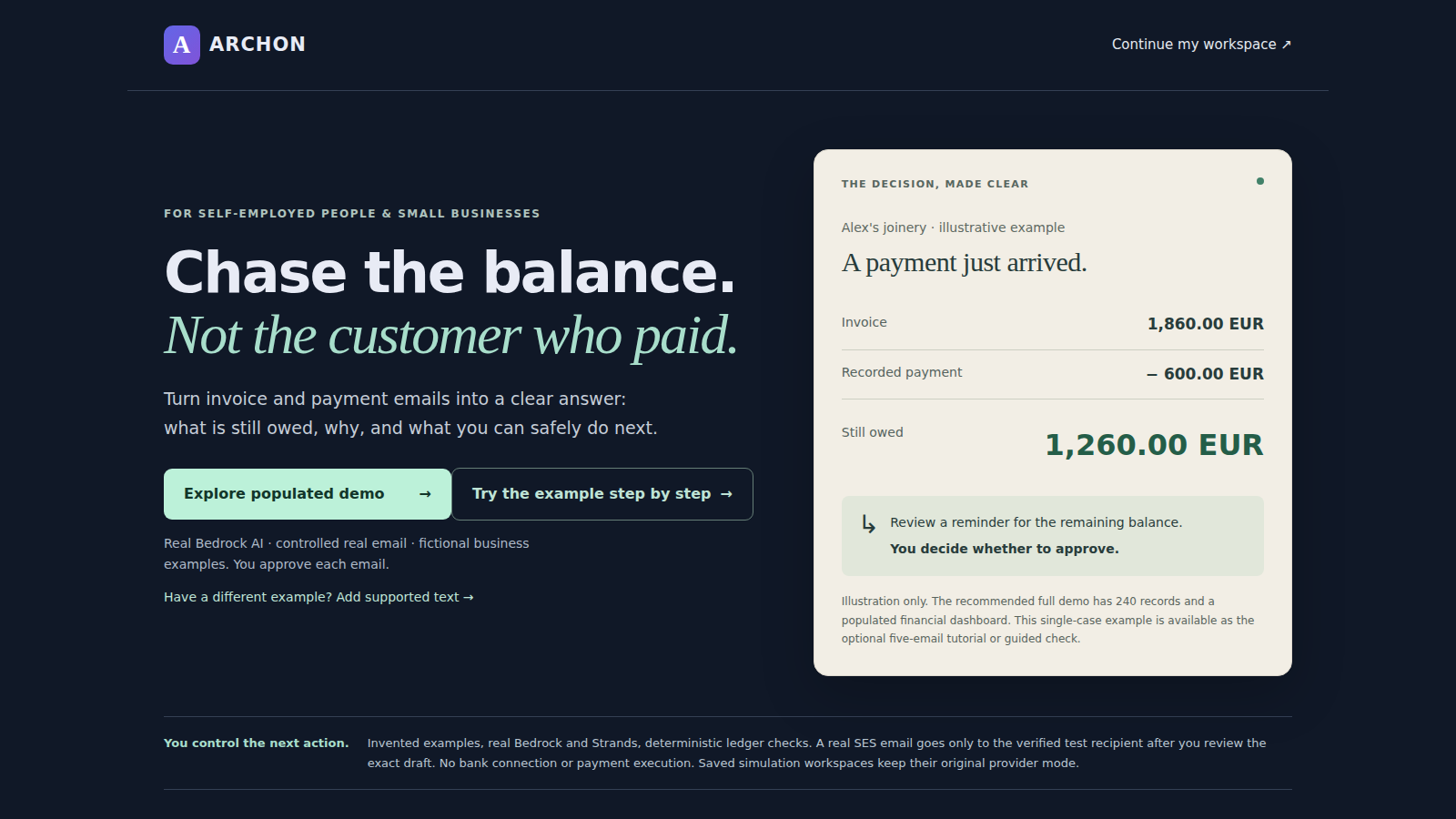
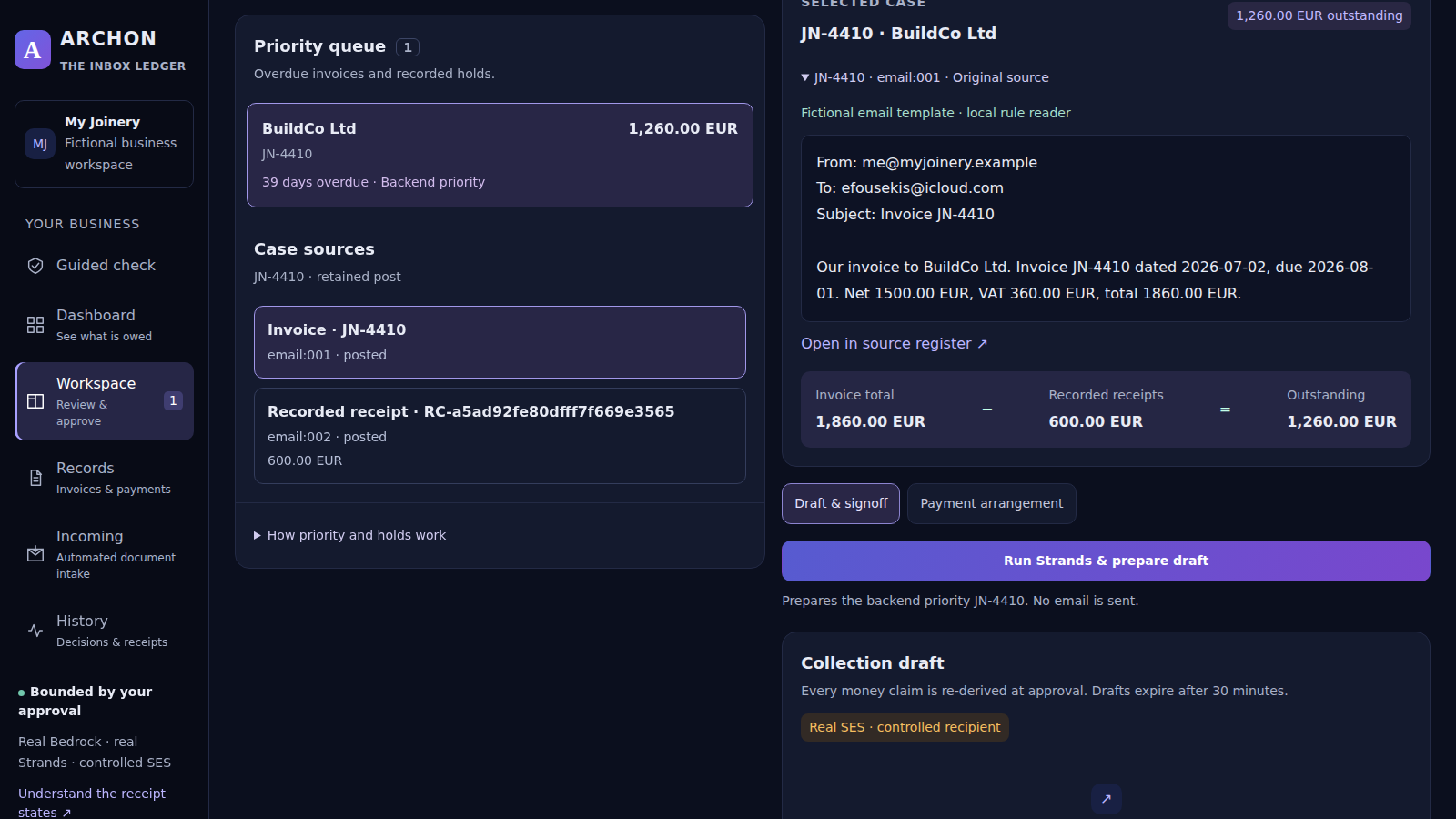
Archon's landing page makes the decision clear: EUR 1,860 invoiced minus EUR 600 recorded leaves EUR 1,260 outstanding.
-
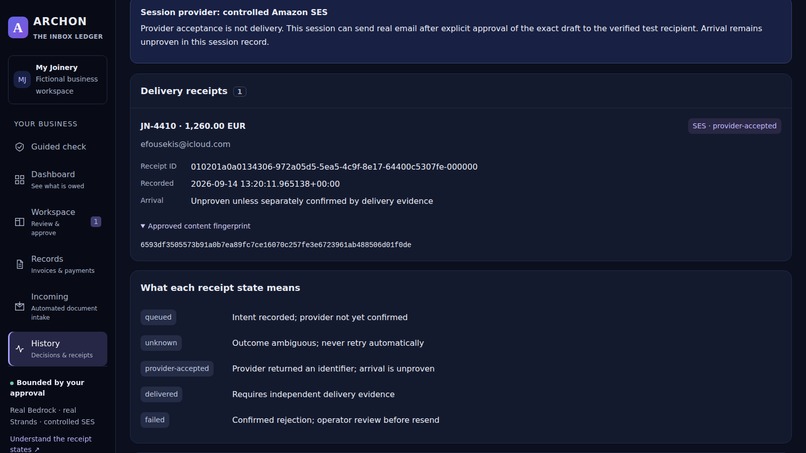
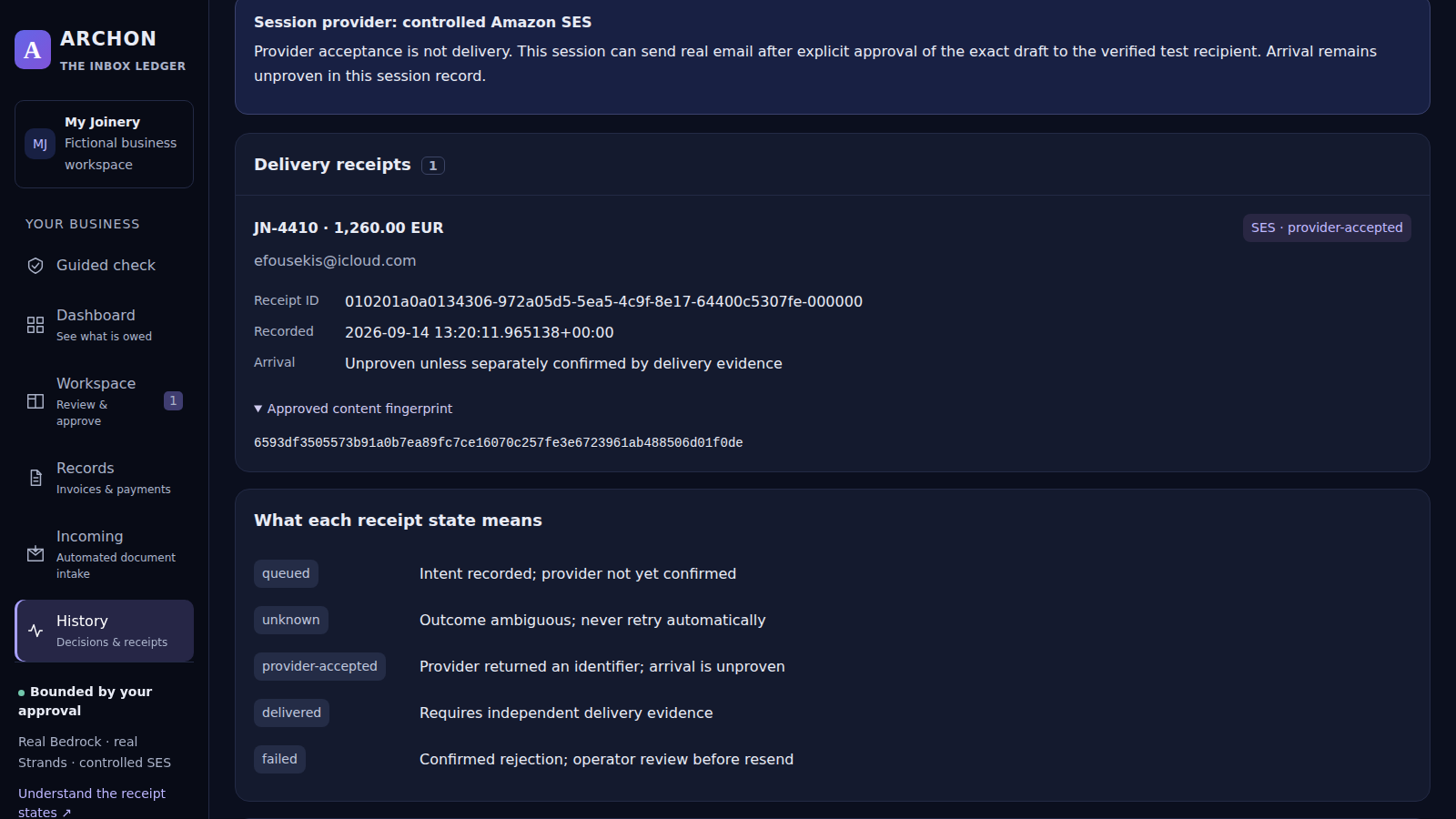
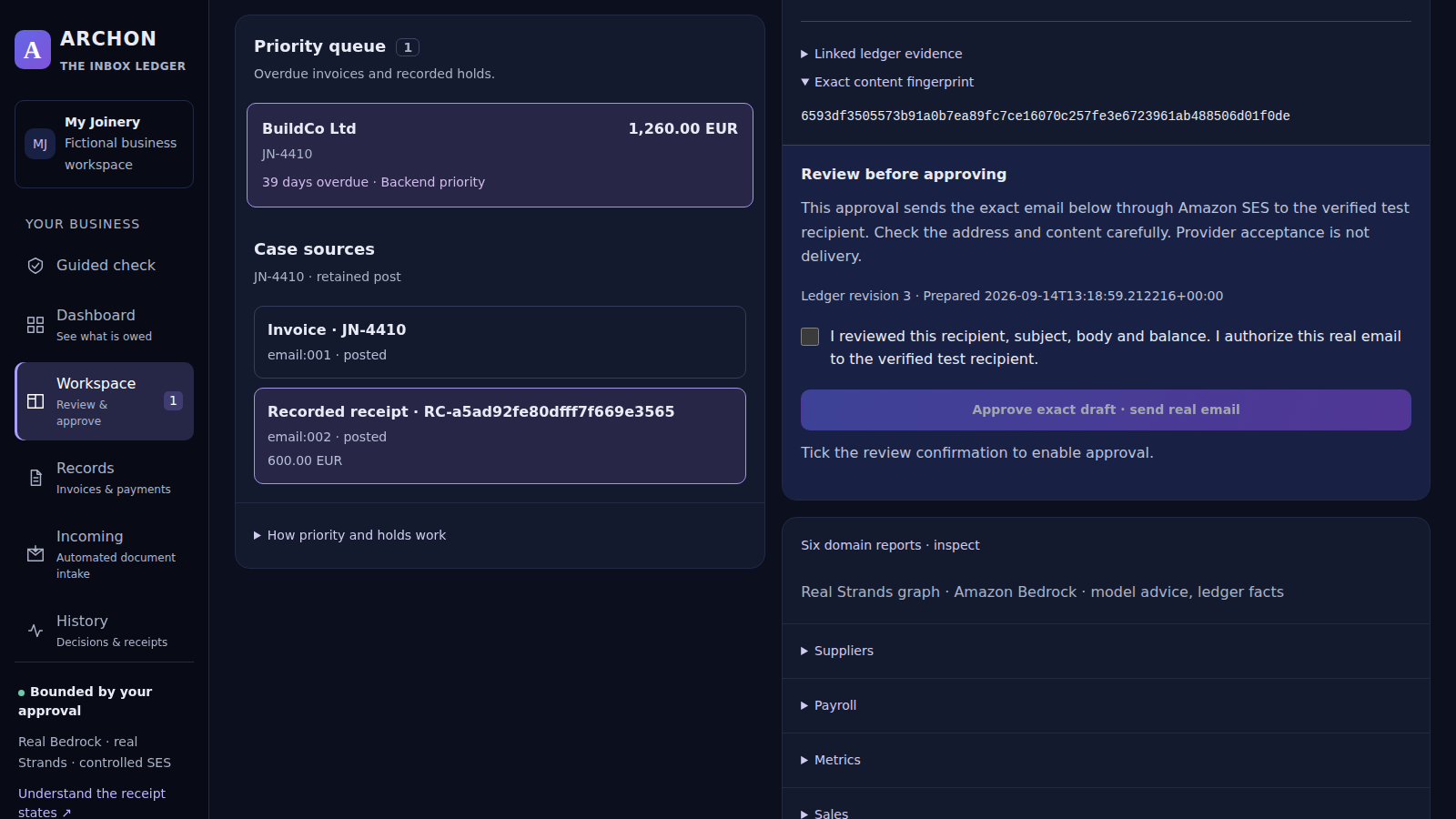
A durable Amazon SES provider-acceptance receipt and approved fingerprint remain available after reload; acceptance is not delivery.
-
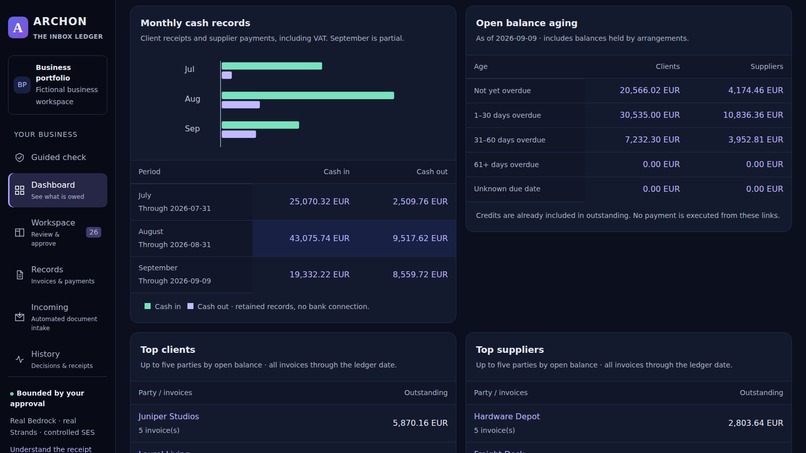
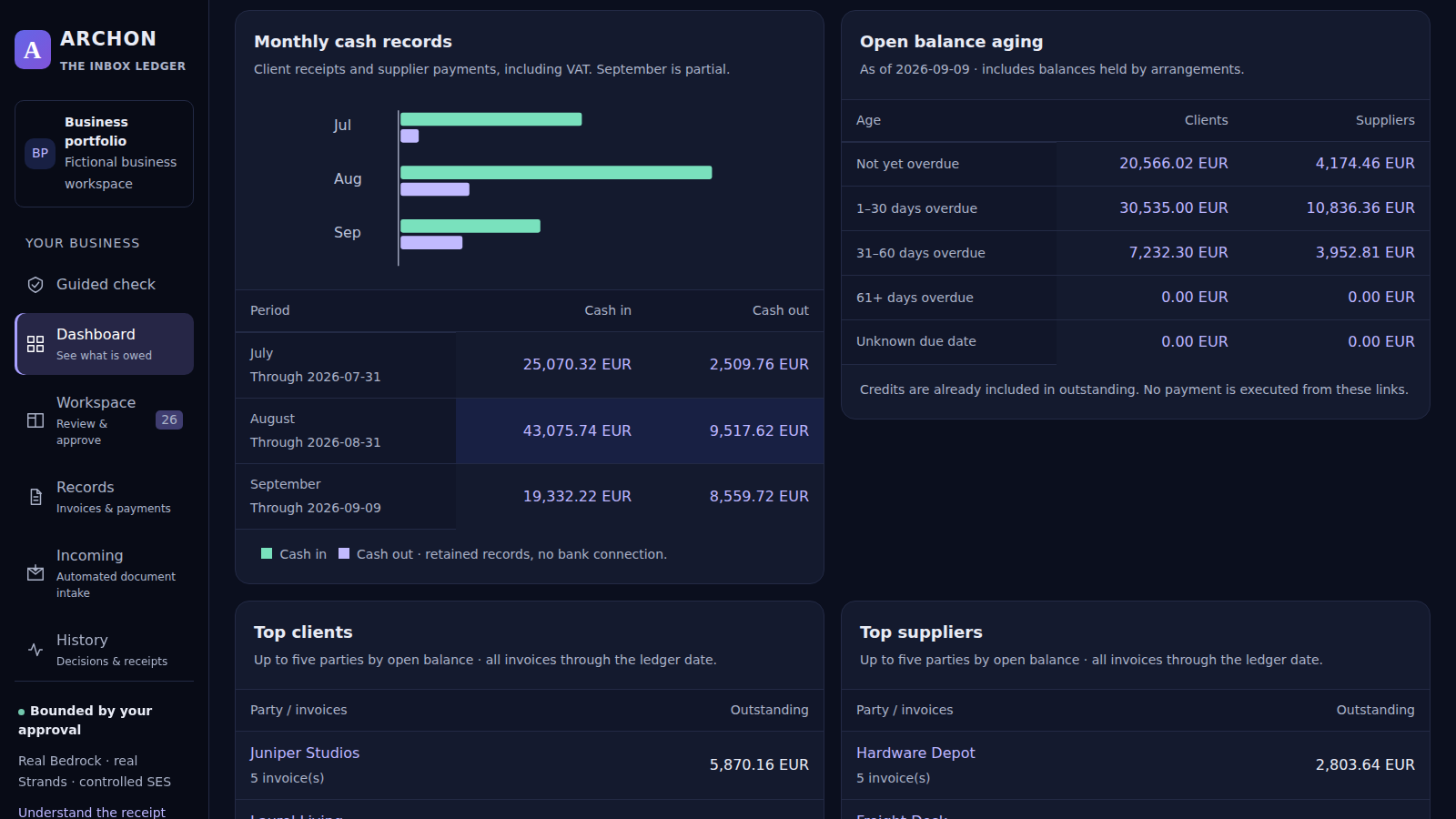
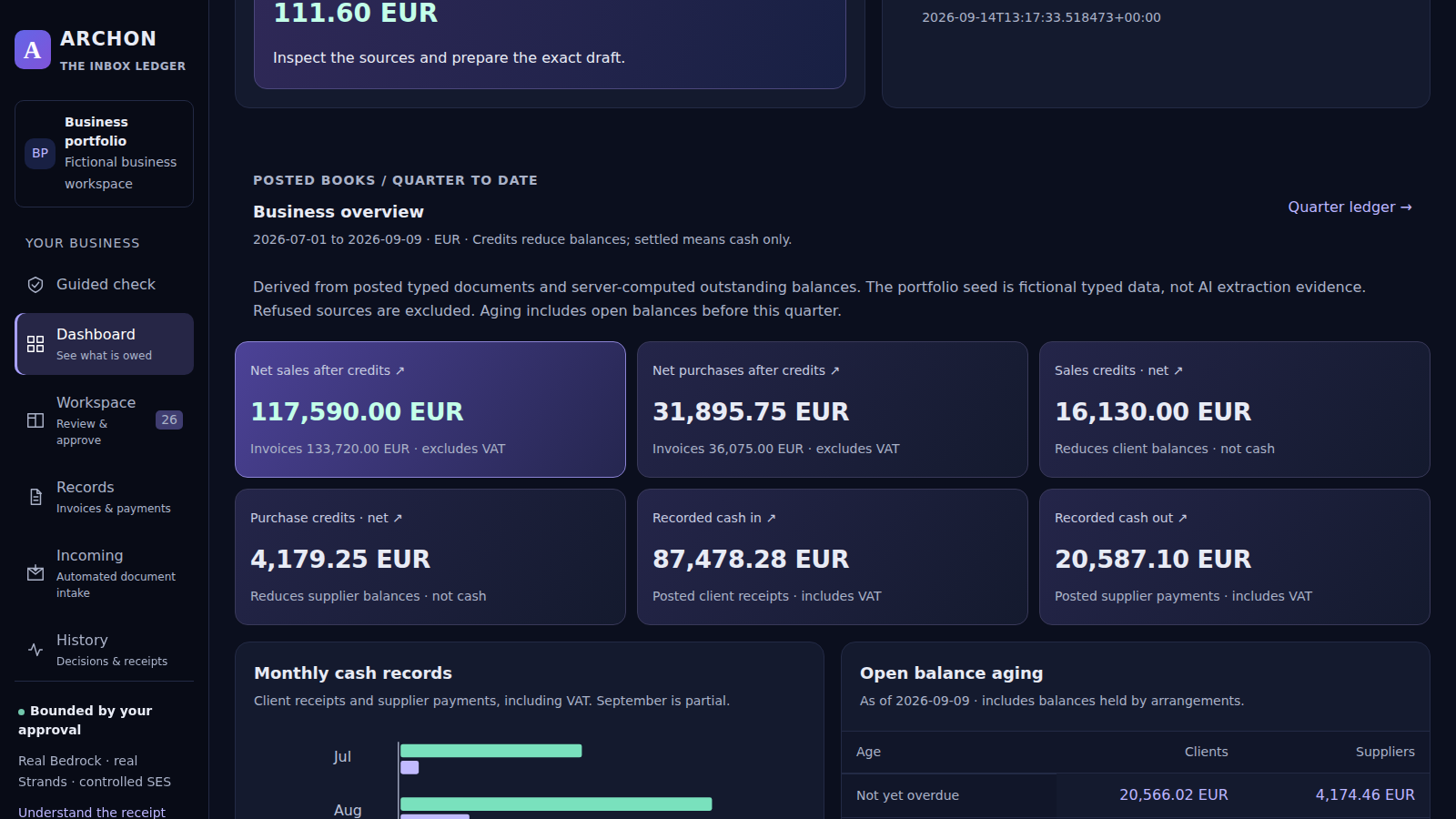
Monthly recorded cash and open-balance aging drill into the 240-record fictional portfolio.
-
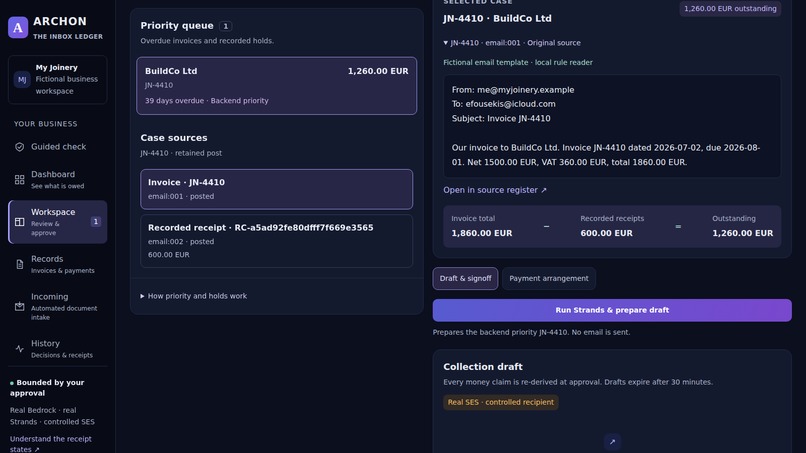
The source-backed equation: EUR 1,860 invoiced minus EUR 600 recorded equals EUR 1,260 outstanding.
-
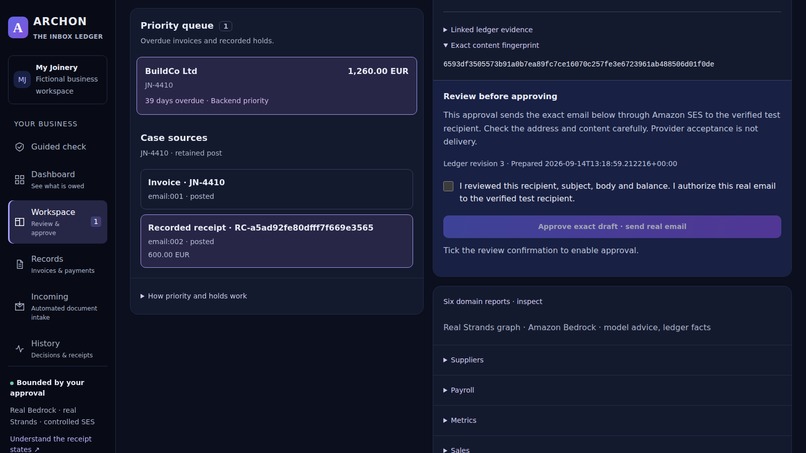
Sending stays disabled until a person reviews the exact recipient, subject, body and balance.
-
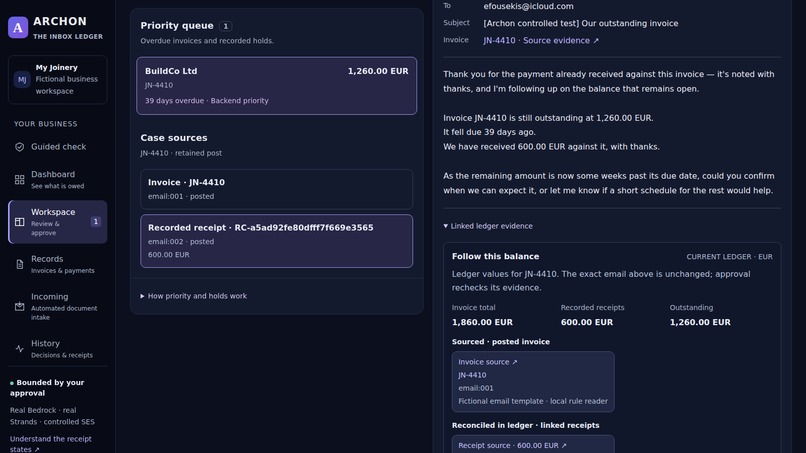
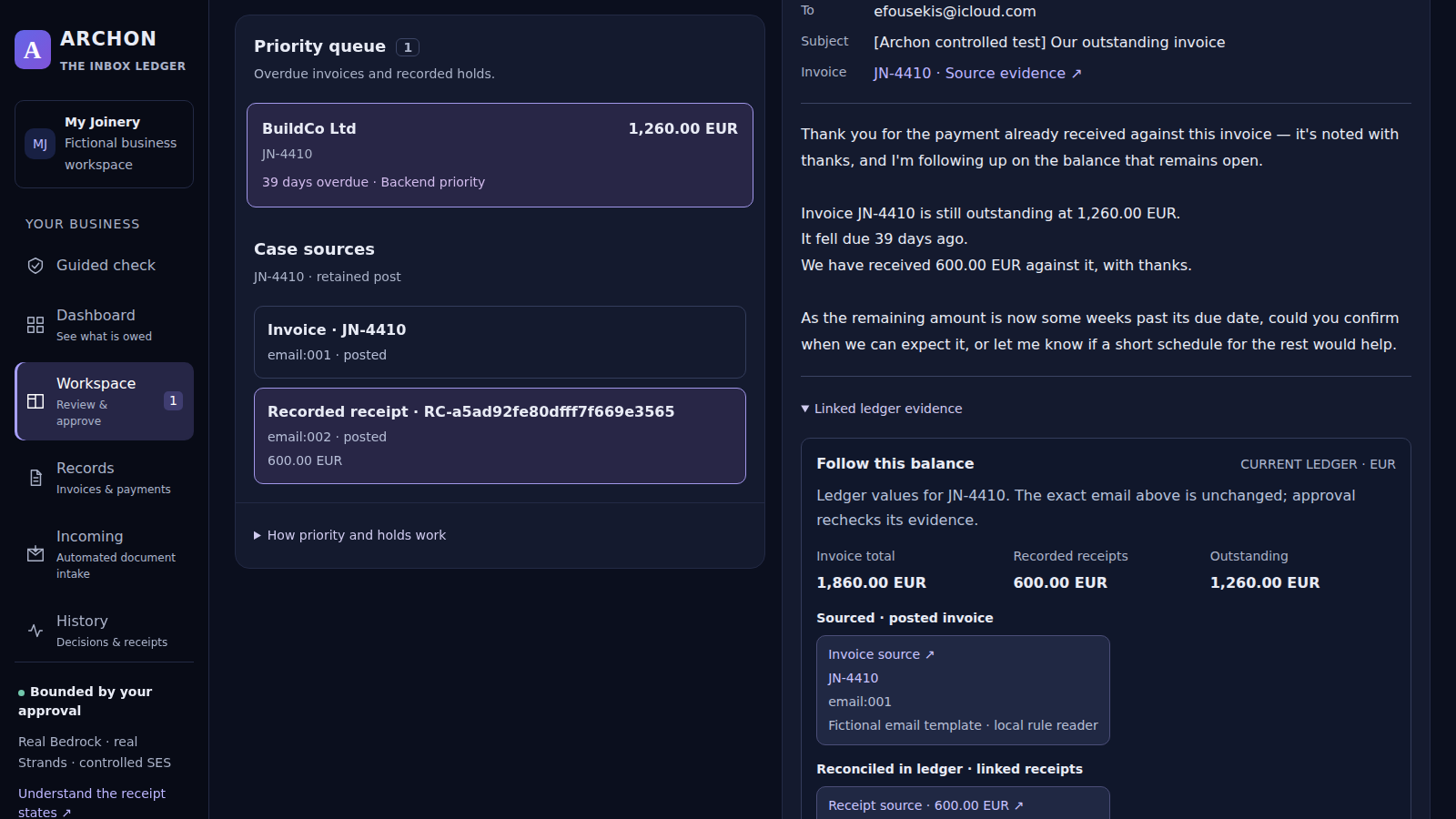
An actual Bedrock-generated collection email with linked ledger evidence for every monetary claim.
-
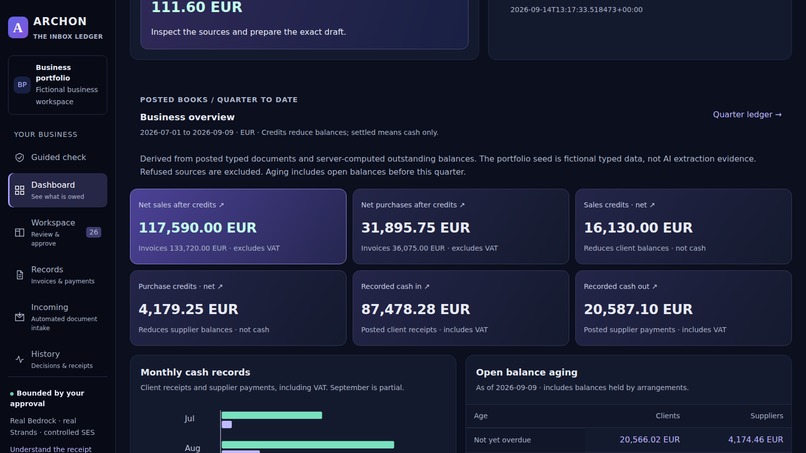
Six financial metrics summarize 240 fictional sales, purchase, credit, receipt and payment records.
-
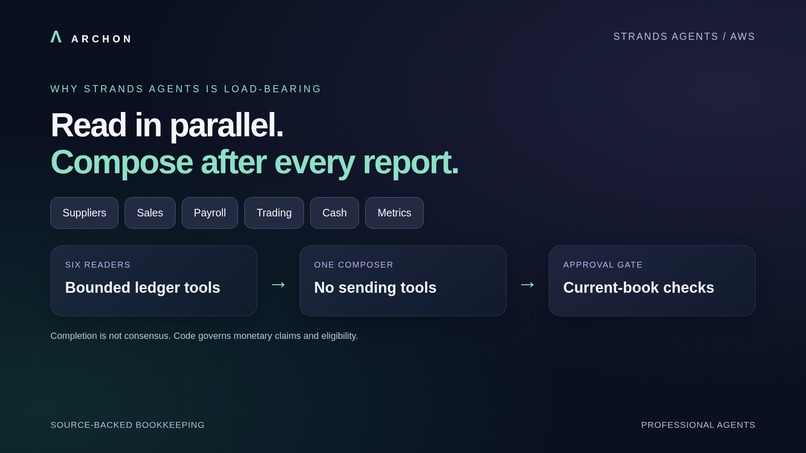
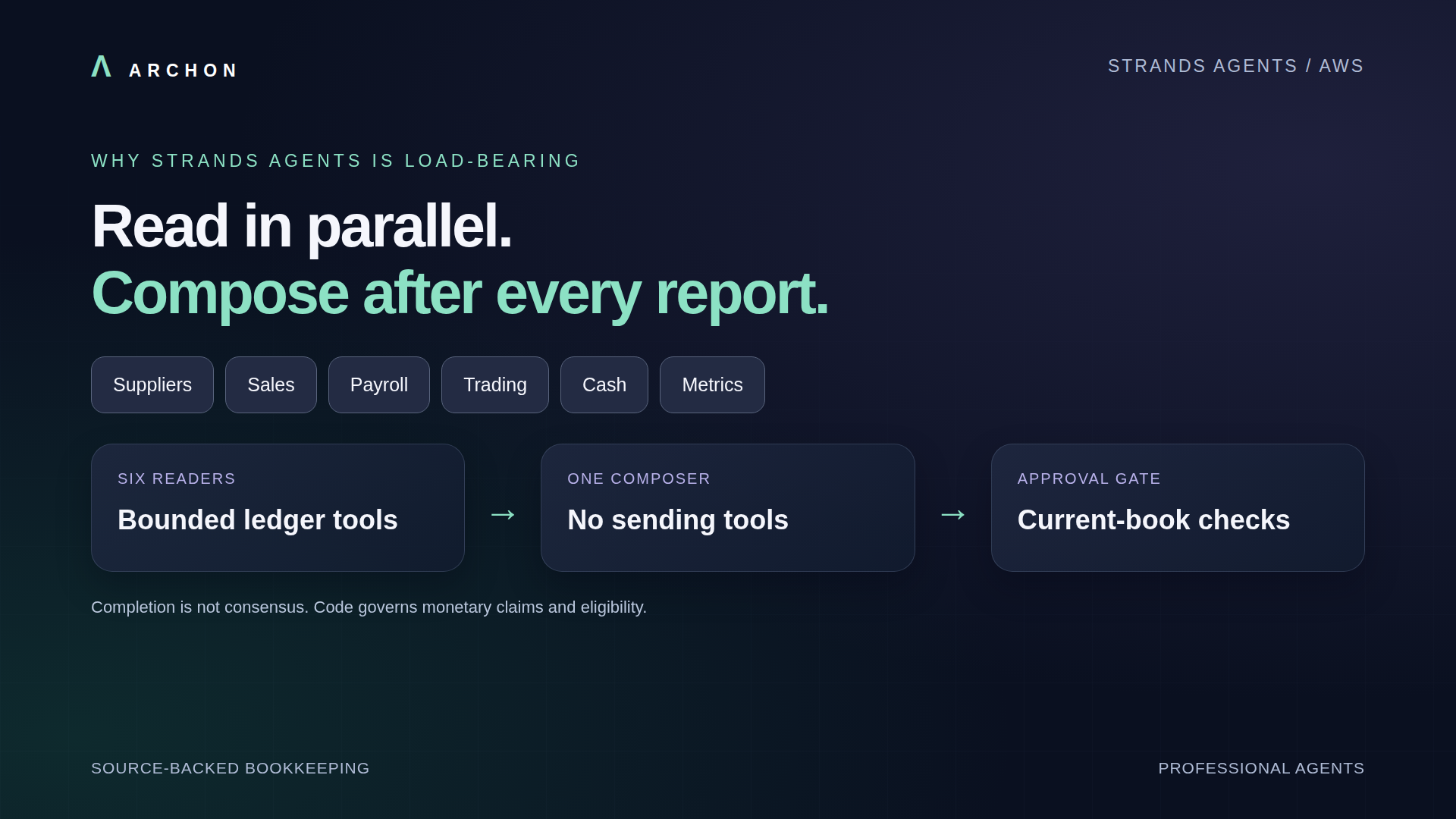
Six Strands readers complete before a tool-less composer runs; ledger checks and human authorization remain separate.
-
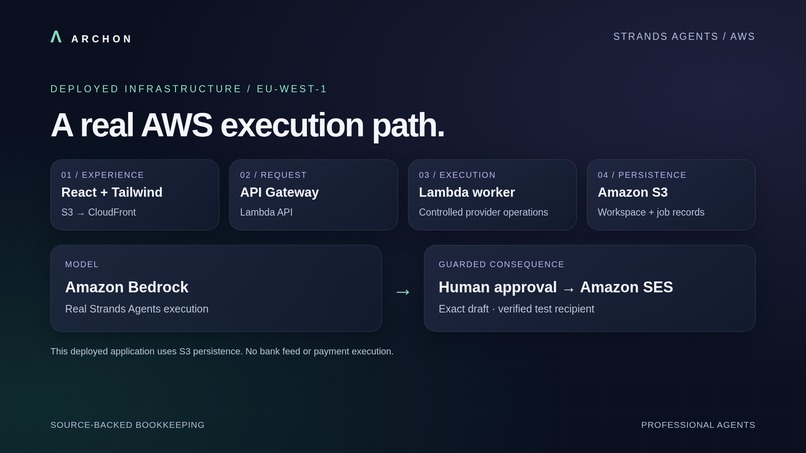
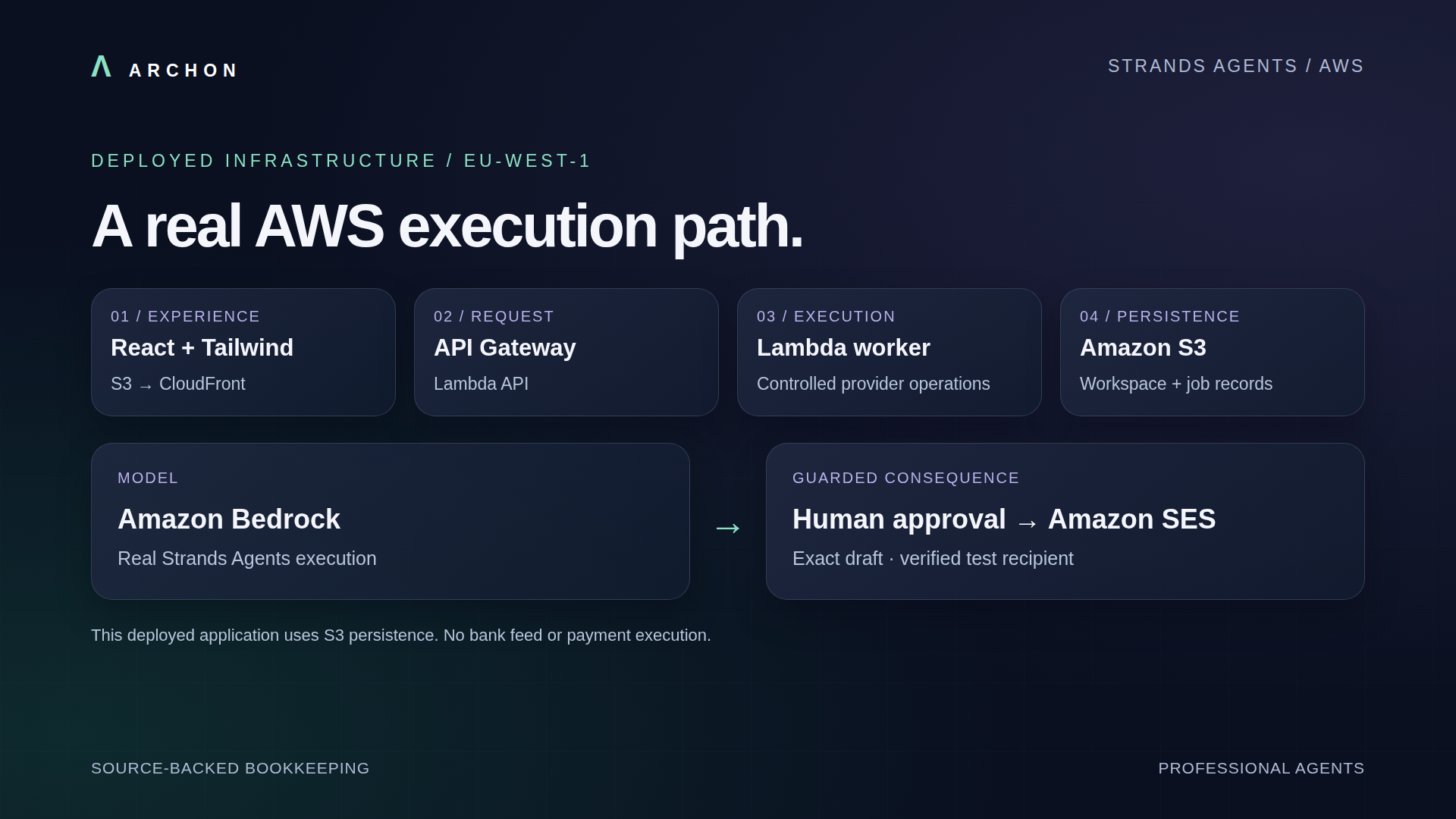
The deployed S3, CloudFront, API Gateway, Lambda, Bedrock and SES path.
-

Editorial artwork: Archon turns invoice and payment evidence into a human-approved collection email, built with Strands Agents on AWS.

Inspiration
A joiner should be building kitchens, not reconstructing a client's balance from an inbox.
An invoice and a payment can arrive in different messages. Chasing the original amount after a partial payment can damage a customer relationship. Archon asks one narrow, consequential question: what is still owed, and what can I safely say about it?
What it does
Archon prevents a partial payment from becoming a false collection demand. It is a working financial operations application for independent joiners: inspect the books, trace every amount to source evidence, run the agent workflow and approve only the exact message supported by the current ledger.
In the flagship walkthrough, fictional invoice JN4410 is €1,860. A recorded €600 payment establishes €1,260 outstanding. If new payment or conflicting evidence arrives after review, Archon discards the old draft and approval. The person must review a newly derived decision; a duplicate transfer holds collection instead of crediting the same payment twice.
The public AWS release also provides a populated financial workspace with 240 fictional records across sales invoices, purchase invoices, both credit-note directions, client receipts and supplier payments. Dashboard totals drill into searchable retained records instead of stopping at decorative widgets.
See it working
- Open the live AWS application and follow the welcome page or six-stop tour.
- Load the business portfolio and drill from dashboard metrics into records and linked movements.
- Switch to the guided collection scenario and inspect the €1,860 invoice and €600 payment.
- Select Run Strands & prepare draft to execute the six-reader Strands graph through Amazon Bedrock.
- Review the recipient, €1,260 balance, linked evidence and exact message before approval.
- Inspect History and reload. The controlled SES provider acceptance and approved fingerprint remain durable.
The 4:51 working video shows this end to end. The accepted release receipt records three controlled provider journeys, 45 Bedrock calls and three restricted SES acceptances.
How we built it
Strands Agents is load-bearing, not a chatbot label. Python Strands Agent instances, scoped @tool readers and GraphBuilder form a six-reader fan-in across suppliers, sales, payroll, trading, cash and metrics. Every reader must complete before a tool-less composer can prepare wording through Amazon Bedrock. Removing Strands prevents draft preparation.
The model interprets context and proposes language; it does not own the money. A deterministic ledger selects the eligible invoice, calculates the outstanding balance and inserts checked figures. Digits in model-authored free text are rejected, malformed structured output releases no draft, and changed evidence invalidates approval.
React, TypeScript and Tailwind run from private Amazon S3 behind CloudFront. API Gateway invokes a Lambda API, while a separately permissioned Lambda worker handles Bedrock and controlled SES. Conditional S3 writes retain workspace, job and outbox state and expose stale conflicts. The API role cannot call Bedrock or SES directly.
The hard engineering boundary
Approval is bound to the exact recipient, subject, body, balance, draft fingerprint, ledger revision and expiry. Pending or uncertain sends are retained for reconciliation and are not blindly retried. This is Archon's return-of-control rule: the agent proposes; the ledger proves; the person authorizes one precise external action.
Why it matters
Archon is not another AI email generator. It helps a sole professional avoid chasing money already paid, preserve the customer relationship and understand exactly why collection is ready or held. The distinctive result is not fluent prose; it is a source-backed decision whose permission expires when the evidence changes.
Evidence boundary and next step
The records are fictional. Controlled-live sessions use real Amazon Bedrock, Strands Agents and SES restricted to the configured test recipient; retained simulation is separately labelled and never sends. SES acceptance is not proof of delivery. Archon does not execute payments, verify bank settlement, provide legal advice or claim independently measured recovery.
Next steps are broader document evaluation and carefully scoped intake integrations while preserving the same evidence and approval boundary. Source and MIT license · Architecture · Evaluation
Built With
- amazon-bedrock
- amazon-ses
- amazon-web-services
- aws-lambda
- python
- react
- strands-agents
- tailwind-css
- typescript

Log in or sign up for Devpost to join the conversation.