-
-
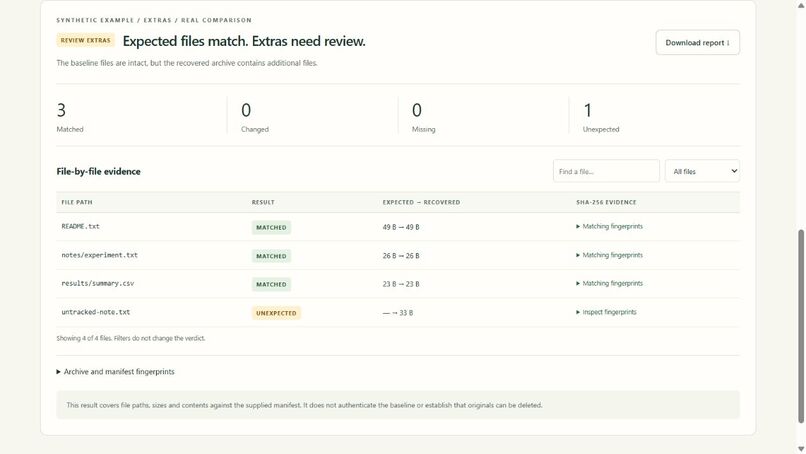
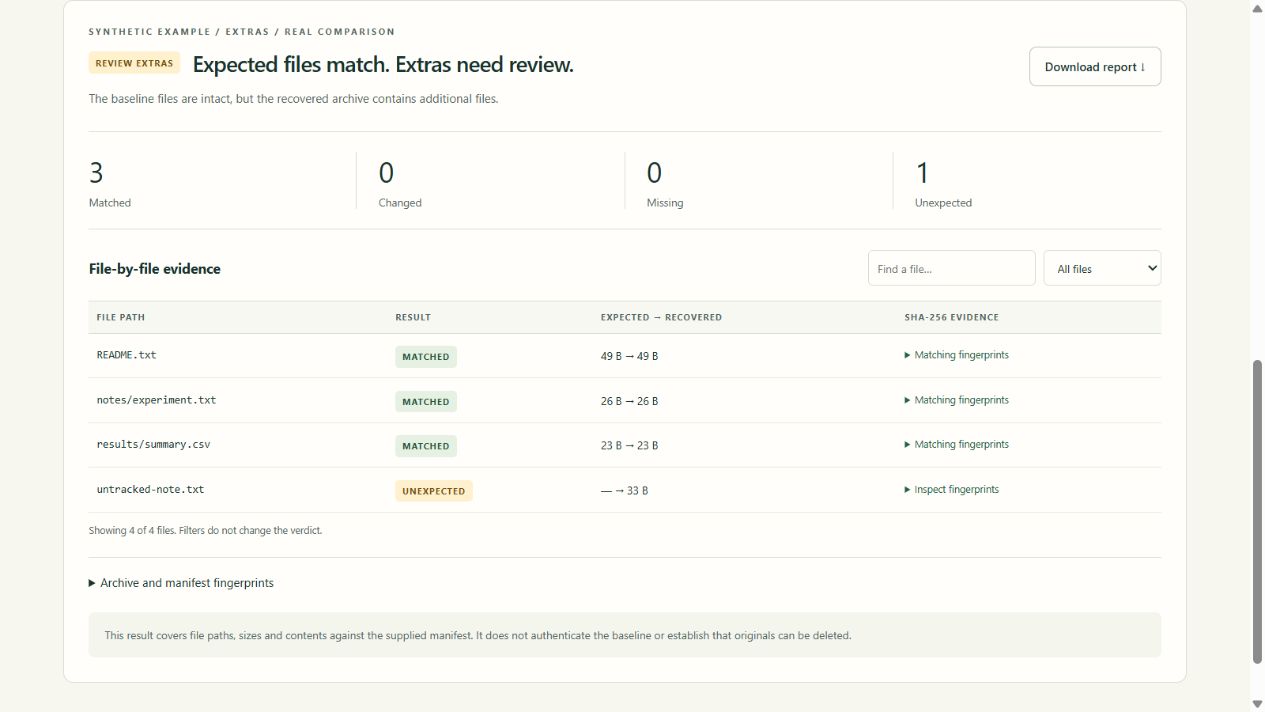
Synthetic extra-file copy: matching expected files cannot hide an unexpected addition.
-
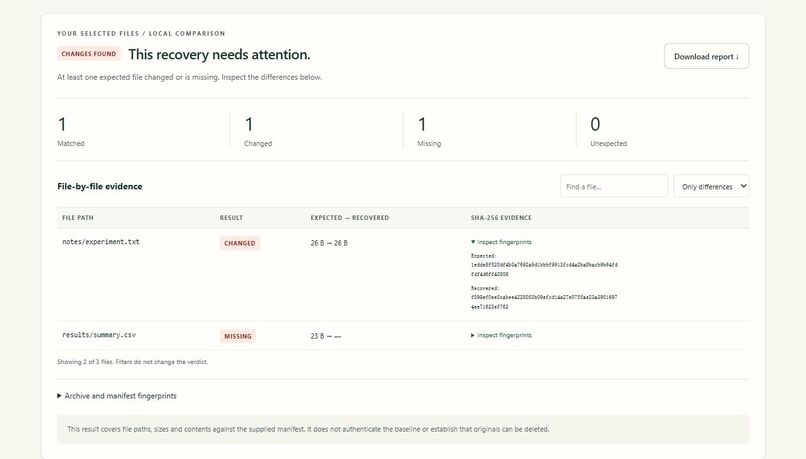
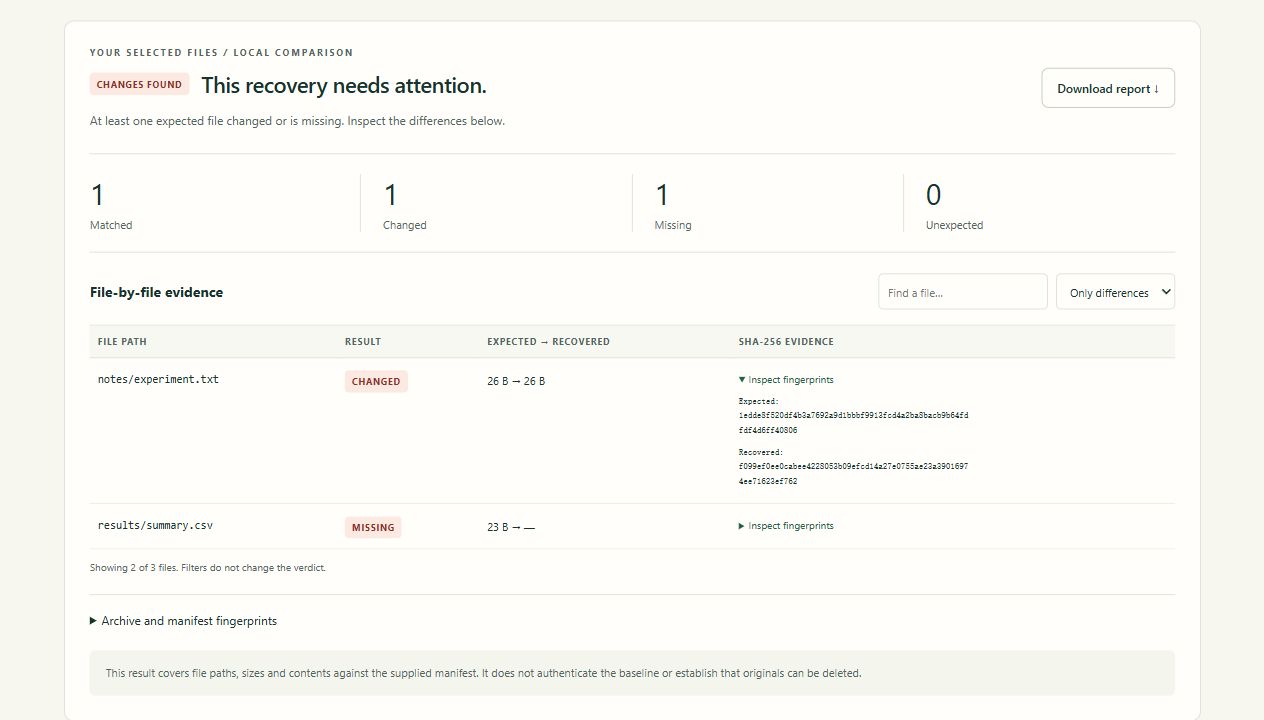
Synthetic damaged copy: one file changed without changing size, and one file is missing.
-
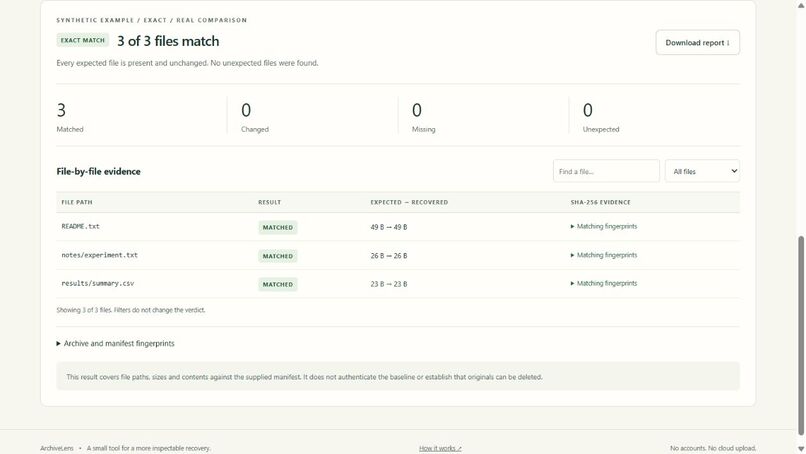
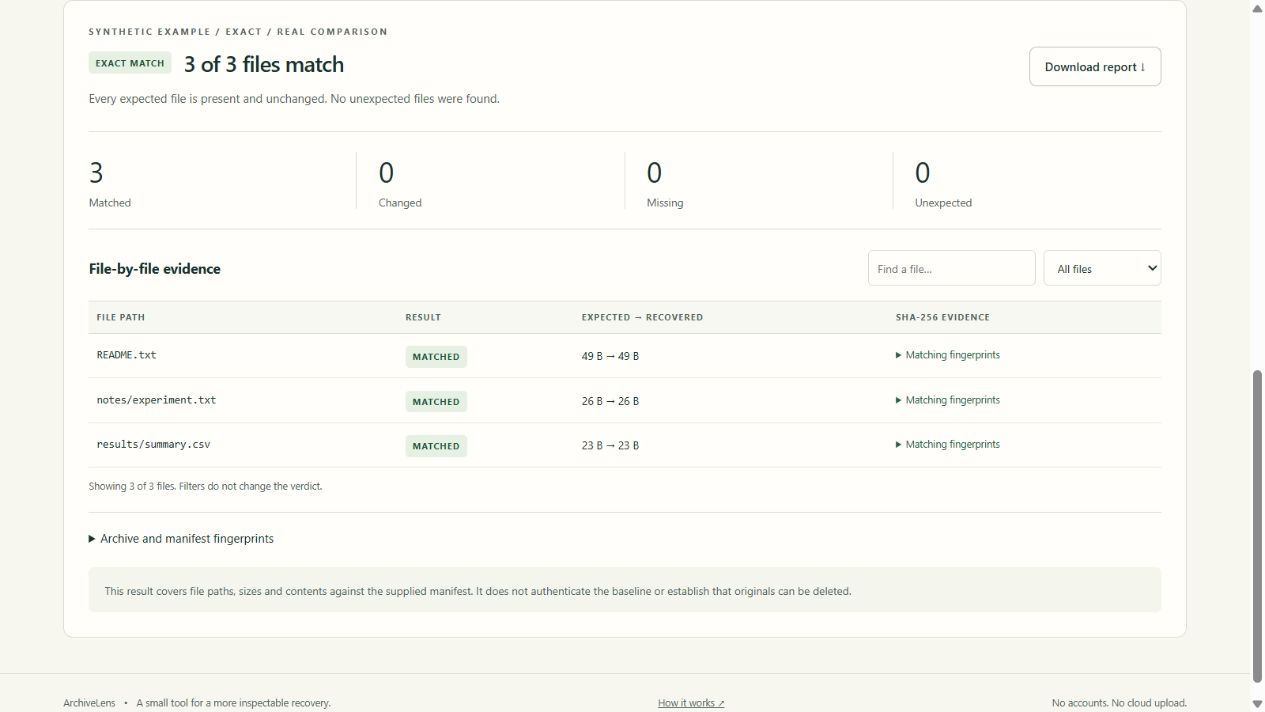
Synthetic exact copy: all three expected files match; no unexpected files.
-
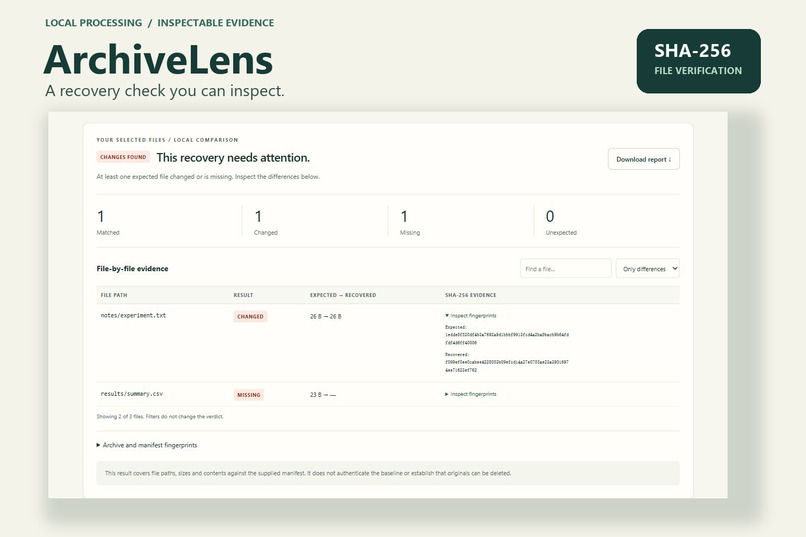
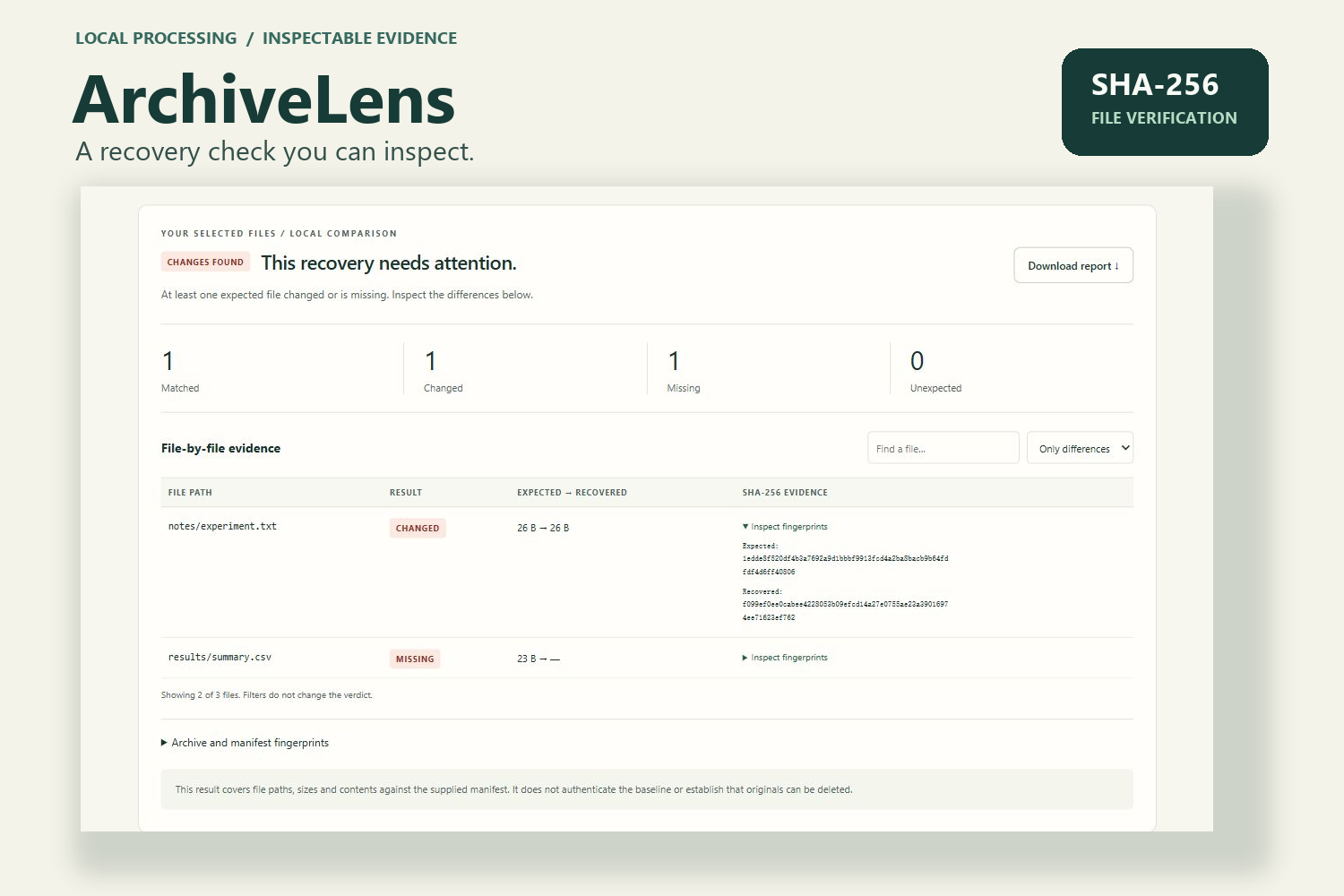
ArchiveLens: a local recovery check with inspectable SHA-256 evidence.
Inspiration
People who archive research or competition projects need more than a ZIP that opens. They need to know whether the expected files came back unchanged. ArchiveLens grew from the entrant's practical request for recoverable project archiving.
What it does
Create a manifest from a known-good original ZIP and keep it independently. Later, choose that manifest and a recovered ZIP. ArchiveLens compares every file's relative path, byte count and SHA-256, then separates four outcomes: exact match, changed or missing files, unexpected extras that need review, and blocked invalid input. A searchable table exposes the evidence; a JSON download preserves the result and fingerprints.
The demo uses three synthetic archives and the actual comparison engine. A same-size content mutation is detected, a missing file is identified, and an extra file prevents an exact-match verdict. A repacked ZIP can correctly pass its file-level comparison while reporting different container bytes.
How it was built
ArchiveLens is a new project created on October 13, 2026. Python's standard library handles bounded ZIP reads, hashing and a loopback-only server. Plain HTML, CSS and JavaScript provide the workbench. There are no runtime AI calls, cloud credentials, third-party UI packages or copied application code from earlier competition projects. The repository contains runnable source, synthetic fixtures, tests and the scope, PRD, spec, checklist and app map.
Engineering challenges and verification
The main challenge was preventing a reassuring but false success: file-size checks miss same-length changes, and matching expected files must not hide extras. Tests also cover malformed manifests, ZIP corruption, duplicate and colliding paths, links, resource limits, local-request boundaries and non-overwriting report creation. All 22 automated checks passed. Agent-operated browser checks exercised real file selection, manifest download and reload, verification, filtering, report export, invalid input, reset and narrow layout.
AI and learning-workflow disclosure
The entrant delegated completion to a Codex AI agent. The agent selected the detailed design and generated the planning documents, implementation, tests, this description and demo narration. The Devpost Learn Skill Pack at commit a0f065781873e8a7ed9a9a705a8dafa6a0810439 was read and used as the planning and verification structure. Its learner interview, individual sign-offs, hands-on checkpoints and human-written-copy workflow were adapted to the entrant's explicit delegation. Planning documents retain draft status; this is not a claim that the standard learner-led workflow was completed. No human hands-on testing, personal learning reflection or learning outcome is claimed. The repository documents this openly in AI_DISCLOSURE.md. The video combines actual local-app screen captures with synthetic narration and edited pacing.
Limits and next steps
This proof of concept compares contents against the supplied baseline. It does not authenticate that baseline, check continuing cloud availability, scan for malware, or prove that originals can be deleted. It never extracts or deletes files. ZIP processing is bounded to 64 MiB compressed, 128 MiB expanded, 32 MiB per member and 1,000 entries. Future work could add signed manifests and streaming for larger archives after further testing and user feedback.

Log in or sign up for Devpost to join the conversation.