-
-
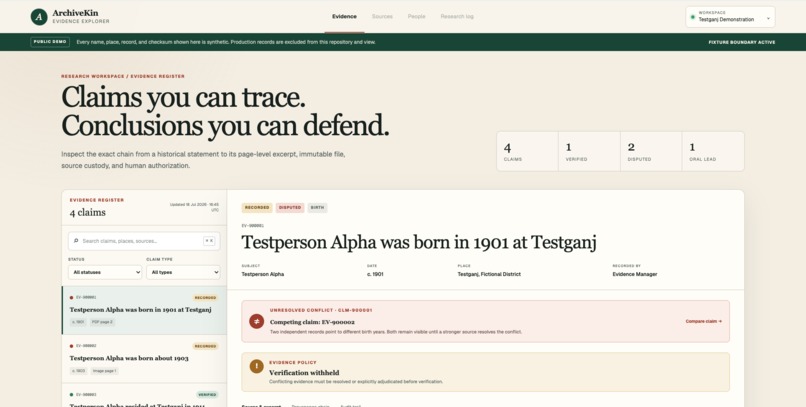
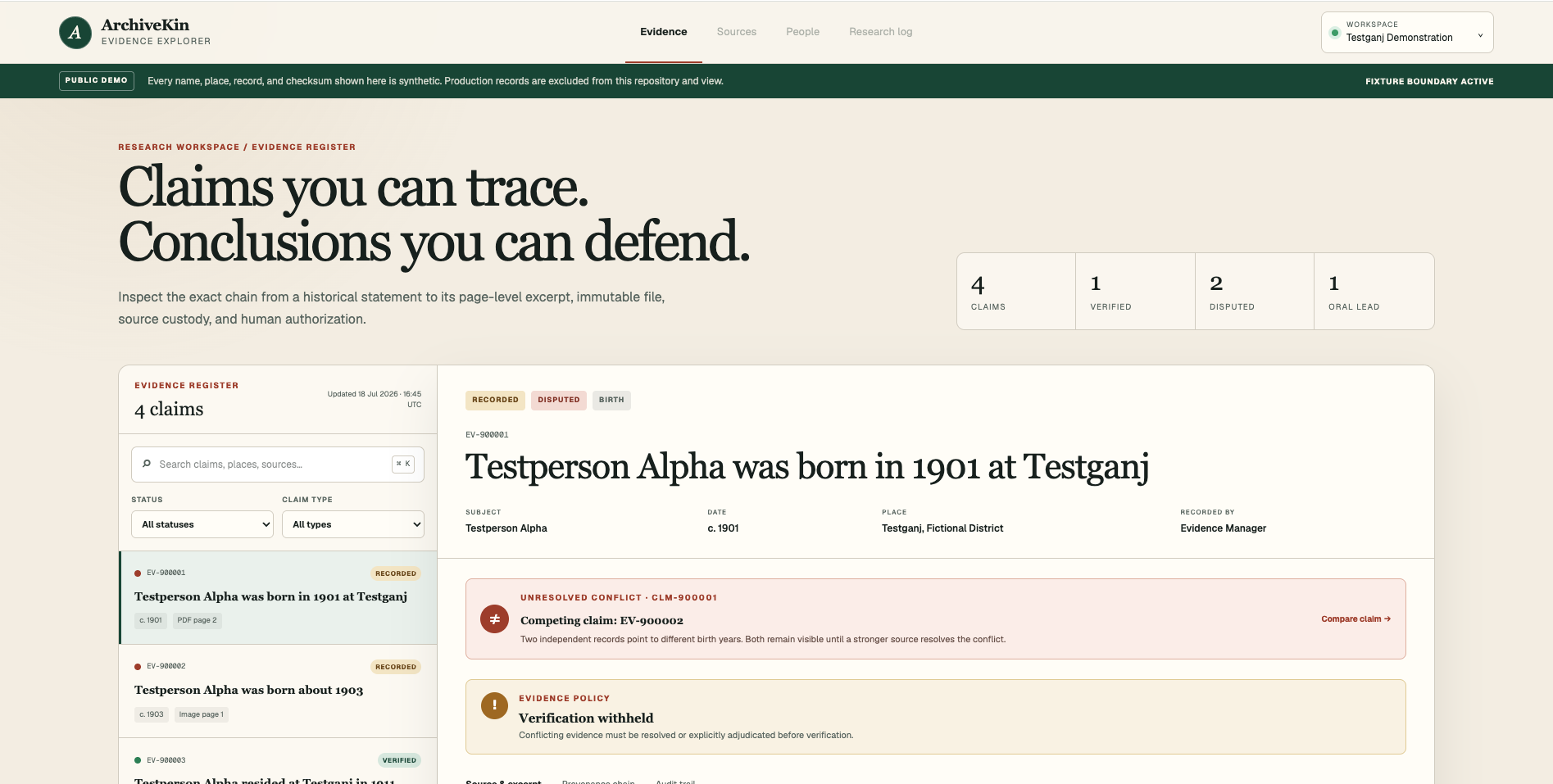
ArchiveKin Evidence Explorer trace every genealogy claim through its citation,immutable source file,confidence rating,verification decision.
# ArchiveKin

> **An AI-powered genealogy research operating system that discovers, verifies, and connects family history through archival evidence, precise citations, and complete provenance.**

## Inspiration

ArchiveKin began with a personal question:

**How can I research my family history with AI without allowing AI to turn uncertainty into fact?**

Family history is often scattered across oral accounts, aging documents, government records, newspapers, gazetteers, municipal archives, and handwritten material in multiple languages. Traditional genealogy software is useful for displaying a family tree, but it often stores conclusions without preserving the complete research process behind them.

Generative AI makes searching and interpreting archives faster, but it introduces a serious risk: a plausible answer can sound authoritative even when it has no documentary support. A person with the same surname, occupation, or hometown can easily be mistaken for an ancestor.

I started with the Pardeshi family of Sangamner, Maharashtra, as ArchiveKin’s first real-world case study. However, ArchiveKin is designed as a general research platform that can be used for any family, geographic region, language, or archival collection.

The core principle is simple:

> **No historical claim should become a genealogical fact unless it can be traced back to documentary evidence.**

## What ArchiveKin Does

ArchiveKin is not simply an AI family-tree generator. It is an **evidence-first research operating system**.

A Research Orchestrator coordinates specialized agents responsible for:

- Archival source discovery and acquisition
- Document cataloging
- PDF text extraction and OCR
- Marathi and regional-script transcription
- Historical place-name research
- Municipal and government-record research
- Genealogical reasoning and contradiction detection
- Evidence management and verification

Every substantive finding must include:

- The original source
- Repository and retrieval provenance
- Document and derivative checksums
- Exact PDF image or page reference
- Printed-page label when reliably established
- Supporting transcription or excerpt
- Confidence and uncertainty
- Verification status
- A complete audit trail

Oral family history is preserved, but it remains explicitly labeled as oral history until documentary evidence corroborates it. Search snippets, filenames, repository metadata, and same-surname matches are treated as leads—not proof.

## How I Built It

ArchiveKin uses a repository-centered architecture so that the research history exists independently of any single AI conversation.

The system maintains:

- Immutable original documents
- SHA-256 checksums
- Source and evidence catalogs
- Page-level extracted text
- OCR derivatives
- PDF-image-to-printed-page mappings
- Structured citations
- Research questions and search logs
- Agent handoffs
- Confidence and verification decisions
- Negative findings and unresolved conflicts

Each agent has a bounded role. For example, the Document Researcher controls source-catalog records, while the Evidence Manager controls evidence and person records. The Research Orchestrator may authorize verification but cannot directly edit authoritative evidence records.

Development also uses a two-model review process. An implementation agent performs repository work, while OpenAI Codex acts as an independent reviewer of architecture, permissions, evidence policy, provenance, and audit results. This separation has repeatedly caught inconsistencies before they could become accepted research data.

## The First Archival Pilot

For the initial pipeline test, ArchiveKin acquired ten freely accessible British-era government gazetteer PDFs relevant to the Bombay Presidency and the Ahmednagar region.

One 764-page volume was selected as an end-to-end canary test:

- 752 pages used embedded-text extraction.
- 12 pages required Tesseract OCR.
- Every page received a stable PDF-image reference.
- Raw text and OCR derivatives were preserved separately.
- The original PDF remained unchanged.
- Four representative, page-cited evidence records were created.
- No person or family relationship was inferred.
- None of the four findings was marked verified because they still depended on a single historical source.

For ArchiveKin, refusing to verify those claims was a successful result: the review gate worked as designed.

## Challenges

### OCR Is Not Evidence

OCR can confuse names, digits, and historical typography. One population figure produced conflicting readings, demonstrating that preserving the source image, embedded text, OCR output, and reviewed transcription separately is essential.

### PDF Pages Are Not Printed Pages

Scanned books frequently contain covers, bookplates, blank pages, foldouts, and unnumbered front matter. ArchiveKin therefore distinguishes the PDF page index from the printed page label and never invents a printed-page number when mapping confidence is low.

### Identity Resolution Is Difficult

A shared surname or location does not establish a family relationship. ArchiveKin records competing candidates, rejection reasons, and unresolved identity questions instead of selecting the most plausible person.

### Corroboration Requires Independence

Two digital copies or repeated passages from the same publication are not two independent sources. ArchiveKin must track shared provenance, editions, derivatives, and copied material before treating evidence as corroboration.

### Agent Permissions Require Careful Boundaries

AI tool permissions are often broader than file-level research roles. ArchiveKin combines least-privilege tools, single-writer ownership, serialized database updates, validation checks, and audit logs to reduce this risk.

### Long-Running Research Can Exceed Model Limits

Archival research may span thousands of pages and many agent tasks. I am developing provider-neutral checkpoints so bounded work can be safely resumed by OpenAI Codex without relying on another model’s hidden conversation state.

## What I Learned

The most important lesson was that genealogy is not primarily a search problem—it is a **provenance and identity-resolution problem**.

I also learned that:

- Confidence and verification are different concepts.
- Negative search results are valuable research outputs.
- An AI agent stopping at an unresolved ambiguity is a feature, not a failure.
- Every normalized claim must remain connected to the source’s exact wording.
- Historical claims require temporal and geographic scope.
- Specialized agents are only reliable when their handoff contracts and authority boundaries are explicit.
- Reproducibility requires recording tools, versions, settings, checksums, and failures—not only successful conclusions.

## What Comes Next

The next milestones are to process the remaining pilot documents, expand multilingual archival support, develop privacy controls for living people, and make the agent framework portable across AI providers.

Timeline and knowledge-graph capabilities will be added only after the evidence database and verification workflow are stable. The family tree should be a projection of verified evidence—not the place where unsupported assumptions become permanent.

ArchiveKin’s long-term goal is to make rigorous genealogy accessible to anyone:

> **Build your family history on evidence, not guesses.**
Built With
- claude
- codex
- gpt5.6sol

Log in or sign up for Devpost to join the conversation.