Inspiration
After decades of selecting and presenting work for clients including Nike, Adidas, Mercedes-Benz, IKEA, UNICEF, and FAO, I kept encountering the same problem: the most relevant case study is not always the most persuasive one.
Experienced creative leaders do not choose precedents only because the sector, market, or format matches. They remember why past work mattered, what kind of risk it overcame, and which story will give a particular client confidence. That professional narrative judgment is usually locked inside a few people’s heads — in creative agencies, consultancies, law firms, and other expertise-driven businesses with deep archives.
Archive to Argument explores how AI can make that judgment inspectable, contestable, and reusable without pretending to replace the expert who ultimately decides what counts as evidence.
What it does
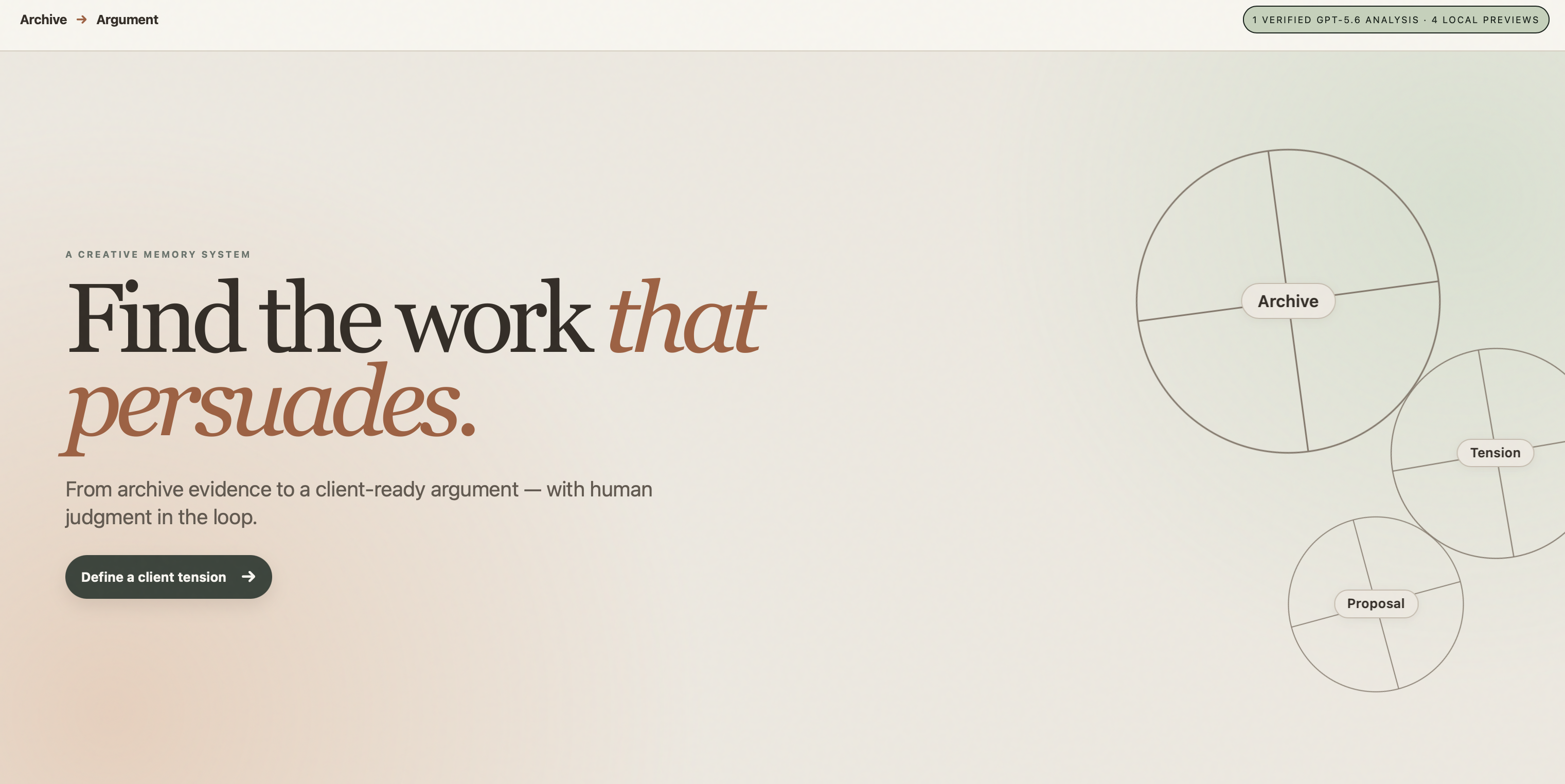
Archive to Argument turns a project archive into a traceable persuasion workflow.
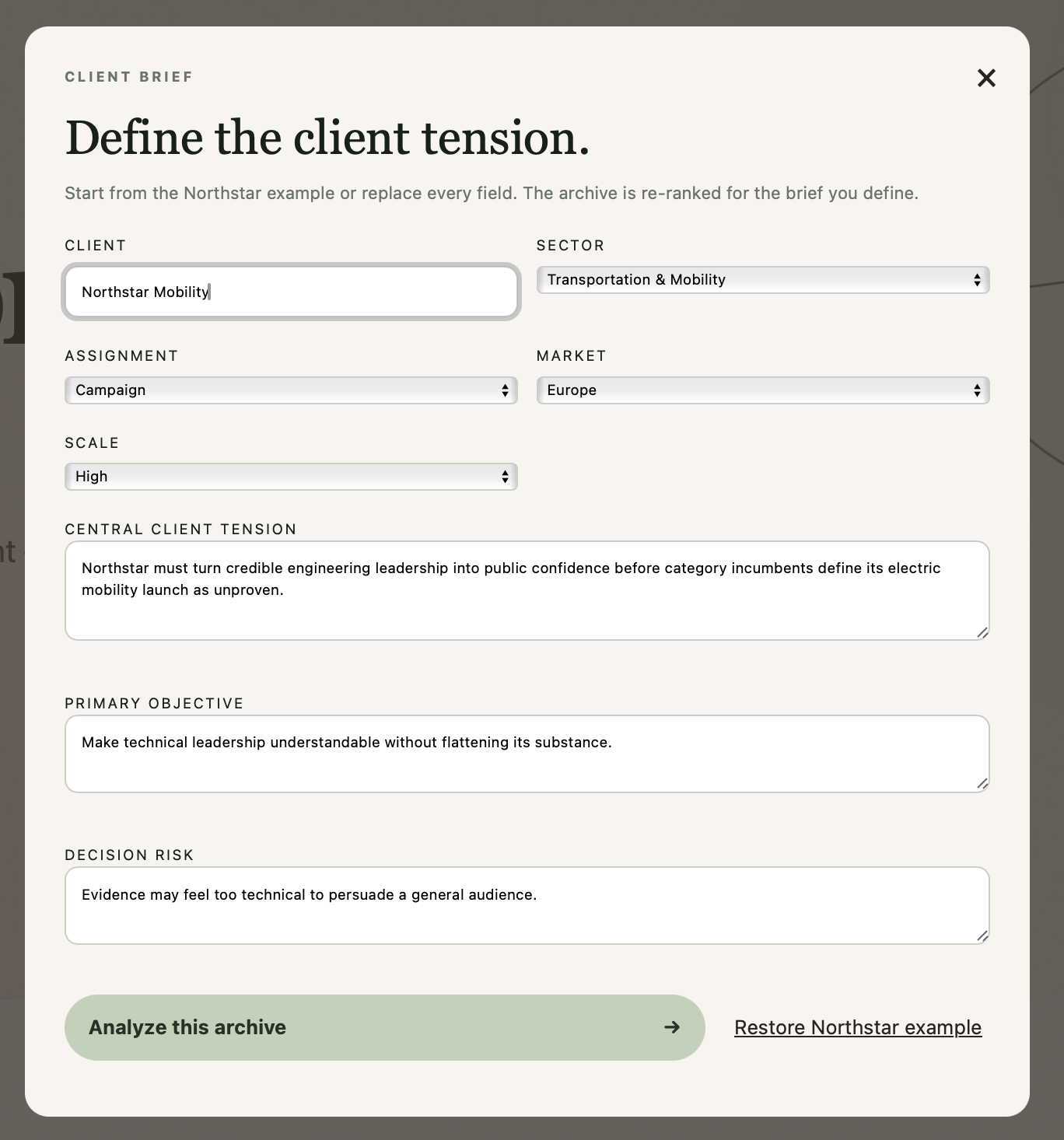
- It converts a client brief into a visible central tension and a set of decision risks.
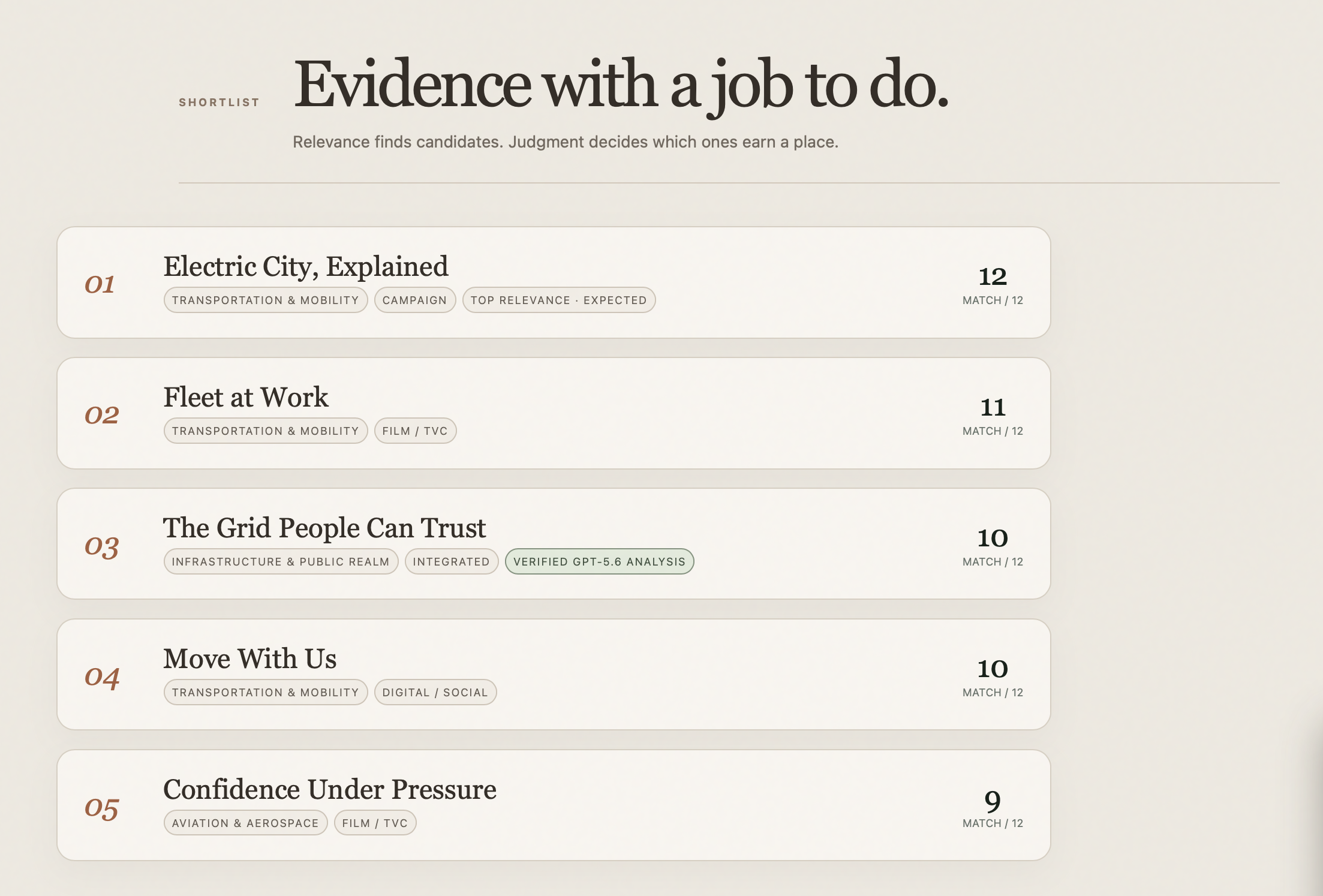
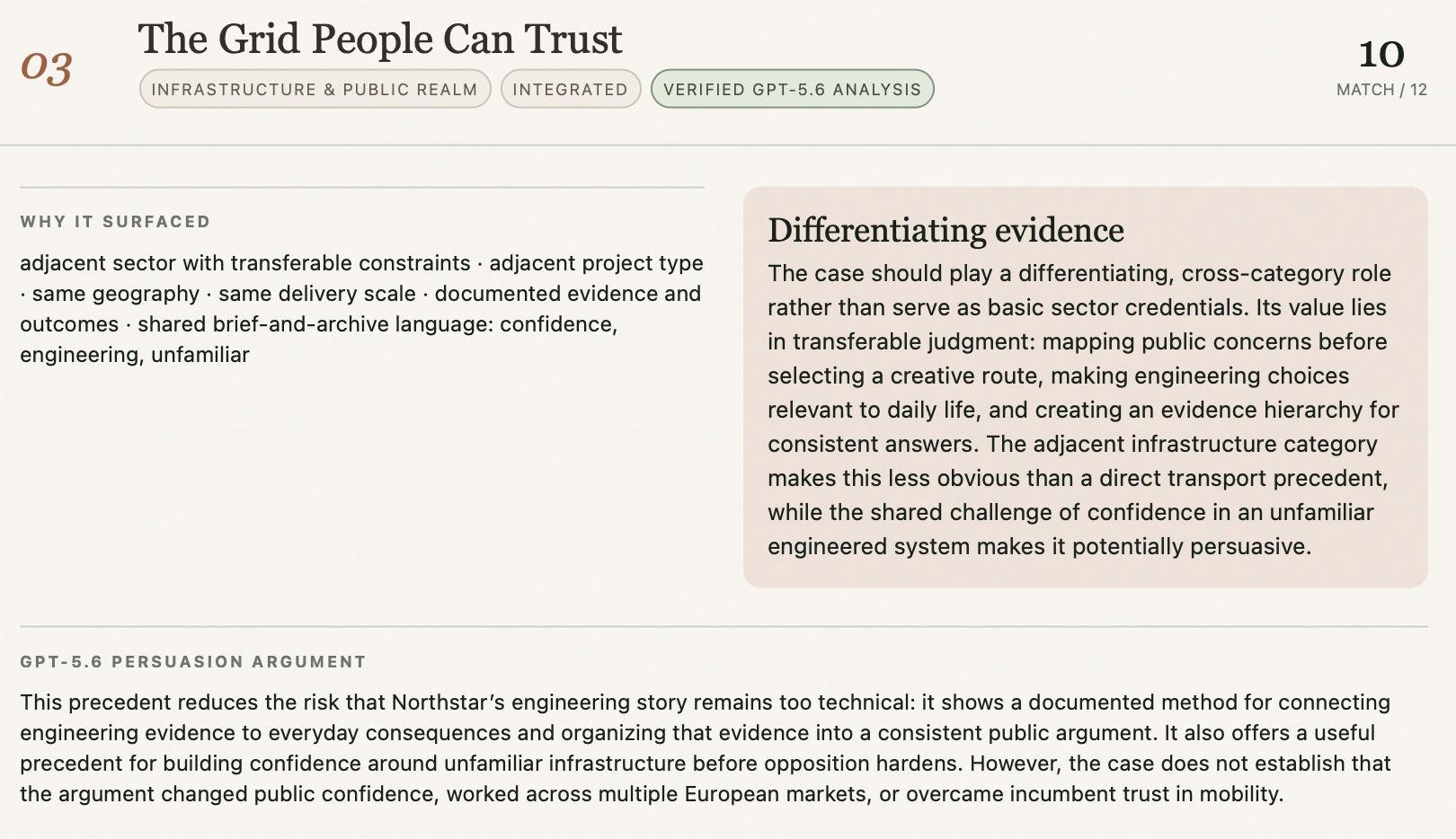
- It retrieves potentially relevant archive cases using deterministic rules and an inspectable 12-point score.
- It uses GPT-5.6 structured output to answer the harder question: what persuasive role could each precedent play for this specific client?
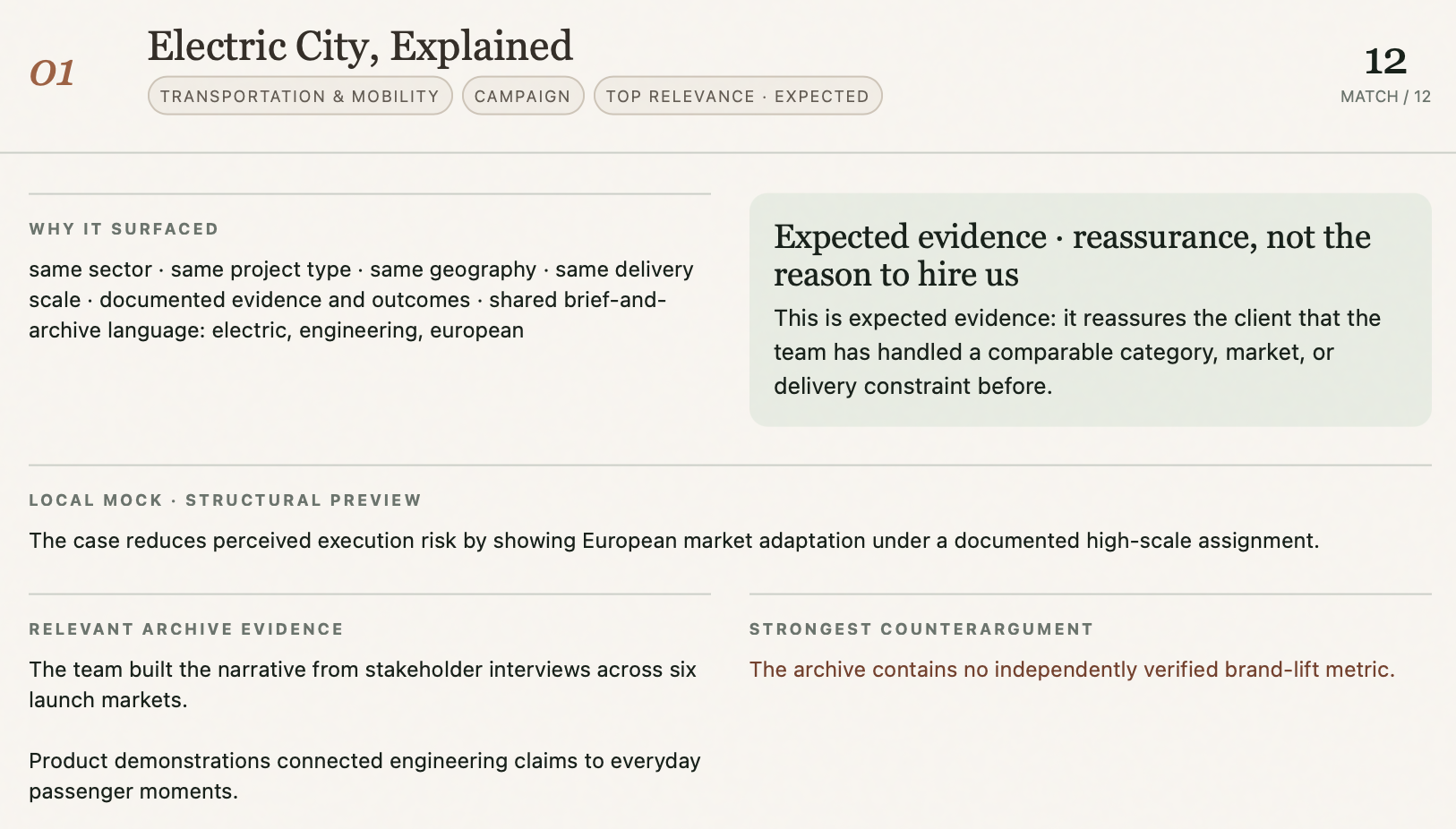
- It distinguishes Expected evidence — work that reassures the client that the team can deliver — from Differentiating evidence, which demonstrates a less obvious but more distinctive form of judgment.
- It requires every model analysis to contain a grounded argument, the strongest counterargument, missing evidence, and exact source excerpts.
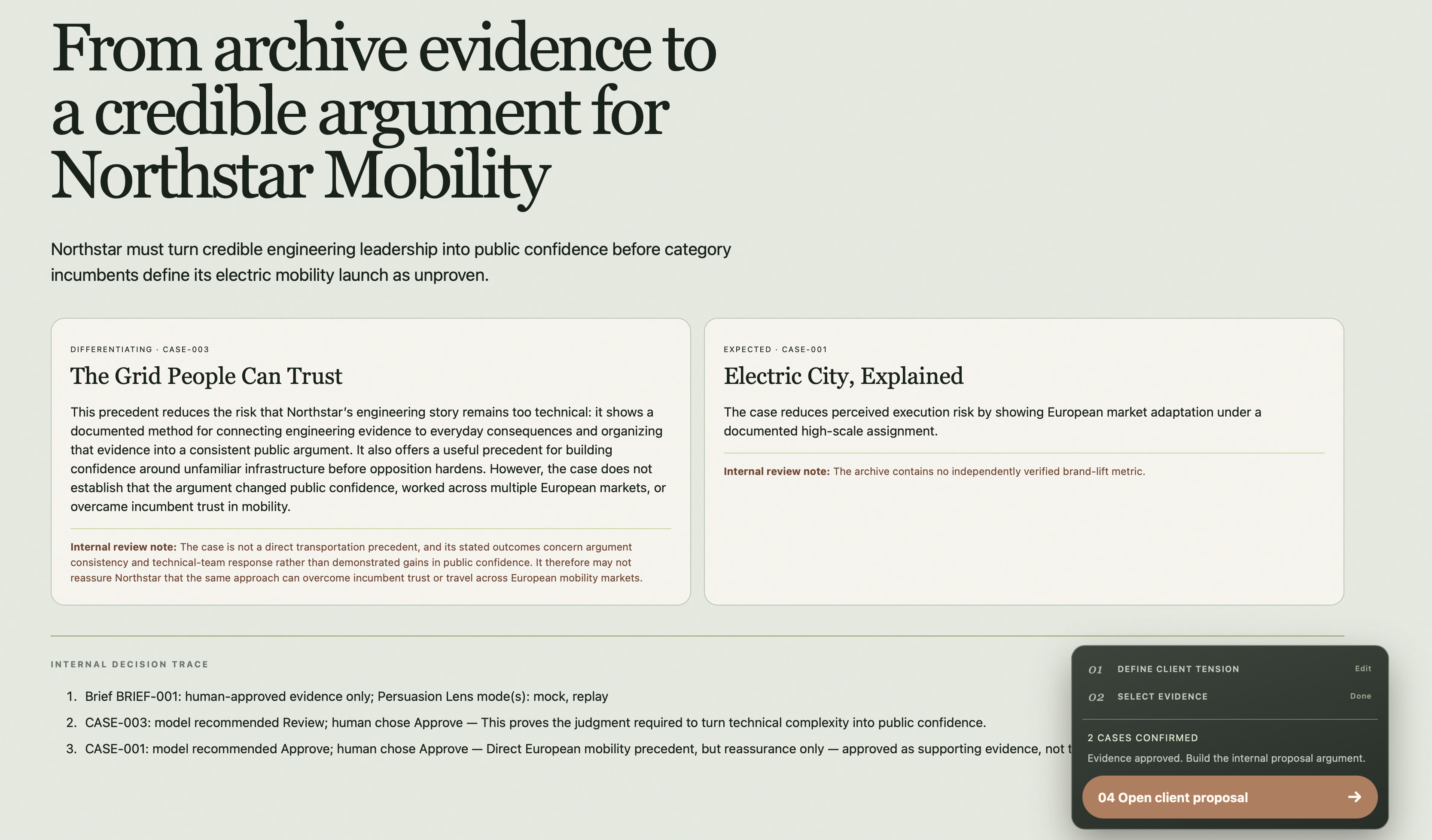
- It requires a human reviewer to approve, reject, or override the recommendation and explain the decision.
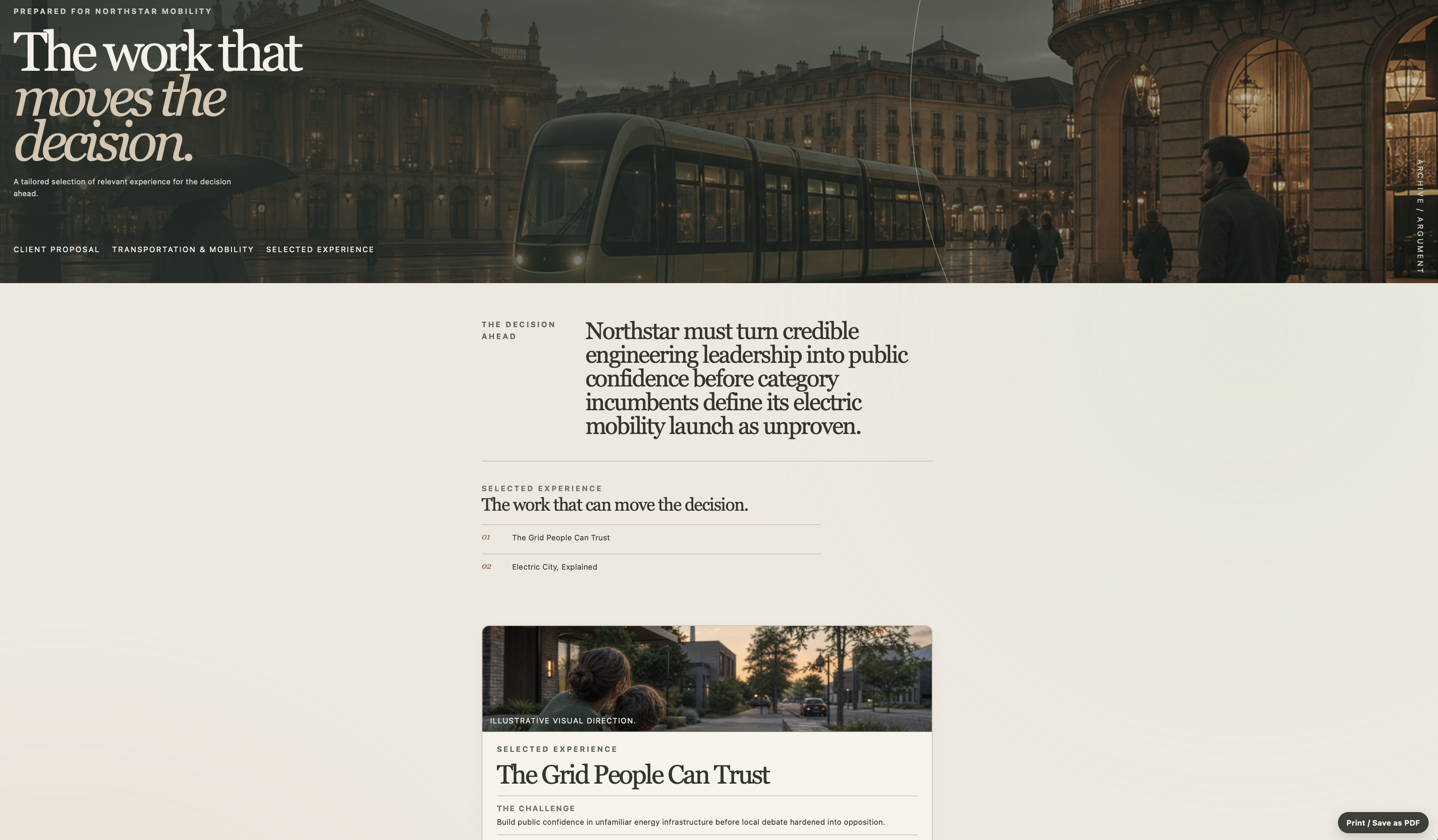
- It composes only human-approved evidence into a client-ready proposal with a traceable model-and-human decision history.
- It retains human decisions and verified outcomes as controlled institutional memory. Only verified outcomes can influence future ranking.
The defining product moment is deliberately counterintuitive: a case may receive a perfect 12/12 relevance score and still be classified as:
Expected evidence — reassurance, not the reason to hire us.
A less similar case may provide the stronger differentiating argument.
How I built it
The application has a typed Python core and a zero-build local web interface. It does not require a frontend framework, so a judge can run the complete demonstration with a minimal local setup.
Controlled vocabularies, stable identifiers, explicit validators, and deterministic matching establish a reliable baseline before any model reasoning occurs.
The Persuasion Lens uses the OpenAI Responses API with gpt-5.6 and strict JSON Schema output. GPT-5.6 receives the client brief, candidate facts, and deterministic relevance score. It does not receive the archive curator’s internal evidence-role label.
A grounding layer checks every cited excerpt against the exact supplied brief or case field before accepting the analysis. Unsupported excerpts are rejected. The curator-assigned evidence label is also prohibited as citable evidence, ensuring that the model must reach its classification independently.
The public judge workflow includes one verified GPT-5.6 analysis generated through the live API. The remaining candidates are clearly labelled as local structural previews. The public repository contains no API key and cannot initiate public model calls.
What’s new during Build Week
Archive to Argument is an honest V2 of an earlier internal proposal prototype.
The previous version already explored structured archives, deterministic matching, Expected and Differentiating evidence, human checkpoints, LLM-assisted framing, decision traces, and PDF output.
The Build Week implementation is a new, isolated repository built with Codex. The evaluated work created during Build Week includes:
- typed and sanitized demonstration data;
- stable identifiers and controlled vocabularies;
- explicit separation of facts, deterministic scores, model interpretation, and human judgment;
- the grounded GPT-5.6 Persuasion Lens;
- persistent human approvals and overrides;
- the judge-facing browser workflow;
- a traceable client-ready proposal artifact;
- controlled generated visual direction;
- a reliability suite containing 46 automated tests.
The original source was not modified, and no confidential production data was copied into the Build Week repository.
How GPT-5.6 is used
GPT-5.6 performs one narrow, high-value reasoning task:
Determine how one known case might persuade one specific client.
It receives only the client brief, candidate facts, and deterministic score. It never receives the curator’s internal Expected or Differentiating label.
For each candidate, GPT-5.6 must:
- determine the likely persuasive role of the case;
- produce a grounded argument;
- identify the strongest counterargument;
- state what evidence is missing;
- cite exact excerpts from the supplied material;
- recommend review when the available facts are ambiguous.
Strict structured output makes the response machine-checkable. The grounding validator rejects unsupported excerpts before they can be displayed.
GPT-5.6 therefore does not select evidence autonomously. It produces a constrained, inspectable interpretation for a human expert to judge.
How Codex was used
Codex served as technical lead and implementation agent throughout Build Week.
It:
- audited the official competition rules and the boundary between pre-existing work and new work;
- reduced the concept to an achievable and testable architecture;
- built the repository through incremental, tested commits;
- implemented the deterministic matching and model-reasoning layers;
- constructed the product interface and proposal artifact;
- ran functional, grounding, and safety audits;
- prepared repository documentation and submission materials.
The commit history and the primary /feedback session document that work.
The key product decisions remained human decisions: positioning the system around professional narrative judgment, making the Persuasion Lens the central Build Week contribution, using fictional demonstration data, preserving explicit human authority, and declining to rebuild the legacy PDF workflow.
Challenges I ran into
The central challenge was keeping four epistemically different things separate:
- archive facts;
- deterministic relevance;
- model inference;
- human judgment.
Without that separation, a system can easily turn a plausible interpretation into something that looks like a fact.
The grounding and decision layers were designed specifically to prevent those categories from collapsing into one polished answer.
During development, an independent audit discovered that the first live model analysis had been given the archive curator’s internal evidence-role label as input. That meant the classification was not fully independent.
I corrected the architecture by:
- withholding the curator label from the model;
- prohibiting the label as citable evidence;
- adding regression tests;
- rerunning the live GPT-5.6 analysis.
GPT-5.6 reached the same conclusion independently, now using only the brief, candidate facts, and deterministic score.
A second challenge was making a pre-existing idea eligible and understandable without overstating novelty. The repository therefore includes a detailed V1/V2 capability matrix, a dated provenance log, and incremental commits tied to explicit acceptance gates.
Accomplishments that I'm proud of
- A persuasion workflow that makes AI reasoning contestable instead of merely plausible.
- A clear product moment in which a perfect 12/12 relevance match is correctly identified as reassurance rather than the reason to hire the team.
- Strict GPT-5.6 structured output combined with exact source-excerpt validation.
- A grounding audit that caught and corrected my own information leak.
- A human decision trail that the model cannot overwrite.
- Fictional demonstration data and no leakage from confidential production archives.
- Generated visuals clearly separated from evidentiary material.
- A zero-build local workflow and a self-contained client-ready proposal.
- A reliability suite containing 46 automated tests.
What I learned
The most valuable form of archive intelligence is not retrieval.
It is reasoning about the rhetorical role of evidence.
A direct sector match may reassure a client. An adjacent case may differentiate the team by proving the exact judgment, adaptability, or risk management the client is afraid will be missing.
Models become more useful when they are required to articulate that role, expose the strongest objection, cite the underlying facts, identify uncertainty, and leave the final decision to an expert.
The goal is not to automate professional judgment. It is to make that judgment visible enough to examine, challenge, preserve, and improve.
What’s next for Archive to Argument
The production path includes richer archive ingestion, including:
- project scope;
- team composition;
- investment bands;
- verified reach and commercial outcomes;
- media assets;
- rights and governance information;
- client-specific access controls.
A production system would also require evaluation datasets, collaborative review, observability, privacy controls, and organization-level permissions.
The longer-term opportunity is controlled institutional memory: not merely remembering which work was similar, but learning which arguments were approved, which evidence was rejected, and which recommendations were later validated by real outcomes.
Built With
- codex
- css
- docker
- gpt-5.6
- html
- javascript
- json-schema
- openai-responses-api
- python


Log in or sign up for Devpost to join the conversation.