-
-
-
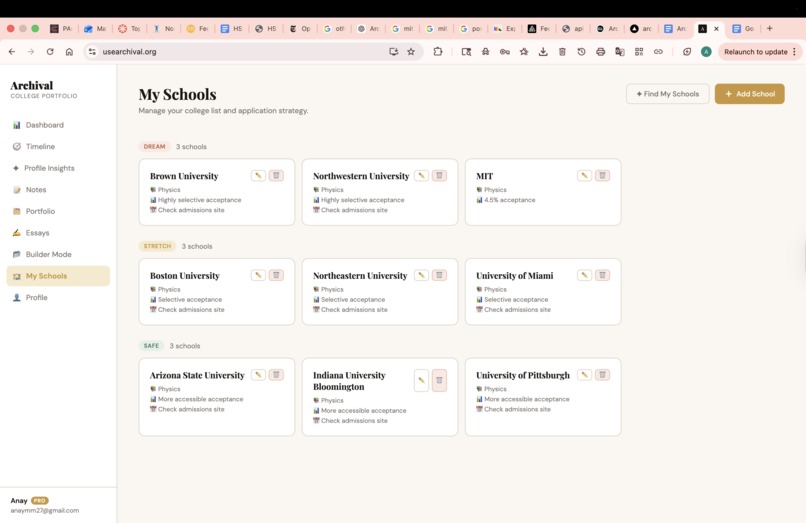
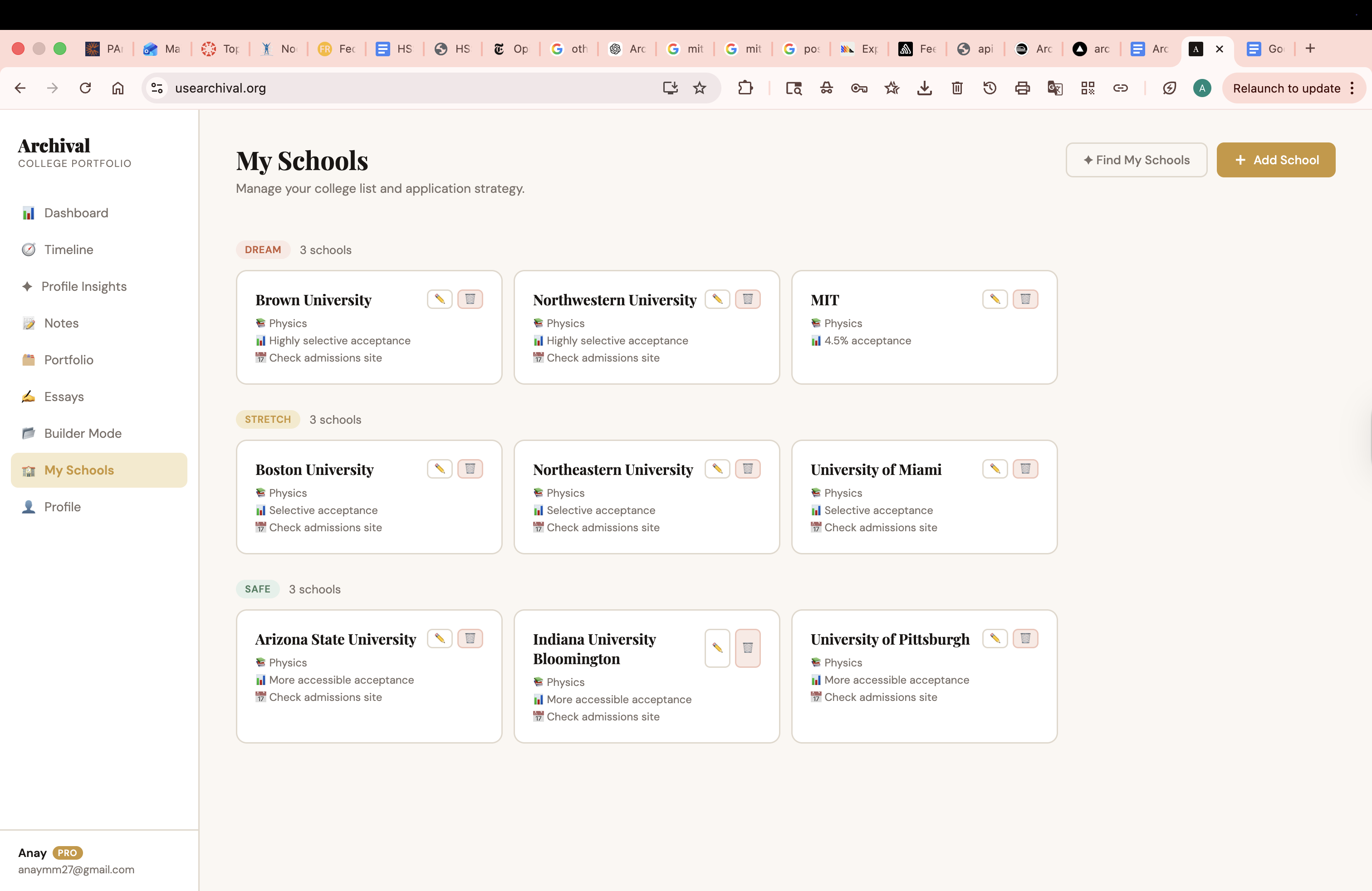
Find my Schools
-
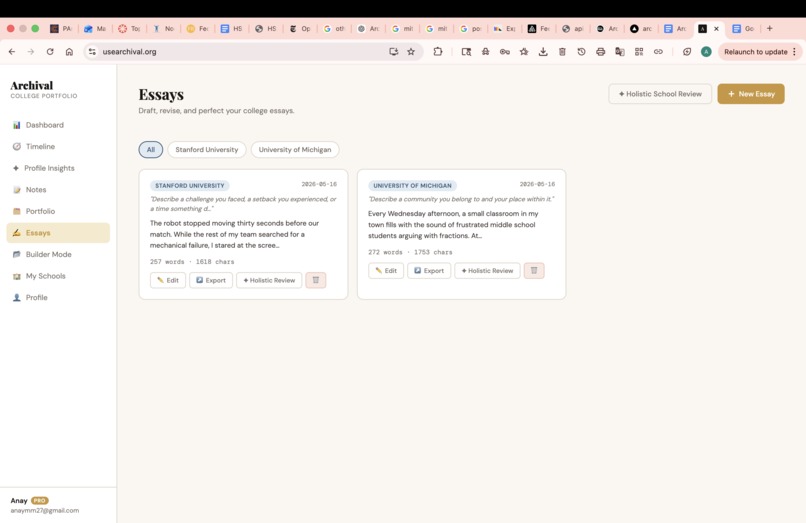
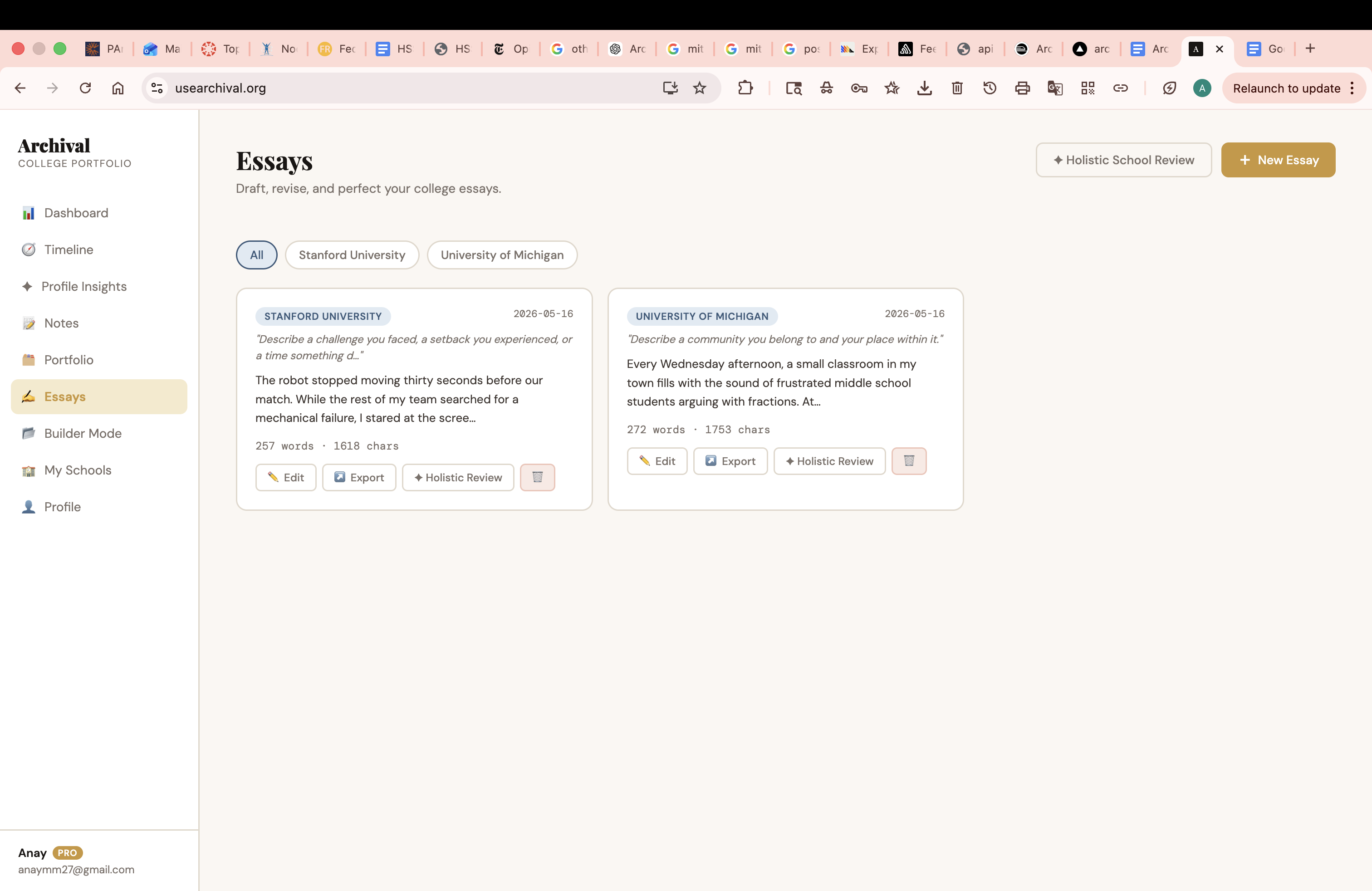
Essays
-
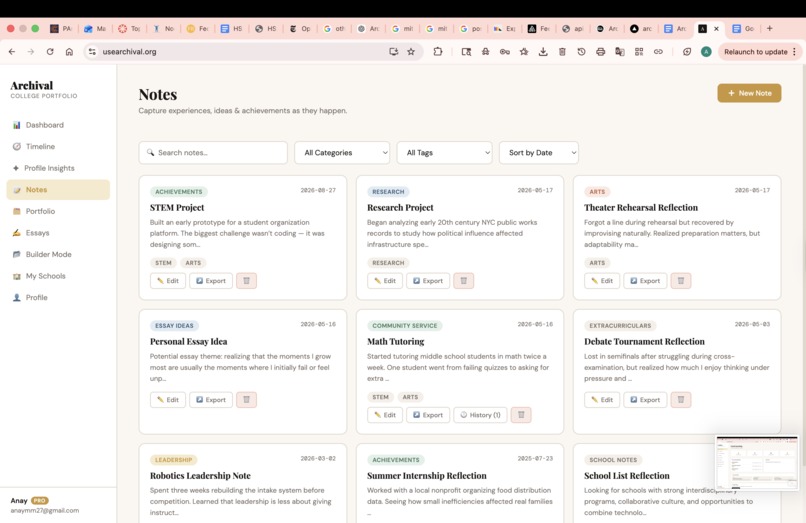
Notes
-
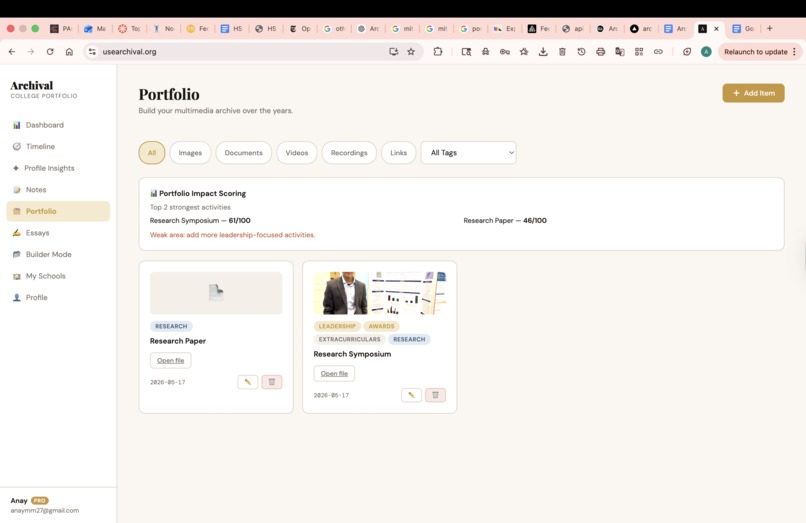
Portfolio
Inspiration
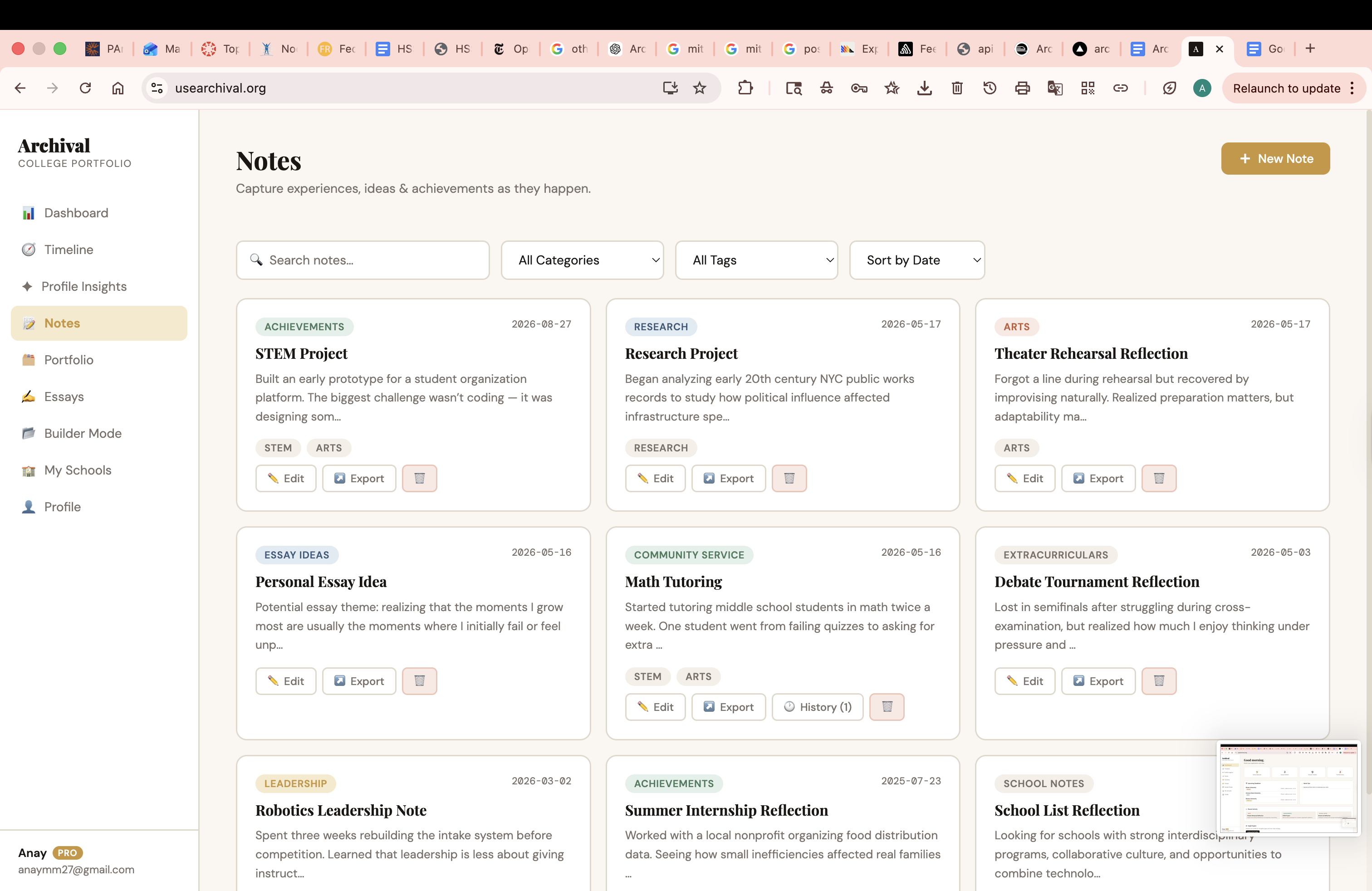
Applying to college is one of the most important and stressful processes students go through, yet most students manage it with scattered Google Docs, Notes apps, random folders, and last-minute memory. By senior year, students often spend more time trying to remember their experiences than actually reflecting on them.
I built Archival to solve that problem.
The idea behind Archival is simple: instead of rebuilding your story from memory during application season, students should be able to build it gradually over time. I wanted to create a system where students could capture achievements, activities, essays, reflections, projects, and ideas as they happen, and then use AI to turn those experiences into stronger applications later on.
What it does
Archival is an AI-powered application operating system for students.
Students can:
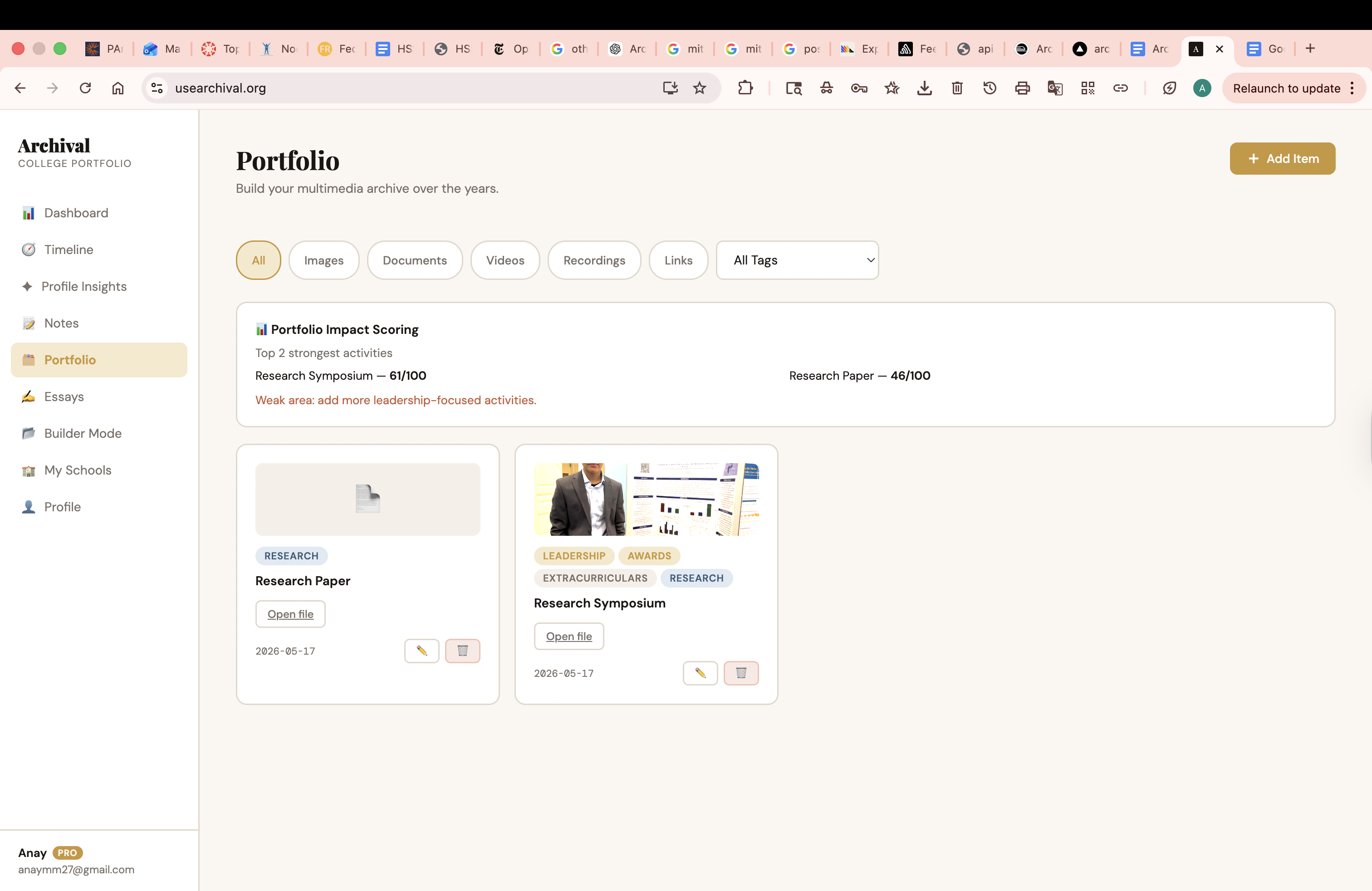
Save notes, achievements, activities, and reflections Upload portfolio items like photos, PDFs, and documents Organize schools, essays, and application materials Use Builder Mode to generate stronger application content using their real experiences Get AI-powered writing and planning assistance Build a long-term archive of their academic journey
The most important feature is Builder Mode. Instead of giving generic AI responses, Archival uses the student’s saved archive of notes, essays, portfolio items, and activities to generate contextual, personalized application guidance.
How I built it
I built Archival as a fully deployed web platform using:
React + Vite frontend Express backend MongoDB Atlas Cloudinary media storage Stripe subscriptions PostHog analytics Sentry monitoring AI-powered workflows
The platform includes real authentication, persistent databases, media uploads, analytics, AI infrastructure, and deployed production environments.
Challenges I ran into
One of the biggest challenges was moving from a prototype into a real production-ready system. I had to implement authentication, secure media uploads, analytics, backend validation, rate limiting, deployment infrastructure, and AI workflows while keeping the experience fast and intuitive.
Another challenge was designing Builder Mode in a way that felt genuinely useful instead of gimmicky. I wanted the AI to feel contextual and personalized rather than generic, which meant building systems that could intelligently use a student’s saved experiences over time.
Accomplishments that I'm proud of
One of the things I’m most proud of is turning Archival from an idea into a real deployed platform with production infrastructure. The app includes authentication, AI workflows, analytics, persistent databases, media uploads, monitoring, subscriptions, and deployed front-end and back-end environments.
I’m also proud of Builder Mode, which has become the platform's core differentiator. Instead of giving generic AI responses, it uses a student’s saved experiences over time to generate more contextual and personalized application guidance.
Most importantly, I’m proud that Archival solves a problem I’ve personally experienced and that many students immediately relate to.
What I learned
I learned that building a useful product is not just about adding features — it’s about solving a real problem clearly and simply.
I also learned how much infrastructure goes into turning an idea into a real deployed product. Building Archival required learning deployment pipelines, authentication systems, analytics, monitoring, databases, media storage, AI integration, and user experience design.
Most importantly, I learned that the best products are not just technically impressive — they feel genuinely useful to the people they are built for.
What's next for Archival
The next step for Archival is private beta testing with real students. I want to learn how students actually use the platform over time, which features become habitual, and how AI can better help students organize and communicate their experiences.
Long term, I want Archival to become more than just a college application tool. My goal is to build a system that helps students understand, organize, and develop their academic identity throughout high school instead of only during application season.
Built With
- claudeapi
- cloudinary
- express.js
- javascript
- jwt-authentication
- mongodb-atlas
- node.js
- posthog
- railway
- react
- resend
- rest-apis
- sentry
- stripe
- vercel
- vite

Log in or sign up for Devpost to join the conversation.