-
-
Logo
-
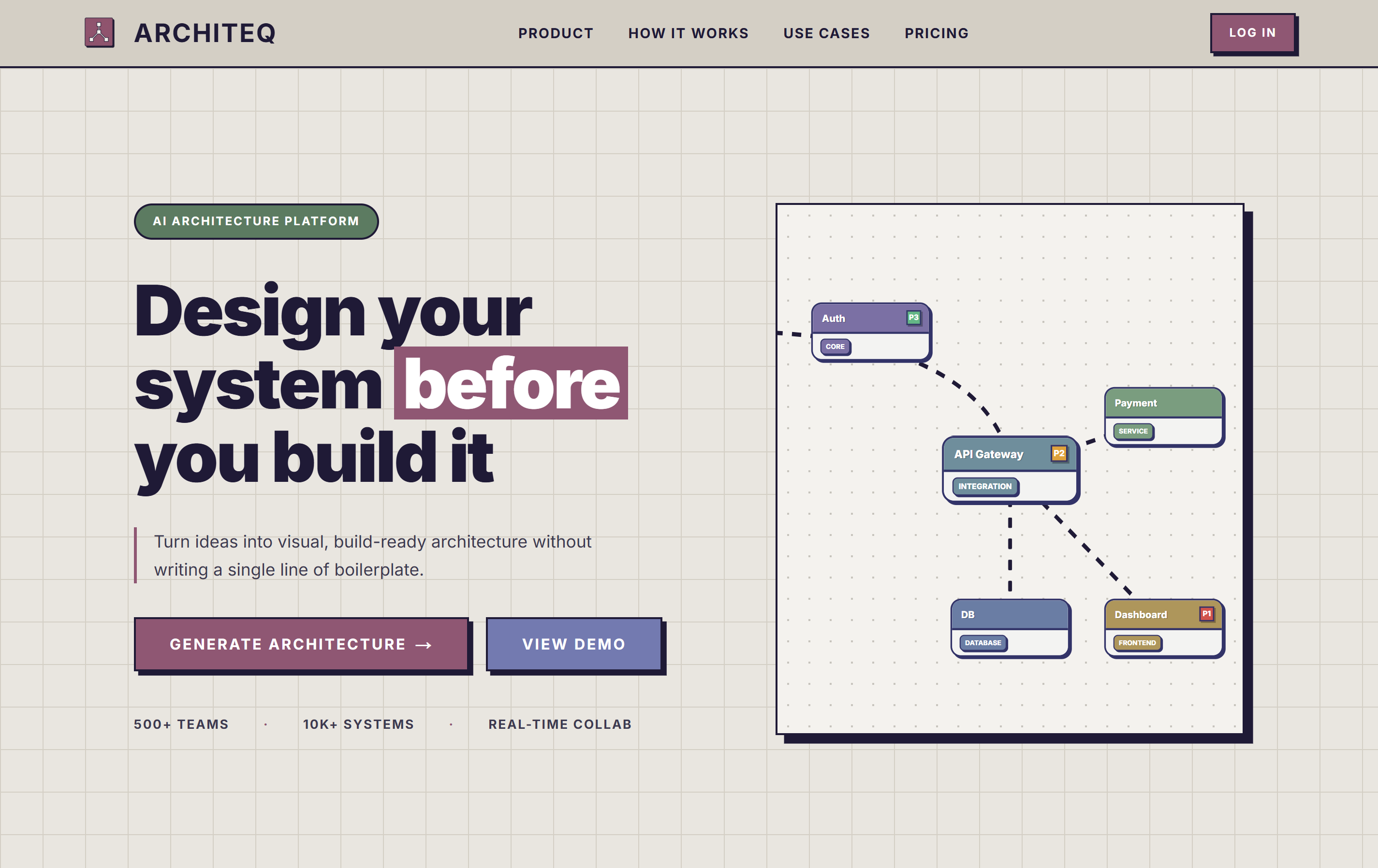
Hero Section
-
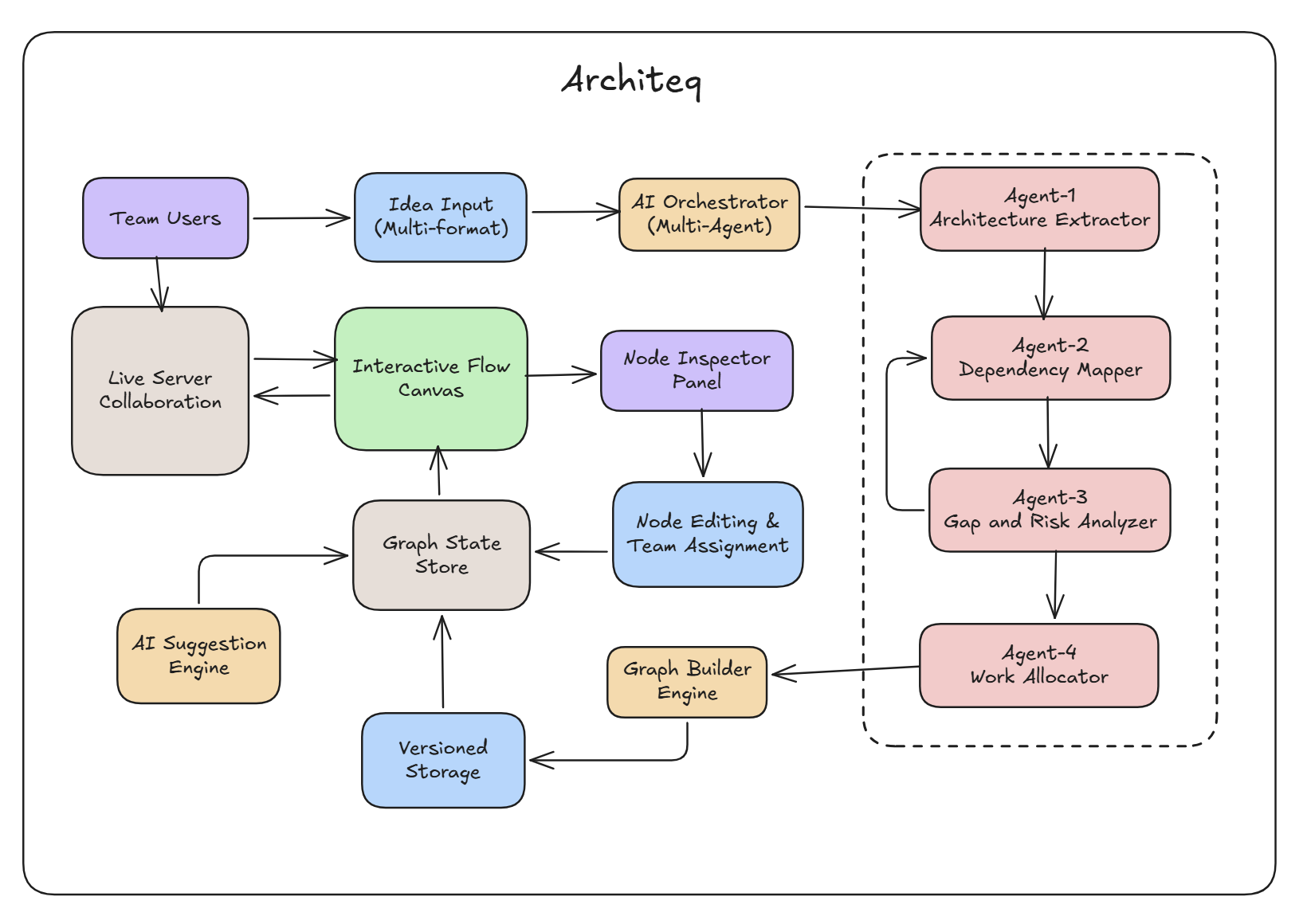
Architecture Diagram
-
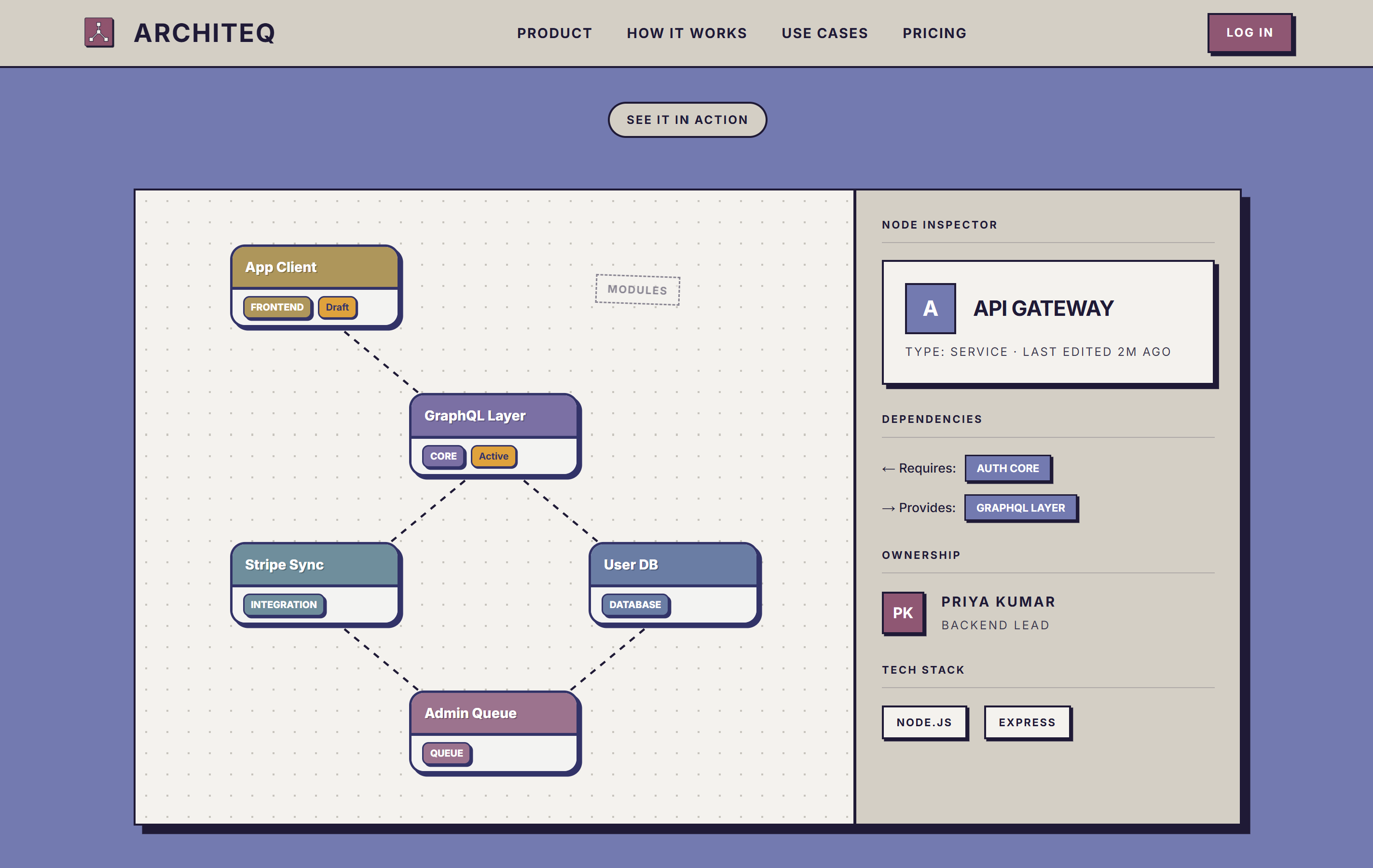
Landing Page Section
-
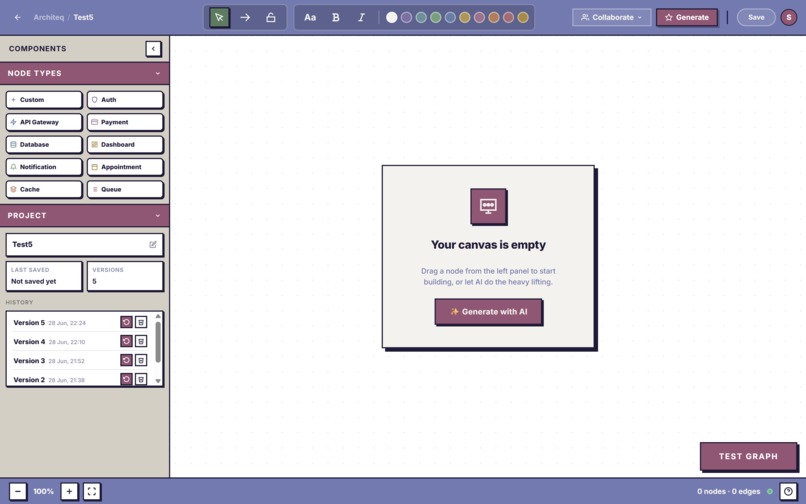
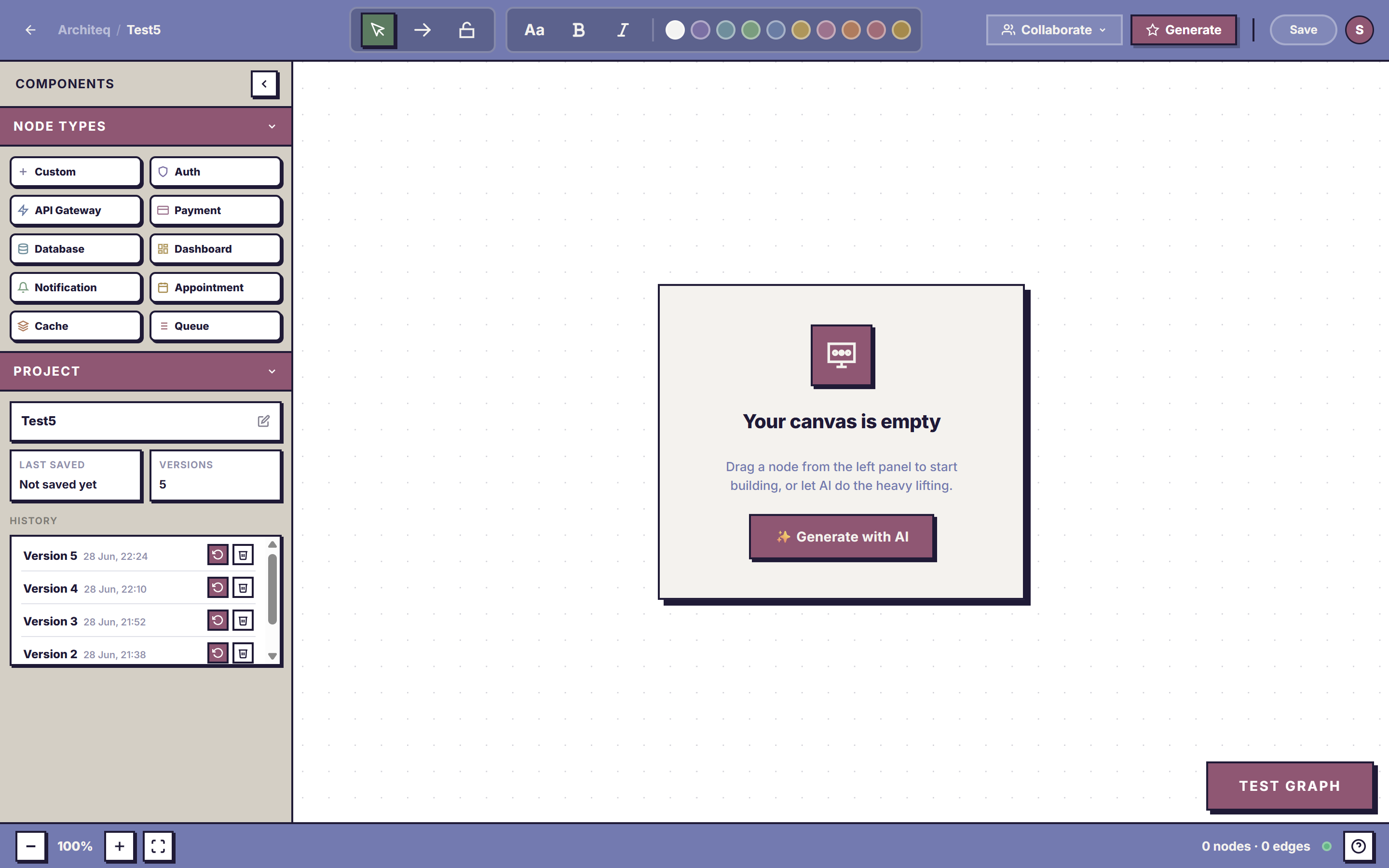
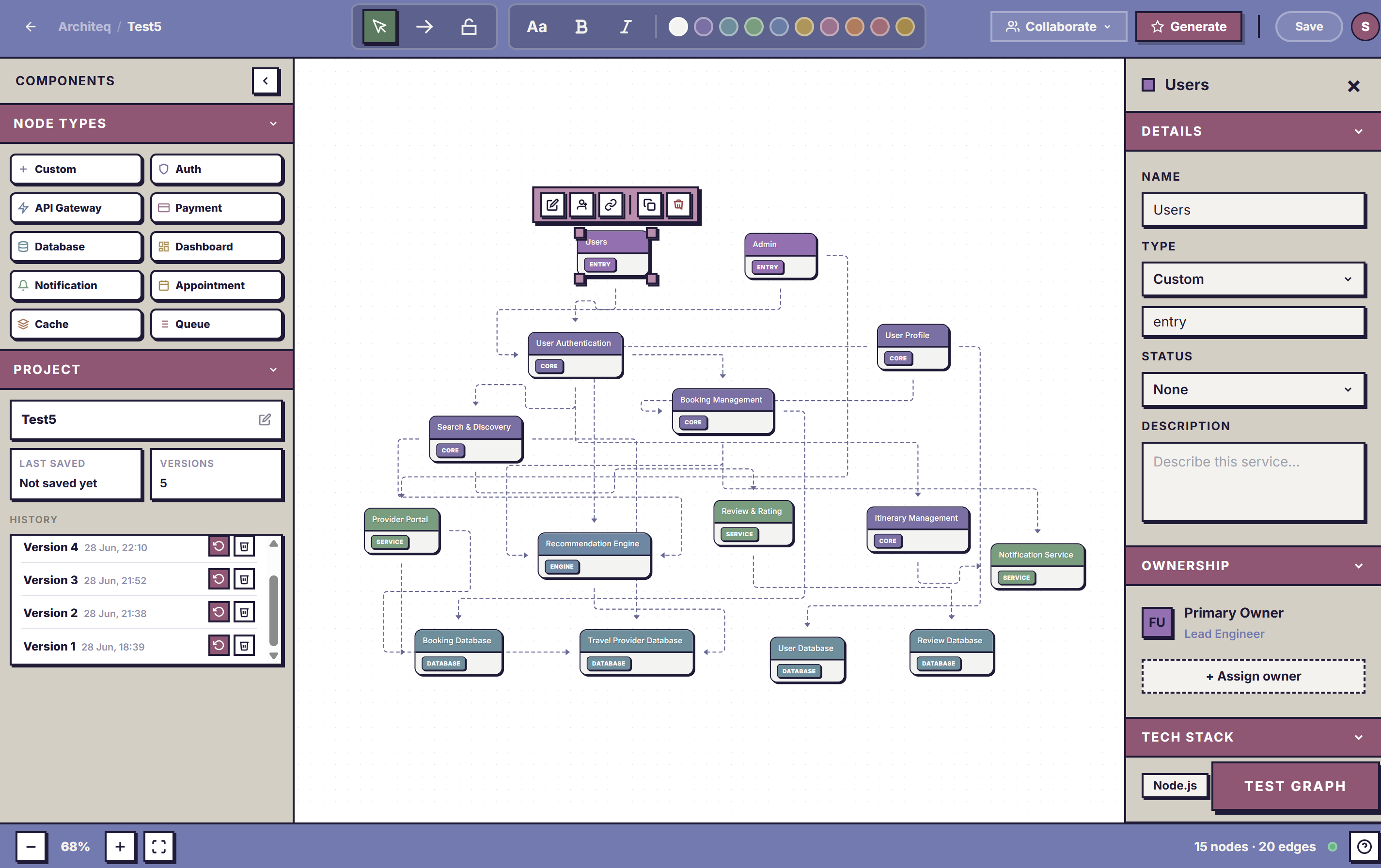
Main Canvas
-
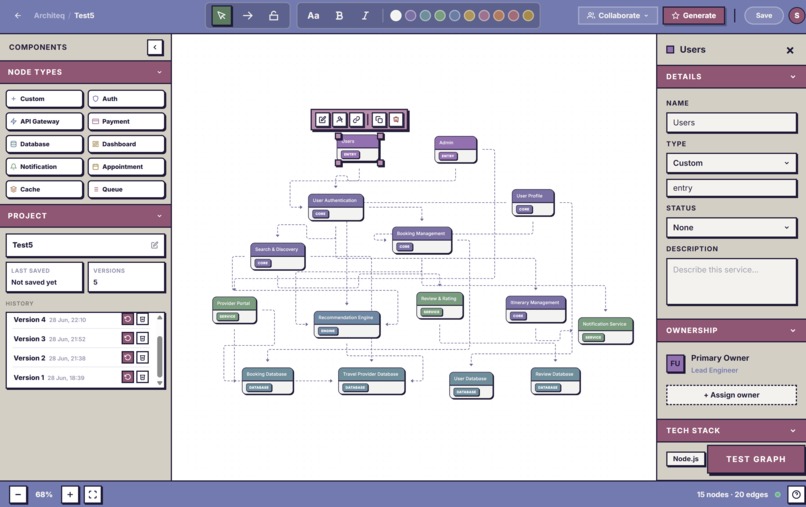
Canvas with architecture graph
-
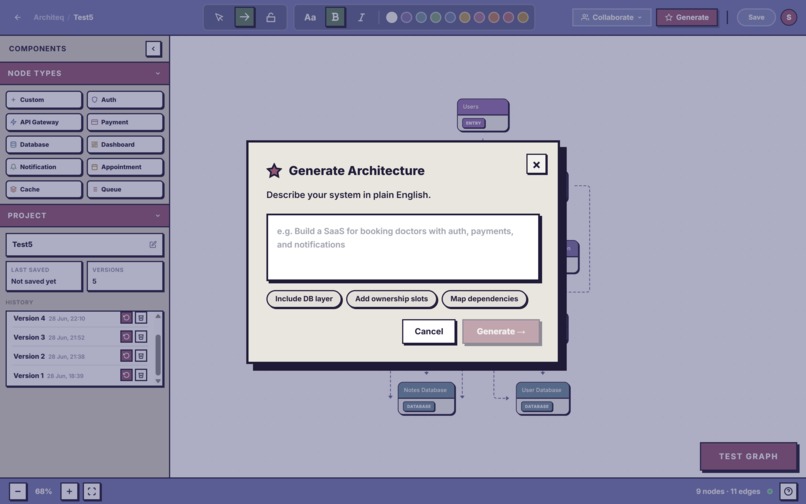
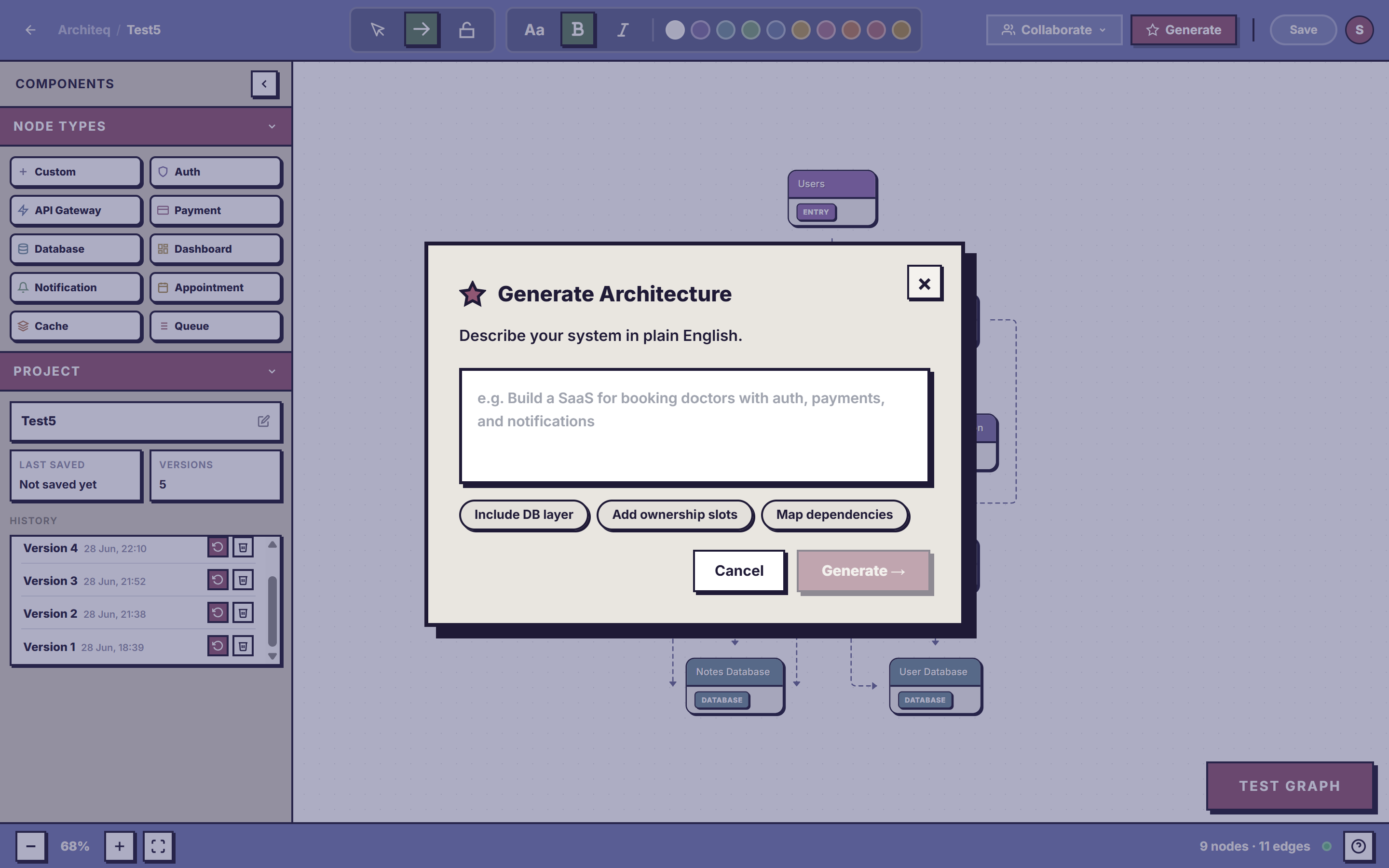
Ai graph generation modal
-
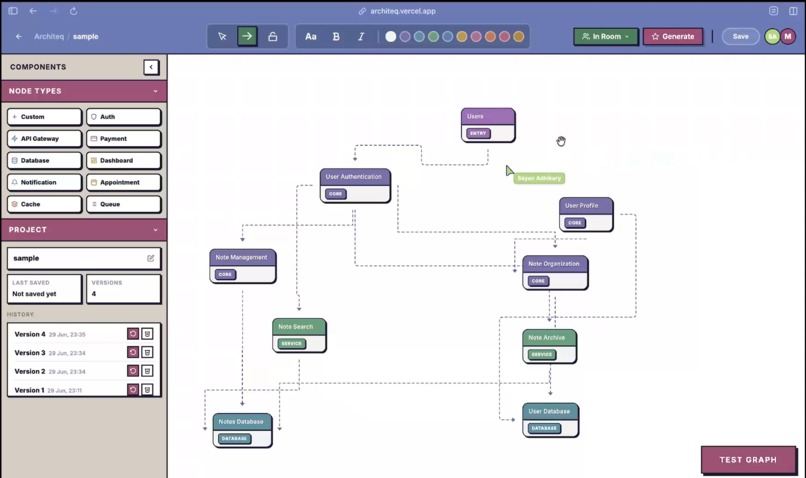
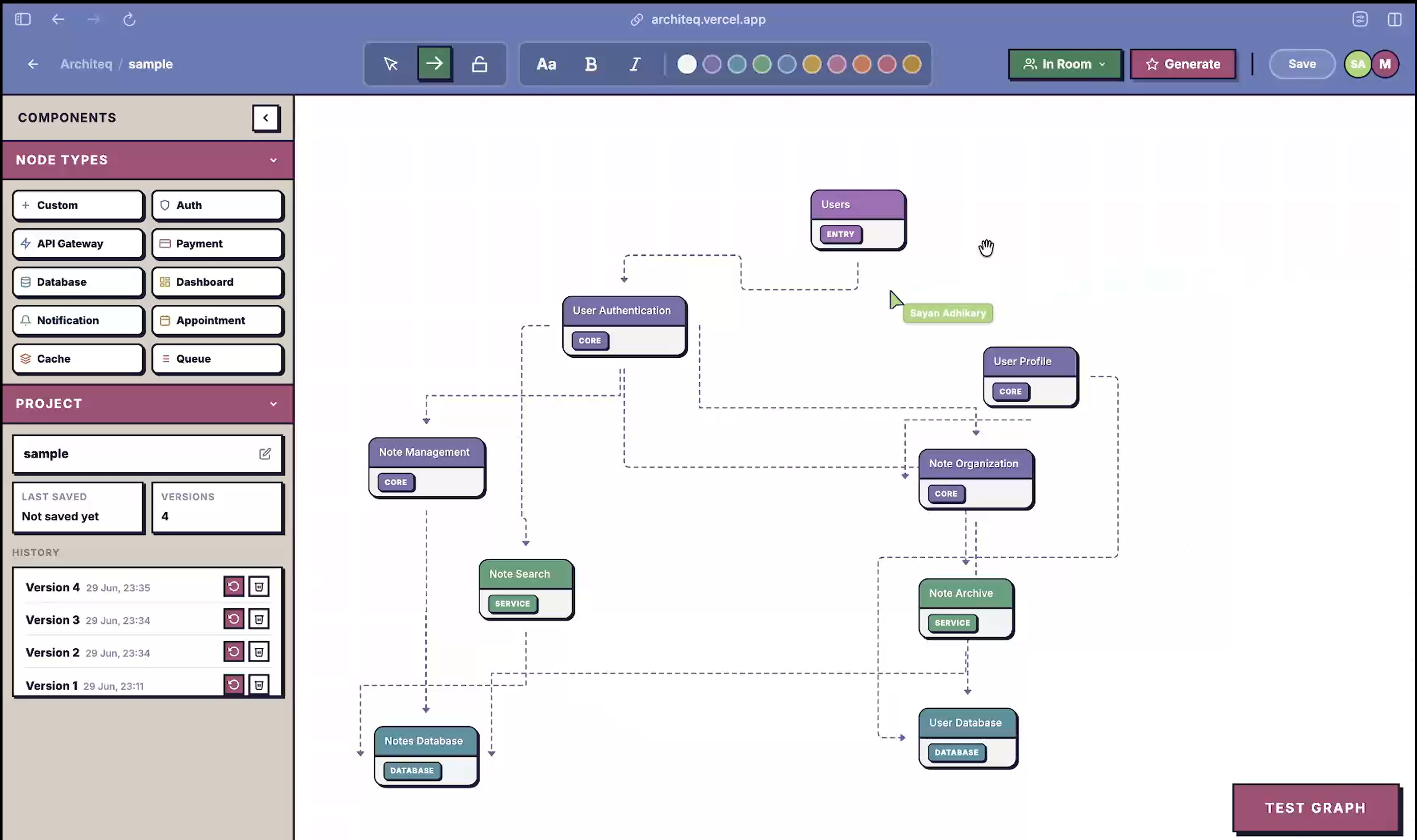
Live collaboration of Canvas
-
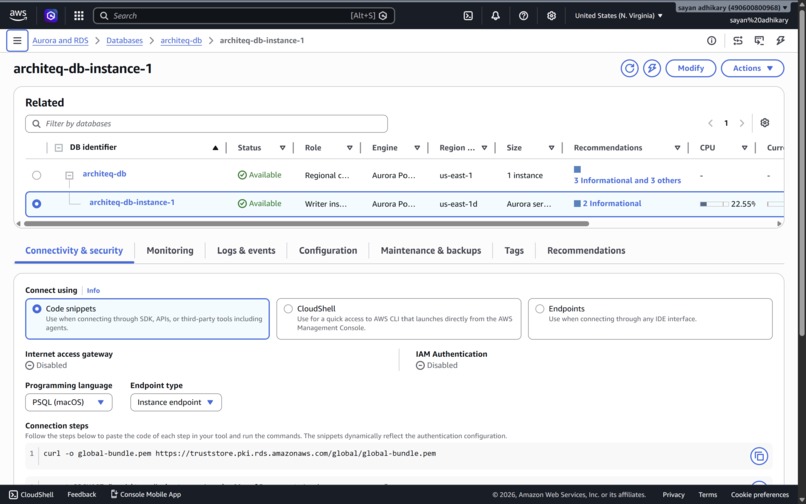
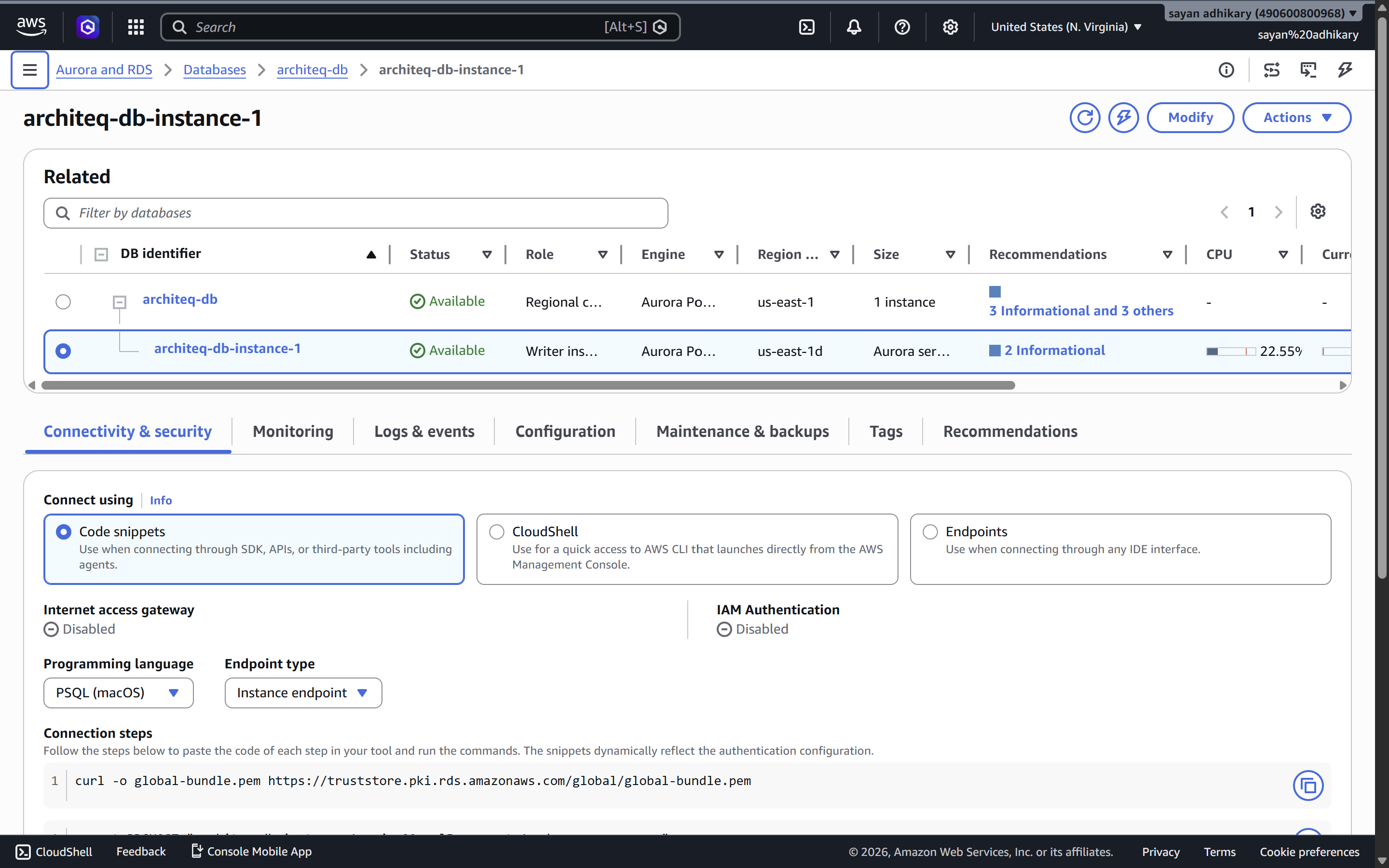
Aws Aurora Postgresql console
-
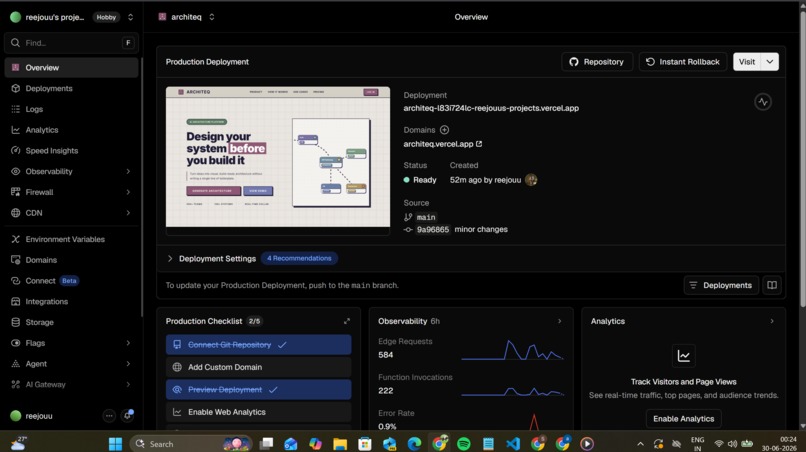
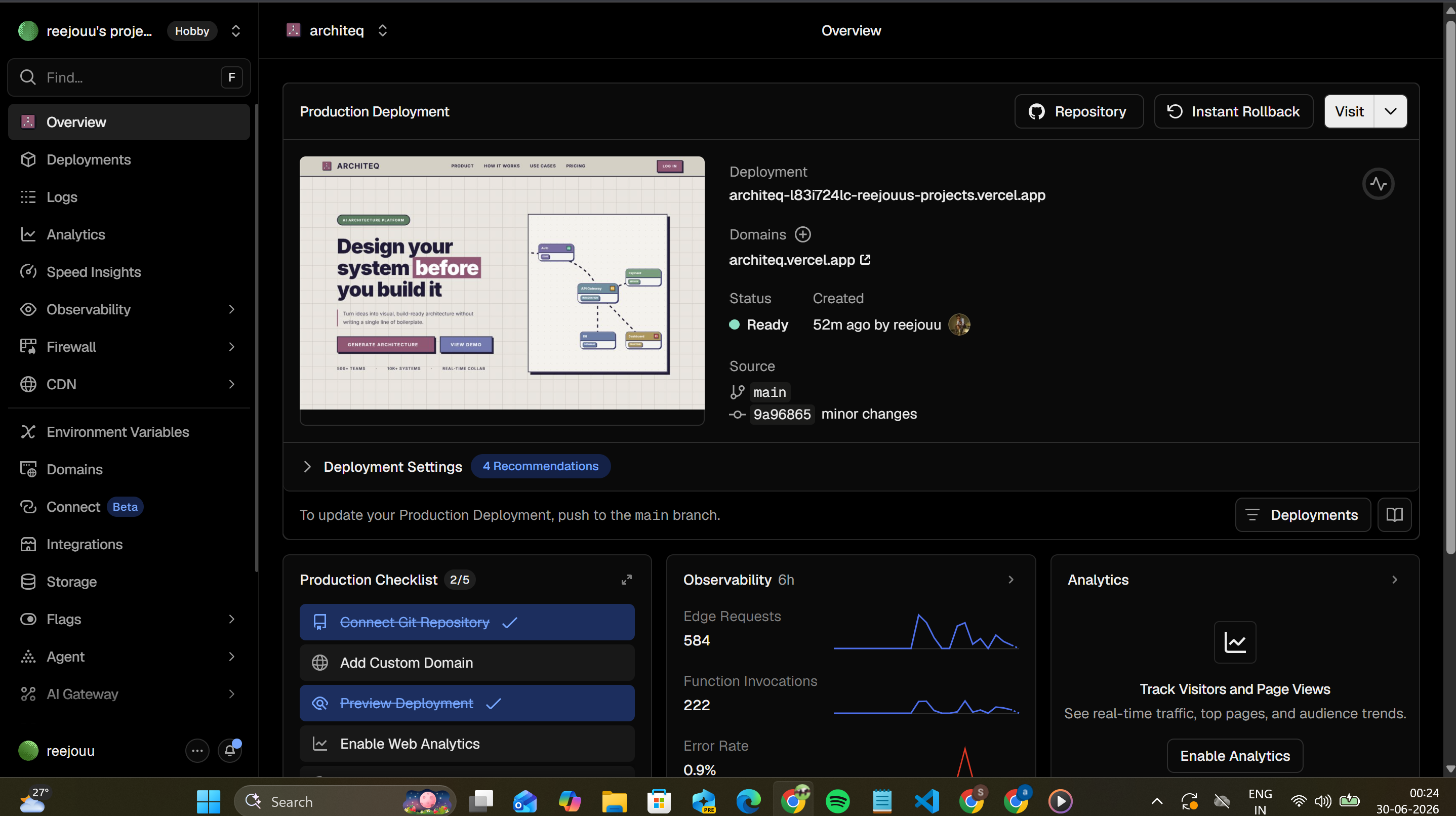
Vercel Deployment Console
-
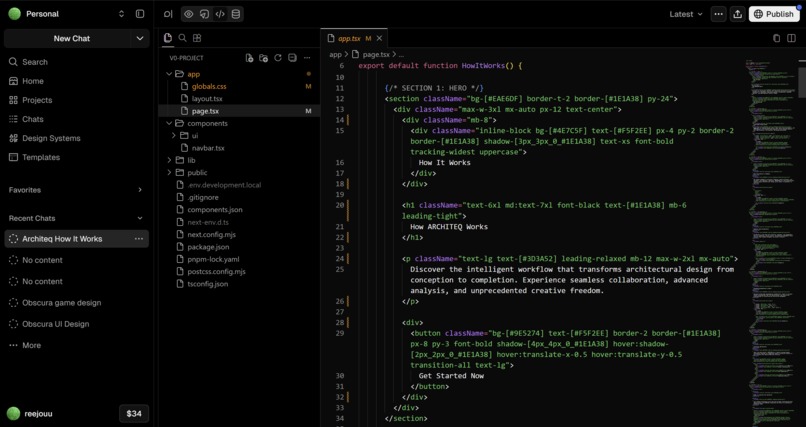
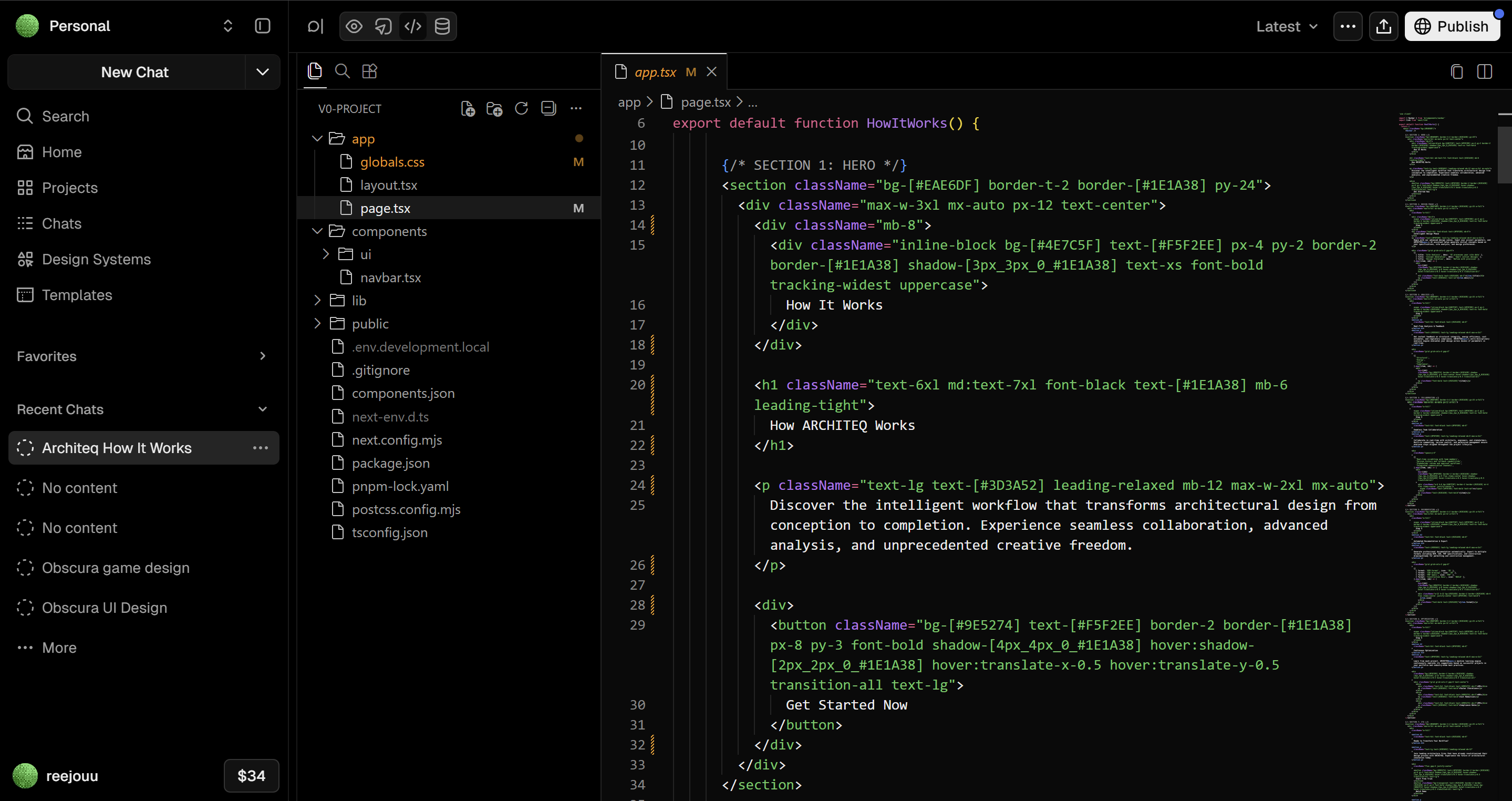
V0.dev Console
Architeq
Inspiration
Every software project begins with an idea, but transforming that idea into a well-structured system architecture remains one of the most time-consuming and collaborative parts of software engineering.
Teams constantly switch between requirement documents, whiteboards, chat applications, and diagramming tools before writing a single line of code. As projects evolve, architecture diagrams quickly become outdated, dependencies are overlooked, responsibilities become unclear, and design decisions are lost.
We wanted to eliminate this gap between product thinking and system design.
Our vision was simple: what if AI could understand a product idea, automatically generate a production-ready software architecture, allow teams to collaboratively refine it, and preserve every design decision through version control?
That vision became Architeq.
What it does
Architeq is an AI-powered collaborative software architecture workspace that transforms raw product ideas into interactive, editable system architecture diagrams.
Users can provide product ideas, feature specifications, PRDs, or requirement documents. A multi-agent AI pipeline analyzes the requirements, extracts software components, maps dependencies, identifies architectural risks, and generates a fully editable architecture graph.
Unlike traditional AI-generated diagrams, the generated architecture is not static.
Teams can:
- Edit nodes and connections
- Add new components
- Assign implementation ownership
- Receive AI-powered architectural recommendations
- Collaborate in real time
- Save immutable architecture versions
- Restore previous system designs whenever required
Instead of becoming outdated documentation, the architecture evolves together with the project.
How we built it
AI Multi-Agent Pipeline
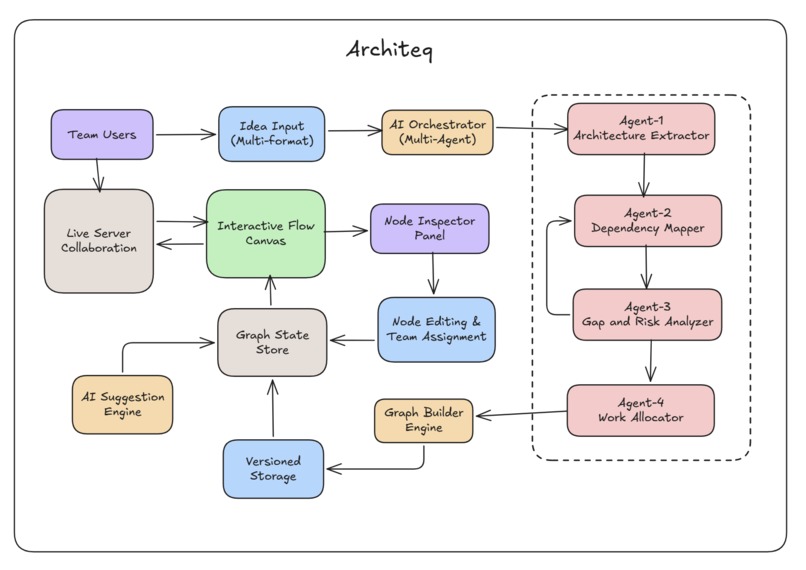
Rather than relying on a single LLM response, Architeq uses a specialized multi-agent pipeline where each agent owns a distinct engineering task. We deliberately consolidated what began as four separate agents into two high-throughput agents, each performing two tightly-related jobs in a single pass:
- Blueprint Agent – extracts the product's software components (services, APIs, core features, authentication, databases) and maps the dependencies between them in one pass, producing the structural skeleton of the system as nodes and edges. It is intentionally product-focused, modeling the components a team would actually name and build rather than low-level infrastructure plumbing.
- Refine Agent – performs gap & risk analysis (surfacing missing components, architectural bottlenecks, and design risks) and generates implementation ownership and build-priority assignments in one pass, completing the skeleton into a build-ready plan.
Collapsing four sequential agents into two roughly halves the number of LLM round-trips. Each call runs on Gemini 2.5 Flash with reasoning/"thinking" disabled and a constrained JSON response schema for fast, deterministic structured output, plus an automatic OpenAI fallback for resilience. The result is a dramatic reduction in architecture-generation latency without sacrificing quality.
These outputs are merged into a single structured graph instead of plain text.
Interactive Visual Workspace
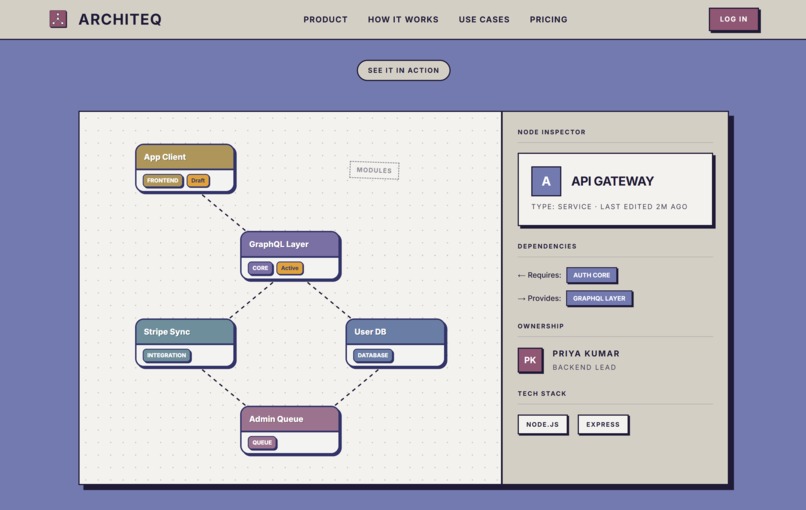
The generated graph is automatically laid out using ELK.js (the Eclipse Layout Kernel) — a battle-tested layered-graph layout engine that produces a clean hierarchical arrangement with orthogonal, node-avoiding edge routing. The laid-out graph is rendered inside an interactive collaborative canvas (built on React Flow) where users can:
- Move components freely
- Edit architecture nodes
- Create or remove services
- Modify dependencies
- Assign team members
- Update metadata
- Continuously evolve the design
This makes the AI-generated architecture a living engineering workspace rather than a static diagram.
Production-Ready Cloud Infrastructure
Instead of relying on a local database, we built Architeq on Amazon Aurora PostgreSQL (AWS RDS) to provide a scalable, production-ready persistence layer.
Aurora stores:
- User accounts
- Projects
- Architecture versions
- Graph nodes
- Graph edges
- Team assignments
- Project metadata
We designed a normalized relational schema using Prisma ORM, enabling type-safe database access while efficiently modeling graph-like relationships and immutable architecture snapshots.
The frontend is deployed on Vercel, while Next.js API Routes communicate with Amazon Aurora PostgreSQL through Prisma, creating a clean separation between presentation, business logic, and persistence.
To accelerate frontend development, we leveraged Vercel v0 to scaffold and refine key interface components before integrating them into our production application. These generated components were then extensively customized to fit Architeq's collaborative workflow, architecture editor, and design language.
Version-Controlled Architecture
One of Architeq's core capabilities is immutable versioning.
Every save creates a new architecture snapshot instead of overwriting existing work.
This enables teams to:
- Restore previous architectures
- Compare design evolution
- Experiment safely
- Track architectural decisions throughout development
Version history transforms architecture diagrams from temporary documentation into long-term engineering assets.
Why Amazon Aurora PostgreSQL?
Architeq manages highly relational data including users, projects, versions, graph nodes, edges, assignments, and project metadata.
We chose Amazon Aurora PostgreSQL because it combines PostgreSQL compatibility with fully managed cloud infrastructure, allowing us to focus on building the product instead of managing database operations.
Aurora provides:
- Managed backups
- High availability
- Automatic scaling
- Production-grade reliability
- Native PostgreSQL compatibility
This allowed us to prototype quickly while building on infrastructure capable of supporting real-world collaborative workloads.
Challenges we ran into
One of our biggest engineering challenges was designing a persistence model for editable architecture graphs.
Graph structures are naturally connected, while relational databases are optimized for structured tables. We redesigned our persistence layer into a normalized schema capable of representing nodes, edges, projects, assignments, and immutable architecture versions without sacrificing query performance.
Migrating to Amazon Aurora PostgreSQL also required configuring secure cloud networking, relational modeling, Prisma integration, and production-ready database connectivity.
Another significant challenge was orchestrating multiple AI agents into a single coherent architecture instead of producing disconnected outputs. Consolidating the pipeline from four agents into two — each handling two related tasks per call — meant carefully designing prompts and response schemas so component extraction, dependency mapping, risk analysis, and task allocation stayed consistent while keeping generation fast.
Automatically arranging the generated graph was a challenge in itself. We initially built a custom hierarchical layout engine, but achieving clean, readable diagrams with non-overlapping nodes and orthogonal edge routing proved difficult to maintain. We migrated to ELK.js, which gave us reliable, production-grade layered layouts and let us focus on the editing experience instead of layout math.
Finally, enabling collaborative editing while preserving architecture history required careful state management and versioning strategies.
What we learned
Building Architeq taught us that production AI applications require far more than prompt engineering.
Throughout this project we gained hands-on experience with:
- Multi-agent AI orchestration and pipeline consolidation for lower latency
- Structured LLM output with response schemas and model fallbacks
- Automatic layered graph layout with ELK.js
- Graph-based application design
- Cloud-native database architecture
- Amazon Aurora PostgreSQL
- Prisma ORM
- Secure database connectivity
- Version-controlled persistence
- Collaborative application state management
- Production deployment using Vercel
One of our biggest takeaways was learning how to migrate from a document-oriented persistence model to a normalized relational architecture while preserving the flexibility required for editable graph data — and, on the AI side, that fewer, well-scoped agents can outperform a longer chain of narrow ones.
Most importantly, we learned that AI is most valuable when it augments engineering workflows instead of replacing engineers.
What's next for Architeq
We envision Architeq becoming a complete software architecture operating system for engineering teams.
Our roadmap includes:
- GitHub integration for automatic architecture synchronization
- Infrastructure-as-Code generation
- Cloud deployment recommendations
- Security and compliance analysis
- Cloud cost estimation
- Architecture quality scoring
- Sprint planning integration
- Multi-project dependency visualization
- Export to production-ready engineering documentation
By combining AI-powered architecture generation, ELK.js layout, Amazon Aurora PostgreSQL, Vercel, v0, and modern collaborative workflows, we built a platform that transforms software ideas into living, version-controlled system architectures that continuously evolve alongside the products they represent.
Built With
- amazon
- amazon-web-services
- api
- aurora
- authentication
- css
- elk
- flow
- framer
- gemini
- jwt
- langchain
- langgraph
- liveblocks
- motion
- next.js
- node.js
- orm
- postgresql
- prisma
- rds
- react
- shadcn/ui
- tailwind
- typescript
- v0
- vercel


Log in or sign up for Devpost to join the conversation.