-
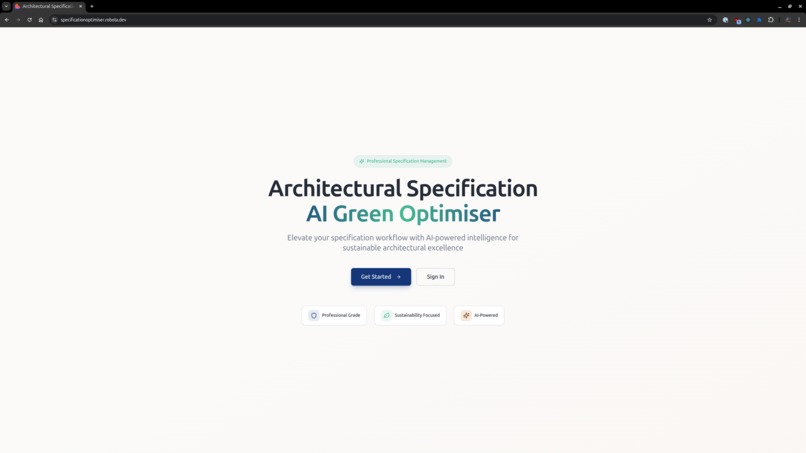
Initial Landing page
-
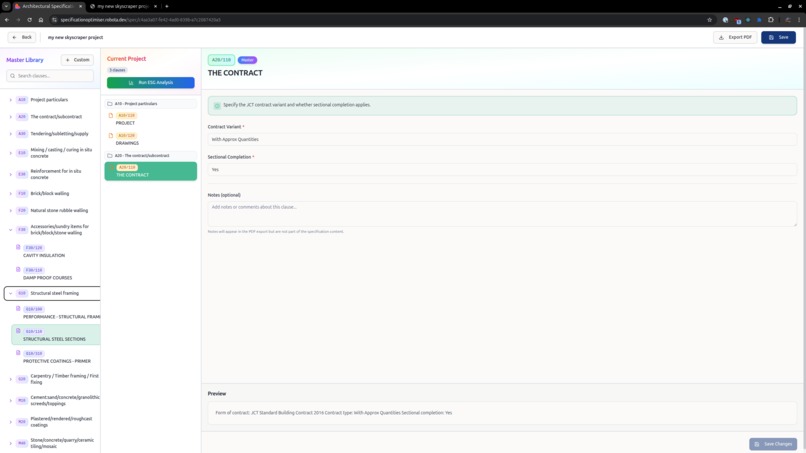
Main interface and CAWS Builder prototype
-
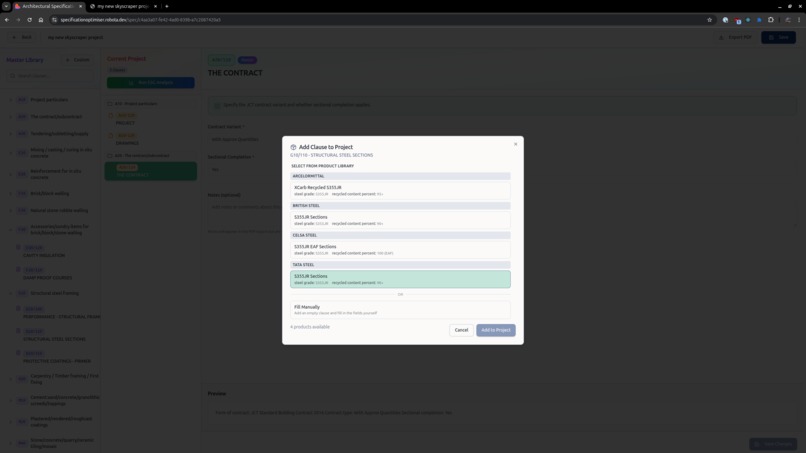
Automated Filling of new section with options from Vendor Library
-
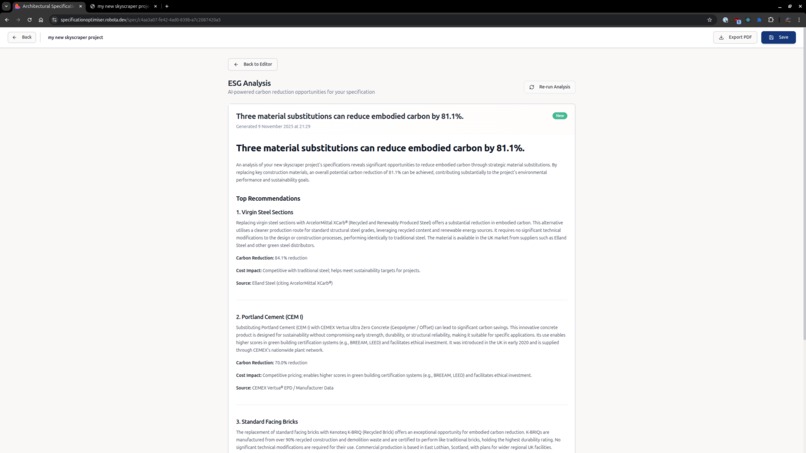
suggested substitutions and replacements to improve CO2 balance


Inspiration
Architectural specifications are the detailed, structured, and legally binding documents that define the required materials, components, quality standards, and workmanship for a building project, serving as the definitive quality control blueprint.
The project was inspired by the daily professional challenges faced by our team member, Carmen, a practicing architect. Existing specification building tools exist in the UK but they're a near monopoly and very expensive with enterprise pricing, with smaller practices and independent professionals unable to afford them. Our goal was to create an efficient, affordable, and highly functional alternative focused on sustainability.
What it does
The Architectural Specification AI Green Optimiser is a web-based platform designed to create regulatory-compliant construction specifications and integrate intelligent sustainability analysis.
It addresses two primary needs:
- Efficiency: It allow users to assemble CAWS-compliant specifications (one of the official standards for such jobs) from a master library of clauses, significantly reducing the time spent on documentation.
- Environmental Optimization: the AI scans the compiled specification text. It uses the Gemini API to identify material selections and then proposes lower-carbon alternatives. This analysis provides the user with data on estimated carbon savings and their cost impact, both key information to have in modern construction
How we built it
We heavily relied on a range of AI technology to speed up development.
Technology Stack:
The application uses TypeScript and React compiled via Vite for the frontend. The backend, including PostgreSQL database, authentication, and serverless Edge Functions, is hosted on Supabase (detached from Lovable own cloud).
AI Integration: The core LLM functionality is provided by the Google Gemini API, integrated via Edge Functions for controlled access and rate limiting.
Development: We utilized various AI tools for rapid prototyping and code generation, including lovable to kick start the process, and Claude Code plus Cursor for accelerated development. Gemini was used to iterate on the idea, and help refine the requirements for implementation and track the high level progress of things, trying to keep a conceptual separation between tools for implementation and tools for ideation.
Deployment: The application is deployed to Cloudflare Pages with a custom DNS. GitHub Actions handles automatic deployments and database migrations, to adhere to best pratice and be able to iterate quickly
Challenges we ran into
- User Experience Flow: Designing the interface to handle the complexity of the CAWS structure is hard, as it's a highly specialised workflow - the application risk being impenetrable to non-professional audiences.
- Data Population: Sourcing, compiling, and normalizing the necessary material data, vendor information, and embodied carbon properties is highly time-intensive. The solution's utility depends directly on this data density and its accuracy, and this data is not highly digitized or accessible freely - this is problematic in a time constrained environment such as a hackaton.
- Time Constraints: Successfully integrating the full technology stack—frontend, backend, authentication, CI/CD, and the LLM analysis job pipeline—within the strict time limit required tight focus and prioritized feature development.
Accomplishments that we're proud of
We successfully delivered a functional application that goes beyond a mere demonstration. The system is live and accessible via a custom URL, fully deployed with automatic CI/CD and a secure, scalable infrastructure. We achieved a near-MVP state, establishing all core components: a professional specification builder, secure user authentication, and the fully integrated Hybrid Analysis engine. The infrastructure is robust and designed for scale, essentially moving the project from an idea to a deployed product with minimal immediate hosting cost.
What we learned
- While high-level visual prototyping tools like lovable are useful, tools designed for professional coders (Claude Code and Cursor) are still order of magnitude more efficient and fast - but require people to know the software development flows.
- Leveraging LLMs shamelessly for both cretion, implementation, and review, we found that quickly the constraining bottleneck became the product refinement phase, trying to shape the "what's next" and refine features and user journeys enough for them to be implementation level and not leave details down to random choices by the LLMs.
What's next for Architectural Specification AI Green Optimiser
- Data Expansion: this is the main hurdle to go from hackaton to MVP - having a good dataset of vendors is going to be key for this to be actually useful
- User Testing: We plan to maintain the hosted application and invite colleagues working in small firms to use the platform for free - maybe not the AI EGS section as that's the expensive part. This is to gether feedback.
- Cost Management: The current hosting and database costs are negligible (totaling under £20/month for a baseline capacity that is likely to support up to a 1k users). AI features are the main driver of cost, so that's something to be mindful of before offering to people.
Built With
- claude
- cloudflare
- cursor
- gemini
- github-actions
- lovable
- react
- supabase
- typescript
- vite


Log in or sign up for Devpost to join the conversation.