-
-
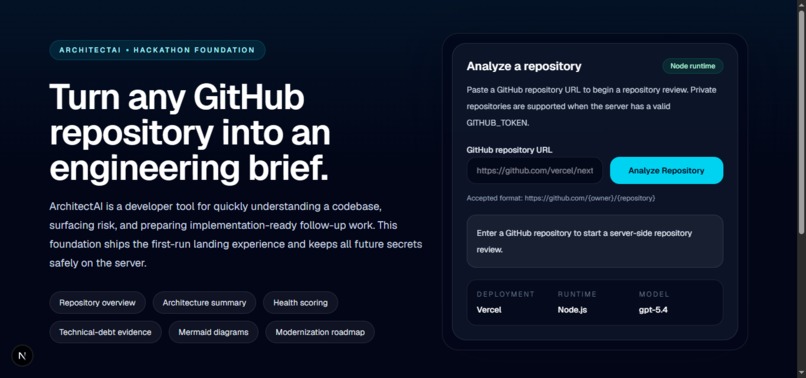
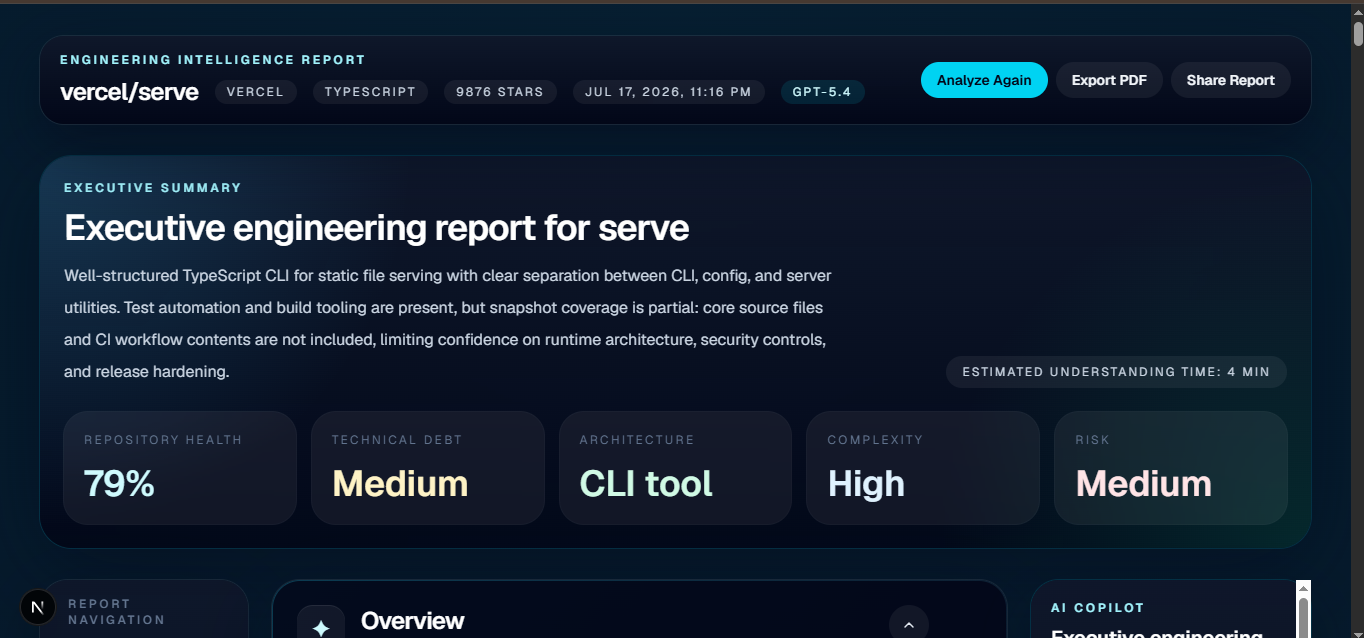
Landing Page
-
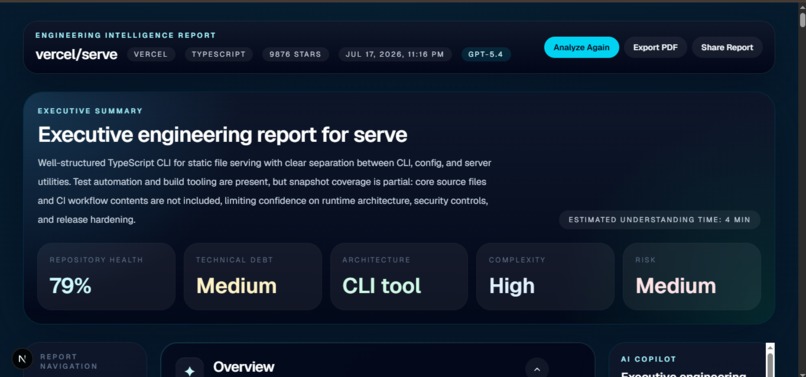
Excutive Summury
-
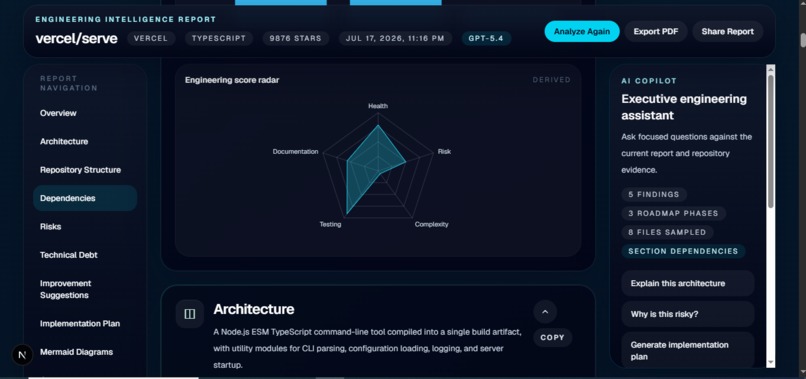
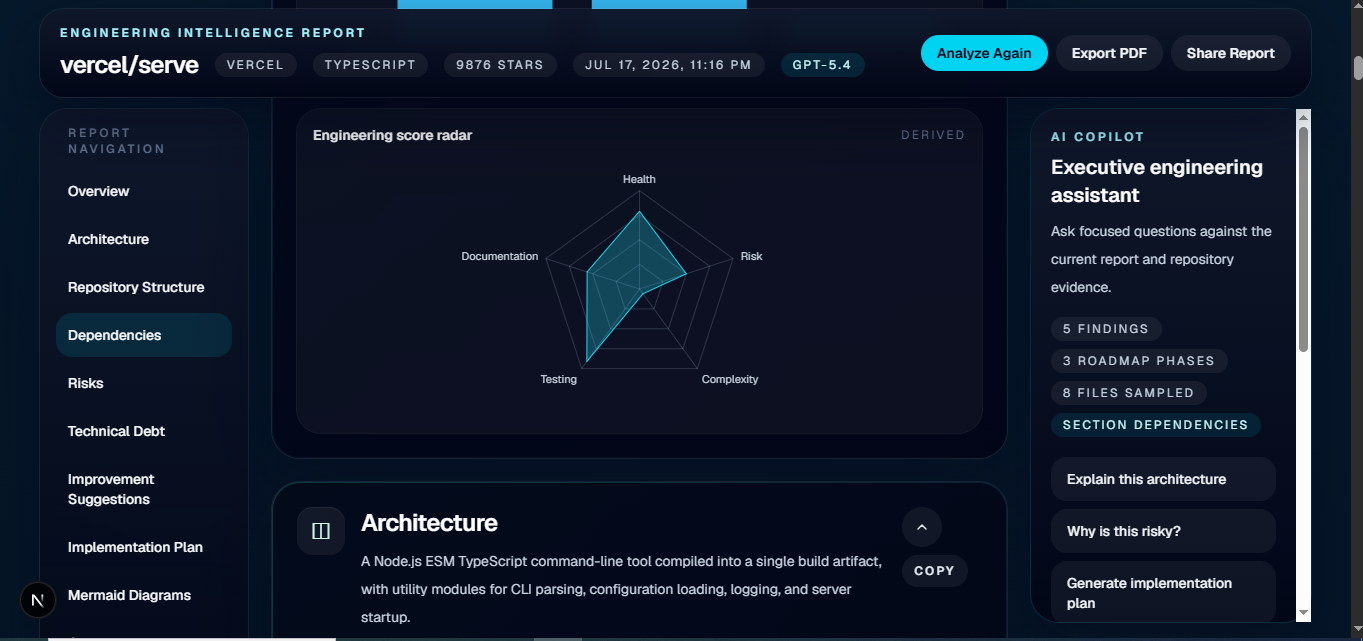
Analysis Workspace
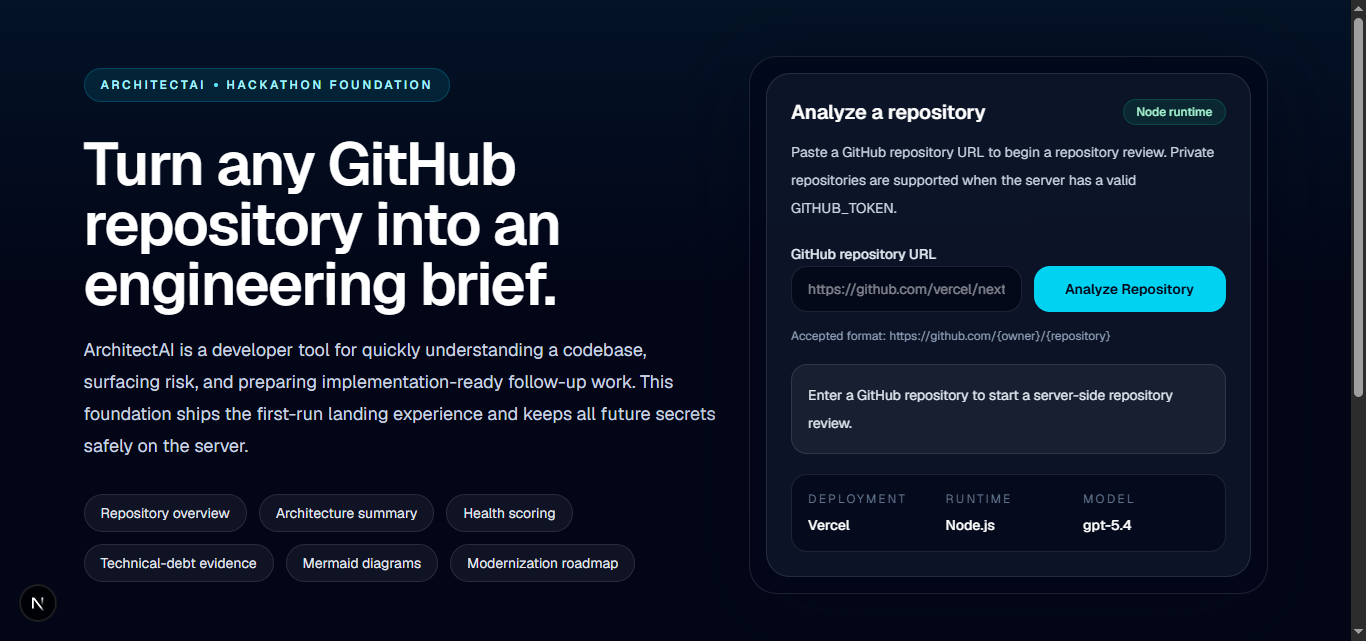
ArchitectAI
Inspiration
Every developer has experienced the challenge of joining an unfamiliar codebase. Before contributing meaningful code, you often spend hours reading documentation, tracing dependencies, and figuring out how different parts of the system fit together. That onboarding process becomes even more difficult when documentation is outdated or incomplete.
I built ArchitectAI to reduce that learning curve. The idea was to transform a GitHub repository into an AI-powered engineering workspace that helps developers understand a project before making changes. Instead of manually exploring hundreds of files, users receive architecture insights, engineering findings, implementation guidance, and an interactive AI Copilot grounded in the repository itself.
What it does
ArchitectAI analyzes a GitHub repository and generates an executive engineering report powered by GPT-5.6.
The application provides:
- A repository overview and technology profile
- Architecture explanations
- Evidence-backed engineering findings
- Potential risks and areas for improvement
- A phased implementation roadmap
- Repository-aware code-change proposals
- An AI Copilot for repository-specific follow-up questions
The goal is to help developers understand a project faster and make more informed engineering decisions.
How I built it
ArchitectAI is built with Next.js, TypeScript, React, Tailwind CSS, and server-side API routes.
The workflow is straightforward:
- A user submits a GitHub repository URL.
- The server validates the repository and retrieves repository metadata, the file tree, README content, and selected source files using the GitHub REST API.
- A repository snapshot is prepared without cloning or executing the repository.
- GPT-5.6 analyzes that snapshot and generates structured architecture summaries, engineering findings, and implementation roadmaps.
- The frontend presents the results through an interactive engineering dashboard with an integrated AI Copilot.
Throughout development, I used OpenAI Codex as an engineering assistant to inspect the existing codebase, implement new features, debug issues, improve the user interface, refine workflows, and verify changes through iterative development. GPT-5.6 powers the repository analysis performed inside the application.
Challenges I ran into
One of the biggest challenges was deciding how much repository context to send to the model. Sending too much information increased cost and response time, while sending too little reduced the quality of the analysis.
Other challenges included:
- Supporting repositories with different languages and project structures.
- Designing prompts that consistently produced structured engineering reports.
- Grounding AI responses in repository evidence rather than generic explanations.
- Balancing analysis quality with token usage and response time.
- Presenting large amounts of engineering information in a clean, developer-friendly interface.
Accomplishments that I'm proud of
I'm proud that ArchitectAI became much more than a repository summarizer.
Some of the accomplishments include:
- Building a complete end-to-end repository analysis workflow.
- Creating an executive engineering dashboard instead of returning raw AI responses.
- Integrating an interactive AI Copilot for repository-specific questions.
- Generating implementation roadmaps and repository-aware code-change proposals.
- Delivering a polished developer experience that combines architecture understanding, engineering guidance, and AI-assisted exploration in one application.
What I learned
This project reinforced how important context selection and prompt engineering are when building applications with large language models. The quality of the output depends just as much on preparing the right repository evidence as it does on choosing the model.
I also learned that building AI developer tools requires careful attention to user experience. Even strong AI-generated insights become much more valuable when they are presented in a structured, easy-to-explore interface.
Working with OpenAI Codex throughout development also showed me the value of iterative engineering—building features incrementally, reviewing changes, validating them, and continuously refining both the implementation and the user experience.
What's next for ArchitectAI
ArchitectAI has already been tested successfully on Laravel and Vercel-based repositories, where it produces useful architecture summaries, engineering findings, and implementation guidance. As development continues, I plan to expand testing across more languages, frameworks, and repository structures to further improve analysis quality and confidence.
The roadmap includes:
- Expanding validation across additional ecosystems such as Python, .NET, Go, Java, and mobile projects.
- GitHub OAuth and a more complete private repository workflow.
- Persistent report history and sharing.
- Team collaboration features.
- Deeper dependency and architecture analysis.
- Automatically generated architecture diagrams.
- Pull request review assistance.
- Issue generation from implementation roadmaps.
- CI/CD integration.
- Better support for very large enterprise repositories.
My long-term goal is to make ArchitectAI a practical engineering assistant that helps developers understand unfamiliar codebases, onboard faster, and make better technical decisions regardless of the technology stack.
Built With
- github
- gpt-5.6
- next.js
- node.js
- openai
- react
- tailwind
- typescript

Log in or sign up for Devpost to join the conversation.