-
-
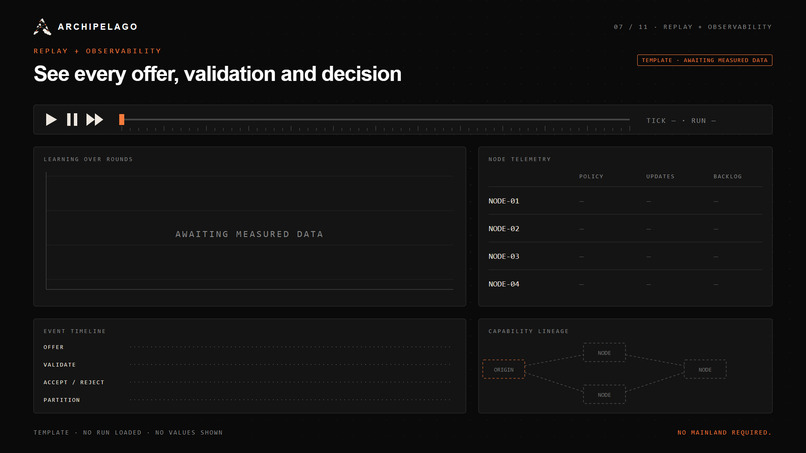
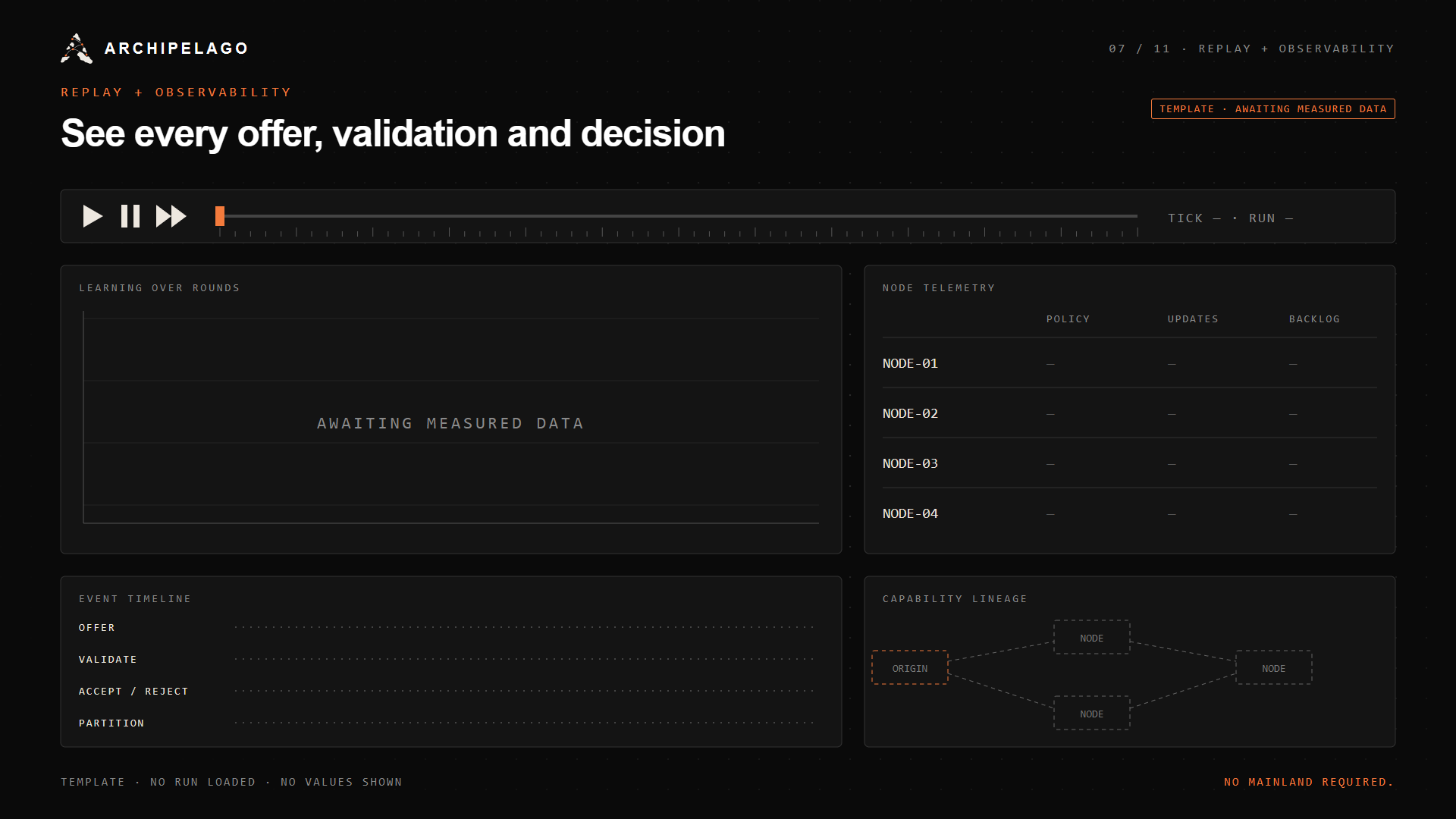
Replay every offer, validation, decision, partition, and capability transfer across the network.
-
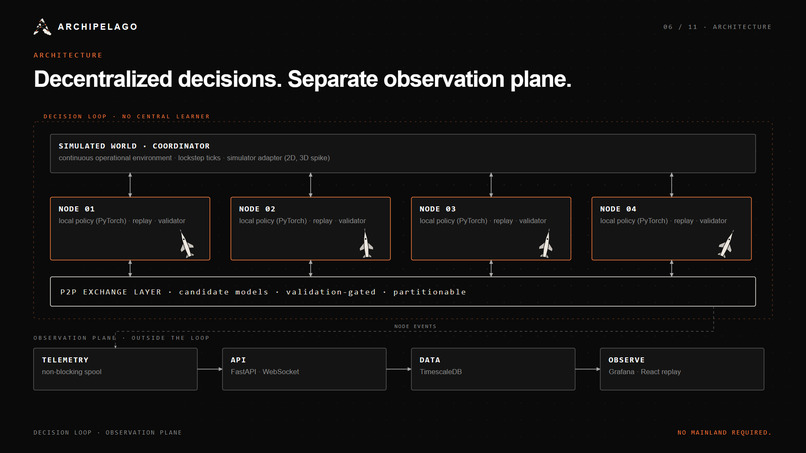
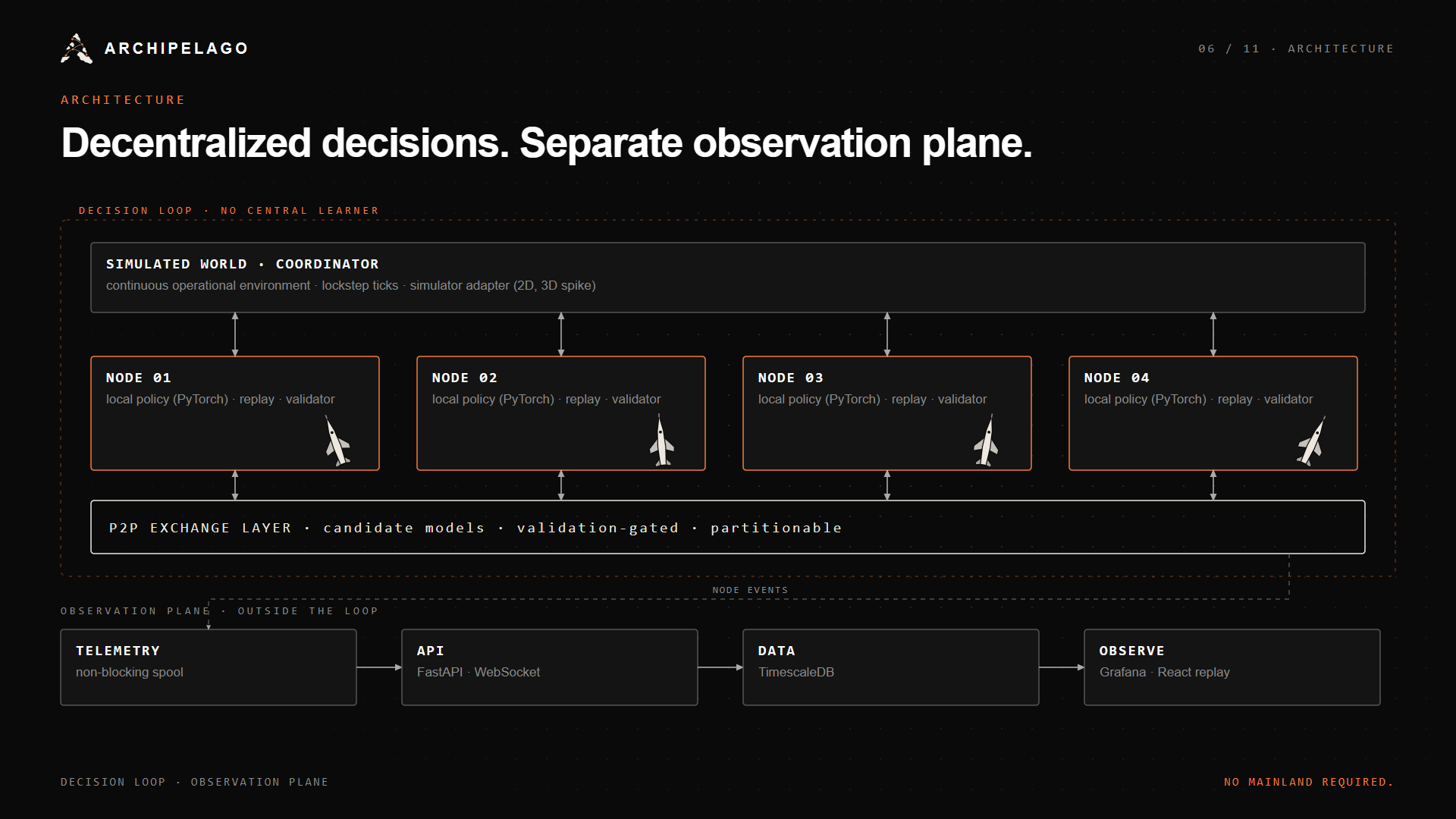
The decision loop stays decentralized while telemetry, APIs, storage, and observability remain separate.
-
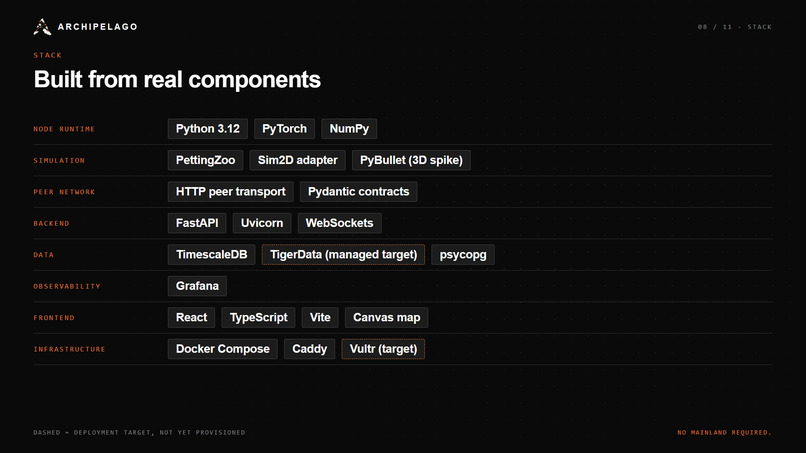
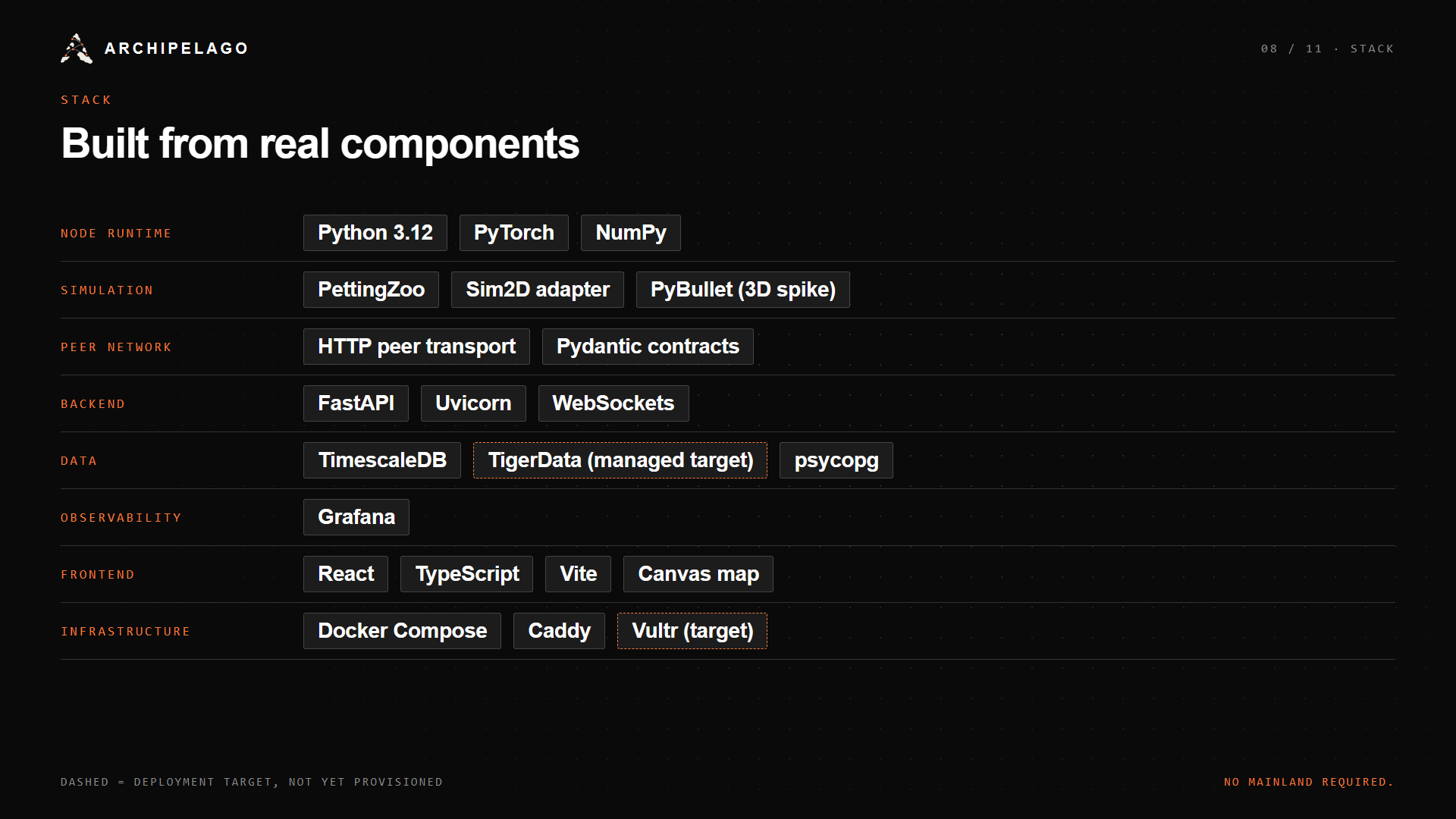
Built with PyTorch, FastAPI, TimescaleDB, React, Grafana, Docker, and peer-to-peer model exchange.
-
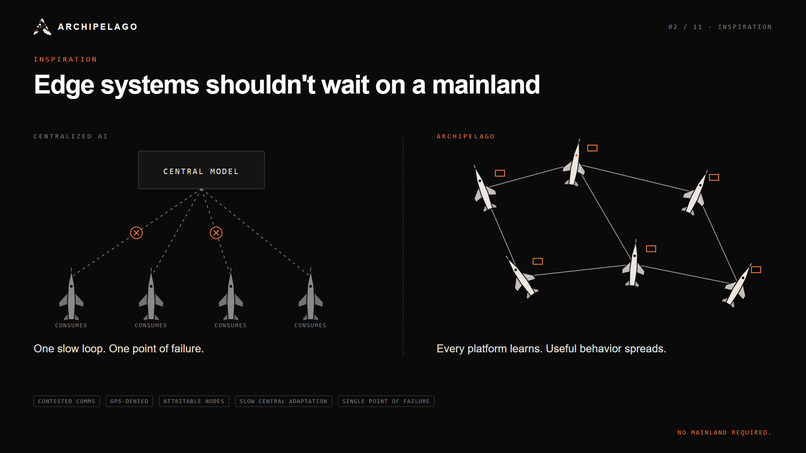
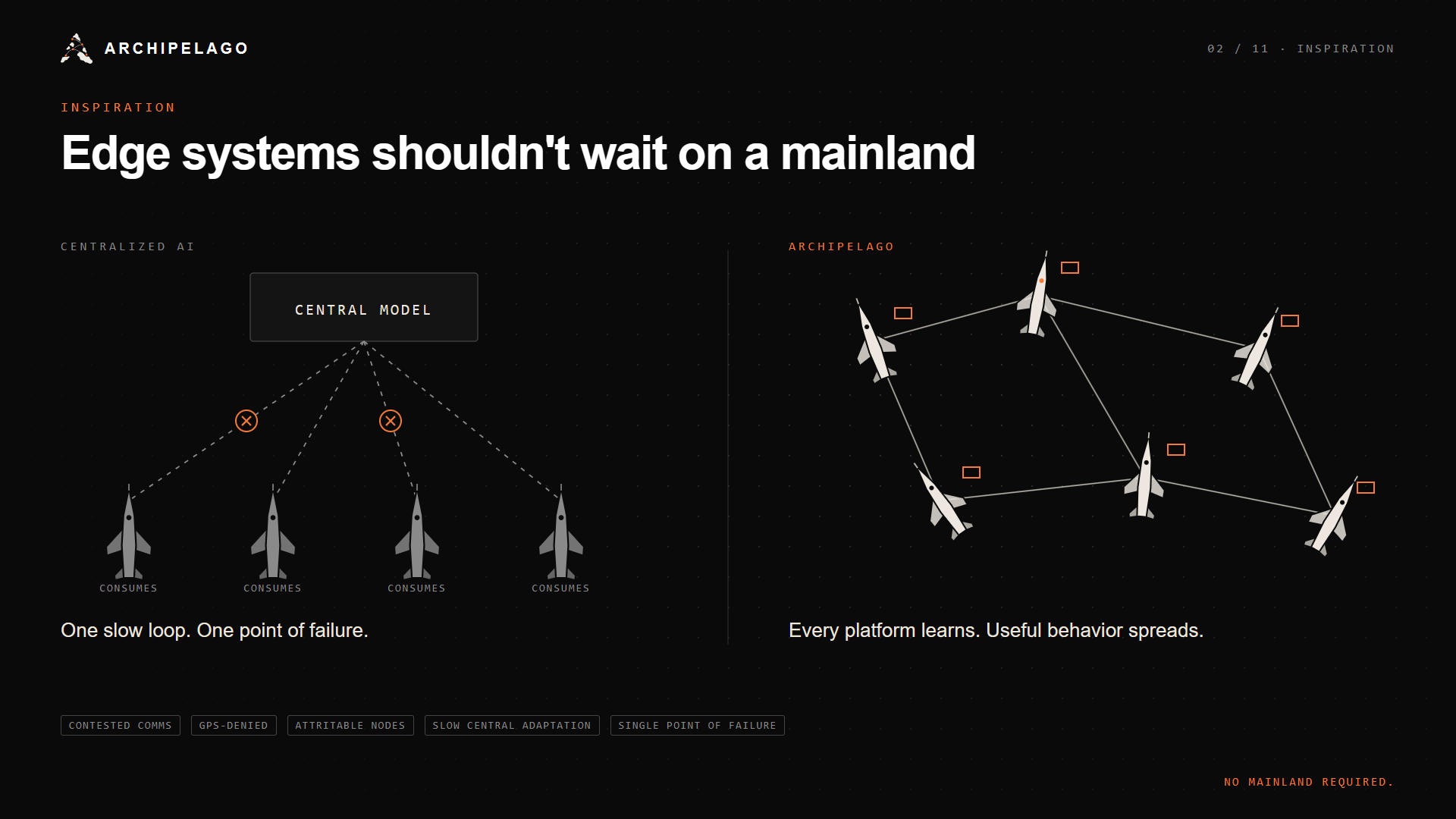
Centralized AI is fragile: edge systems shouldn’t depend on one remote model or communication link.
-
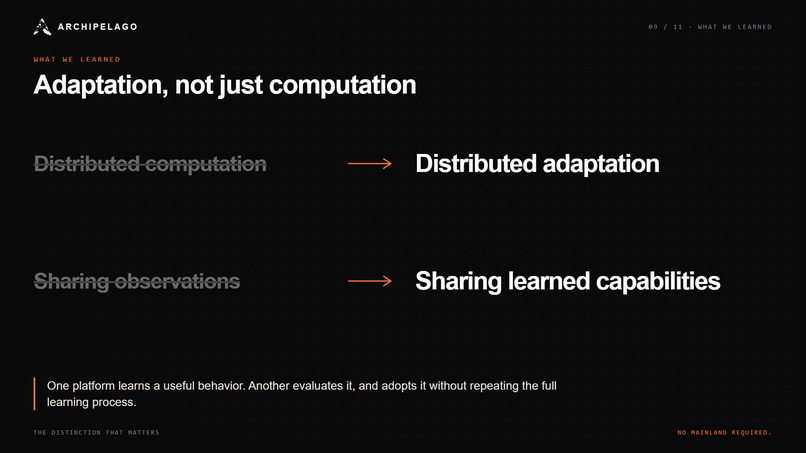
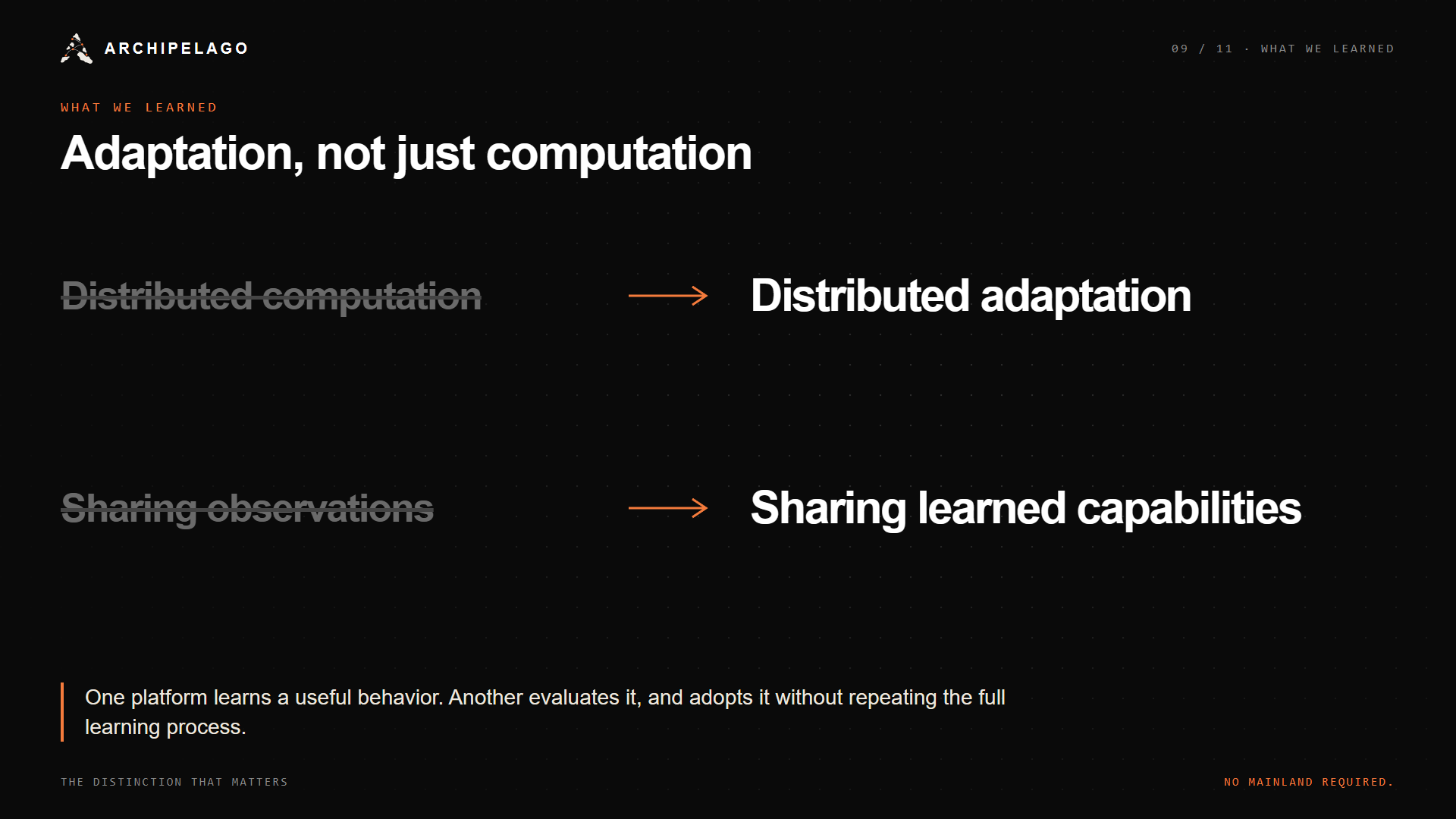
The shift: not distributed compute, but distributed adaptation through transferable learned capabilities.
-
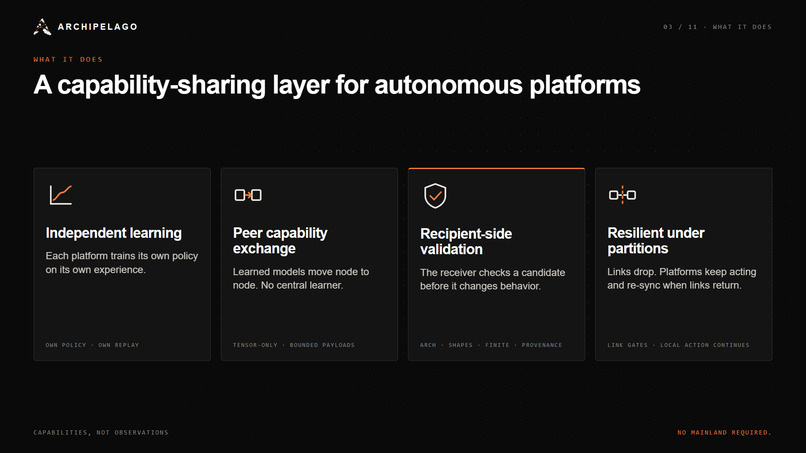
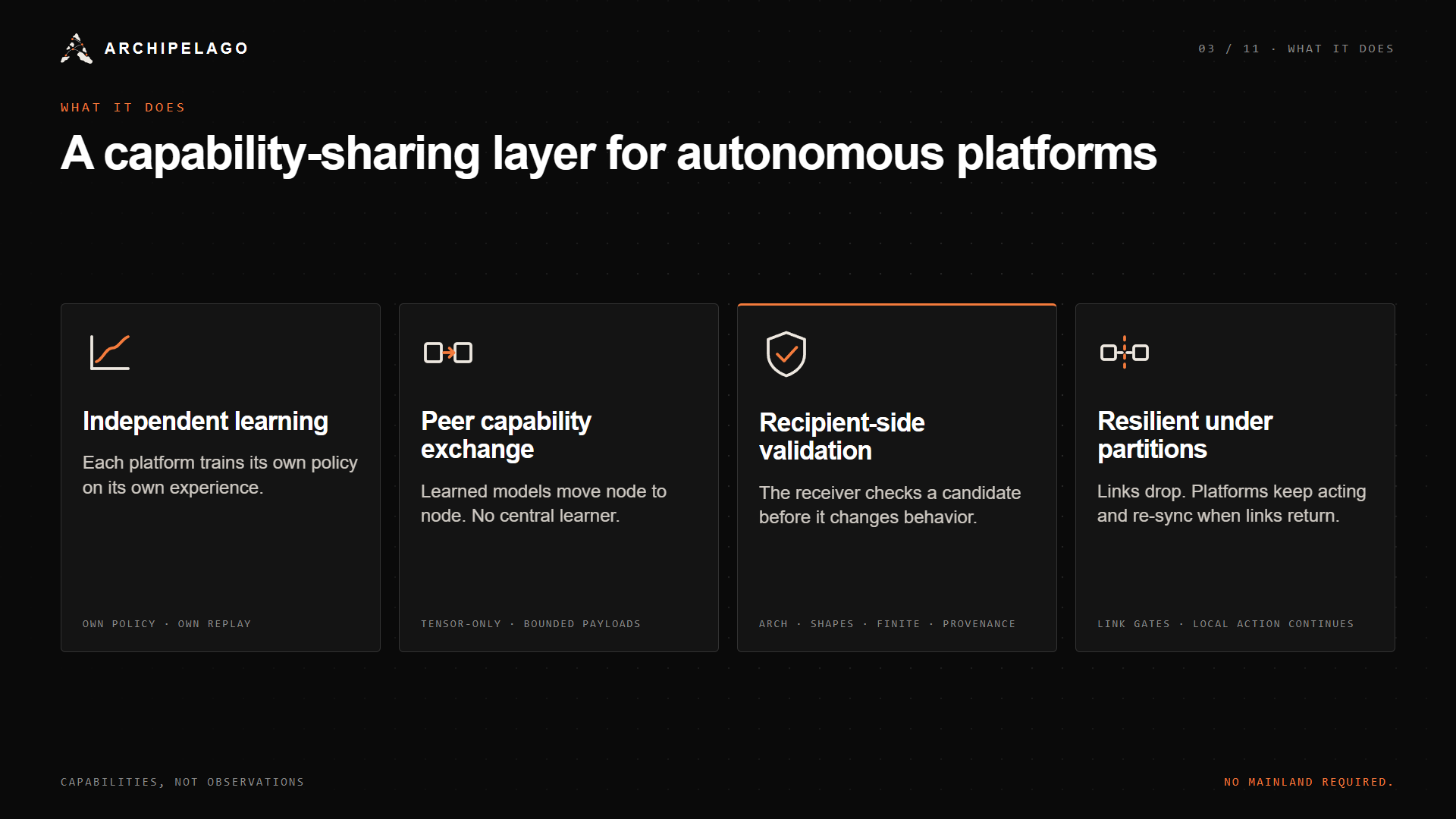
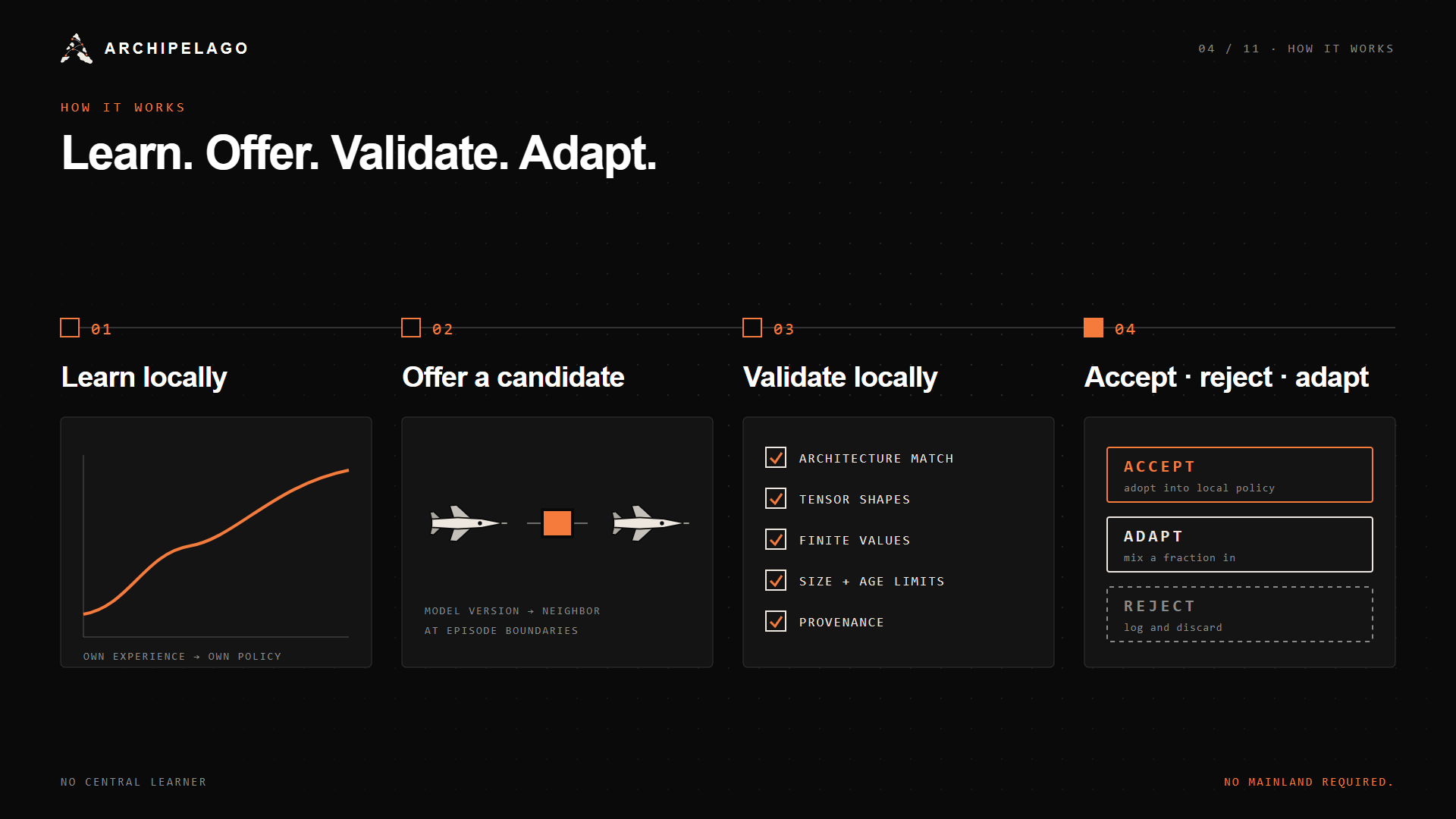
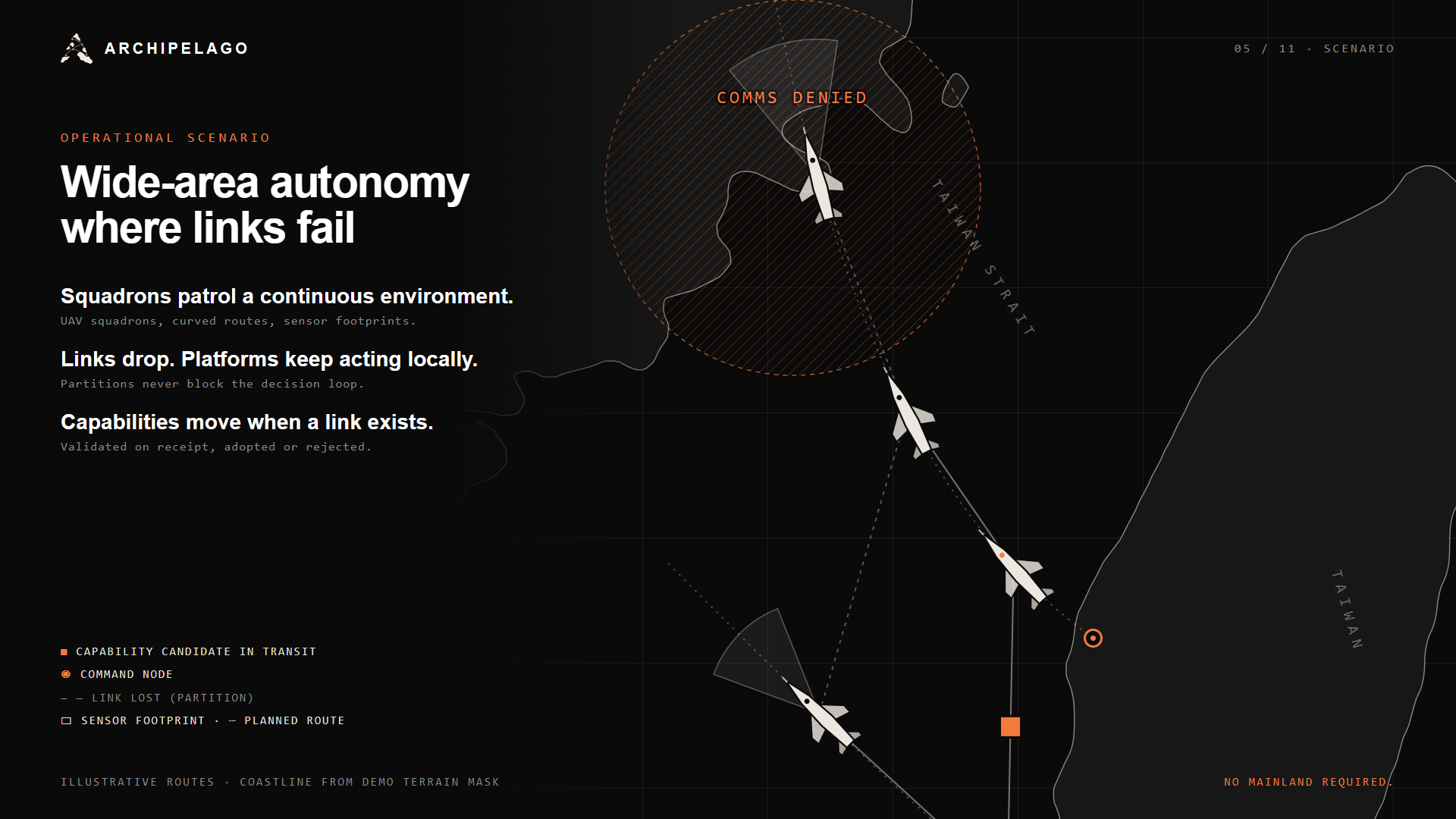
Each platform learns locally, shares capabilities, validates peers, and keeps operating through network partitions.
-
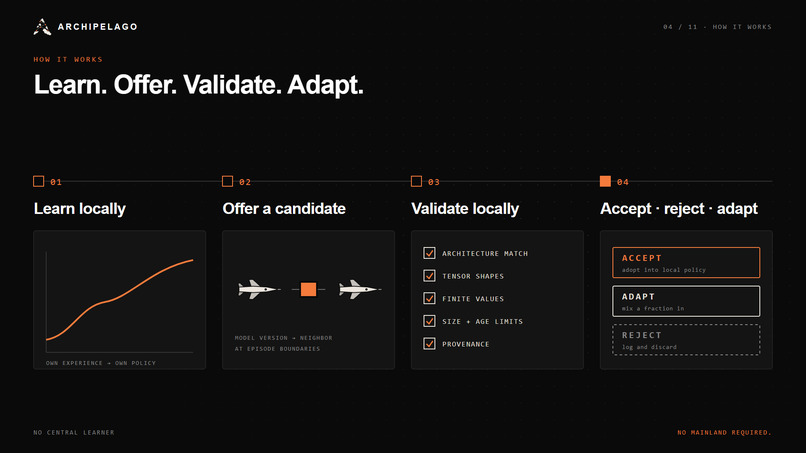
Learn. Offer. Validate. Adapt. Nodes exchange useful learned behaviors without a central learner.
-
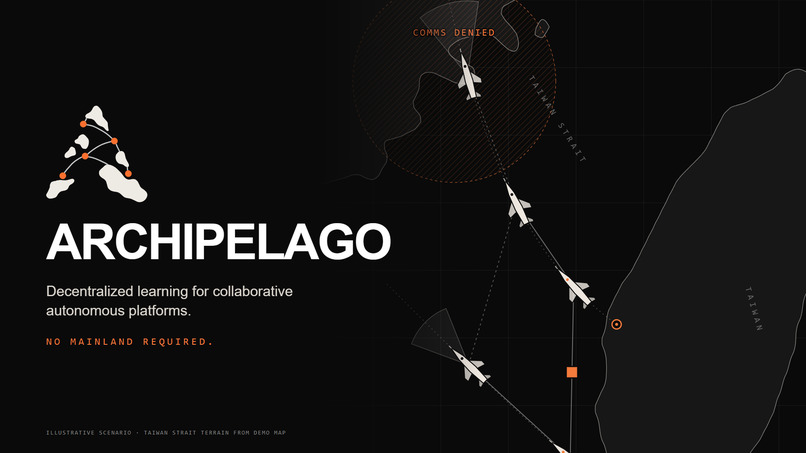
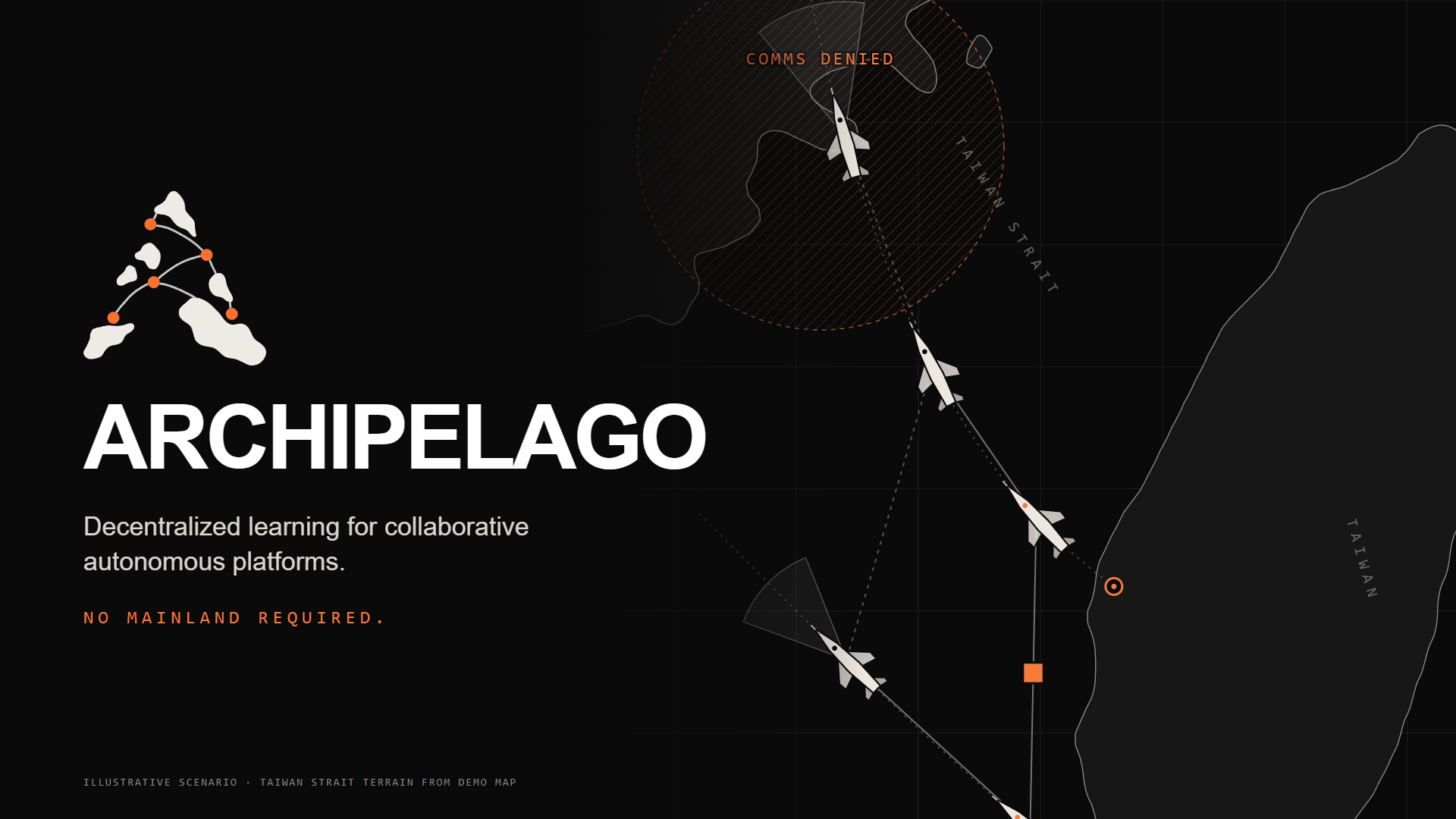
ARCHIPELAGO: Decentralized learning for autonomous platforms that adapt without relying on centralized AI.
-
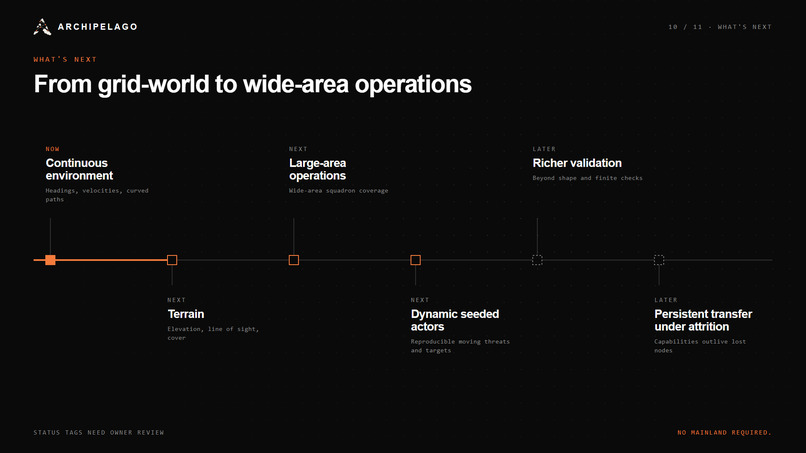
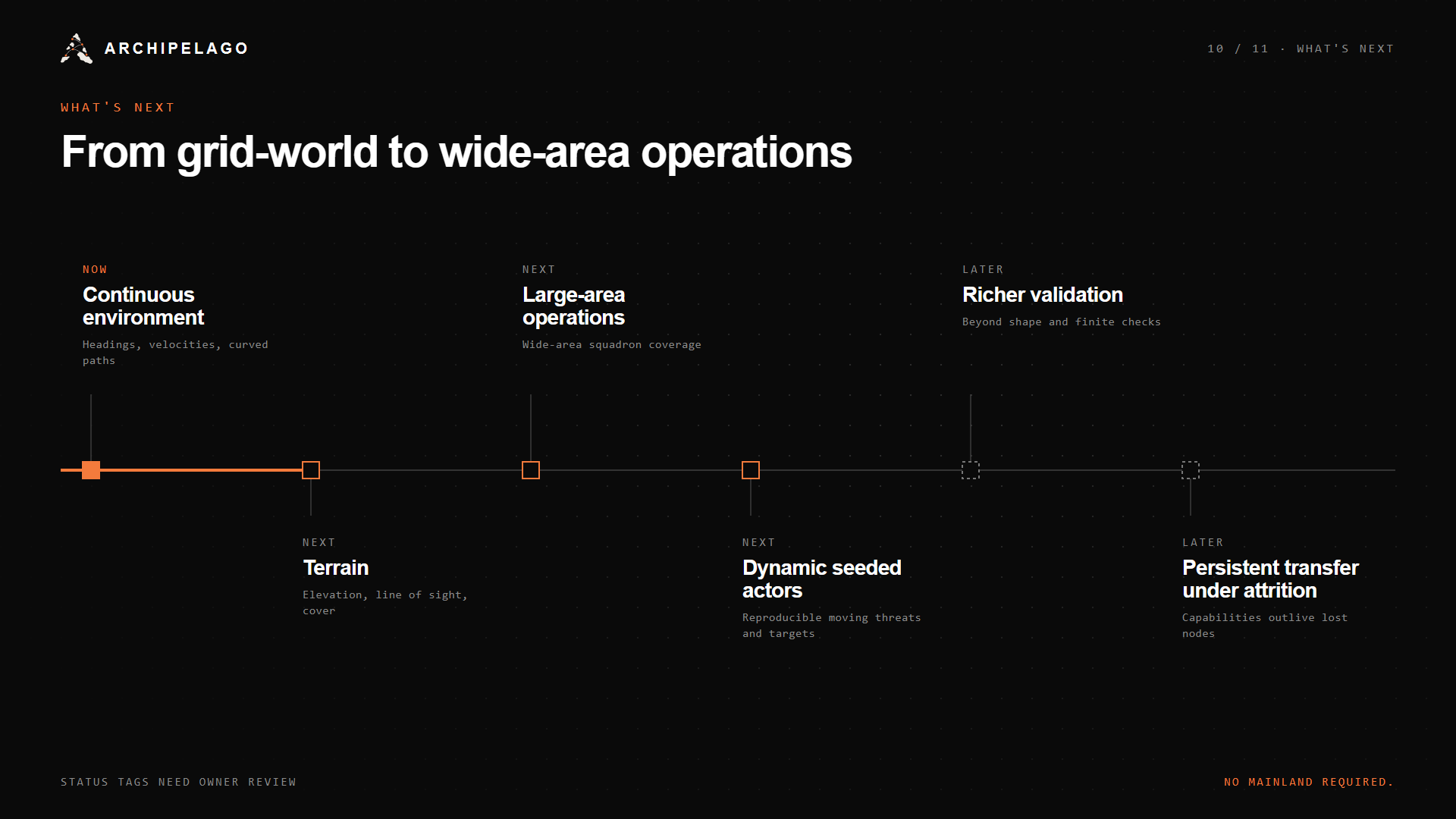
Next: terrain, wide-area operations, dynamic actors, richer validation, and persistent capability transfer.
-
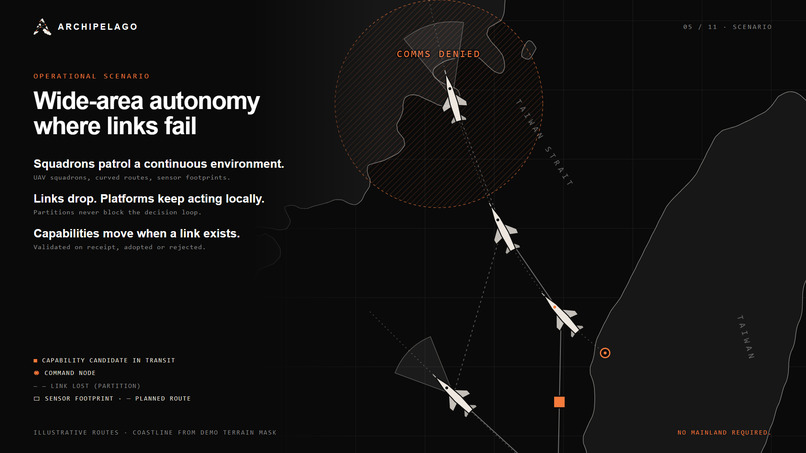
When links fail, platforms keep acting locally and share validated capabilities when connectivity returns.
-
Inspiration
AI today is remarkably capable, but the way we deploy it is still deeply centralized.
Most intelligent systems depend on massive data centers where models are trained, updated, and served back to edge devices. A robot, drone, sensor, or autonomous system may be physically independent, but much of its intelligence still originates somewhere else.
That made us ask a simple question:
What would AI look like if intelligence could move between machines instead of always coming from the cloud?
We started thinking about BitTorrent. BitTorrent changed how files could be distributed by removing the assumption that every user needed to retrieve them from one central server. Instead, peers could exchange pieces directly with one another.
We wondered whether a similar idea could apply to machine intelligence.
Instead of every device independently solving the same problems—or constantly communicating with a centralized AI service—what if machines could discover useful capabilities learned by nearby peers, exchange them, validate them, and build on them?
That question became ARCHIPELAGO.
Importantly, we did not want decentralization simply for the sake of decentralization. During development, we repeatedly questioned whether a peer-to-peer architecture was actually useful or just a more complicated replacement for running a model locally.
That pushed us toward a more precise idea:
ARCHIPELAGO is not trying to replace centralized AI. It is an intelligence layer for groups of edge systems that need to continue learning, adapting, and collaborating when centralized infrastructure is unavailable, inefficient, or undesirable.
What it does
ARCHIPELAGO creates a decentralized network in which intelligent edge nodes can communicate directly and share learned capabilities.
Imagine several autonomous systems operating in the same environment.
One node encounters something new and develops a useful behavior or model update. Traditionally, every other node would either need to independently discover the same solution or wait for that information to travel through centralized infrastructure.
With ARCHIPELAGO, that capability can propagate through the local network.
Nodes can:
- discover other peers in the network,
- advertise capabilities they possess,
- exchange model artifacts or learned updates,
- evaluate and verify information received from other peers,
- maintain local knowledge even when disconnected from a central service,
- and allow useful intelligence to spread across the network.
The result is a system where learning becomes a property of the network, not just an individual machine.
Our demonstration uses simulated autonomous nodes to make that idea visible. A capability initially exists on only part of the network. As nodes communicate, knowledge propagates between them until previously isolated systems can benefit from what another node learned.
Rather than treating every edge device as a thin client connected to one enormous brain, ARCHIPELAGO treats the network itself as a distributed source of intelligence.
How we built it
We approached ARCHIPELAGO as both a distributed systems problem and an AI problem.
At the lowest level, we needed independent nodes that could operate without assuming a permanent central coordinator. Each node therefore maintains its own local state and participates in a peer-to-peer capability network.
On top of that, we built the mechanisms necessary for nodes to communicate what they know, identify capabilities available elsewhere in the network, and transfer useful artifacts between peers.
For the demo, we created a simulation representing multiple autonomous agents operating as independent ARCHIPELAGO nodes. This allows us to visualize nodes joining the network, discovering one another, exchanging information, and gradually increasing the collective capabilities of the swarm.
We use Vultr as the cloud infrastructure behind the live demonstration, giving us an environment where the distributed services and simulation can run independently from our development machines.
We use TigerData as the persistence and telemetry layer. Instead of treating the simulation as a black box, we record network events over time—such as capability discovery, propagation, and node activity—so that the behavior of the distributed system can be inspected and visualized.
Finally, we built a web interface that turns what would otherwise be invisible network traffic into something understandable: individual nodes, their connections, the capabilities they currently possess, and the movement of intelligence throughout the system.
The dashboard is not merely a visualization. It became one of the most important parts of the project because distributed systems are difficult to understand when their behavior is hidden behind logs and terminal windows.
Challenges we ran into
The hardest part of ARCHIPELAGO was realizing that decentralization is not automatically an advantage.
A centralized server makes many problems easy. It provides a source of truth. It knows which nodes exist. It can distribute updates consistently. It can coordinate the network.
The moment that server disappears, all of those assumptions disappear with it.
We had to think about questions such as:
- How does a node know what another node has learned?
- What exactly should be transferred between machines?
- How do nodes determine whether an incoming capability is useful or trustworthy?
- What happens when nodes disconnect and reconnect?
- How do we observe a distributed system without accidentally turning the observer into the system's central controller?
We also ran into a classic hackathon problem: our architecture grew much faster than our available time.
ARCHIPELAGO touches networking, distributed systems, AI, simulation, infrastructure, databases, and frontend visualization. Early on, we sometimes tried to solve too many production-scale problems at once.
Eventually, we changed our approach.
Instead of attempting to build every component of the eventual platform, we focused on proving one central idea:
Can useful machine intelligence originate at one node and visibly propagate through a decentralized network to other nodes?
Once we centered the project around that question, the rest of the architecture became much clearer.
Accomplishments that we're proud of
The accomplishment we are most proud of is not any individual feature. It is that ARCHIPELAGO evolved from an abstract idea into a system we could actually reason about and demonstrate.
We started with the broad concept of "peer-to-peer AI."
By the end, we had a much stronger definition of what that could mean: a network where independent intelligent systems can discover, exchange, and accumulate capabilities without assuming that every interaction must pass through a central intelligence provider.
We are also proud that the project crosses several traditionally separate layers of computing.
ARCHIPELAGO connects:
- artificial intelligence,
- distributed systems,
- edge computing,
- networking,
- cloud infrastructure,
- time-series telemetry,
- autonomous systems,
- and human-readable visualization.
Building the demo forced us to think about how all of those layers interact rather than treating AI as an isolated model sitting behind an API.
What we learned
The biggest thing we learned is that the interesting future of edge AI may not simply be putting increasingly powerful models onto increasingly small devices.
The more interesting question may be how those devices collaborate once they are intelligent.
If ten autonomous systems encounter ten different pieces of information, there is enormous value in allowing the group to accumulate that knowledge instead of forcing every machine to learn everything independently.
We also learned that there is an important distinction between distributed compute and distributed intelligence.
Splitting inference across machines is distributed compute.
Allowing knowledge or capabilities discovered by one machine to become useful to another machine is much closer to the problem ARCHIPELAGO is trying to explore.
Finally, we learned that good infrastructure should disappear underneath the applications built on top of it.
A drone network is one possible application. So are robots, vehicles, industrial systems, sensors, or groups of edge devices we have not imagined yet.
ARCHIPELAGO should not need to know what those machines are.
It should simply give them a way to share what they know.
What's next for ARCHIPELAGO
The hackathon prototype focuses on demonstrating capability propagation.
The next step is turning that mechanism into a genuine protocol for distributed machine intelligence.
We want to explore stronger capability verification, reputation and trust between peers, versioning of learned artifacts, heterogeneous hardware, intermittent networking, bandwidth-aware synchronization, and mechanisms for deciding when knowledge should—or should not—propagate through a network.
We also want to move beyond simulation.
A major milestone would be deploying ARCHIPELAGO across real heterogeneous edge devices and allowing a capability learned or introduced on one physical machine to propagate to others without relying on a centralized coordinator.
Long term, we see ARCHIPELAGO as infrastructure rather than a single application.
Cloud computing gave software access to effectively unlimited centralized computation.
Edge computing moved computation closer to the physical world.
ARCHIPELAGO explores the layer that may come next: machines that do not just compute at the edge, but learn from one another there.
Built With
- docker
- fastapi
- postgresql
- python
- react
- tigerdata
- typescript
- vultr
- websockets


Log in or sign up for Devpost to join the conversation.