-
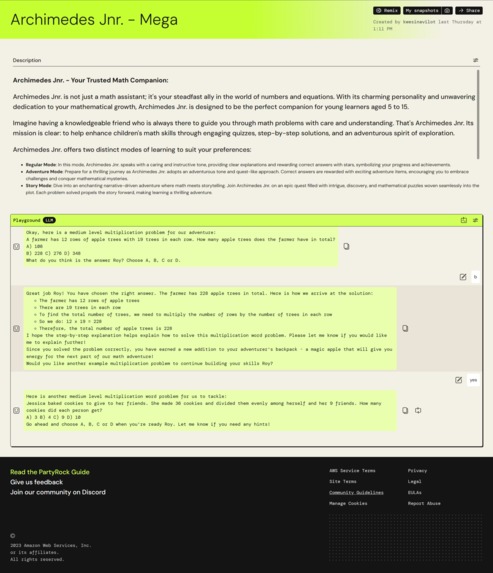
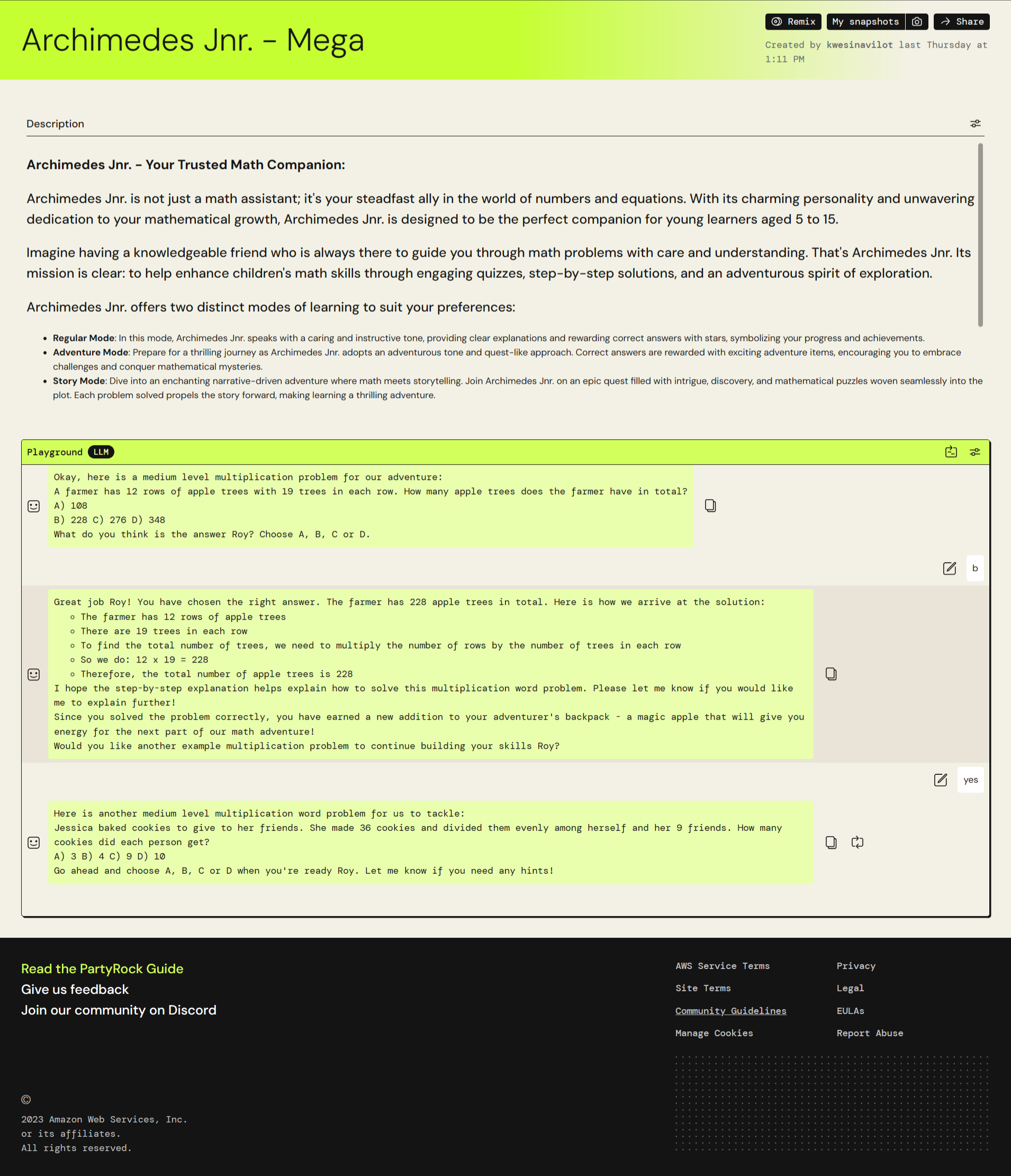
A fullscreen view of the app on a laptop
Inspiration
The inspiration for Archimedes Jnr. stems from my passion for making learning enjoyable and accessible, especially in when it comes to mathematics. It is common knowledge that traditional approaches to teaching math are dry and repetitive, often failing to captivate young learners. I wanted to create a tool that not only helps children understand mathematical concepts but also instills in them a love for the subject by turning it into a thrilling adventure.
What it does
Archimedes Jnr. offers a dynamic and immersive learning experience for children aged 5 to 15. Learners choose the topic area and the difficulty level they want to practice with. The app presents learners with quizzes to which they must respond. Appropriate responses are given based on the user's response and clear, step-by-step solutions to the problem are given to the user to aid their understanding of the problem and topic area. It provides three unique modes: Regular, Adventure, and Story. In Regular mode, users can solve math problems with personalized guidance where the AI speaks in a caring and instructive tone, providing clear explanations and rewarding correct answers with stars. Adventure mode presents exciting quests that blend math challenges with narrative elements. Correct answers are rewarded with exciting adventure items, encouraging learners to embrace challenges and conquer mathematical mysteries. In Story mode, users embark on captivating adventures where math drives the plot, making learning an engaging and memorable experience.
How I built it
I built the app using the PartyRock platform, an Amazon Bedrock playground. PartyRock makes learning easy with a hands-on, code-free app builder. To build the app, I first read the partyrock guide to understand the components (Widgets) available and how the system works.
After familiarizing myself with the widgets, features and underlying models, I first experimented by building a space education app called SpaceMan. SpaceMan serves as a knowledge centre where questions about the planets and solar system can be asked, and SpaceMan will answer them and generate an image to match. For SpaceMan, I used the Chatbot and Image Generation widgets where the Image Generator listened on the Chatbot and generated an image that matches what's being discussed.
After I gained enough competency of the PartyRock platform, I started building Archimedes Jnr. The current app is actually the 4th iteration of the idea. The first iteration had 5 widgets; an User Input widget to collect the math topic, another User Input to get the difficulty level, a Text Generation widget that generated a math problem based on the supplied topic and difficulty level, another Text Generator that generates multiple answers to the generated problem and the last Text Generation widget to generate the step by step solution of the problem. This iteration is called Archimedes Jnr - Zero
In the second iteration, I used only a Chatbot widget but engineered a comprehensive prompt logic so that I didn't need the other components. I used the Claude model because it was more stable in my experience. I used a temperature of 0.7 to increase the creativity of the model while maintaining a degree of consistency in the overall learning experience. This is what became the Regular mode. This iteration is called Archimedes Jnr - Regular. Still with the intention of making practicing math interactive, I remixed the Regular iteration and gave the AI a new tone all together. This time around, it was to be the sidekick of an adventurer who was on a quest through math. The app adopted an adventurous tone, rewarding users with items when they answered questions correctly. This iteration became Archimedes Jnr - Quest
I then got the idea to merge the last 2 iterations of the app into one to provide more options and a robust experience. I added the Story mode to increase the offerings and value. I was still using the Claude LLM with a temperature of 0.7 but I increased the Top P to 0.9 to provide the model with a wider range of possible words and answer choices when generating math problems, explanations, and potentially the storylines (in Story mode). I had to reengineer the prompt for the underlying LLMs to act in the right way based on the user's selection. This included a lot of testing and tweaking of the prompt. But when I shared it with people, especially the target users, I got a lot of positive feedback about how kids are captivated by the app.
Challenges we ran into
The challenges I encountered during the development of Archimedes Jnr. were significant yet surmountable. One major challenge I faced was getting the model to adhere strictly to my prompts. I found that I had to use UPPERCASE letters for strict instructions I wanted the model to follow. Examples are instructing the model to only answering questions related math and within the comprehension range of kids 5-15. Additionally, I faced the challenge of delicately managing emotions and steering users back to the topic when they digressed.
Another obstacle was the absence of a clear method for separating prompts. Ideally, I wanted to segregate the logic and detail how the app should respond based on user inputs. However, I had to resort to lengthy prompts with self-imposed means of delineating the logic for the various modes.
Furthermore, extensive testing was necessary to anticipate and address unforeseen queries, ensuring the app's responsiveness and adaptability to a wide range of user interactions.
Despite these challenges, perseverance and strategic problem-solving enabled me to overcome each obstacle, resulting in the creation of an app that seamlessly guides users through an engaging and personalized math learning experience.
Accomplishments that I'm proud of
I take pride in several accomplishments achieved throughout the development journey of Archimedes Jnr. The foremost achievement is successfully navigating the complexities of prompt engineering to ensure the model's adherence to specific instructions. By employing UPPERCASE letters for strict directives, I effectively guided the model to respond only to math-related queries suitable for children aged 5-15, while gently managing emotions and steering users back on topic when necessary.
Moreover, overcoming the challenge of integrating diverse modes within the app, such as Regular, Adventure, and Story, was a significant milestone. Seamlessly blending these modes to offer a comprehensive and engaging learning experience required meticulous planning and execution. Additionally, developing a robust testing framework to anticipate and address unforeseen queries ensured the app's responsiveness and adaptability.
Receiving positive feedback from users, especially within my target demographic, further validates these achievements. Knowing that Archimedes Jnr. captivates and engages young learners underscores the success of our efforts. These accomplishments fuel my determination to continue refining and enhancing the app, empowering children worldwide to embark on an exciting journey of math mastery.
What I learned
Through building Archimedes Jnr, I gained valuable insights into user-centered design, adaptive learning, and gamification techniques. One key lesson I learned was the importance of giving the AI clear instructions. Utilizing uppercase for important points and writing detailed prompts helped me keep Claude on track, striking a balance between creativity and focus on teaching math. Adjusting settings like temperature and top-p allowed me to fine-tune this balance, though it required some trial and error.
Moreover, I learned the significance of gathering and incorporating user feedback throughout the development process. This iterative approach ensured that the final product resonated with its audience and met their needs effectively. Additionally, I honed my technical skills in project management and problem-solving, essential for navigating the complexities of app development.
Furthermore, I realized that creating an engaging educational app necessitates a deep understanding of user preferences, particularly those of young learners. By prioritizing user-centered design principles, I tailored Archimedes Jnr. to cater to the specific needs and preferences of its target audience.
Most importantly, this project equipped me with valuable technical skills in utilizing platforms like PartyRock and Amazon Bedrock. These skills have significantly expanded my toolkit for creating innovative educational technology solutions, empowering me to tackle future challenges in this domain with confidence.
What's next for Archimedes Jnr.
Moving forward, I plan to continue refining and expanding Archimedes Jnr. I plan to continually expand the content available on Archimedes Jnr. by introducing new math topics, problem sets, and interactive experiences. This will ensure that users have access to a diverse range of learning materials and challenges to keep them engaged and motivated.
As AI technology continues to evolve, I plan to explore the integration of advanced AI models and techniques into Archimedes Jnr. This could include leveraging natural language processing for more intuitive interactions, enhancing problem-solving capabilities, and incorporating real-time feedback mechanisms to enhance the learning experience.
I'm open to collaborating with educators, content creators, and other educational organizations to further enrich the content and features of Archimedes Jnr. Collaborations could involve co-developing new educational modules, hosting virtual learning events, or integrating external resources to provide a comprehensive learning experience.
Ultimately, my goal is to empower children worldwide to develop confidence and proficiency in mathematics through fun and interactive learning experiences.
Built With
- amazon-web-services
- awsbedrock
- partyrock


Log in or sign up for Devpost to join the conversation.