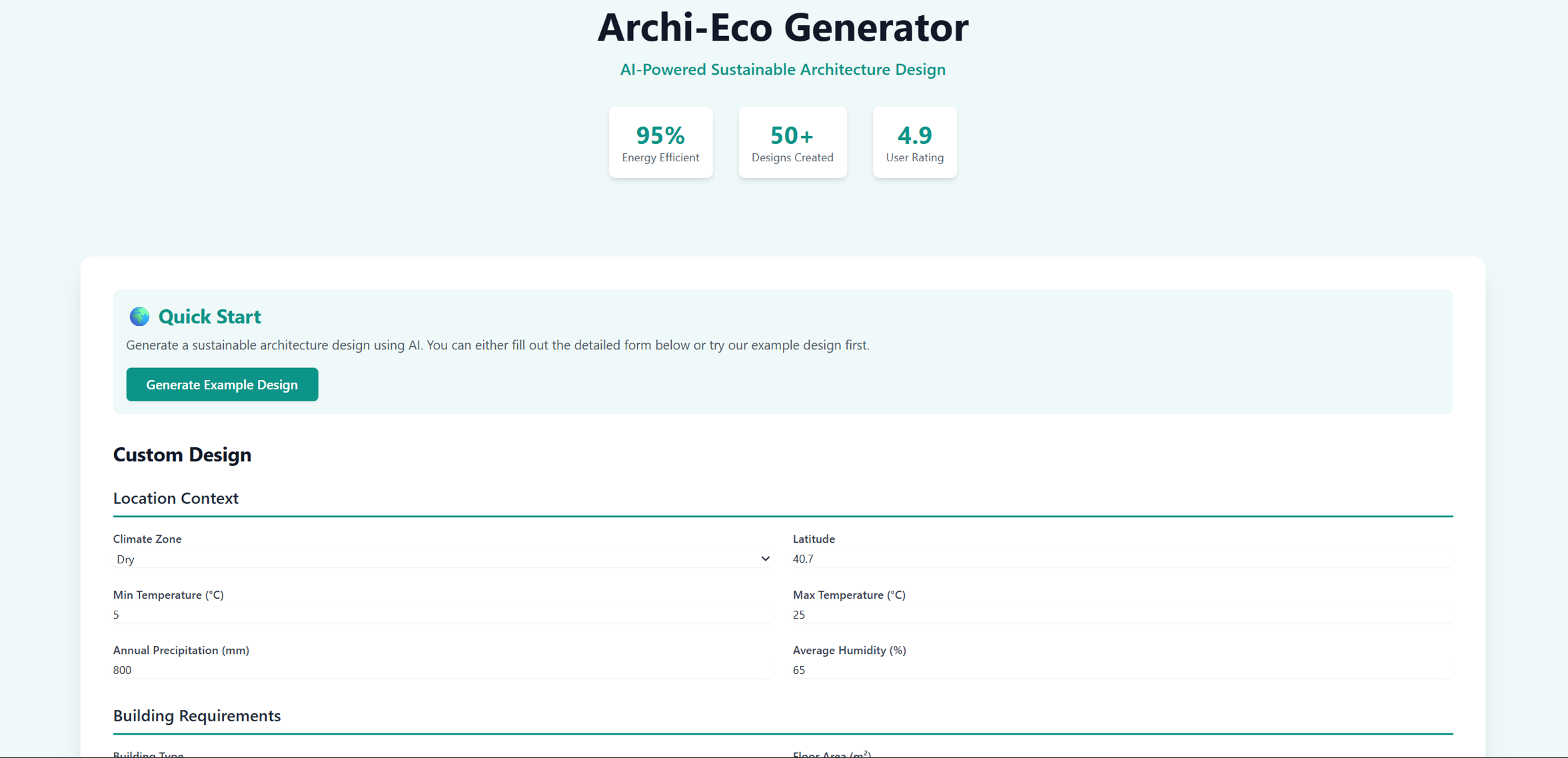
Project Story: Archi-Eco Generator
Inspiration
The climate crisis demands urgent action in all sectors, especially construction, which contributes nearly 40% of global CO₂ emissions. Yet, sustainable architectural design remains inaccessible to most people due to high costs and expertise barriers. I was inspired to democratize eco-friendly design using AI, allowing anyone to generate climate-responsive architecture instantly. The vision was to create a tool that could help reduce the environmental footprint of buildings by making sustainable design principles accessible to homeowners, developers, and architects alike.
What I Learned
Building Archi-Eco Generator was a deep dive into multiple domains:
- Generative AI Integration: Mastering Google's Gemini API for both text analysis $($for design recommendations$)$ and image generation $($for visualizations$)$
- Climate-Responsive Design Principles: Studying how buildings interact with different climate zones, incorporating passive solar design, natural ventilation, and material selection based on environmental factors
- Full-Stack Development: Creating a responsive Flask application with seamless frontend-backend communication
- Architectural Visualization Techniques: Learning how to craft effective prompts for generating consistent architectural visualizations across different views $($$\text{exterior}, \text{interior}, \text{plan}$$$)$
The mathematical modeling behind energy efficiency was particularly fascinating, especially calculating optimal building orientation:
$$ \text{Energy Savings} = \eta \times A \times \frac{\cos(\theta - \alpha) \times I}{\text{UA}} \times \Delta T $$
Where $\eta$ is efficiency, $A$ is area, $\theta$ is panel angle, $\alpha$ is solar azimuth, $I$ is solar intensity, $\text{UA}$ is building heat transfer coefficient, and $\Delta T$ is temperature difference.
How I Built the Project
The development followed a structured approach:
- Backend Architecture: Built a Flask server with RESTful endpoints for design generation
- AI Integration: Implemented Gemini API for generating both textual design analysis and image prompts
Prompt Engineering: Developed sophisticated prompt templates that incorporate:
- Climate data $($temperature, precipitation, humidity$)$
- Architectural requirements $($size, style, preferences$)$
- Sustainability parameters $($energy efficiency, materials$)$
Frontend Development: Created an intuitive UI with React-inspired vanilla JavaScript for dynamic interactions
Image Processing: Designed a system to generate multiple coordinated visualizations $($exterior, interior, plans$)$
The application flow: $$ \text{User Input} \rightarrow \text{API Processing} \rightarrow \text{Gemini Analysis} \rightarrow \text{Image Generation} \rightarrow \text{Results Presentation} $$
Challenges Faced
Several significant challenges emerged during development:
Prompt Consistency: Ensuring AI-generated images maintained consistent style and scale across different views required extensive prompt engineering iterations
Architectural Accuracy: Balancing AI creativity with practical architectural constraints $($structural integrity, building codes, functionality$)$
Performance Optimization: Managing API rate limits and response times for multiple simultaneous image generations
Climate-Design Mapping: Creating accurate correlations between climate data and appropriate design responses $($e.g., roof pitch for snow loads, window placement for solar gain$)$
Error Handling: Developing robust fallbacks for when the AI generated impractical or inconsistent designs
The most complex challenge was mathematically modeling the trade-offs between different sustainability features:
$$ \text{Total Efficiency} = \sum_{i=1}^{n} w_i \times f_i(\text{climate}, \text{design}) $$
Where $w_i$ represents weightings for different efficiency features $($insulation, solar orientation, ventilation, etc.$)$ and $f_i$ are functions mapping climate and design parameters to performance metrics.
Despite these challenges, the final product successfully demonstrates how AI can make sustainable architectural design accessible to a broader audience, potentially contributing to reduced environmental impact in the built environment.
Built With
- api
- gemini
- react
- tailwind
- typescript


Log in or sign up for Devpost to join the conversation.