-
-
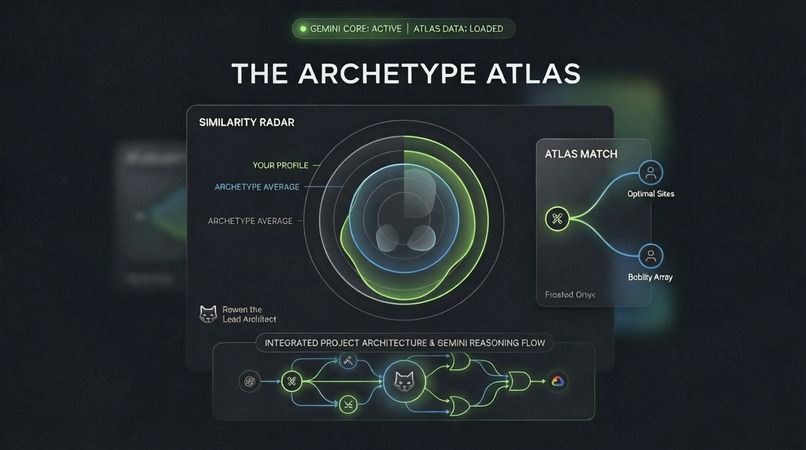
USA Athletes Type Atlas
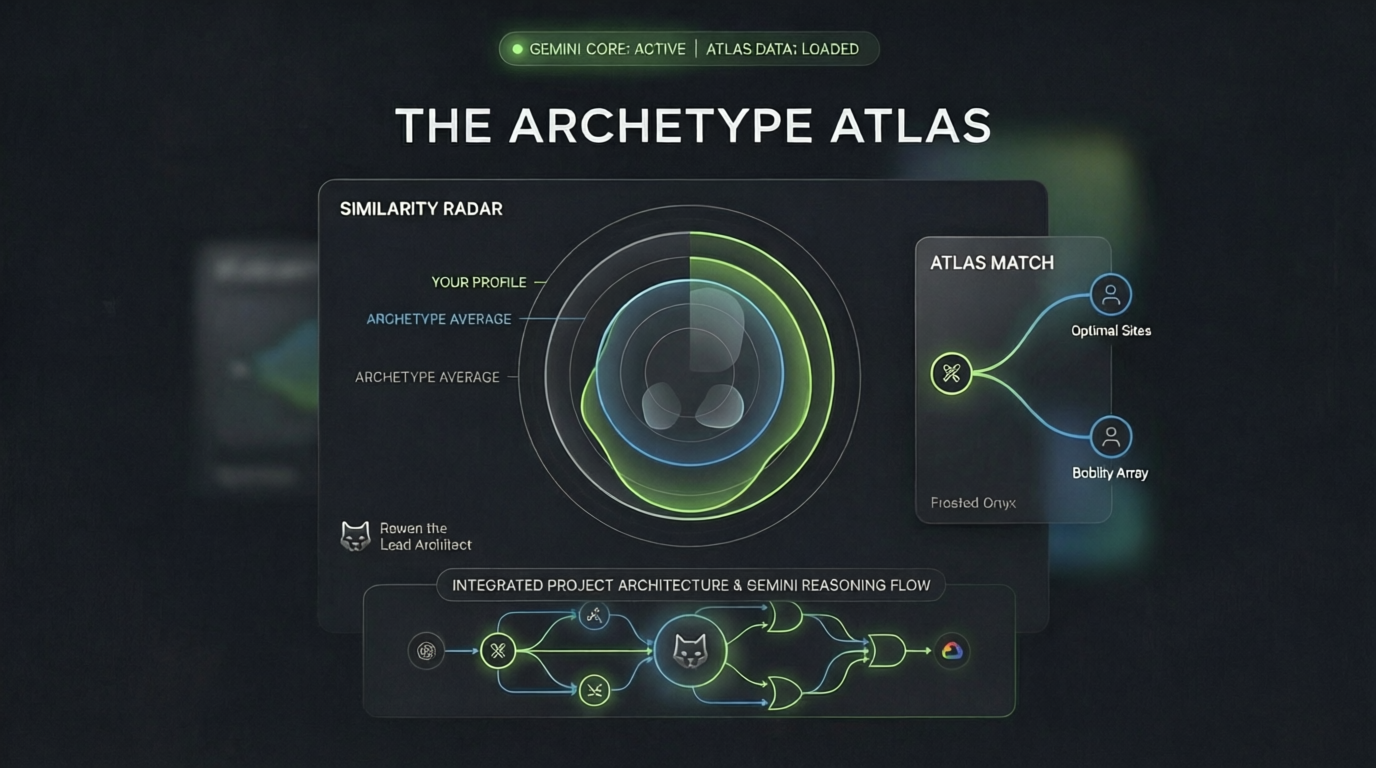
Inspiration
The Archetype Atlas was born from the vision of "Collective Power"—the idea that elite human performance is a universal language. We noticed a data gap in how the public perceives Olympic and Paralympic athletes, often viewing them as separate categories rather than a singular spectrum of biomechanical excellence. We were inspired to build a "Digital Mirror" that proves, through data, that whether you are a world-class long jumper or a champion fencer, the underlying mathematical blueprints of success are one and the same.
What it does
The Atlas is a high-precision biometric mapping engine. Users input their height, weight, and wingspan to discover their "Athletic Archetype." The system then performs a multi-variate analysis to match the user with a pair of Team USA legends—one Olympian and one Paralympian—who share their physical "blueprint." Beyond simple matching, it generates an Architect’s Note using AI to explain the specific mechanical advantages (e.g., horizontal propulsion or rotational torque) shared between the user and these elite athletes.
How we built it
We built the Atlas using a Stateless Python Architecture designed for security and deterministic precision:Logic Engine: A FastAPI backend that utilizes Z-score normalization to calculate the biometric distance between user input and a grounded dataset. The similarity score $S$ is derived from the Euclidean distance across normalized features:$$S = 1 - \frac{\sqrt{\sum_{i=1}^{n} (z_{user,i} - z_{match,i})^2}}{\sqrt{n}}$$Intelligence: Gemini 1.5 Flash via Vertex AI, acting as a "Narrator" that synthesizes the mathematical match into a technical handbook-style analysis.Frontend: A "Liquid Glass" UI inspired by high-end engineering handbooks, built with HTML and Tailwind CSS.Infrastructure: Deployed on Google Cloud Run with Secret Manager for secure API credential rotation.
Challenges we ran into
The primary hurdle was Archetype Calibration. Early versions of the engine suffered from "Logic Drift," where users with slightly different heights were being collapsed into the same match. As security and software engineers, we solved this by implementing Retrieval-Augmented Logic. By "grounding" the AI in a verified CSV source of truth and tightening our mathematical thresholds, we ensured the engine could distinguish between a 183 cm fencer and a 188 cm track athlete with 80%+ confidence.
Accomplishments that we're proud of
Mathematical Parity: Successfully creating an engine where Olympic and Paralympic data are treated as a unified pool.
The "Onyx" UI: Achieving a minimalist, reactive interface that feels like a professional tool rather than a toy.
Zero-Footprint Security: Implementing a professional deployment pipeline that keeps all sensitive API keys completely isolated from the source code.
What we learned
We learned that data grounding is the key to making AI useful in technical contexts. By using the AI to narrate the "Why" while letting a deterministic Python engine handle the "Who," we eliminated hallucinations and created a tool that provides genuine biomechanical insights. We also deepened our understanding of Ape Index and center-of-mass physics in elite sports.
What's next for Archetype Atlas
The next phase for the Atlas is the expansion of the "Grounding Dataset" to include more specialized Paralympic categories and winter sports archetypes. We also plan to integrate Computer Vision to allow users to scan their proportions via a photo, further automating the bridge between the user’s physical reality and the blueprints of the legends who represent Team USA.

Log in or sign up for Devpost to join the conversation.