-
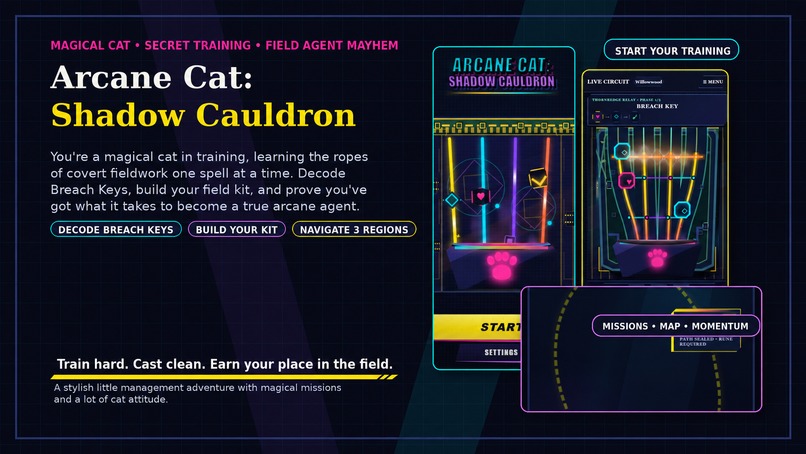
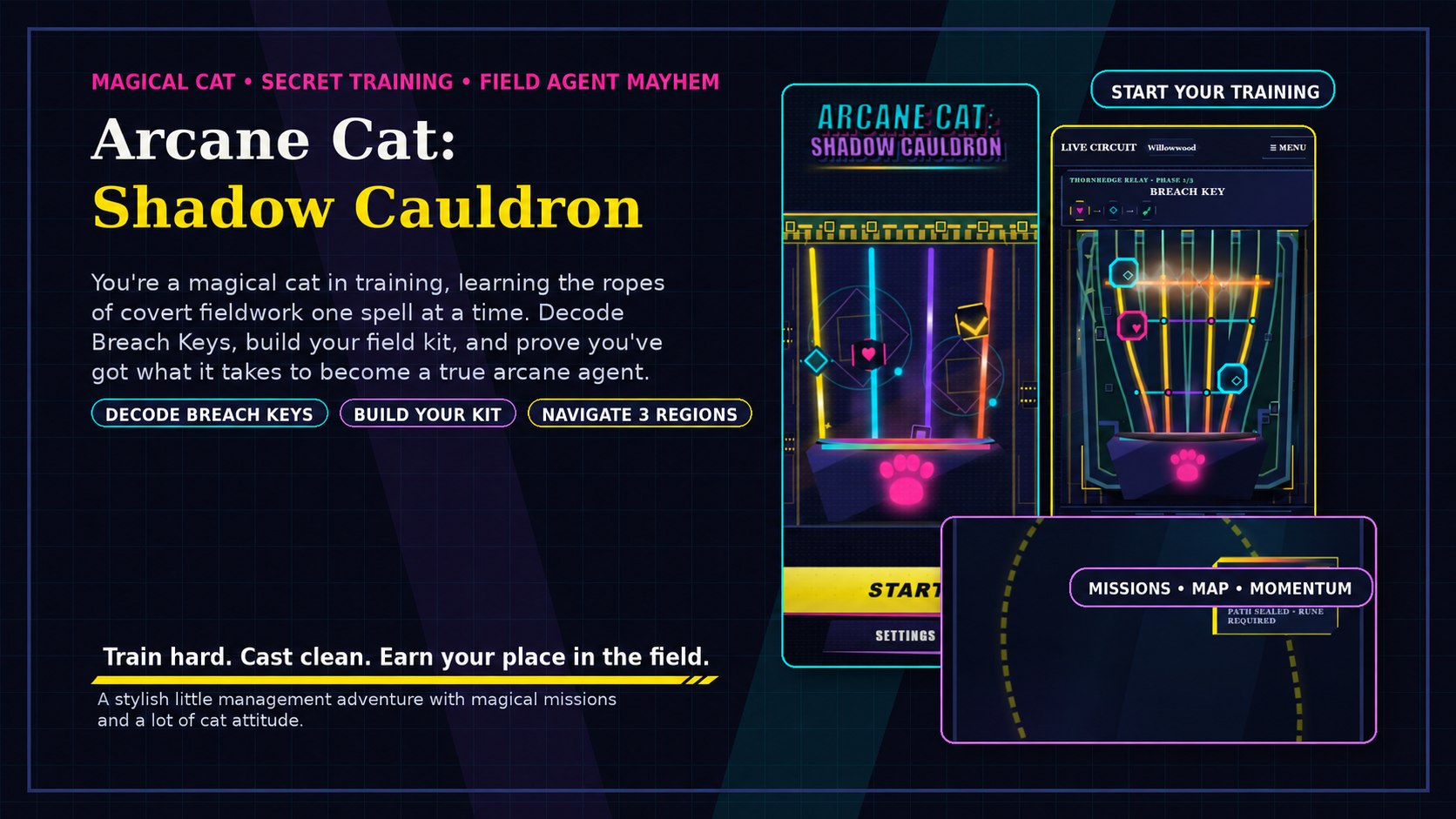
Decode Breach Keys, build your kit, and begin a magical three-region adventure.
-
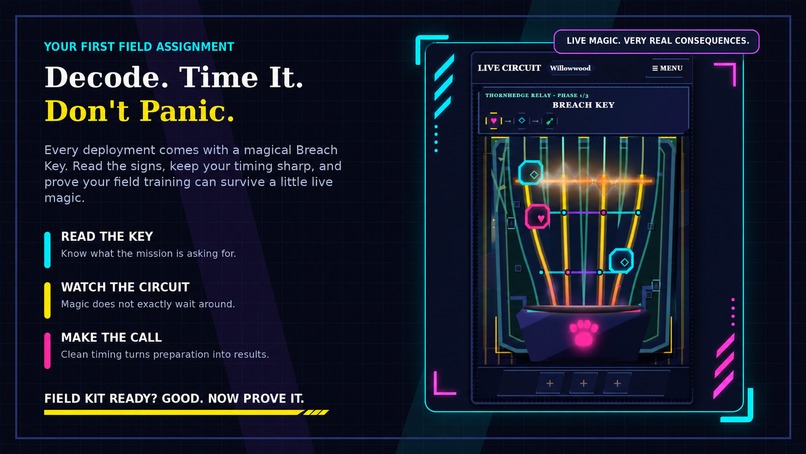
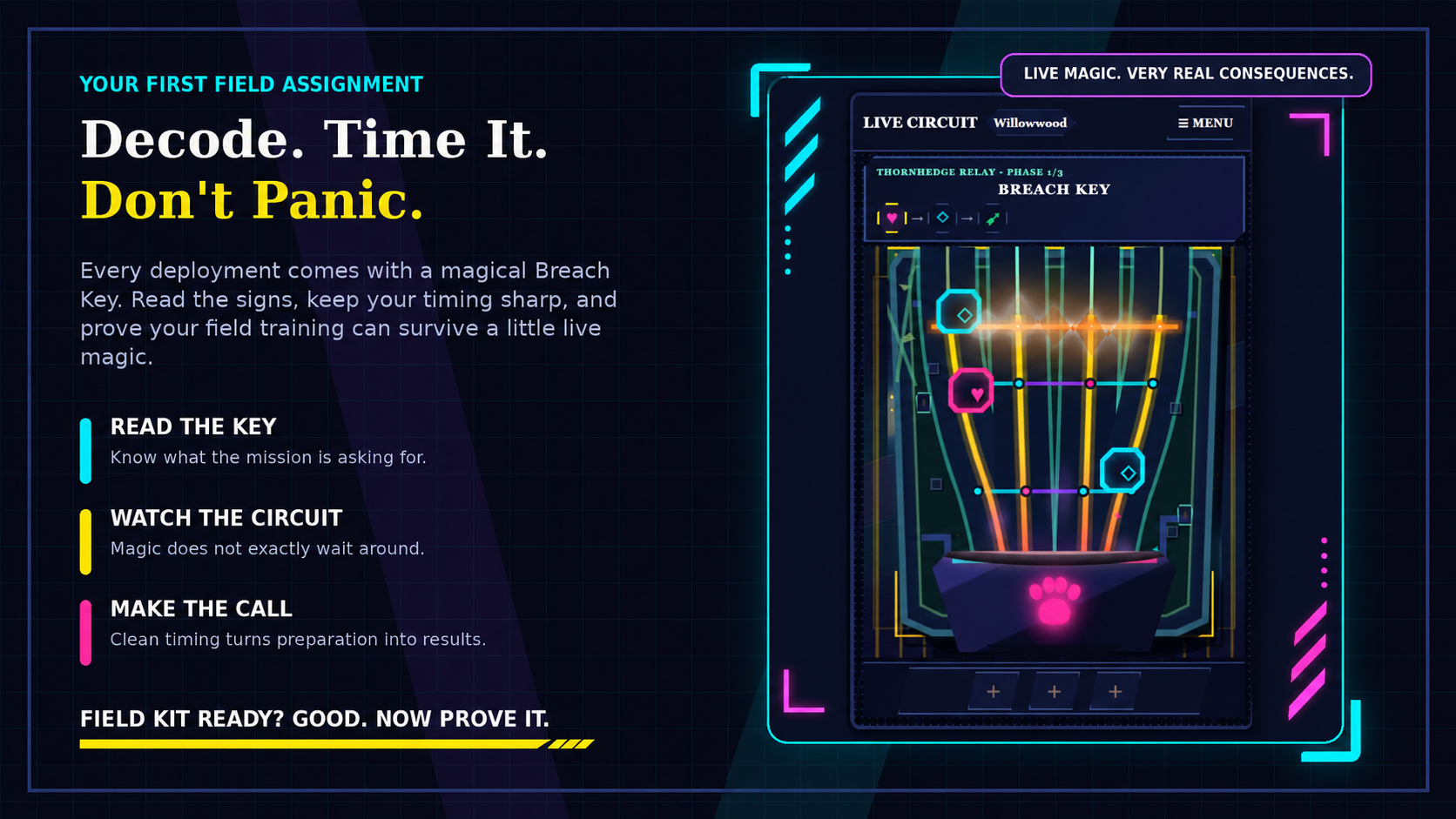
Read the key, watch the circuit, and time your cast before the magic gets away from you.
-
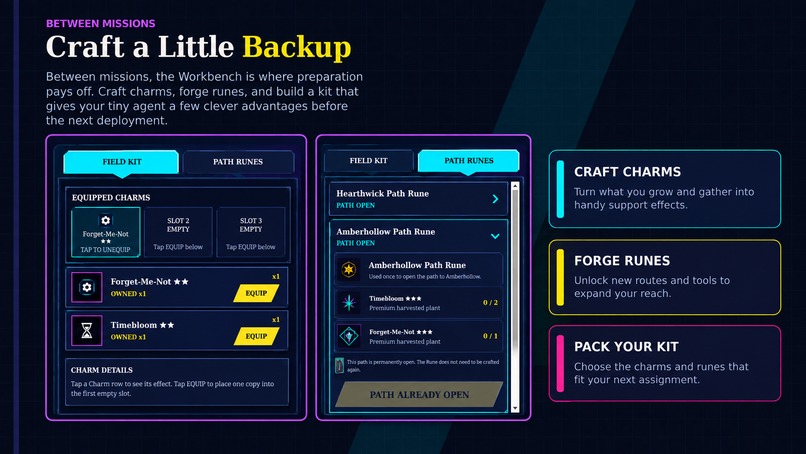
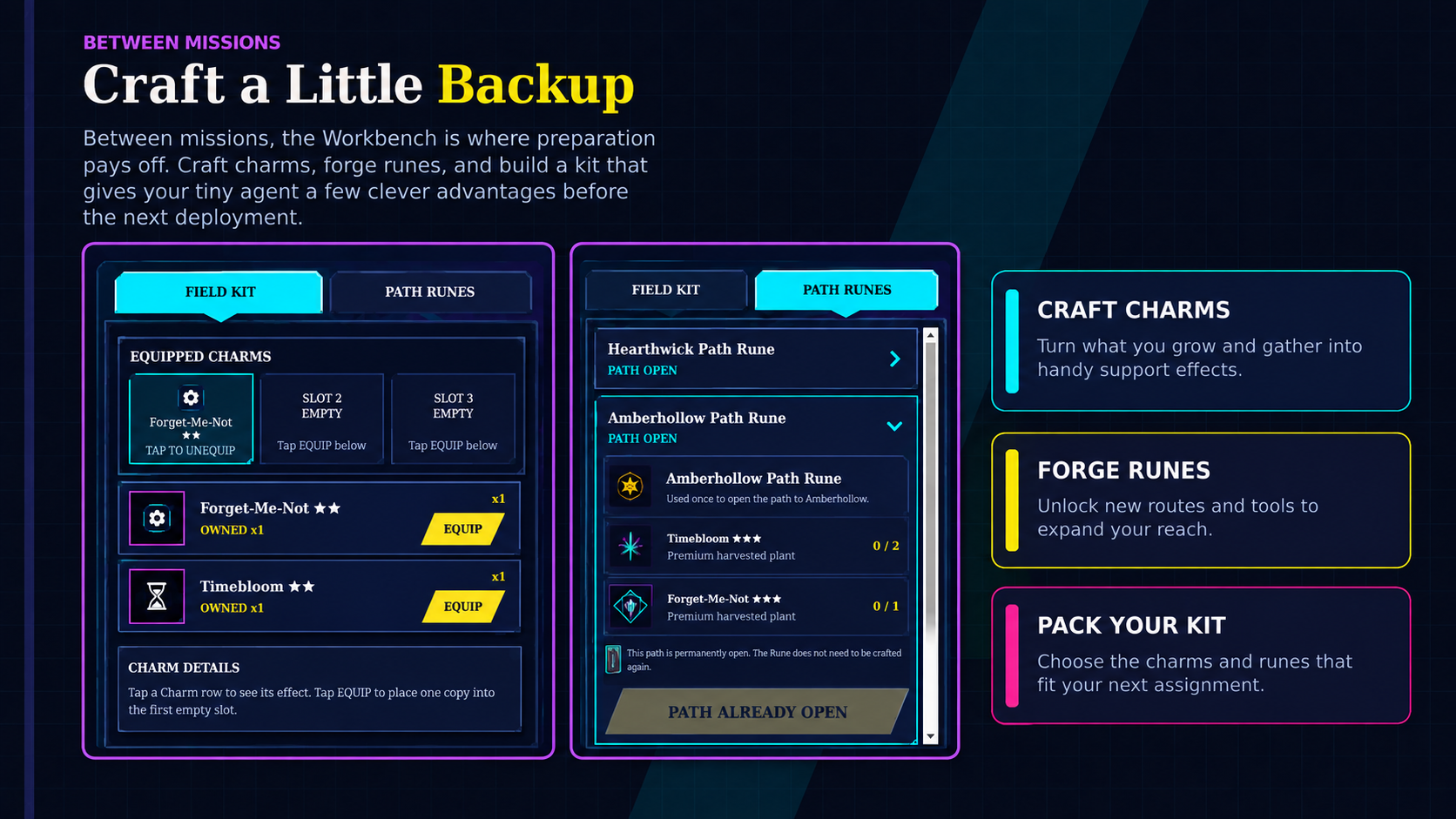
Craft Charms, forge Path Runes, and pack a little magical backup before the next mission.
-
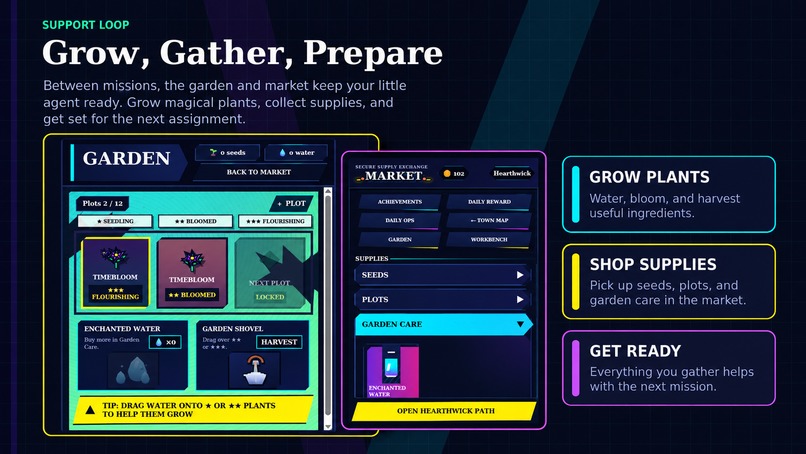
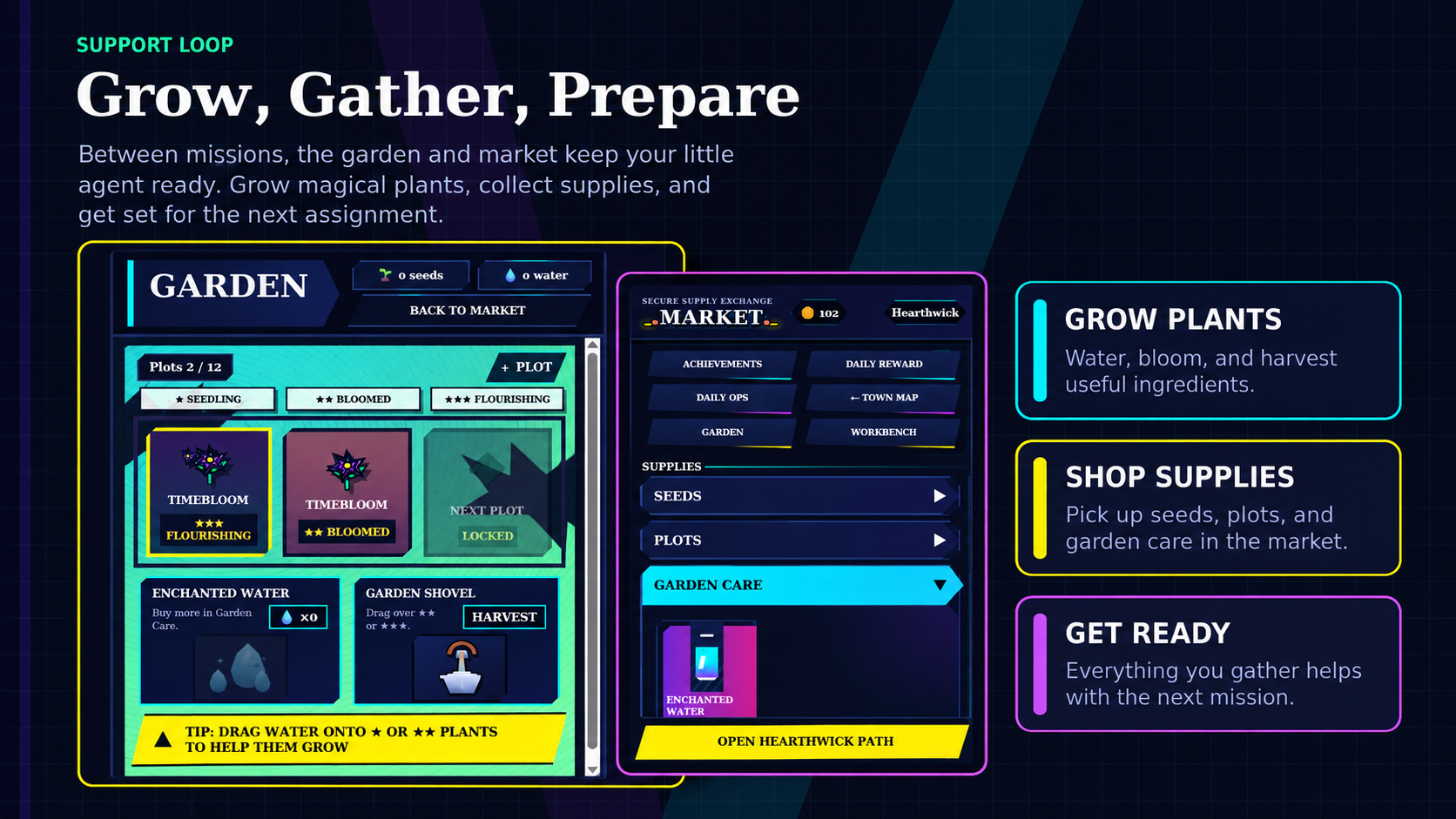
Grow curious plants, gather useful supplies, and keep your field agent ready for whatever comes next.
-
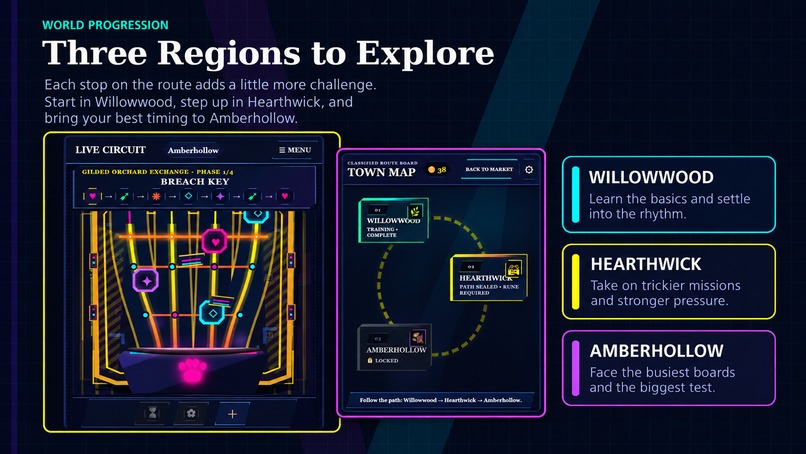
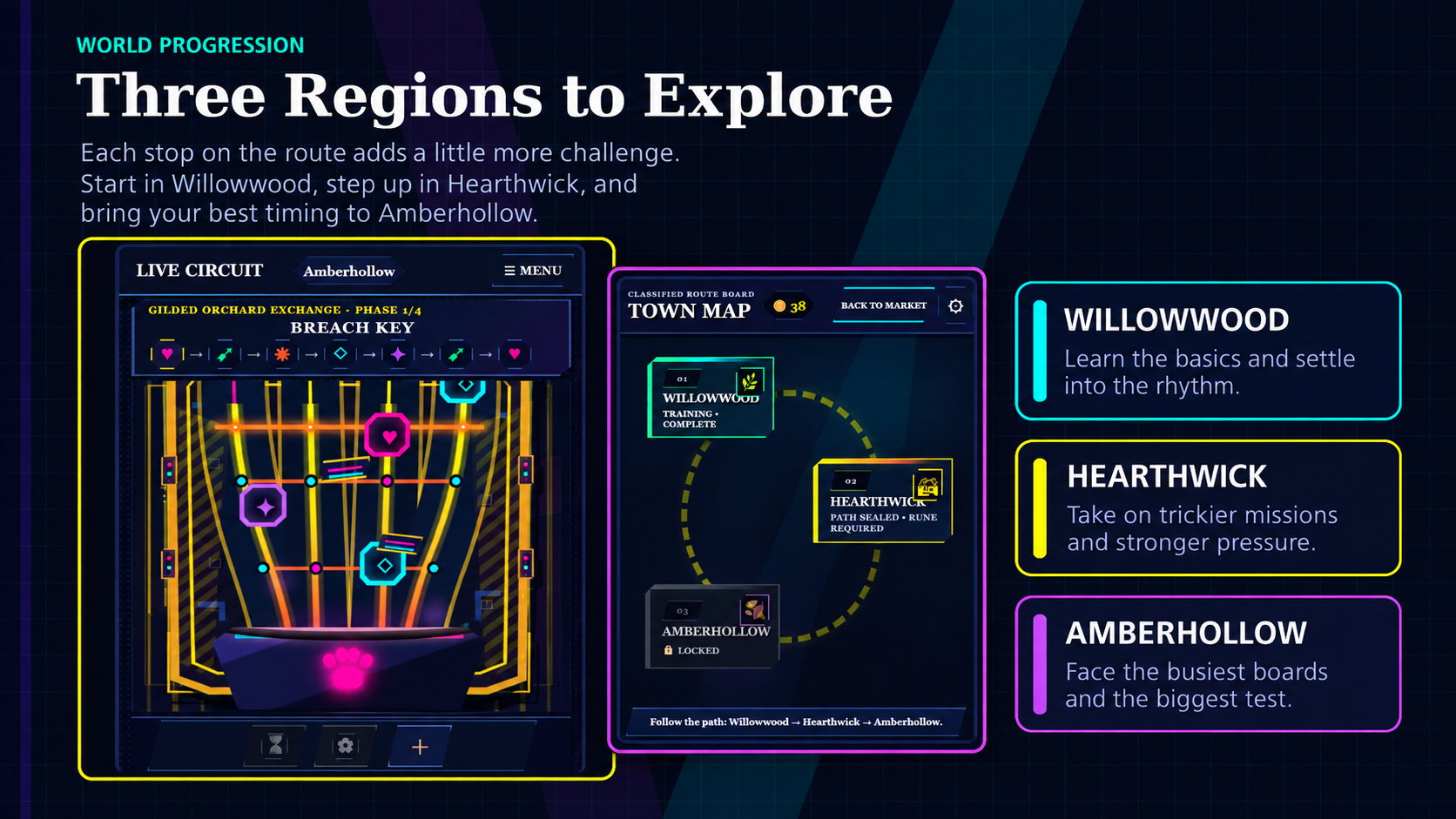
Learn the rhythm in Willowwood, step it up in Hearthwick, and face your biggest test in Amberhollow.
-
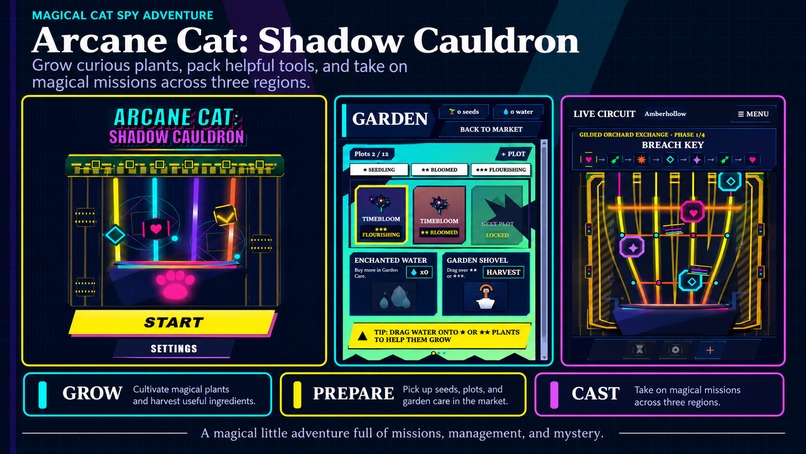
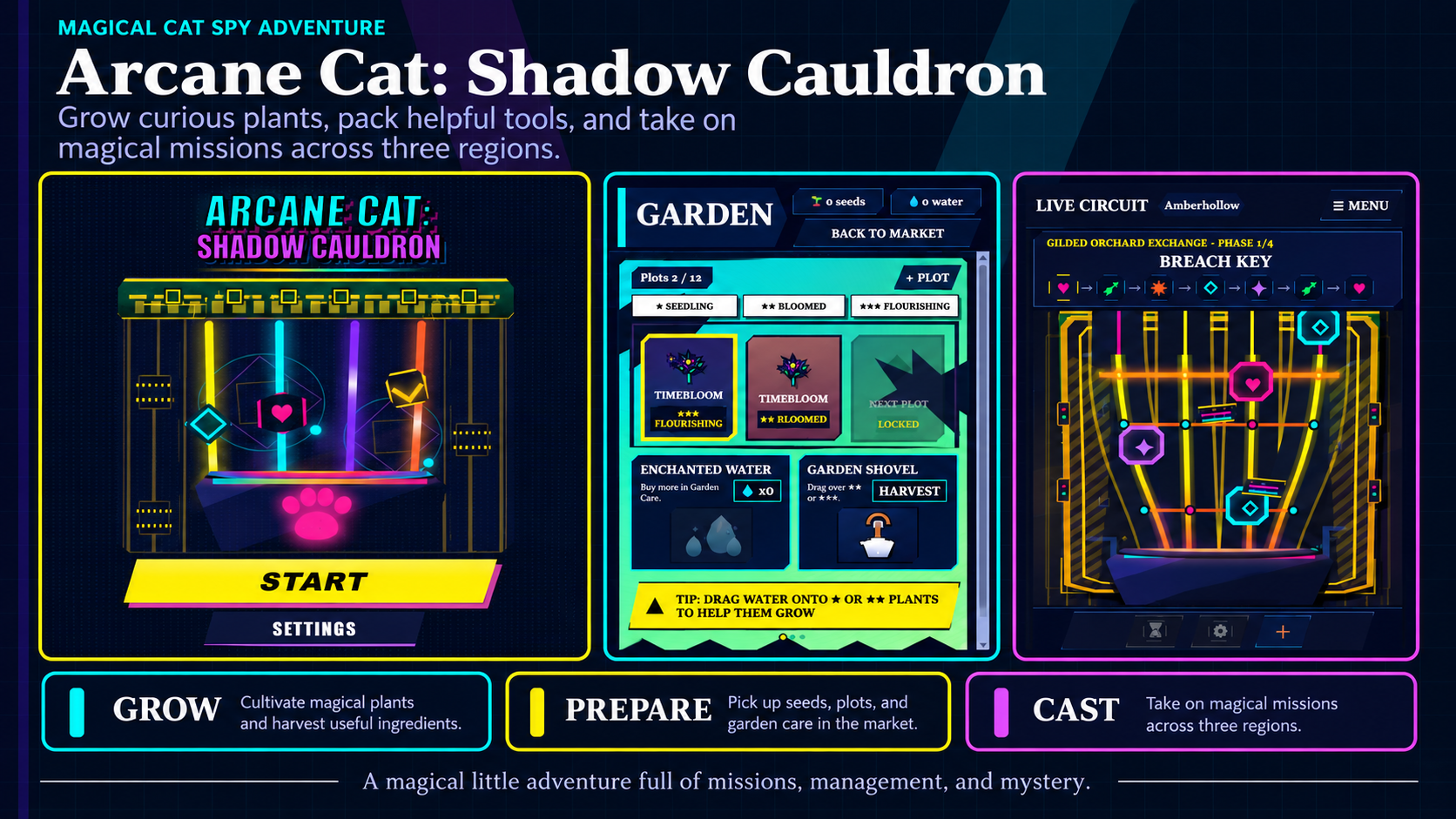
Grow. Prepare. Cast. A magical little management adventure full of missions, progression, and mystery.
Inspiration
I grew up in the era of early-2000s browser games, the kind of simple, colorful games you could find on Disney.com, Millsberry, Neopets, and similar sites and somehow play for hours. They were easy to understand, full of personality, and always had that wonderful “just one more try” feeling.
I also loved the magical spy stories that were everywhere around that time. I kept thinking about what one of those bright little spy games might look like today if it had a little more depth and a management twist.
That became Arcane Cat: Shadow Cauldron , a magical cat spy adventure with a Simulation & Management heart.
I wanted to keep the immediacy and charm of those older games while letting the player grow, prepare, manage, and carry their choices forward. The result is a small thank-you to the games I loved as a kid, mixed with the kind of progression and customization I enjoy now.
What it does
You play as a magical cat in field-agent training, working your way through three regions and preparing for increasingly tricky assignments.
The main rhythm is:
Grow → Prepare → Cast
Grow magical plants and harvest useful ingredients.
Prepare by shopping for supplies, crafting Charms and Path Runes, and packing your Field Kit.
Cast by taking that preparation into Live Circuit missions, where you read magical Breach Keys and time your inputs against moving hazards.
Mission performance earns resources that feed back into the management side of the game, so what you grow and gather becomes part of the kit you carry into the field.
The prototype is portrait-first and mobile-friendly, with preparation and mission beats designed to fit naturally into quick sessions of roughly 3–5 minutes.
It is a magical little adventure full of missions, management, progression, and mystery.
How we built it
I built the project primarily with ChatGPT, which handled most of the coding and helped me work through gameplay systems, progression, debugging, UI structure, accessibility, and iteration.
For some visual exploration, I also used Google Gemini to experiment with CSS ideas and art direction, then brought those ideas back into ChatGPT to refine them into the final comic-inspired magical spy-tech style.
I used VS Code occasionally for small, surgical fixes and testing, and used Codex briefly during a day when my usual ChatGPT workflow was unavailable.
The final prototype is contained in a single self-contained HTML/CSS/JavaScript file and runs offline without external runtime dependencies.
A large part of the process was not simply generating features, but testing them, protecting working systems, and gradually shaping the game into something cohesive.
Challenges we ran into
One of the biggest challenges was learning how precise you sometimes have to be when directing AI.
Something as small as a clipped word, a header sitting a few pixels too high, or a button being wired to old logic could take several rounds to get exactly right. Building for a small portrait screen made those details even more noticeable.
Another personal challenge was moving beyond gray-boxing to build a UI that was both highly legible and visually distinct. The game eventually found its own identity through angular comic panels, magical circuitry, strong color accents, and animation that made it feel a bit more fun and alive.
The biggest technical challenge was protecting systems that already worked. As the project grew, a small change in one area could sometimes affect something somewhere else.
Frequent backups became essential. I kept working versions, documented decisions, tested affected flows, and returned to the last stable build whenever something regressed.
That made regression testing and careful cleanup just as important as adding anything new.
Accomplishments that we're proud of
I am most proud that the game still feels like the kind of bright, slightly mysterious spy game I would have loved as a kid.
It has that pick-up-and-play early-2000s energy, but the systems underneath give it more room to grow.
The player is not only completing missions. They are growing plants, managing coins, deciding what to craft, preparing a Field Kit, unlocking routes, earning stars, and watching those choices carry forward.
I am also proud of how strongly the different parts of the game now belong together.
The Market, Garden, Workbench, Town Map, Field Kit, Path Runes, and Live Circuit all support the same loop instead of feeling like unrelated features.
Visually, I wanted the game to feel unmistakably its own: magical, comic-inspired, mobile-friendly, and full of neon spy-tech energy without becoming difficult to read.
And after many rounds of testing, the entire prototype runs offline from one file.
What we learned
This was my first Simulation & Management game, and it taught me a lot about creating depth without simply adding more mechanics.
One of my biggest lessons was that complexity can come from harder decisions, not more systems.
A premium plant becomes interesting because the player has to decide whether to turn it into a Charm or save it toward a Path Rune. The same small group of mechanics becomes richer when the choices around them matter more.
When building with AI, it can be very tempting to keep adding because there is always another feature you could make. The harder part was knowing when the game already had enough and spending that time making the core loop clearer, more reliable, and more satisfying.
AI made it possible to explore ideas very quickly, but it still needed direction, testing, judgment, and constant refinement.
What's next for Arcane Cat: Shadow Cauldron
The current prototype follows a complete three-region journey through Willowwood, Hearthwick, and Amberhollow.
A larger version could grow naturally from the same Grow → Prepare → Cast foundation with more regions, curious plants, field agents, Charms, Path Runes, assignments, Career progression, and longer-term management choices.
I would want to keep the experience easy to pick up for a quick field assignment while giving players more reasons to return, prepare their little agent, experiment with their Field Kit, and discover what magical assignment is waiting next.
Built With
- chatgpt
- codex
- gemini
- vscode

Log in or sign up for Devpost to join the conversation.