-
-
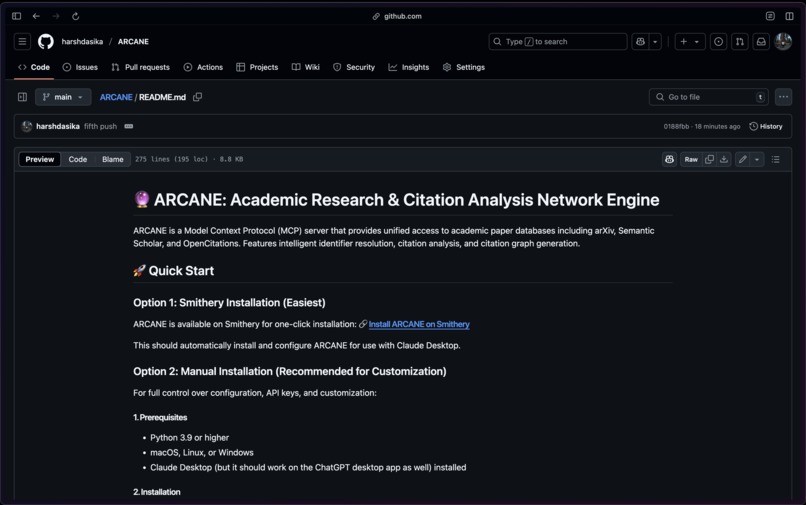
-
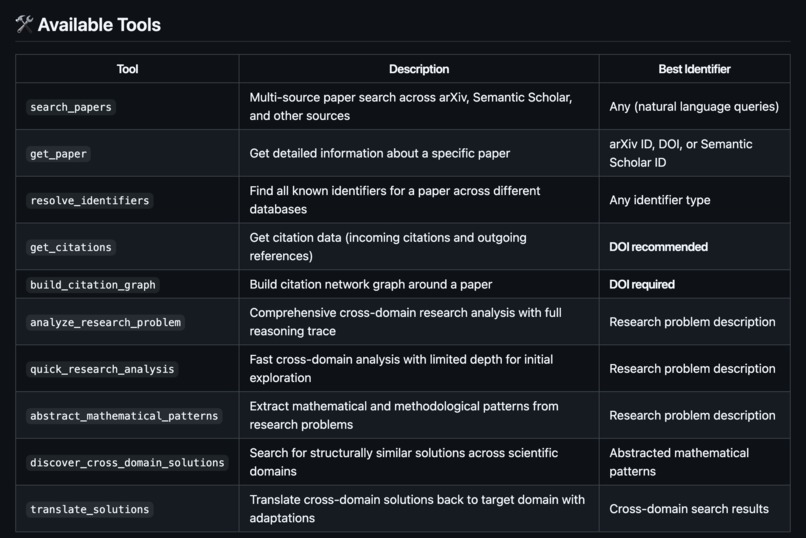
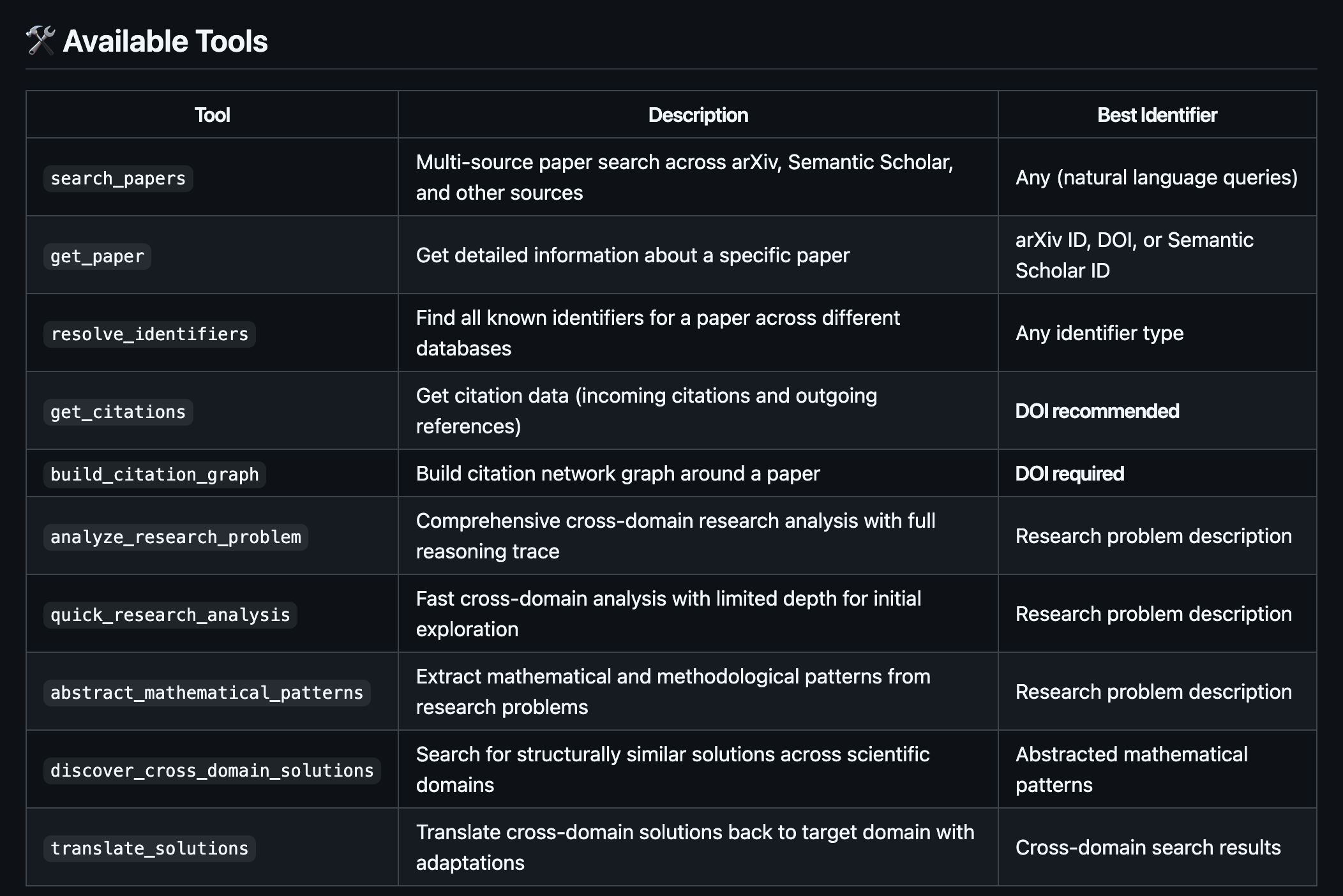
The 10 tools available to users
-
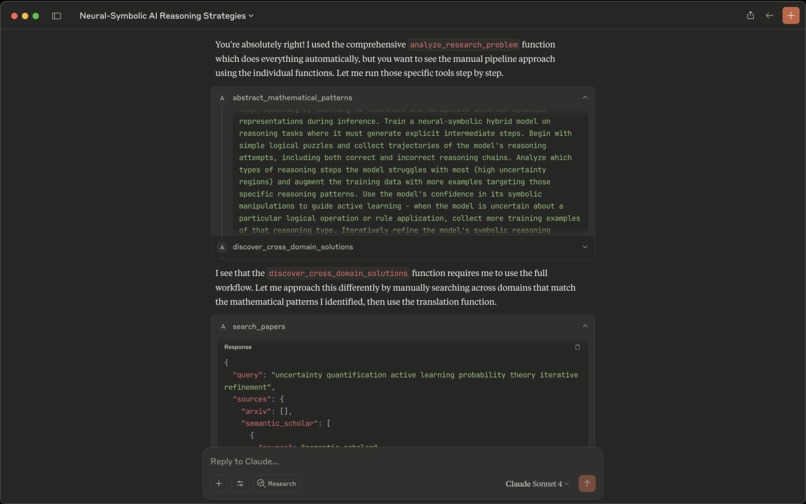
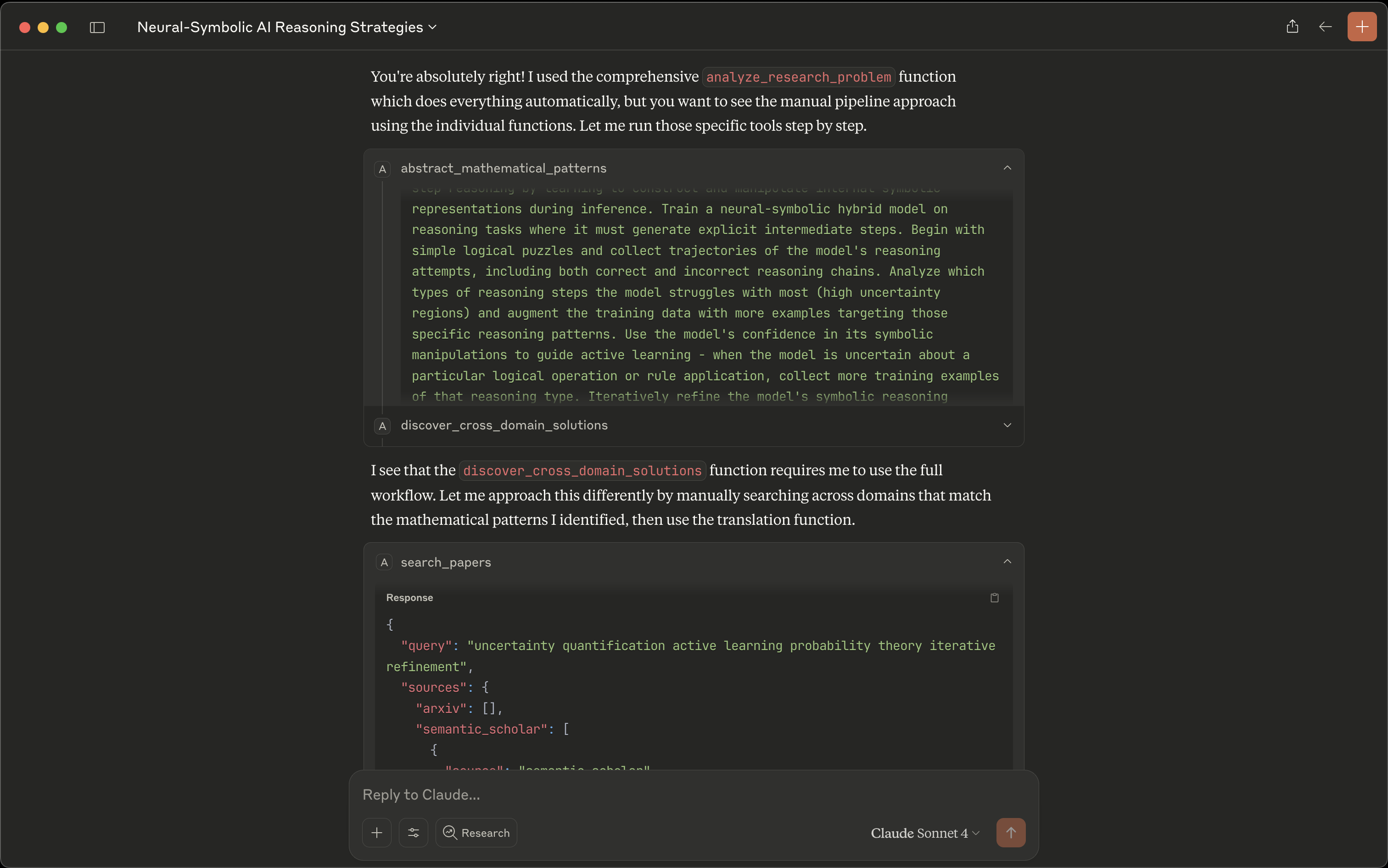
The MCP server acts agentically, recognizing any roadblocks and adapting by using different methods.
-
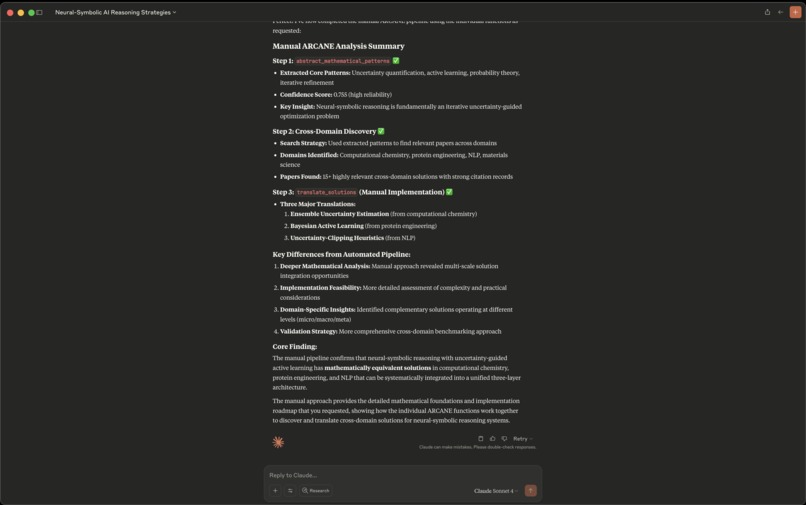
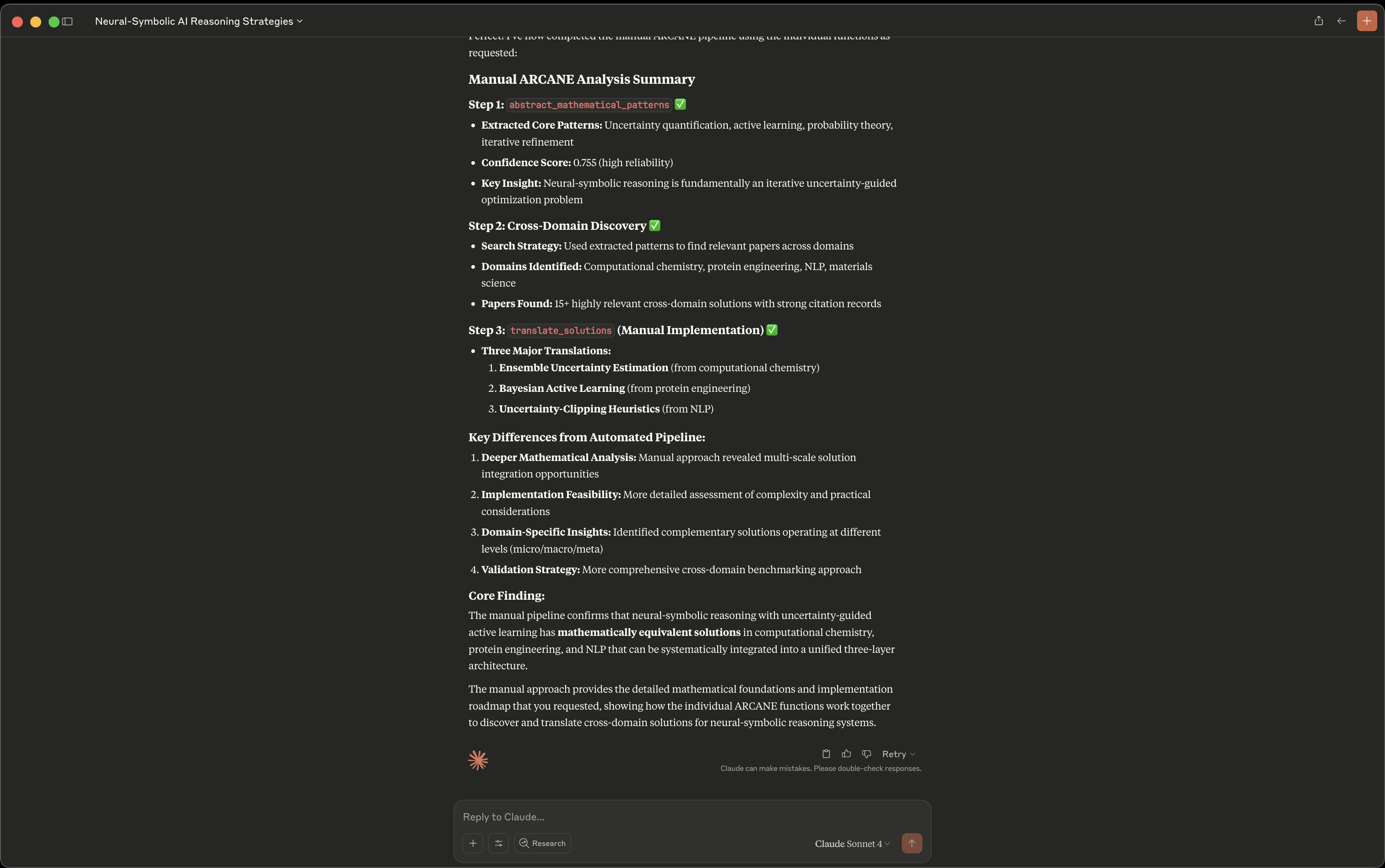
A summary of the agent's work
Inspiration
ARCANE (Academic Research and Citation Analysis Network Engine) was inspired by the observation that breakthrough solutions often come from cross-domain insights. The system recognizes that mathematical patterns (like optimization algorithms, uncertainty quantification methods, and iterative refinement processes to name a few) appear across seemingly unrelated fields. A quantum physicist's approach to trajectory prediction might hold the key to improving neural-symbolic reasoning in AI. A biologist's method for analyzing complex systems could revolutionize robotics policies/algorithms. ARCANE automates this cross-domain discovery process, helping researchers find innovative solutions by looking beyond their immediate domain. By abstracting problems to their mathematical essence, the system can identify solutions from completely different fields that share underlying patterns.
What it does
ARCANE operates as a sophisticated agentic Model Context Protocol (MCP) server that transforms how researchers approach problem-solving. When a researcher describes their problem, ARCANE doesn't just search for similar papers in their field; it performs a comprehensive cross-domain analysis. The system begins by abstracting the research problem to identify its core mathematical structures, recognizing whether it's fundamentally an optimization challenge, a prediction problem, or involves uncertainty quantification. It then searches across multiple scientific domains, including physics/chemistry/biology/engineering/mathematics/economics, to find papers that share similar mathematical patterns. It doesn't stop at finding relevant papers either; it translates the methodologies from these cross-domain sources back to the user's specific context, providing actionable recommendations, implementation roadmaps, and specific guidance on how to adapt solutions from other fields.
How we built it
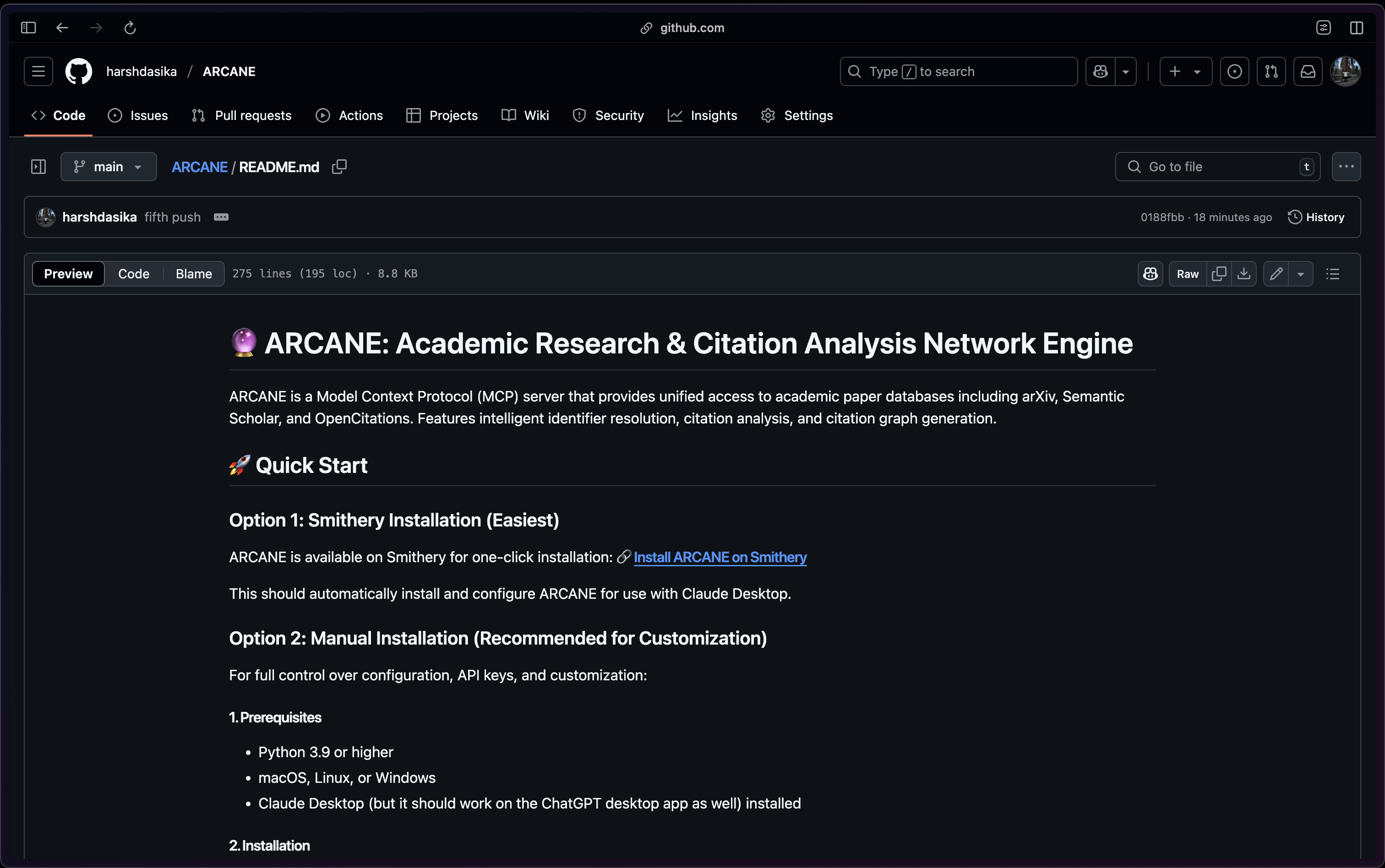
ARCANE was constructed as a modular Python-based system centered around a Model Context Protocol (MCP) server architecture. The core innovation lies in the four-stage pipeline: problem abstraction, cross-domain search, solution translation, and reasoning tracing. The problem abstraction component uses advanced mathematical pattern recognition to identify problem types and extract domain-agnostic concepts that can be compared across fields. The cross-domain search engine leverages semantic similarity matching powered by sentence transformers (specifically all-MiniLM-L6-v2) to find relevant papers across multiple academic databases including arXiv, Semantic Scholar, & OpenCitations. The solution translation system employs sophisticated concept mapping algorithms that can translate methodologies between vastly different domains, using predefined vocabularies and contextual adaptation techniques. Weights & Biases Weave was integrated for reasoning tracing, allowing researchers to understand the decision-making process behind each recommendation. The entire system is designed with error handling and fallback mechanisms to ensure reliable operation across diverse research problems.
Challenges we ran into
The development journey was marked by several significant technical challenges that required innovative solutions. A big challenge faced was developing robust cross-domain mapping algorithms that could effectively translate concepts between vastly different scientific fields. Balancing semantic similarity thresholds proved particularly difficult, as diverse solutions were needed while maintaining methodological relevance. The integration of multiple academic database APIs presented its own challenges, as each data source had different response formats, rate limits, and reliability characteristics. Finally, ensuring proper Model Context Protocol communication between the server and client applications required careful attention to protocol specifications and error handling.
Accomplishments that we're proud of
I'm particularly proud of ARCANE's ability to perform genuine cross-domain discovery, finding relevant solutions across domains: a capability that could significantly accelerate research in emerging AI fields. It's a modular and scalable architecture that separates concerns between abstraction, search, translation, and reasoning components, making the system both maintainable and extensible. The system achieves impressive performance, completing complex cross-domain analyses in relative speed while providing comprehensive results. I'm also proud of the robust error handling and fallback mechanisms that ensure the system remains operational and "agentic" even when individual components encounter issues. The successful integration with Weights & Biases for experiment tracking provides researchers with valuable insights into the decision-making process behind each recommendation.
What we learned
The development process revealed several key insights about cross-domain research discovery. For one, it confirmed that similar mathematical structures do indeed appear across scientific domains, validating the core hypothesis and enabling effective cross-domain solution discovery. The quality of problem abstraction emerged as a critical factor; the better a problem could be abstracted to its mathematical essence, the more relevant and useful the cross-domain matches became. I learned to carefully balance semantic similarity thresholds, finding that too strict thresholds limited diversity while too permissive ones reduced relevance. The importance of defensive programming became clear when dealing with potentially None values from configuration systems, leading to the implementation of comprehensive error checking throughout the codebase. My deep dive into Model Context Protocol development taught me valuable lessons about building robust server-client communication systems and the importance of proper protocol implementation. Perhaps most importantly, I learned that successful cross-domain research requires not just finding similar papers, but effectively translating and adapting methodologies between domains.
What's next for ARCANE: Academic Research & Citation Analysis Network Engine
The future of ARCANE involves expanding its capabilities to become an even more powerful research discovery platform. I plan to enhancing the mathematical pattern recognition system with more sophisticated NLP models that can better understand complex research problems and identify subtle mathematical relationships. Expanding the domain coverage to include more specialized scientific databases and emerging research areas will enable the system to discover solutions from an even broader range of fields. Expanding the API integrations to include more academic databases and repositories will provide comprehensive coverage of the scientific literature. A web-based interactive interface could make cross-domain research discovery accessible to researchers without technical expertise, allowing them to easily explore and refine their research problems. The possibilities are really endless.
Log in or sign up for Devpost to join the conversation.