-
-
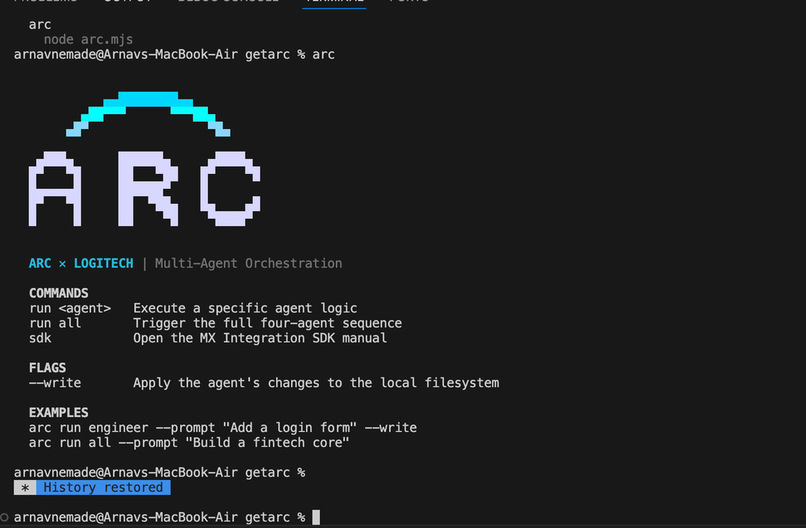
VSCODE integration
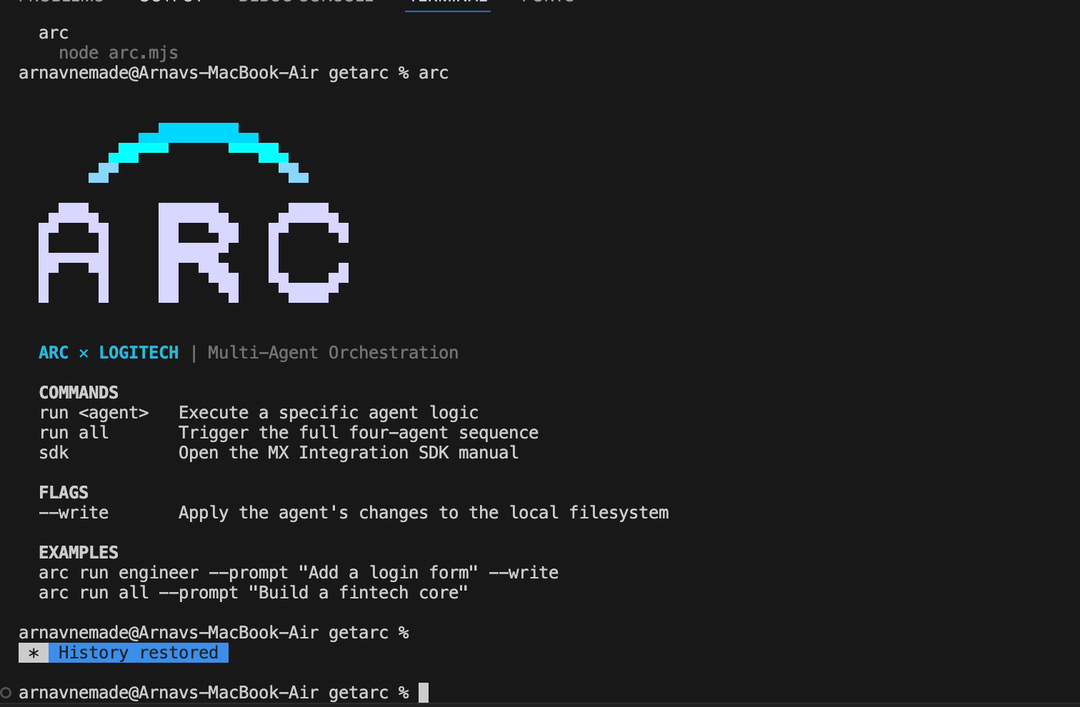
Inspiration
Startups rarely fail because of weak ideas. They fail because execution is fragmented. One founder is forced to operate as developer, CFO, marketer, strategist, and operator simultaneously. That fragmentation slows momentum and kills velocity. Arc was built to eliminate that constraint by creating an AI-native founding team capable of parallel execution across every core startup function.
What it does
Arc is a multi-agent AI startup builder powered by 12 autonomous, role-specialized agents operating in coordination. These agents handle code generation, financial modeling, market analysis, branding, growth strategy, and operational structuring simultaneously while sharing context through a centralized orchestration layer. Instead of issuing isolated prompts, users deploy a synchronized digital team. Arc includes a fully functional VSCode integration, allowing the coding agent to build, refactor, and iterate directly inside a professional development environment. Combined with Logitech programmable hardware control, users can adjust execution parameters, agent focus, and workflow intensity in real time through physical inputs.
How we built it
Arc was engineered as a structured multi-agent architecture with a coordination core responsible for task decomposition and alignment. Each agent operates with defined authority boundaries, persistent memory, and structured communication protocols to prevent overlap or contradiction. A routing layer manages cross-agent collaboration and enforces constraint logic to avoid recursive loops. The VSCode integration connects directly to the development pipeline, enabling real-time code generation and modification within an active workspace. Logitech device APIs were mapped to system-level controls, transforming keypad and mouse inputs into dynamic adjustments within the agent ecosystem.
Challenges we ran into
Multi-agent synchronization proved exponentially more complex than single-agent systems. Maintaining alignment across 12 agents without redundancy required strict communication formatting and task ownership rules. Long-context memory optimization was necessary to preserve performance. Preventing recursive delegation loops demanded engineered constraint layers. Ensuring stable real-time code modification inside VSCode without breaking workflow continuity required careful sandboxing and environment control.
Accomplishments that we’re proud of
We successfully deployed a coordinated 12-agent system functioning as a digital founding team. We implemented a working VSCode integration that embeds AI-driven development directly into a professional coding workflow. We built hardware-level AI control through Logitech programmable devices. In testing environments, Arc significantly reduced startup build timelines from weeks to hours while maintaining structured output integrity.
What we learned
Autonomy requires hierarchy. Parallel intelligence must be structured to scale. Native developer integrations are essential for serious adoption. Physical control increases perceived and functional agency over AI systems. Most importantly, execution velocity determines competitive advantage.
What’s next for Arc
Arc will continue refining agent specialization, improving inter-agent evaluation mechanisms, and strengthening financial and market simulation capabilities. Future development focuses on deeper coordination intelligence, scalable infrastructure deployment, and expanding Arc into a comprehensive AI-native operating layer for company creation.
Built With
- amazon-web-services
- api
- code
- docker
- logitech
- openai
- postgresql
- python
- react
- redis
- sdk
- studio
- typescript
- visual

Log in or sign up for Devpost to join the conversation.