-
-
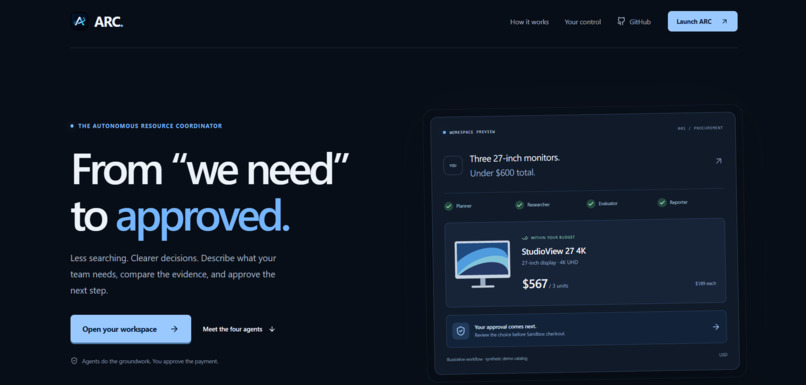
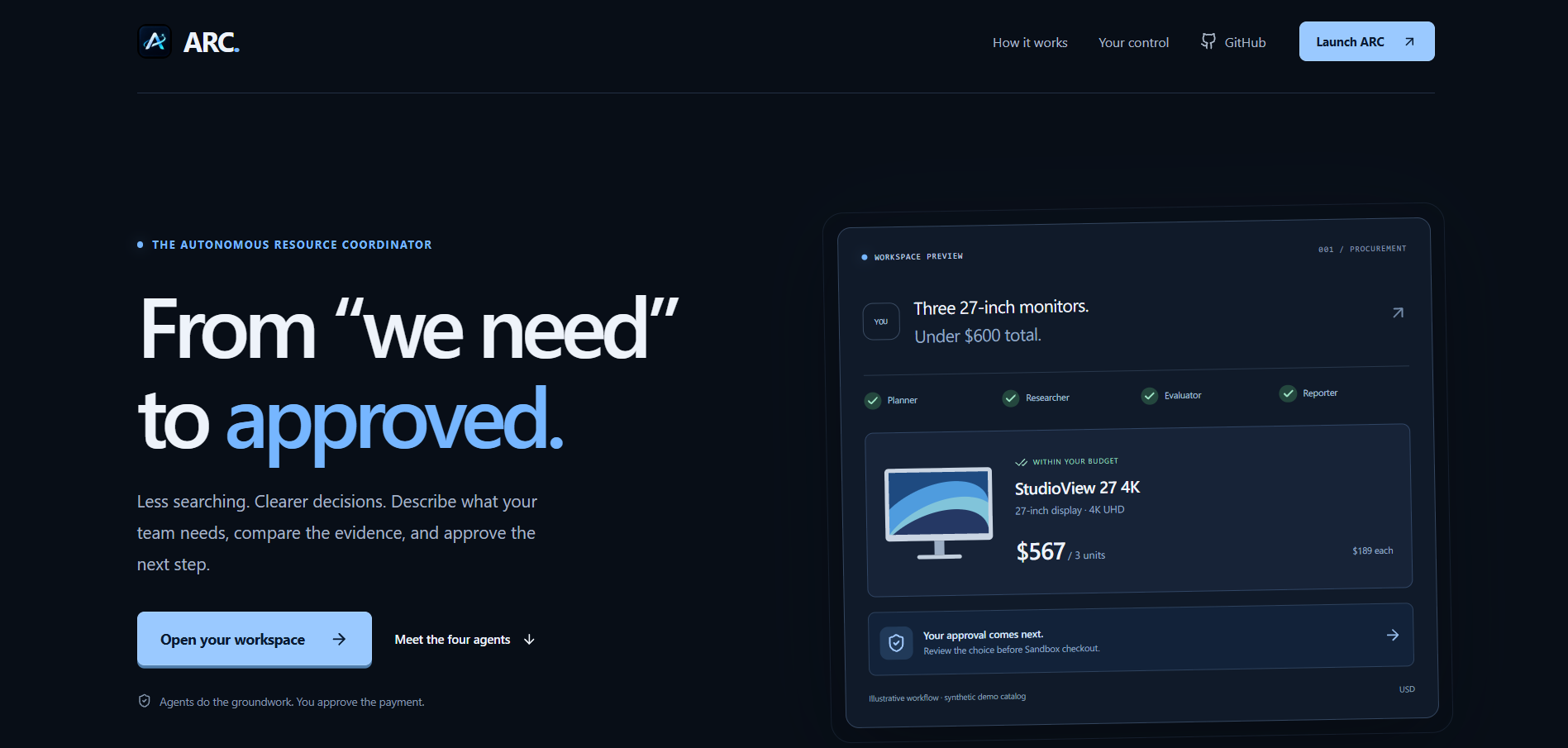
Main Landing Page
-
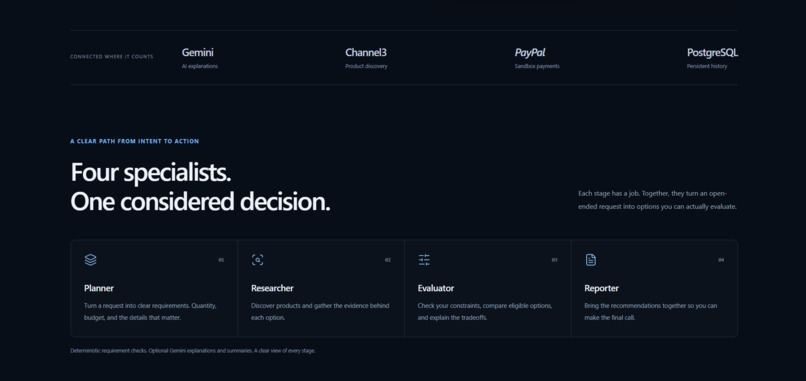
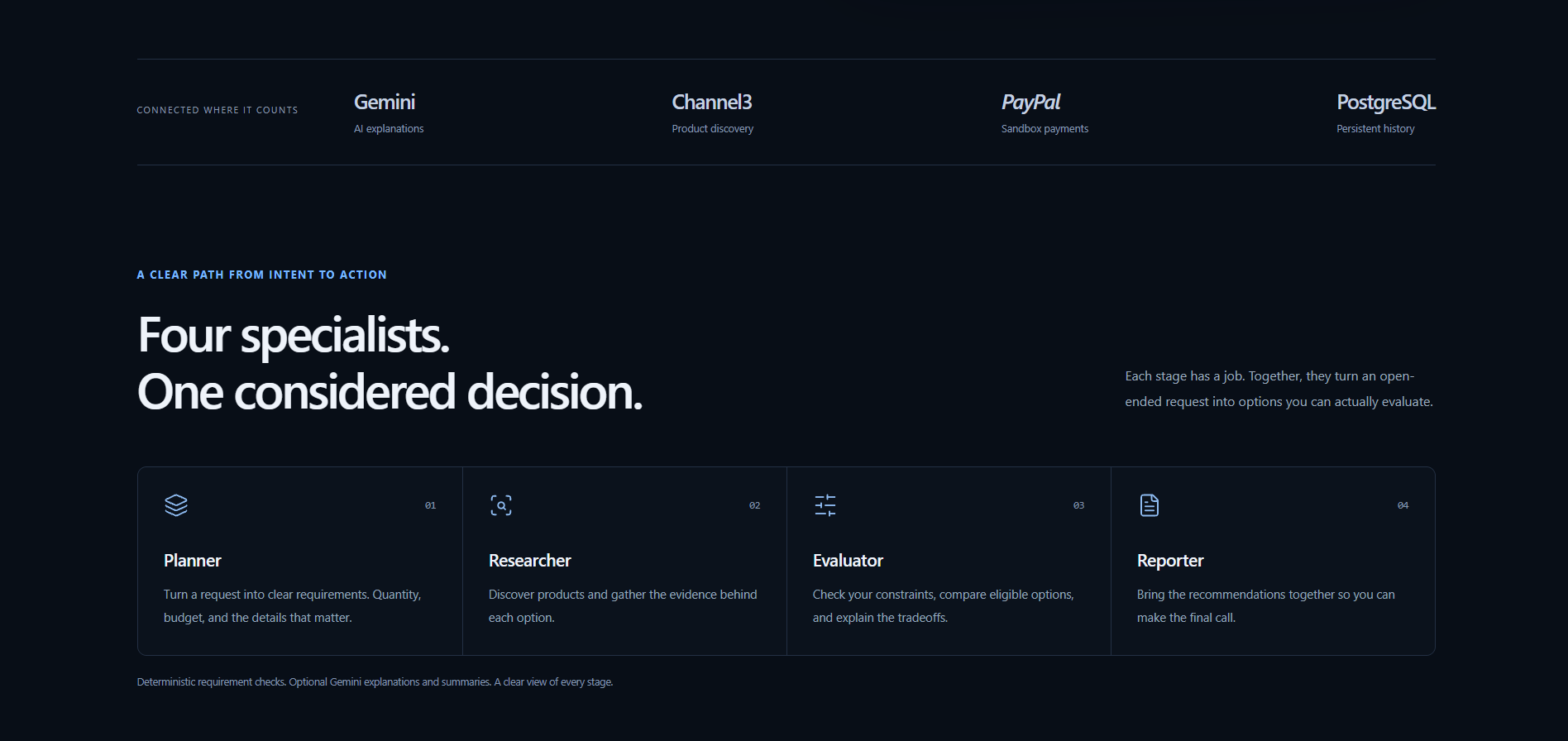
Description of 4 Agents
-
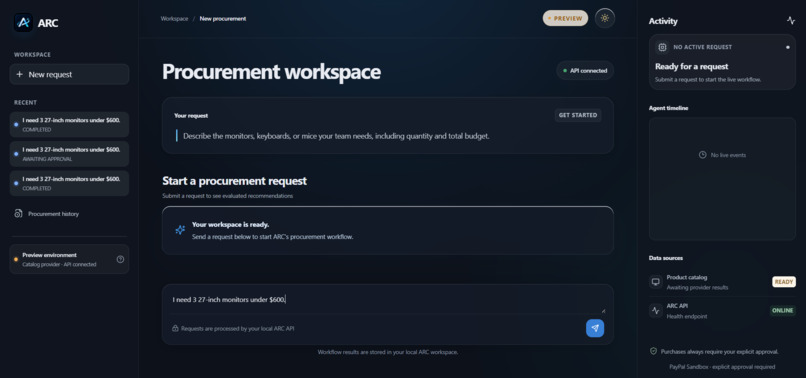
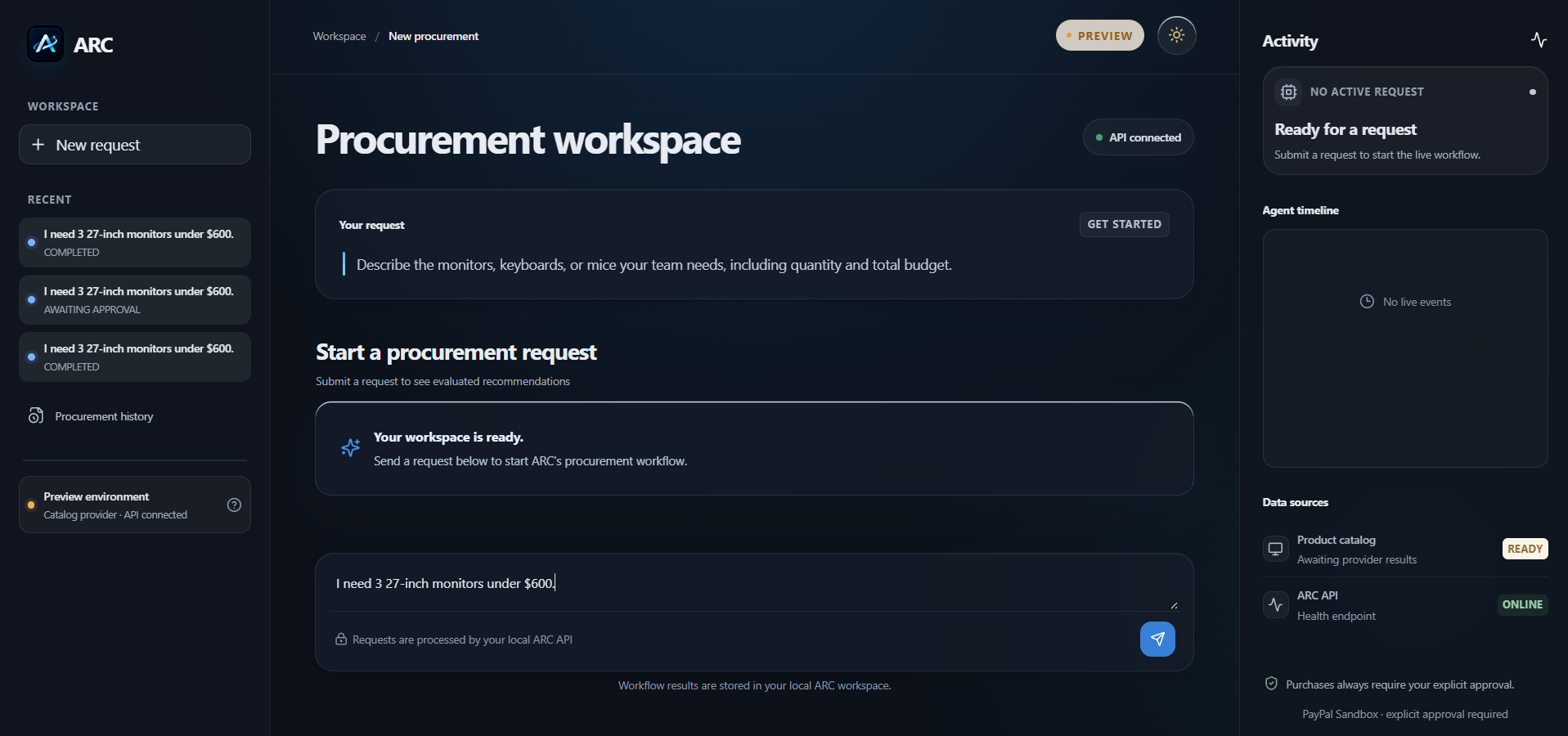
Procurement Workspace
-
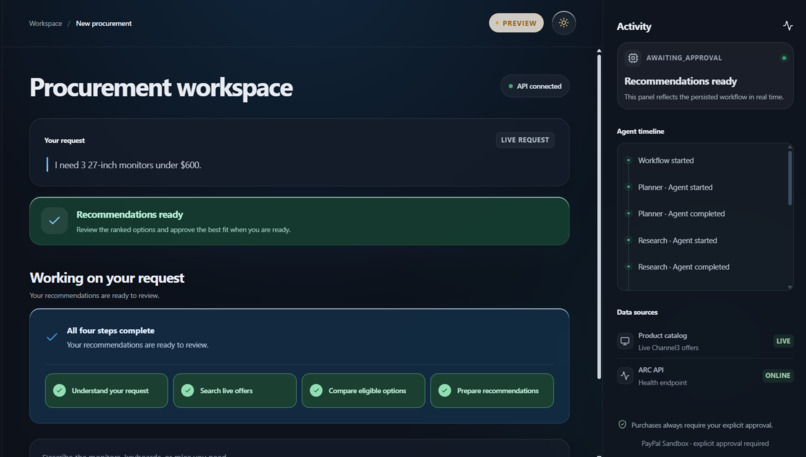
Agents Retrieving Results
-
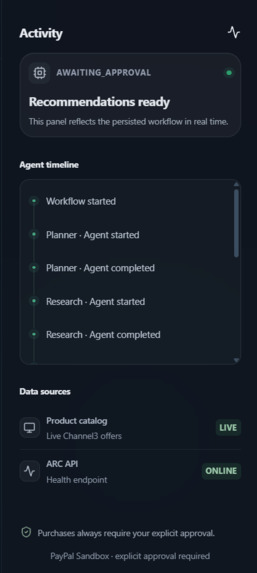
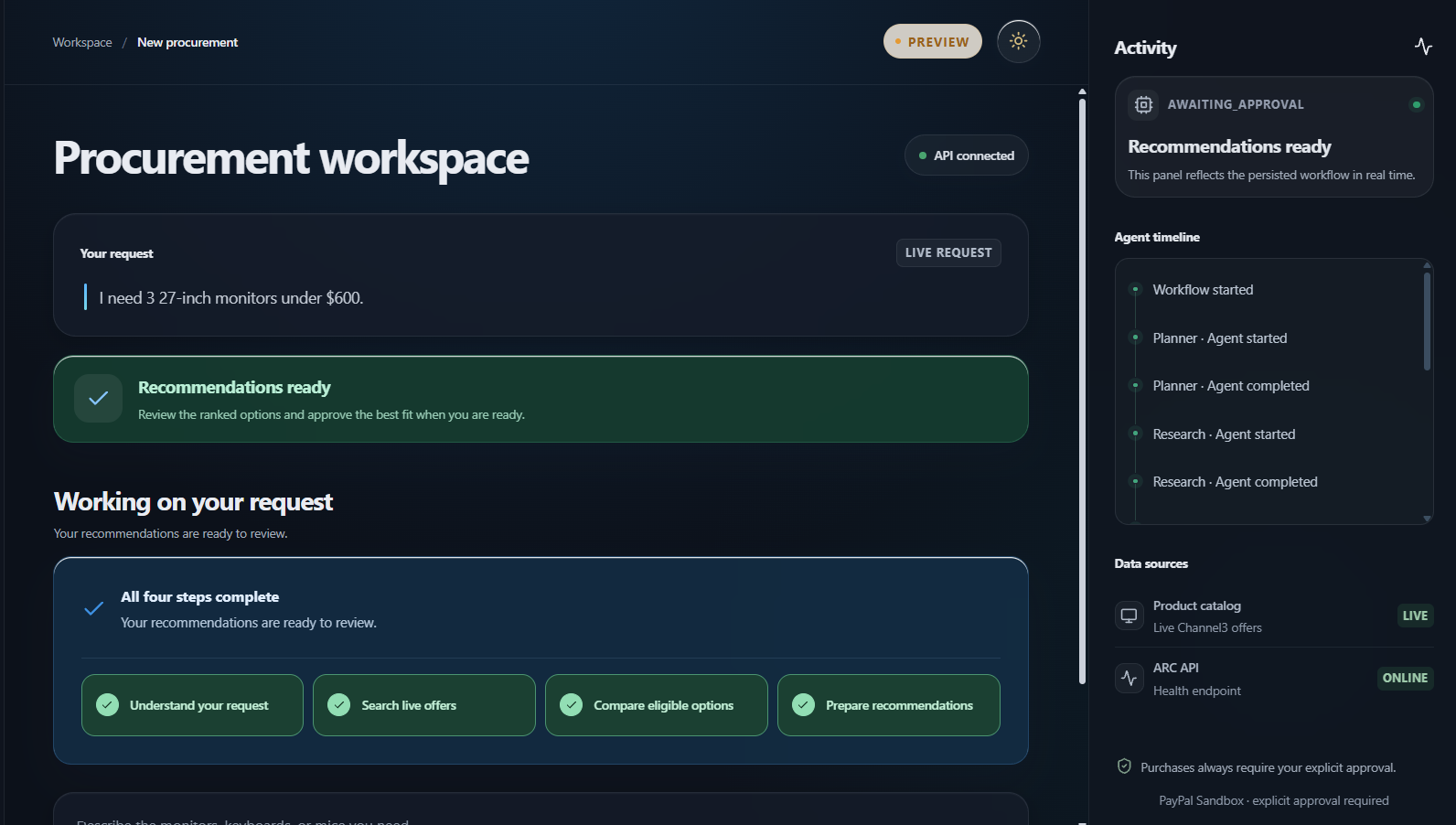
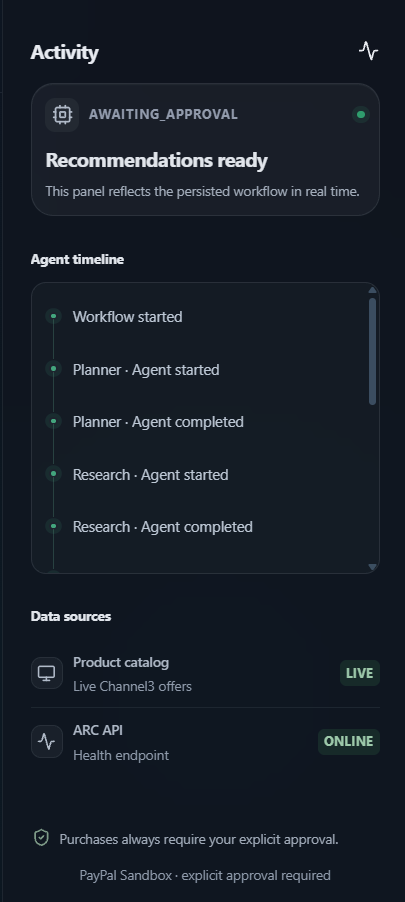
Agent Workflow Timeline
-
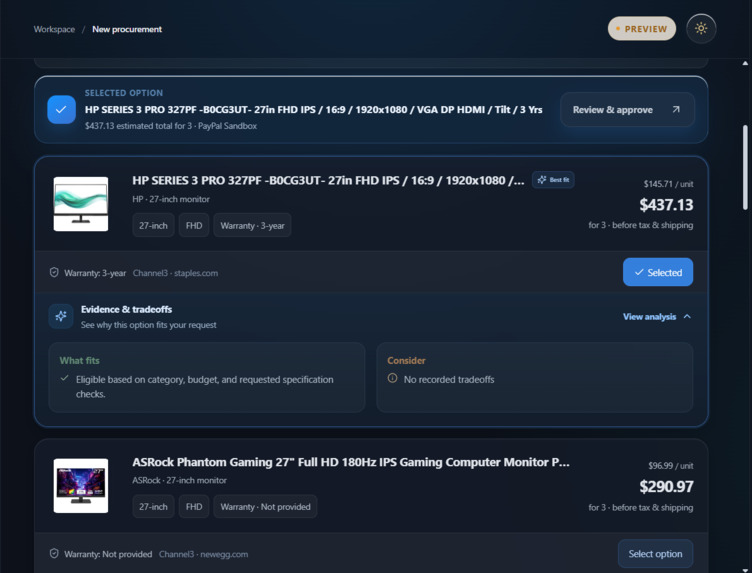
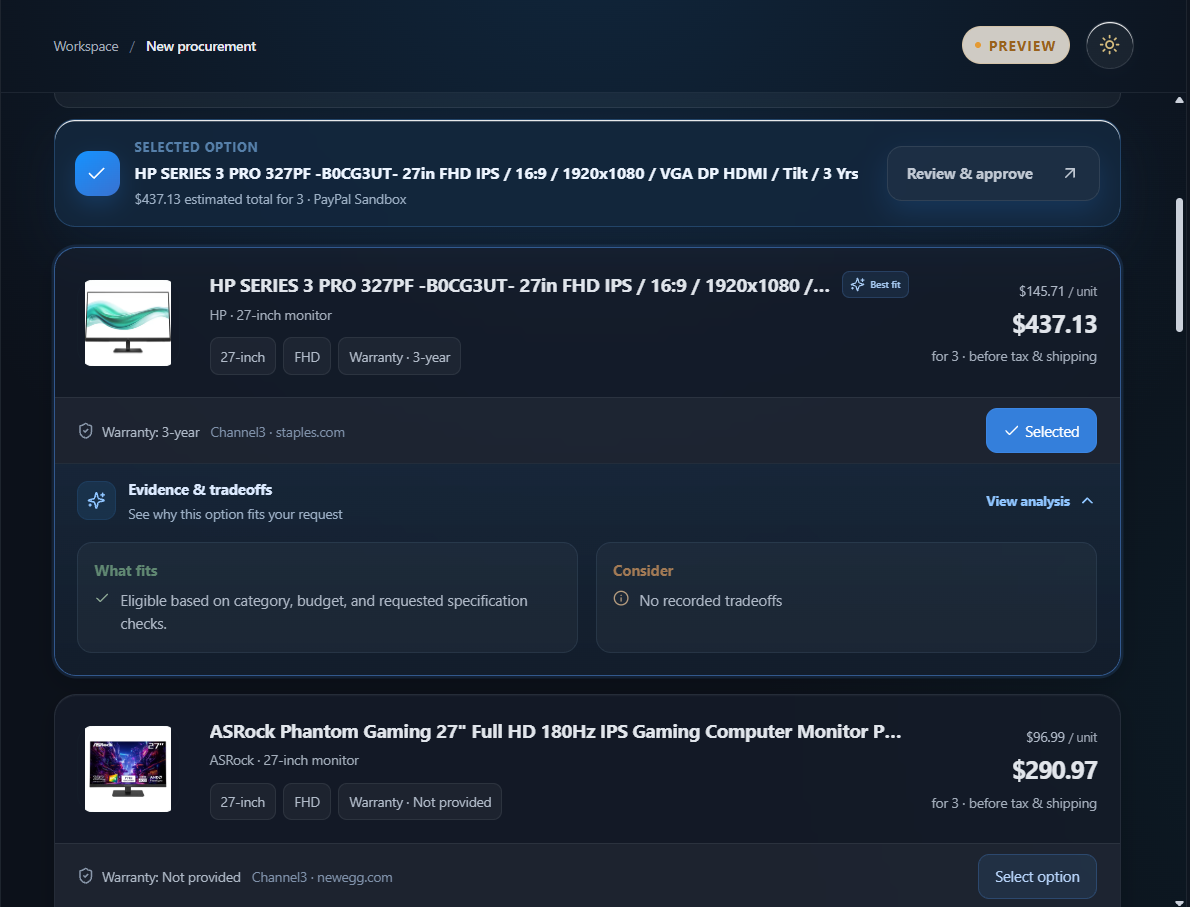
Display of Top Options with Tradeoffs
-
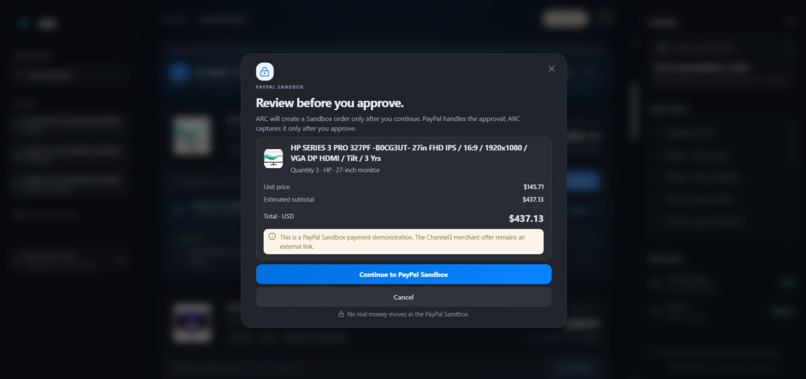
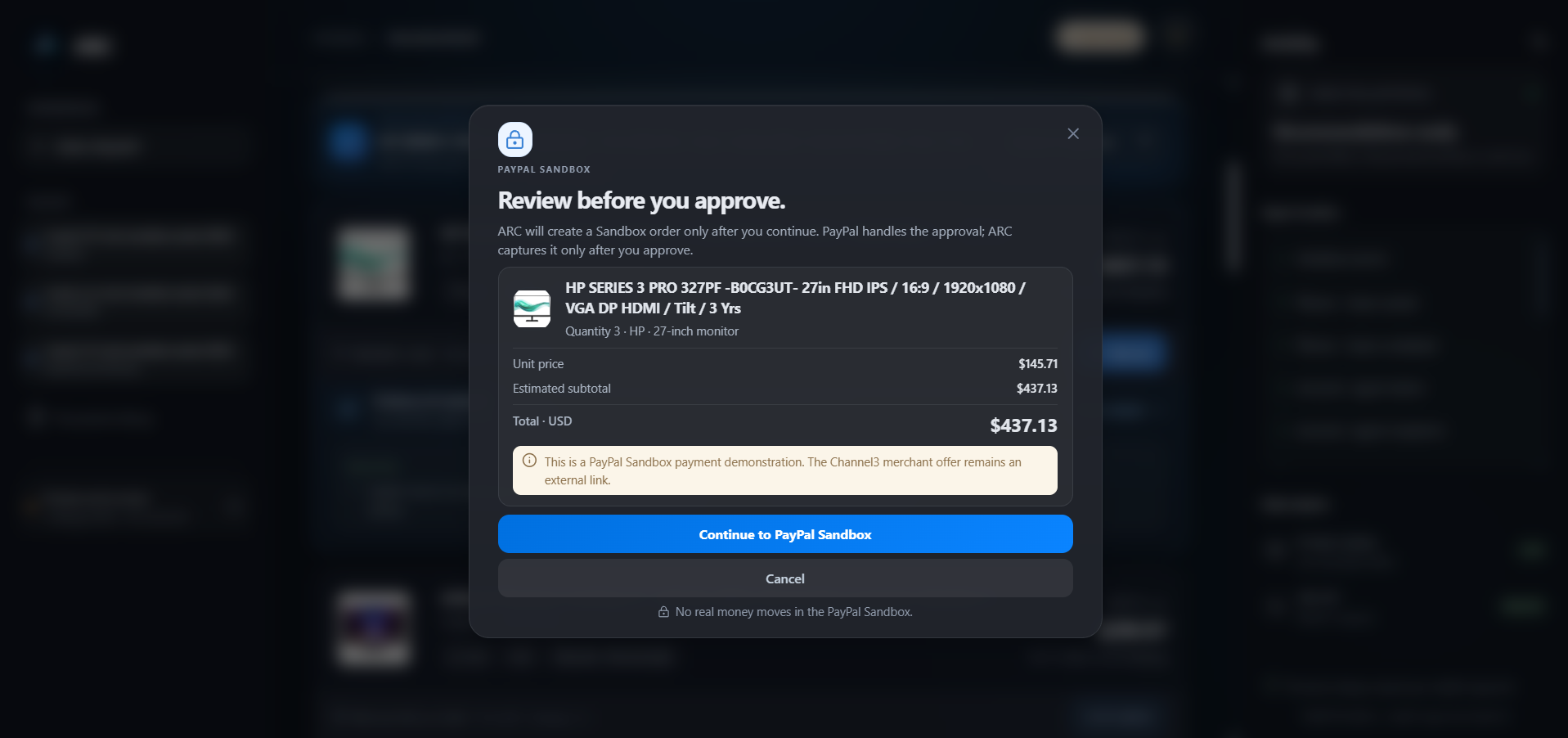
Final Approval Before Payment
-
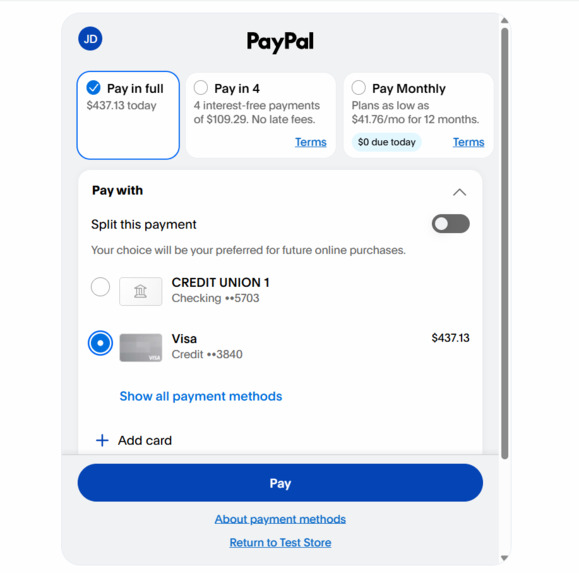
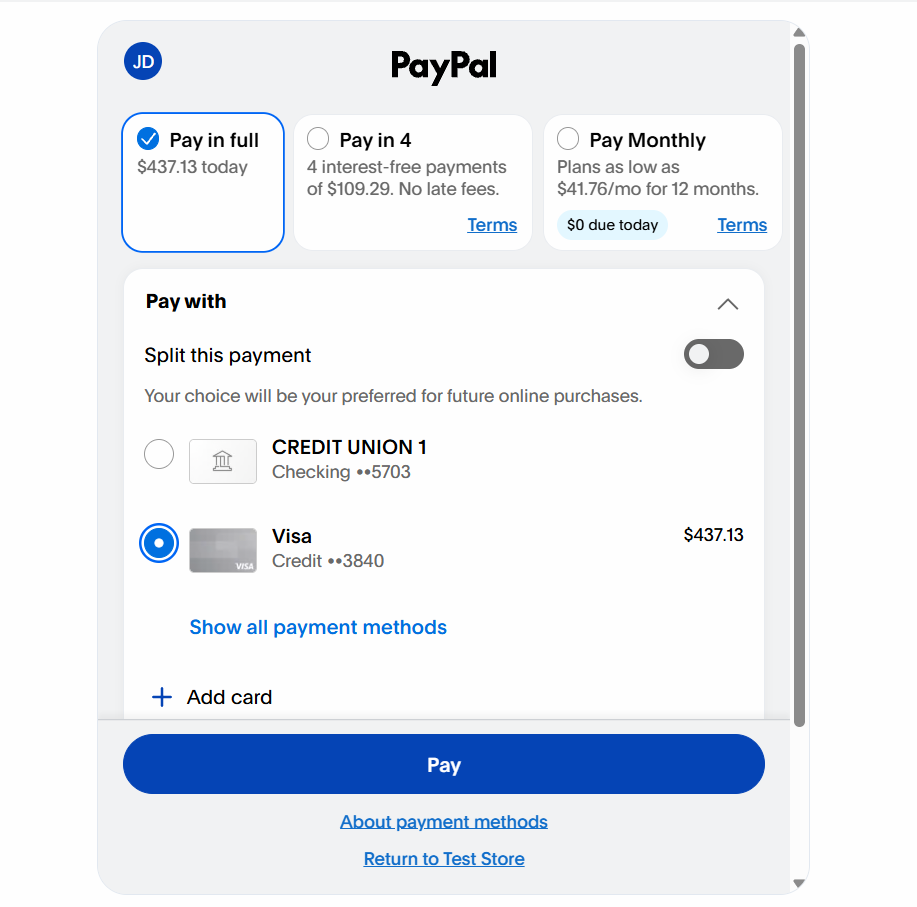
PayPal Sandbox Payment Page After Approval
-
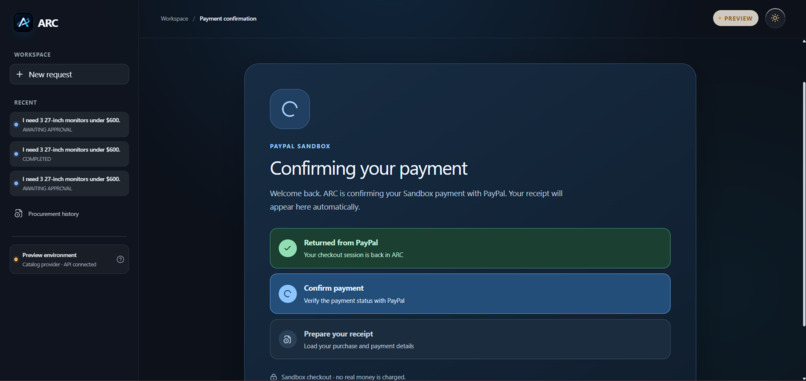
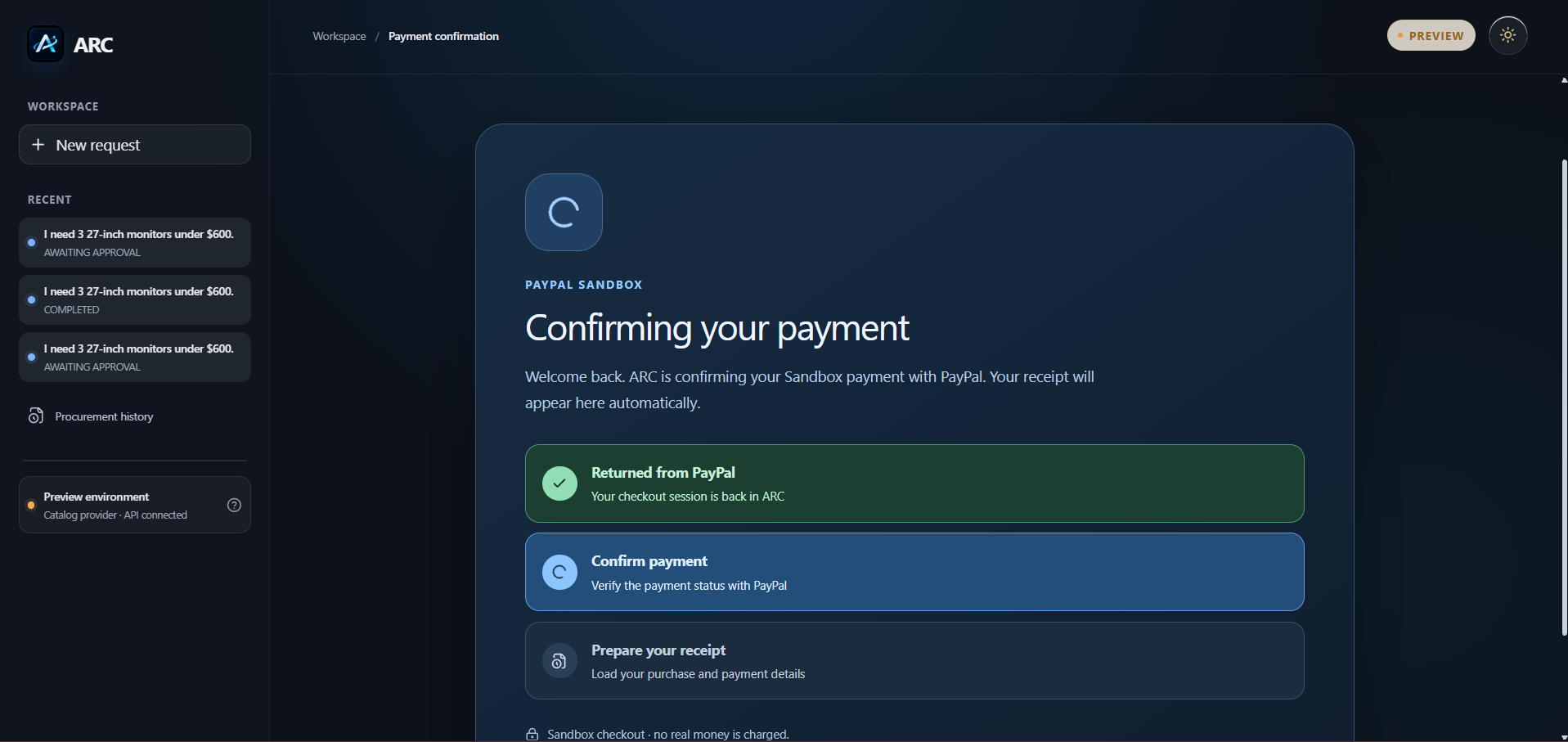
Payment Confirmation Loading Screen
-
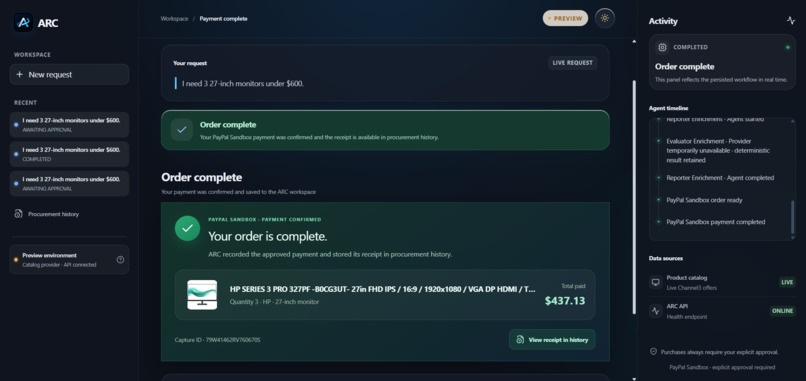
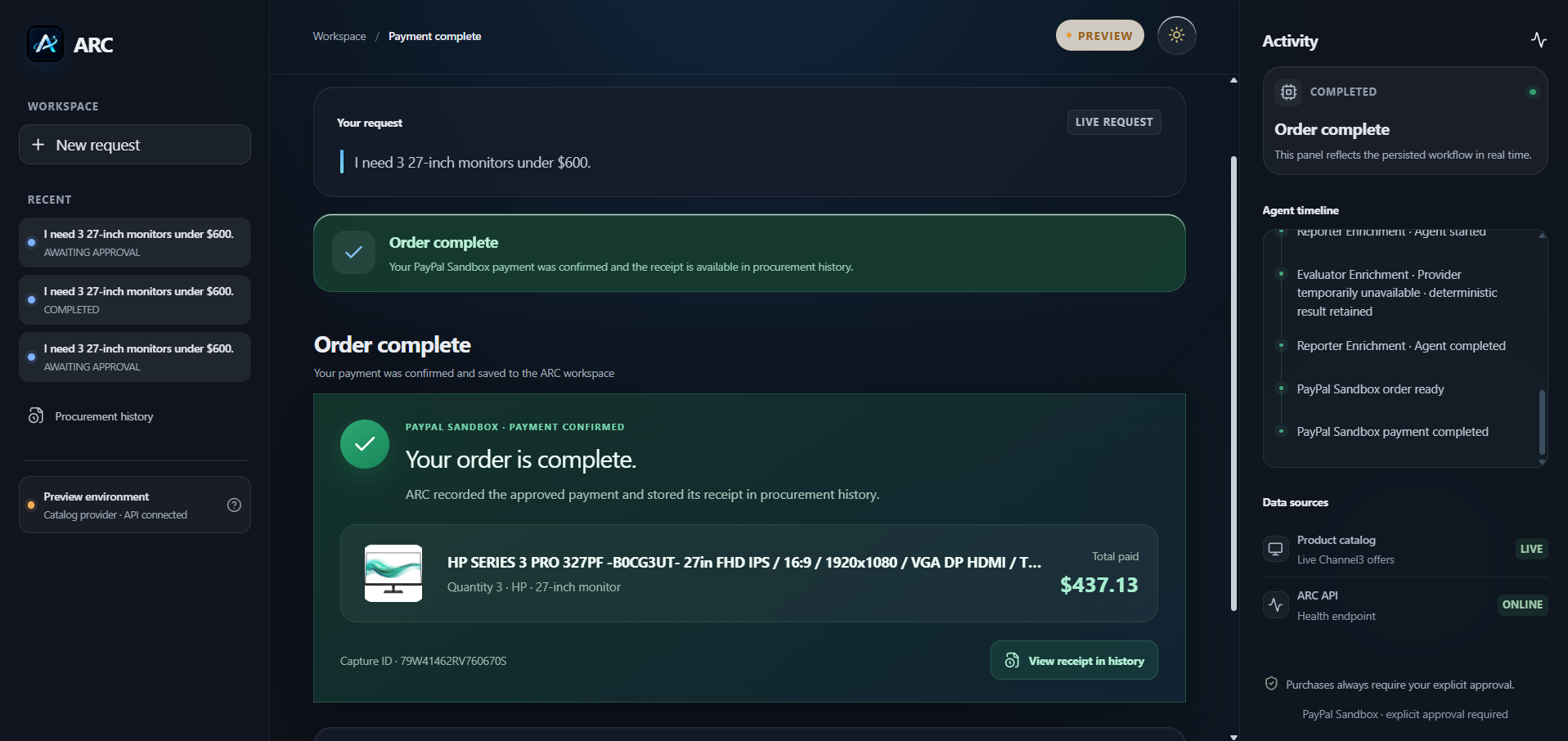
PayPal Confirmation
-
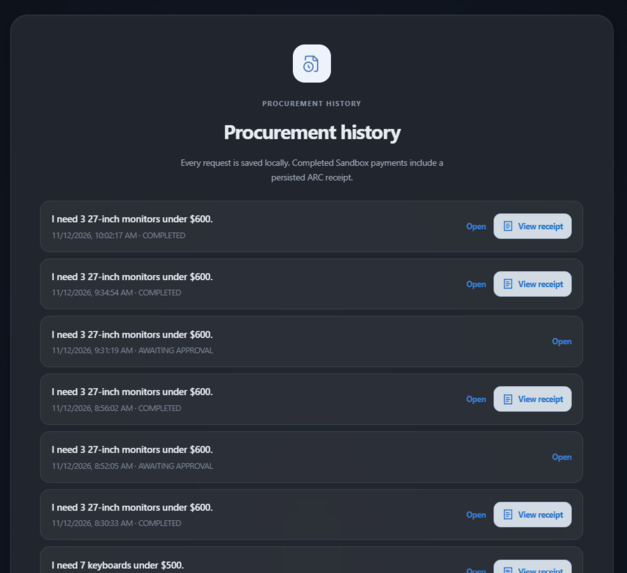
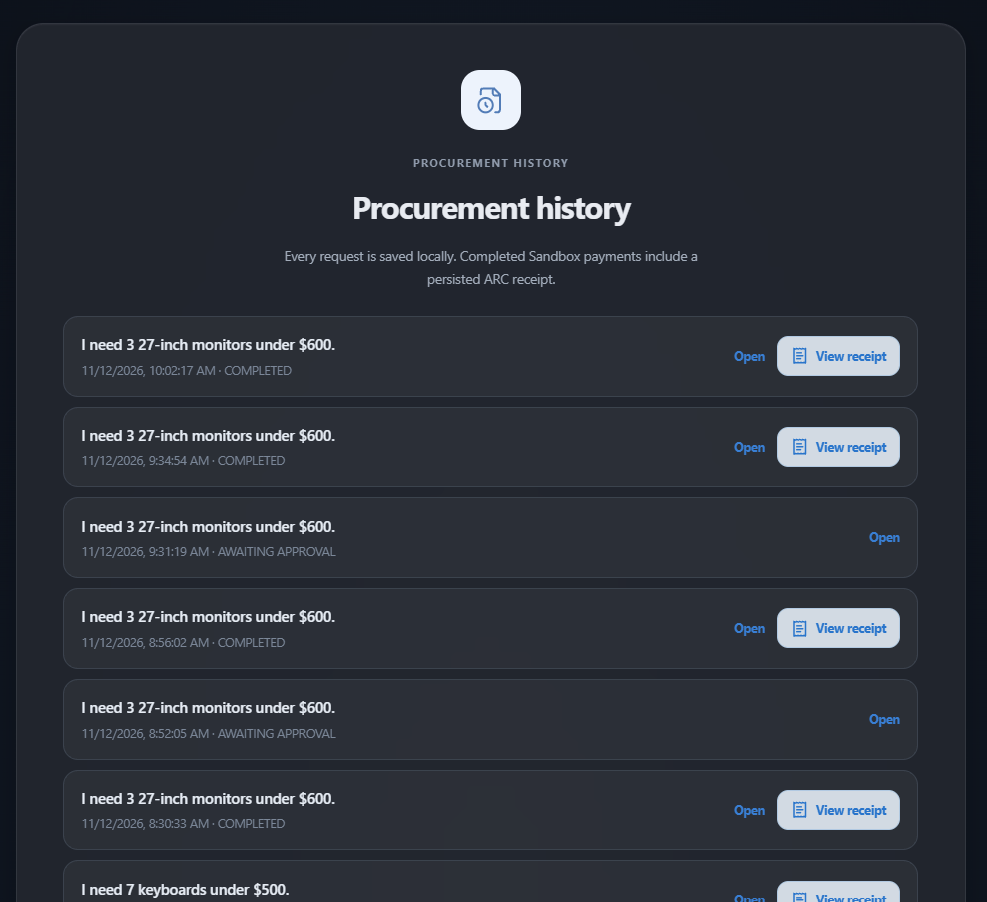
Procurement History Page
-
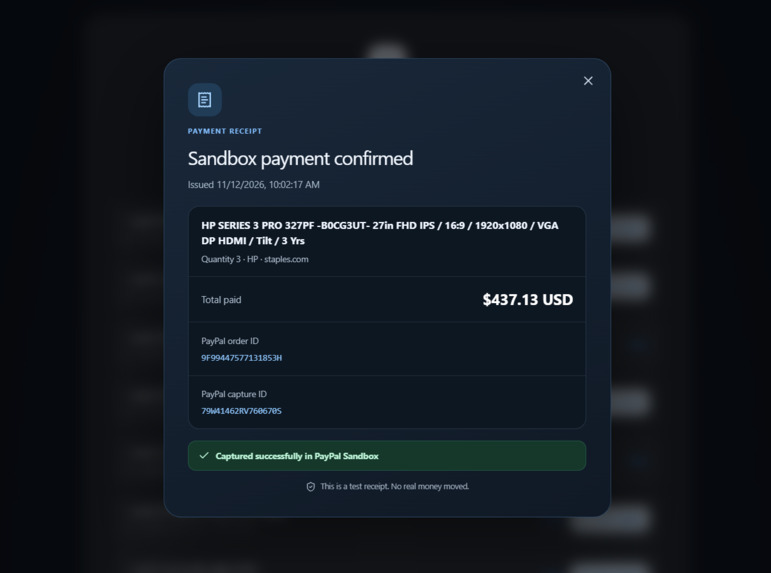
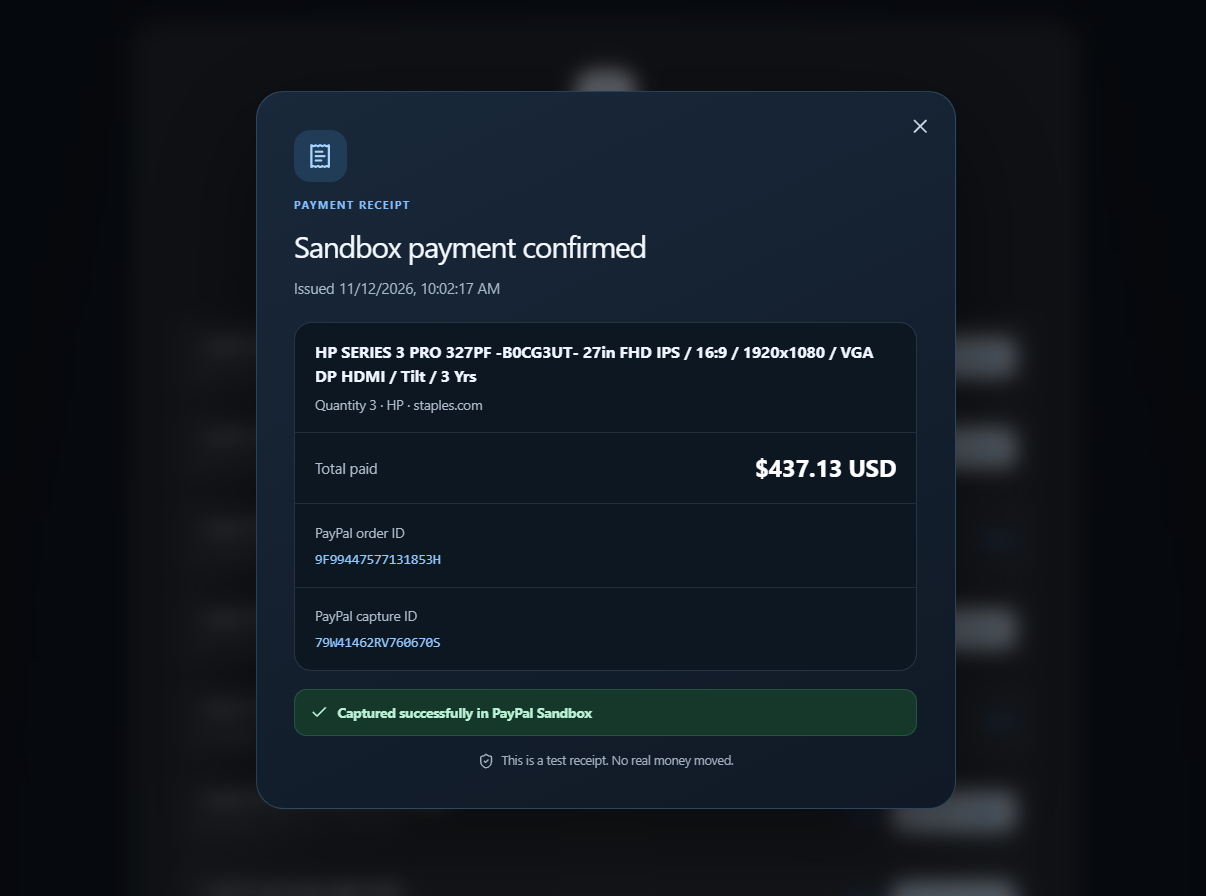
Product Receipt Page
Inspiration
For small businesses, procurement is often more complicated than it needs to be. Finding the right products, comparing prices, evaluating specifications, staying within budget, and coordinating payments can require navigating multiple websites and tools.
I wanted to answer a simple question: What if purchasing for a business could be as easy as describing what you need?
With the growing capabilities of AI agents, I saw an opportunity to go beyond traditional chatbots and build a system capable of coordinating an entire purchasing workflow. Instead of simply recommending products, I envisioned a platform that could research alternatives, evaluate tradeoffs, explain its decisions, and guide users toward checkout while keeping humans in control.
That vision became ARC (Autonomous Resource Coordinator), an AI-powered procurement platform designed to make business purchasing more intelligent, efficient, and accessible.
What it does
ARC transforms natural-language purchasing requests into structured procurement workflows.
For example, a user can submit a request such as:
"Find three monitors for our office with a total budget of $600. Prioritize display quality and value."
ARC coordinates four specialized agents to process the request:
- Planner Agent: Interprets the request and extracts purchasing requirements, including quantity, budget, and product preferences.
- Researcher Agent: Discovers relevant products through Channel3, collecting product information, pricing, and available options.
- Evaluator Agent: Compares products against the user's requirements, considering cost, specifications, and overall suitability.
- Reporter Agent: Organizes the findings into a clear, actionable procurement recommendation.
Throughout the process, ARC provides visibility into agent activity, allowing users to follow how their request is being handled.
Once recommendations are available, users can review their options and explicitly approve a purchase before proceeding to PayPal Sandbox checkout.
ARC also maintains persistent procurement history, allowing users to revisit previous requests, recommendations, and transaction records.
The central idea is simple: AI handles the research and analysis, while humans remain in control of purchasing decisions.
How we built it
I developed ARC as a full-stack application with a clear separation between the frontend, backend, AI orchestration, product discovery, and payment processing.
Frontend
I built the frontend using Next.js, React, TypeScript, and Tailwind CSS, creating a responsive interface that combines conversational procurement with a live agent activity dashboard.
My goal was to make a technically sophisticated multi-agent system feel intuitive. Users can submit requests, inspect recommendations, approve purchases, and review procurement history without needing to understand the underlying architecture.
I also developed a dedicated landing page to introduce ARC, communicate its value, and provide a seamless entry point into the application.
Backend and Agent Orchestration
I built the backend using Python and FastAPI, implementing a centralized orchestration engine that coordinates four specialized agent stages.
Each agent has a distinct responsibility, allowing requests to progress from requirements gathering to product discovery, evaluation, and reporting.
Rather than relying entirely on language models, I combined deterministic Python logic with AI-assisted capabilities. This approach provides greater control over structured requirements, budget validation, and workflow execution.
AI and Product Discovery
I integrated Google Gemini 3.5 Flash and Flash-Lite to support AI-assisted evaluation and reporting, alongside Channel3 for product discovery.
ARC processes product information, compares available options against user constraints, and generates recommendations with explanations rather than simply returning an unstructured list of results.
I also implemented a clearly labeled demonstration fallback to make the workflow reproducible when external product discovery is unavailable.
Payments and Database
I integrated the PayPal Developer Platform to demonstrate a human-approved checkout workflow using PayPal Sandbox.
An important design principle was ensuring that ARC never treats an AI recommendation as authorization to spend money. Users must explicitly approve a proposed transaction before checkout can proceed.
For persistence, I used PostgreSQL to store procurement requests, agent activity, recommendations, and transaction history across sessions.
Together, these technologies create an end-to-end application that connects AI-assisted decision-making with a practical purchasing workflow.
Challenges we ran into
Coordinating Multiple Agents
One of my biggest challenges was designing a workflow in which four specialized agents could collaborate reliably.
Each stage needed to receive structured information from the previous stage while preserving the user's original requirements.
I addressed this by implementing centralized orchestration, clearly defined agent responsibilities, and predictable data flow between stages.
Balancing AI With Deterministic Logic
Early in development, I recognized that relying on an LLM for every operation could introduce unnecessary complexity, latency, and unpredictability.
Instead, I designed a hybrid architecture in which deterministic logic handles structured operations and validation, while Gemini supports tasks that benefit from AI-assisted reasoning and explanation.
This made the system easier to control, understand, and maintain.
Integrating External APIs
Connecting Gemini, Channel3, and PayPal required working with different API contracts, response formats, and potential failure conditions.
I had to normalize product data, handle unavailable external services, and ensure that payment operations remained separate from AI-generated recommendations.
The PayPal integration introduced an especially important constraint: a recommendation must never be treated as authorization to spend money.
Designing an Intuitive User Experience
Multi-agent systems can be difficult to understand because much of their work happens behind the scenes.
I wanted ARC to make the process visible without overwhelming users with technical information.
Bringing together the conversational interface, agent activity dashboard, product comparisons, approval workflow, and procurement history into one cohesive experience was a significant design challenge.
Accomplishments that we're proud of
As a solo developer, I'm particularly proud of building a functional, full-stack application that connects multiple AI and payment technologies into one cohesive experience.
Some of my biggest accomplishments include:
- Building an end-to-end procurement workflow connecting natural-language requests, product discovery, evaluation, recommendations, human approval, and PayPal Sandbox checkout.
- Developing a four-stage multi-agent architecture with specialized responsibilities and centralized orchestration.
- Integrating Google Gemini and Channel3 to support AI-assisted procurement decisions and product discovery.
- Implementing human-in-the-loop purchasing, ensuring that payment actions require explicit user approval.
- Creating a persistent procurement workspace backed by PostgreSQL.
- Designing a polished, responsive interface that makes agent activity and purchasing decisions easy to understand.
- Developing a dedicated landing page that presents ARC as a complete software product.
- Publishing ARC as an open-source project with documentation for local setup and demonstration.
What I'm most proud of is that ARC goes beyond being a chatbot. It connects intelligent recommendations to an actionable business workflow while maintaining transparency and user oversight.
What we learned
Building ARC taught me several valuable lessons about AI engineering, software architecture, and product development.
First, effective AI systems do not necessarily need to use AI for every operation. I learned that combining language models with deterministic software components can create workflows that are more predictable, explainable, and reliable.
Second, multi-agent systems require thoughtful orchestration. Clearly defined responsibilities, structured data, and predictable transitions are essential when several components contribute to one decision.
Third, integrating AI with financial workflows requires deliberate safeguards. Human approval, transparent system behavior, and clearly defined transaction boundaries are fundamental to building trustworthy applications.
Finally, technical sophistication alone is not enough. A successful product must communicate its value through thoughtful design and an intuitive user experience.
Developing ARC independently also strengthened my ability to manage an entire software project, from system architecture and API integration to frontend design, testing, and documentation.
What's next for ARC - Autonomous Resource Coordinator
ARC currently demonstrates an AI-assisted procurement workflow using product discovery, intelligent evaluation, human approval, and PayPal Sandbox payments.
Looking ahead, I would like to expand ARC in several directions:
- Real merchant purchasing: Extend beyond sandbox checkout toward supported, authorized merchant transactions.
- Smarter procurement intelligence: Incorporate purchasing history, vendor comparisons, and more advanced cost optimization.
- Multi-user workspaces: Introduce team accounts, role-based permissions, and multi-level purchasing approvals.
- Budget management: Add departmental budgets, spending analytics, and recurring procurement planning.
- Improved agent intelligence: Expand evaluation capabilities with richer product comparisons and more sophisticated AI-assisted reasoning.
My long-term vision is to transform ARC into an intelligent procurement assistant that helps businesses move from identifying a need to making an informed purchasing decision with less friction.
ARC — Research smarter. Decide faster. Stay in control.
Built With
- alembic
- channel3
- css
- fastapi
- gemini
- git
- github
- html/jsx
- javascript
- next.js
- paypal
- postgresql
- pydantic
- python
- react
- sql
- sqlalchemy
- typescript
- uvicorn
