-
-
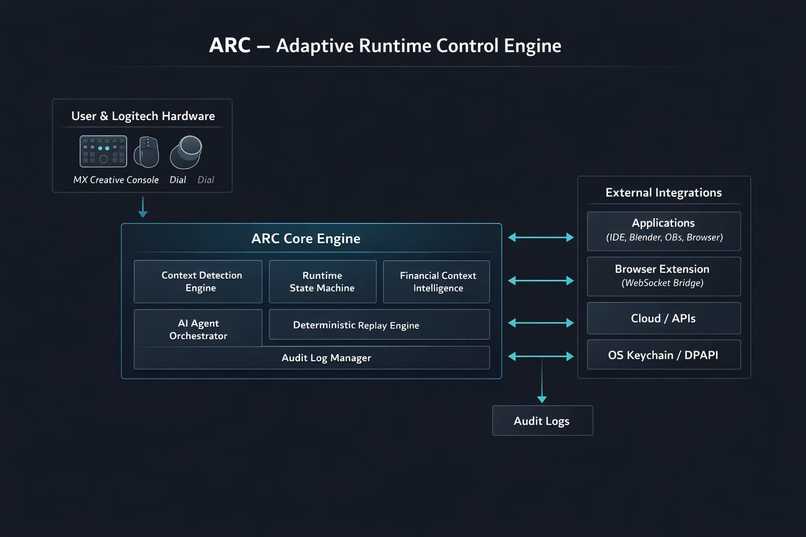
ARC system Architecture
Inspiration
ARC didn’t begin in a lab. It didn’t start as a product roadmap or a feature list. It began with frustration.
We realized something strange about modern digital work, we are surrounded by powerful tools, yet none of them truly understand what we’re doing.
We switch between coding and meetings. Between client work and personal tasks. Between deep focus and chaotic multitasking.
But our hardware stays the same. Static. Blind. Passive.
We lose hours. We forget to track time. We underbill. We context-switch constantly. And we rely on memory instead of systems.
So we asked ourselves: What if hardware didn’t just respond, what if it understood?
That question became ARC.
What It Does
ARC transforms Logitech hardware into a living execution layer. It detects what you’re doing, coding, streaming, designing, meeting, and adapts in real time.
But ARC goes deeper.
It introduces something we call Financial Context Intelligence.
When you open a client repository, join a client meeting, or activate a ticket, ARC automatically switches into Billable Mode.
The hardware changes. Billing begins. Every action becomes traceable.
Not as surveillance, but as clarity.
ARC logs structured proof of work: When you started What tools you used What branch you worked on What APIs were executed When you paused
No forgotten timers. No lost hours.
ARC also integrates AI agents directly into hardware pages: Debug suggestions Documentation helpers Security confirmations
Sensitive actions require physical confirmation, because execution should feel intentional.
ARC turns hardware into accountability.
How We Built It
We built ARC on top of the Logitech Actions SDK, but what we really built was a runtime layer.
A context detection engine A state machine A financial logging system A secure execution vault A lightweight AI orchestration layer
Everything runs locally. Everything is deterministic. Everything is intentional.
ARC doesn’t automate randomly. It executes deliberately.
Challenges We ran into
The hardest challenge wasn’t technical. It was restraint.
At first, ARC tried to be everything, AI orchestration, financial engine, cybersecurity layer, macro automation.
But we stepped back and asked: What is ARC really?
The answer wasn’t “more features.” It was “less chaos.”
Another challenge was trust.
How do you track billing without feeling invasive? How do you create AI suggestions without becoming distracting?
We learned: Intelligence must feel invisible, not intrusive.
Accomplishments We’re Proud Of
We’re proud that ARC feels different.
It doesn’t feel like a shortcut tool. It feels like hardware finally caught up with how we actually work.
We’re proud that: It automatically enters billable mode It generates proof-of-work logs It morphs hardware layouts instantly It makes security physical It keeps everything local and controlled
But most of all, we’re proud that ARC creates calm.
Less mental overhead. Less context switching. Less financial ambiguity. More clarity.
What We Learned
We learned that productivity is not about speed, it’s about alignment.
We learned that context is everything.
We learned that financial awareness should not be an afterthought.
And we learned that hardware can be more than input, It can be intention.
What’s Next for ARC
This is just the beginning.
We want ARC to evolve into: A collaborative financial intelligence layer for teams A secure execution engine for enterprises A personalization system that adapts to your work rhythm
Our vision is simple:
To make Logitech hardware the runtime layer for modern digital work.
Where context drives interface. Where finance integrates with execution. Where every action is conscious.
That’s ARC.
Built With
- calendar.meeting.state.detection
- csharp.plugin.runtime
- csv.pdf.export.engine
- custom.browser.extension
- deterministic.input.replay.engine
- documentation
- encrypted.token.vault
- git.repository.state.detection
- hardware.triggered.execution.validation
- jira)-meeting-&-calendar-state-detection-ai-&-intelligence-layer-large-language-model-integration-(openai-api)-task-specific-ai-agents-(debug
- jira.api.integration
- json.sqlite.log.store
- local.state.machine.engine
- local.websocket.server
- logi.plugin.service
- logi.plugin.tool
- logitech.actions.sdk
- macos.keychain.storage
- node.js.runtime
- obs.websocket.api
- openai.api.integration
- os.application.focus.monitoring
- real.time.audio.monitoring
- secure.http.client.layer
- structured.event.logging.framework
- task.specific.ai.agents
- voicemeeter.remote.api
- windows.dpapi.security

Log in or sign up for Devpost to join the conversation.